The Marketplace of Ur Myth Meaning & Symbolism
A soul's journey through the world's first bazaar, where every transaction echoes with divine fate and the price of a life is weighed not in silver, but in destiny.
The Tale of The Marketplace of Ur
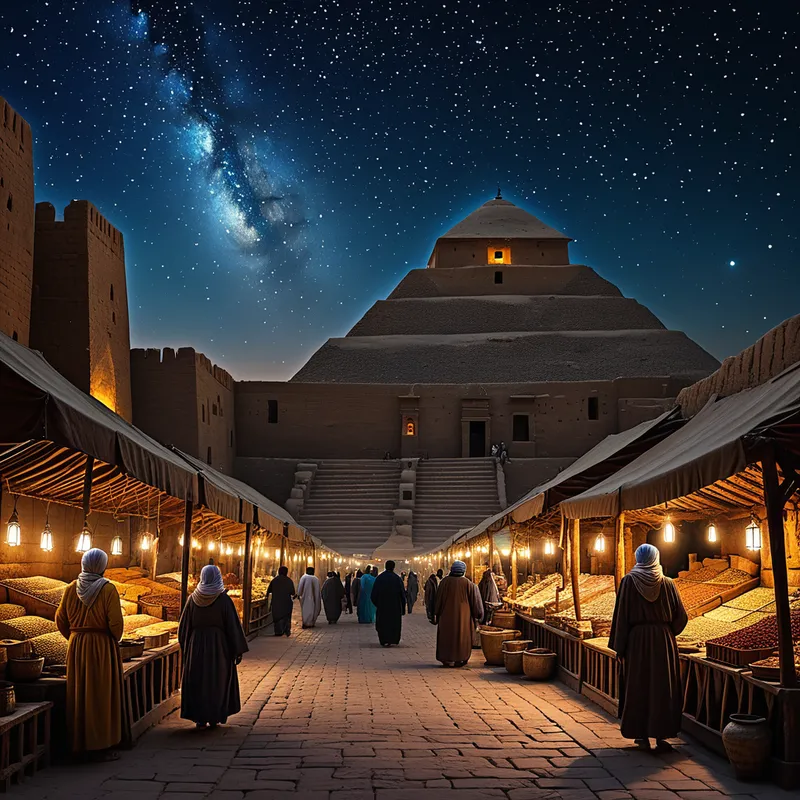
Listen, and hear the whisper of the baked-brick walls. Listen, and feel the sun-bleached dust of the world’s first road beneath your sandals. This is not a story of kings, though kings walk here. This is not a song of gods, though their gaze weighs heavy on every scale. This is the tale of the Marketplace of Ur, where the river of humanity meets the tide of destiny.
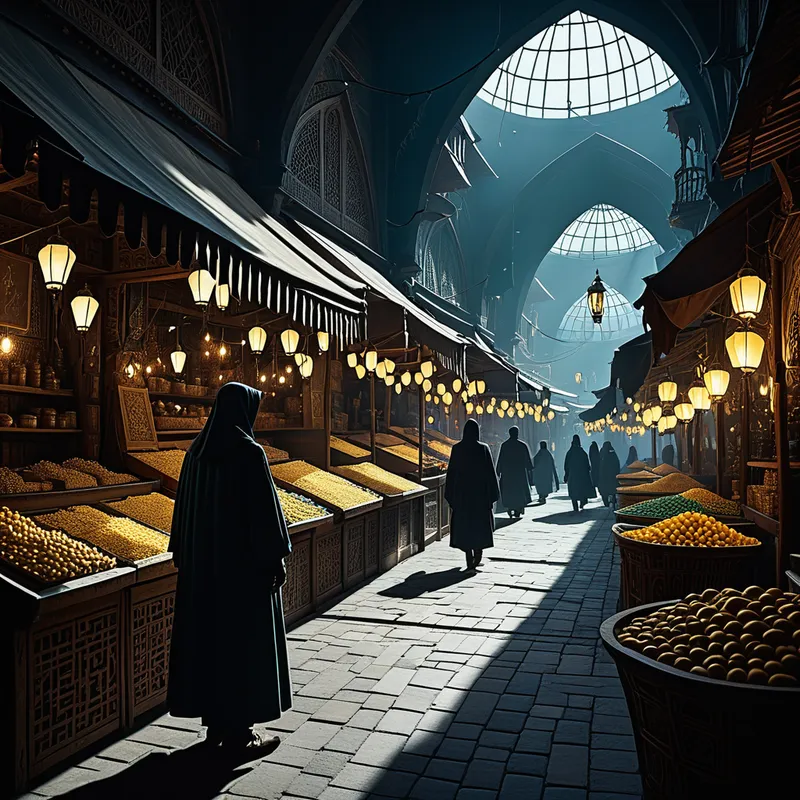
The air is thick—a stew of roasting lamb fat, of cumin and coriander, of sweat from a thousand brows, and the sharp, clean scent of cedar oil from far-off mountains. The sound is a living beast: the clatter of copper ingots, the haggling cries in the tongue of Sumer, the lowing of oxen, the rhythmic thump-thump-thump of the loom from the weaver’s quarter. Beneath the ziggurat of Nanna, silver light of the moon god mingles with the gold of the merchant’s lamp.
Into this churning heart comes a figure. Not a hero with a named sword, but a soul with unnamed longing. Call him Awilu. His pouch holds little: a few worn shekels of silver, a seal of carnelian bearing his father’s mark, and a emptiness that echoes louder than any coin.
He moves past stalls of gleaming lapis lazuli and blood-red carnelian, past bolts of linen fine as mist. He smells the bitterness of the scribe’s ink, hears the dry rustle of clay tablets being sorted. But his feet are pulled, as if by the current of the Euphrates itself, to a quieter corner. Here, under a faded awning, sits a merchant unlike the others. His face is the color and texture of old leather, his eyes the still, dark pools of a deep well. Before him are no spices, no metals, no cloth. Only small, unmarked clay pots, a set of finely wrought bronze scales, and a single clay tablet.
“What do you sell?” Awilu asks, his voice swallowed by the market’s roar.
The merchant does not smile. “What do you seek?”
“Purpose,” Awilu says, the word escaping him unbidden. “A place. Something to fill my hands.”
The merchant nods slowly. He lifts a pot, unstoppers it, and pours not grain, but a handful of shimmering, golden time into his palm—a season of effortless harvests. He pours it onto one scale. “Your youth,” he says. Awilu feels a cold draft across his skin. The price.
Another pot yields a measure of resonant silence—the peace of a forgotten name, the loss of a beloved’s laughter. “For wisdom,” the merchant intones. The scale dips.
Awilu’s heart pounds like a temple drum. He sees pots for love, for power, for legacy. Each with its terrible counterweight. This is the true commerce of Ur: not barter for barley, but the soul’s negotiation with Shimtu, the fixed fate. The market’s noise fades to a distant hum. Here, in this silent transaction, the universe holds its breath.
The merchant’s finger then taps the lone clay tablet. “This one is different. It is not for sale. It is for reading.”
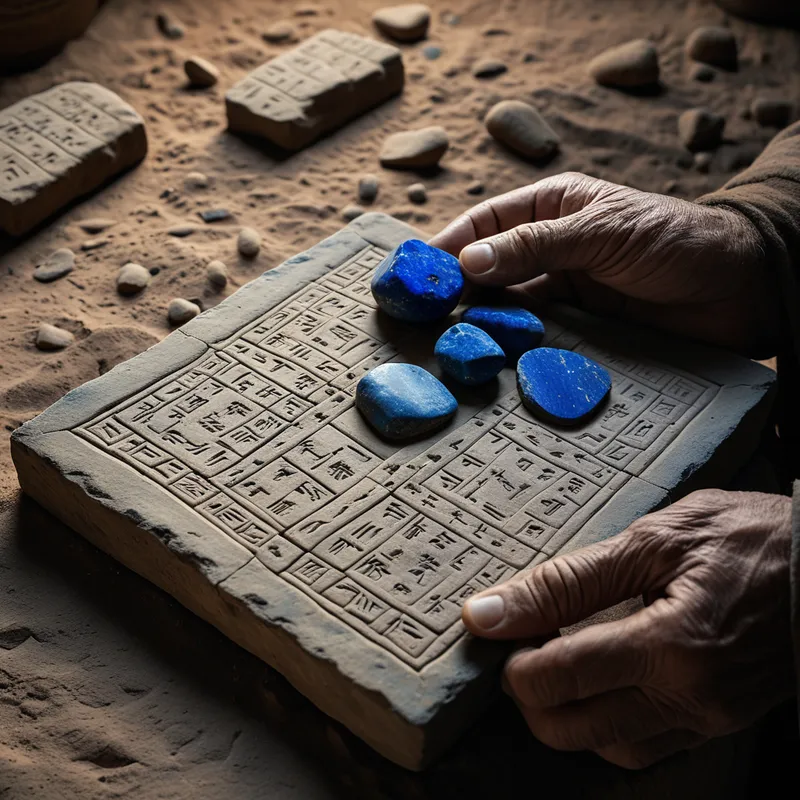
Awilu reaches, his fingers brushing the cool clay. He cannot read the intricate cuneiform, yet meaning floods him. It is not a story of what he must acquire, but of what he already is. The tablet speaks of the journey itself—the dust on his feet, the longing in his chest, the very act of seeking in the marketplace of the world. It names no price, for its currency is attention; its reward, not a possession, but a recognition.
The merchant takes back the tablet. The spell breaks. The cacophony of the market crashes back. Awilu stumbles from the stall, his pouch still light, his hands still empty. Yet he walks differently. The dust is now sacred ground. Every haggling cry is a prayer. He has not bought a destiny; he has glimpsed the ledger of his own soul, and in that glimpse, he has traded confusion for a question—a question that will guide every step henceforth. The marketplace has not given him an answer. It has made him a participant in the great, eternal exchange.
Cultural Origins & Context
The Marketplace of Ur is not a myth preserved on a single, royal inscription. It is a composite narrative, a mytheme woven from the very fabric of Mesopotamian civilization. Ur, in the third millennium BCE, was not just a city; it was a primal node in the earliest network of global trade, a place where the Dilmun boats docked, where Sumerian met Akkadian, and where the will of the gods was interpreted through the movement of goods and silver.
This story lived in the breath between transactions. It was told by caravan masters under the stars, by scribes who recorded debts and destinies on identical tablets, by priests who saw the market as a microcosm of the cosmos—a place where the divine decree (Shimtu) manifested in fortune and famine. Its function was profound: to sacralize the act of commerce, to instill the understanding that every exchange, from a loaf of bread to a treaty between kings, was ultimately an exchange with fate itself, overseen by deities like Nabu and the often-capricious will of the gods. It taught that to be human was to be a trader in the bazaar of existence, forever weighing value against cost.
Symbolic Architecture
At its core, the myth presents the marketplace not as a location, but as the archetypal individuation arena. The bustling square represents the conscious ego, noisy with desires, social roles, and material pursuits. The quiet merchant’s stall is the threshold to the deeper Self, the place where the economy of the psyche is laid bare.
The soul does not shop for finished goods; it negotiates with fragments of its own potential, where every gain is shadowed by a necessary loss.
The merchant is the psychopomp of the bazaar, the guide to the inner economy. He is not a god, but an embodiment of the objective psyche—the law of compensation itself. The clay pots contain the libidinal energies of the soul: ambition, love, security, transcendence. The scales are the innate human faculty of evaluation, of discerning true value. The pivotal clay tablet symbolizes the collective unconscious offering up a piece of Self-knowledge—not as a commodity to be owned, but as a text to be lived. Awilu’s inability to “read” it in the conventional sense, yet his profound understanding of it, mirrors the intuitive, non-rational way the unconscious communicates its truths.

The Dreamer’s Resonance
When this myth stirs in the modern dreamer, it often manifests as dreams of labyrinthine shopping malls, endless online carts, or anxiety about making the “right” choice. The somatic sensation is one of being overwhelmed, of frantic searching amidst plenty. Psychologically, this indicates a critical juncture in the psyche’s development. The ego is “in the marketplace,” actively seeking an identity, a role, a solution—a new job, a relationship, a belief system to purchase.
The dream may present a specific, numinous object or a cryptic merchant figure. This is the Self interrupting the ego’s consumer frenzy, introducing the concept of sacred exchange. The anxiety of the dream is the soul’s resistance to the merchant’s scales—the terrifying, yet liberating, understanding that growth requires payment. To gain independence, one must pay with security. To gain deep connection, one must risk vulnerability. The dream is the soul’s accounting period, forcing a review of what is truly being traded.
Alchemical Translation
The myth models the alchemical nigredo and ablutio of the psyche. Awilu’s initial state is the massa confusa—the confused mass of desires in the market’s chaos. His approach to the merchant is the beginning of separatio, distinguishing the ego’s wants from the soul’s needs.
The confrontation with the pots and scales is the crucial mortificatio—the death of the illusion that one can have everything without cost. This is the dark night of the marketplace, where the glittering goods lose their luster under the harsh light of existential accounting.
The alchemical gold is not found in a pot for purchase; it is forged in the act of turning away from the merchant’s wares to read the tablet of one’s own existence.
The reading of the clay tablet is the illuminatio. It represents the moment the ego aligns with a narrative larger than its own acquisitions—the myth of the journey itself. The final stage is not a return to the old market with a trophy, but a coniunctio with the marketplace as a living system. Awilu returns to the noise, but now as a conscious participant, not a desperate consumer. He has transmuted the base metal of longing into the gold of purposeful seeking. His individuation path is now clear: to walk the aisles of the world, engaging in its countless exchanges, but always listening for the whisper of the merchant, always remembering the text written not on clay, but in the very footsteps of his journey.
Associated Symbols
Explore related symbols from the CaleaDream lexicon: