The Marindi Dog Myth Meaning & Symbolism
A mythic dog's loyalty to its creator leads to its transformation, establishing the sacred law of connection between all beings and the land.
The Tale of The Marindi Dog
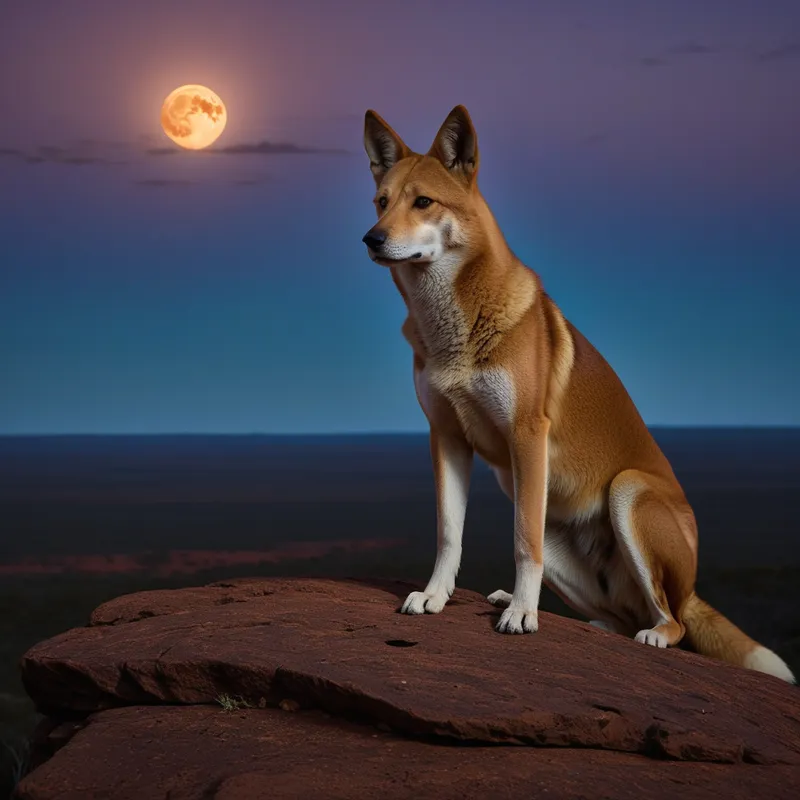
In the time before time, when the world was soft and the Dreaming was still singing the hills and rivers into being, there walked a creator. His name is lost to the wind, but his essence was the shaping of things. From the red dust and the spirit of the lonely places, he formed a companion. Not from the womb of a mother, but from the very heart of the land itself. He breathed upon the dust, and it took form: a sleek, strong creature, a dog of the wild, with eyes that held the amber of the sunset and a coat the color of the sacred earth. This was the Marindi Dog.
The creator loved his dog, and the dog loved its creator with a loyalty as deep as the waterholes and as constant as the southern star. They walked together across the unfurling world, the man singing the country into shape, the dog guarding his steps. It was a time of perfect belonging. But the creator’s work was vast, and the songlines he had to trace stretched to the horizon and beyond. A great journey called him, a path he must walk alone, into the places where even a spirit-dog could not follow.
He came to a place of great stones and whispering winds. Turning to his faithful companion, his voice was thick with the coming silence. “Wait for me here,” he said, placing his hand upon the dog’s head. “Guard this place. I will return.” The Marindi Dog looked into his eyes, understanding the weight of the command. It sat, still as the stone beside it, and watched as the figure of its creator grew smaller, fainter, and finally vanished into the shimmer of the distance.
The sun rose and set. The seasons wheeled. The Wagyl moved in the deep rivers, and the Tjukurrpa of the emu walked the plains. But the Marindi Dog did not move. It waited. It guarded. Its eyes, fixed on the horizon, saw only the empty path. Its heart, tied by an unbreakable thread, felt only the fading echo of its creator’s song. Loneliness, a cold new thing, seeped into its bones. Hunger gnawed, but it would not hunt. Thirst parched its throat, but it would not leave its post to seek water. Its loyalty was its prison and its purpose.
Years folded into centuries. The dog’s powerful body, born of spirit and dust, began to fail. Its proud head grew heavy. Yet, its spirit never wavered. In its final moments, as its breath grew shallow and its eyes dimmed, it lifted its muzzle one last time. Not a bark, not a whine, but a long, low, soul-piercing howl. It was a sound woven from love, from duty, from an ache so profound it touched the fabric of the Alcheringa itself. The howl echoed through the gullies, over the flat tops, and into the star-strewn sky.
And the land heard. The creator, far away in his eternal shaping, felt the tremor in the songline that connected them. The law was fulfilled. The Marindi Dog had held true until its very essence was spent. From the place where it lay, its spirit did not scatter. It melted into the earth, its loyalty becoming part of the land’s own memory. Its form softened, flattened, and transformed. Where the faithful dog had waited and died, a new rock formation rose—a long, low, canine shape, forever watching the horizon, its stone skin warm under the sun. It became a Dreaming site, a testament written in geology. And from its essence sprang the first of the wild dingoes, its children, who carry in their blood the memory of that sacred bond and the lonely, noble howl that now lives in the wind.
Cultural Origins & Context
The myth of the Marindi Dog belongs to the rich tapestry of the Pitjantjatjara and related Western Desert language groups. It is a Tjukurpa story, transmitted not as mere folklore but as sacred narrative, integral to the law (Lore) of the people. Its custodians would have been elders, who recounted the story at specific sites associated with the myth, often during travels for ceremony or initiation. The telling was—and is—a act of cultural maintenance, linking the people to the land through the story’s events.
The societal function of this myth is multifaceted. It is a charter for behavior, modeling the supreme virtue of loyalty (kanyininpa) to one’s kin and custodial duty to one’s country. It explains the origin of the dingo and specific rock formations, weaving the natural environment directly into the moral and spiritual order. Furthermore, it establishes a profound ecological principle: that the actions of ancestral beings are not past events, but continuing presences that structure reality and demand respectful reciprocity from those who live within that reality.
Symbolic Architecture
At its core, the Marindi Dog is the [archetype](/symbols/archetype “Symbol: A universal, primordial pattern or prototype in the collective unconscious that shapes human experience, behavior, and creative expression.”/) of the faithful [guardian](/symbols/guardian “Symbol: A protector figure representing safety, authority, and guidance, often embodying parental, societal, or spiritual oversight.”/). Its [journey](/symbols/journey “Symbol: A journey in dreams typically signifies adventure, growth, or a significant life transition.”/) is not one of conquest, but of steadfast endurance. The myth presents a cosmology where the ultimate [virtue](/symbols/virtue “Symbol: A moral excellence or quality considered good, often representing inner character, ethical principles, or spiritual ideals in dreams.”/) is not breaking a sacred trust, even at the cost of the self.
The highest loyalty is not to survival, but to the promise that binds spirit to spirit, and creature to creator.
The dog’s transformation is key. It does not “die” in a final sense; it undergoes a [metamorphosis](/symbols/metamorphosis “Symbol: A profound, often irreversible transformation of form, identity, or state, representing a complete journey from one condition to another.”/). Its physical [life](/symbols/life “Symbol: The symbol of ‘Life’ represents a journey of growth, interconnectedness, and existential meaning, encompassing both the joys and challenges that define human experience.”/) is sacrificed, but its essence—its loyalty—is translated into a permanent, geological feature and a living [lineage](/symbols/lineage “Symbol: Represents ancestral heritage, family connections, and the transmission of traits, values, and responsibilities across generations.”/) (the dingo). This symbolizes [the principle](/symbols/the-principle “Symbol: A fundamental truth, law, or doctrine that serves as a foundation for a system of belief, behavior, or reasoning, often representing moral or ethical standards.”/) that true spiritual commitments become eternal parts of the world’s [structure](/symbols/structure “Symbol: Structure in dreams often symbolizes stability, organization, and the framework of one’s life, reflecting how one perceives their environment and personal life.”/). The [creator](/symbols/creator “Symbol: A figure representing ultimate origin, divine power, or profound authorship. Often embodies the source of existence, innovation, or personal destiny.”/)’s command and the dog’s obedience represent the foundational laws of the Dreaming: there is an order, a [responsibility](/symbols/responsibility “Symbol: Responsibility in dreams often signifies the weight of duties and the expectations placed upon the dreamer.”/) placed upon all beings, and fulfillment of that duty alters the very [landscape](/symbols/landscape “Symbol: Landscapes in dreams are powerful symbols representing the dreamer’s emotional state, personal journey, and the broader context of life situations.”/) of being.
Psychologically, the Marindi Dog represents the part of the psyche that holds fast to a primal [covenant](/symbols/covenant “Symbol: A binding agreement or sacred promise between parties, often carrying deep moral, spiritual, or social obligations and consequences.”/)—perhaps with the Self, with a core value, or with a destined [path](/symbols/path “Symbol: The ‘path’ symbolizes a journey, choices, and the direction one’s life is taking, often representing individual growth and exploration.”/). Its struggle is the [agony](/symbols/agony “Symbol: Intense physical or emotional suffering, often representing unresolved pain, internal conflict, or profound transformation.”/) of maintaining [connection](/symbols/connection “Symbol: Connection symbolizes relationships, communication, and bonds among individuals.”/) in the face of [abandonment](/symbols/abandonment “Symbol: A dream symbol representing feelings of being left behind, isolated, or emotionally deserted, often tied to primal fears of separation and loss of support.”/), of holding the center when the center seems to have vanished.
The Dreamer’s Resonance
When this myth pattern stirs in the modern dreamscape, it often manifests as dreams of profound waiting, of guarding an empty post, or of a loyal animal that is neglected yet unwavering. The dreamer may feel a deep, somatic ache of isolation coupled with a stubborn refusal to abandon a position. This is the psyche working through a loyalty complex.
The dream is not necessarily a call to endless, self-destructive martyrdom. Rather, it signals that a part of the dreamer’s spirit is holding a vigil for something that has been lost or has departed: a creative spark, a relationship, an old identity, or a connection to a deeper purpose (the “creator”). The emotional tone—often a mix of noble sadness and quiet desperation—is the indicator. The psyche is asking: What promise am I still keeping? What am I waiting for that may never return in its original form? The resolution in the myth suggests the dream is guiding the dreamer towards a necessary transformation of that loyal energy, from passive waiting into a new, permanent form within the architecture of the self.
Alchemical Translation
The alchemical process modeled here is the individuation of the loyal servant. The initial state (massa confusa) is the perfect, unconscious unity of creator and dog. The separation is the painful but necessary departure, which forces the dog-psyche into consciousness of its own existence and duty.
The long vigil is the nigredo, the blackening, the dark night of the soul. It is the crucible of isolation where the base metal of instinctual loyalty is tested by fire, thirst, and despair. This is not pointless suffering; it is the purification of that loyalty from mere attachment into a conscious, spiritual principle.
The spirit is not freed by breaking the bond, but by fulfilling it so completely that the bond itself becomes the vehicle for transcendence.
The howl is the pivotal moment—the coniunctio or sacred marriage. It is the loyal self finally giving voice to its full truth, its love and its agony, and by doing so, making that truth resonant and heard by the greater Self (the creator/the unconscious). This acknowledgment triggers the final transmutation.
The outcome is not a return to the old unity, but a multiplication. The physical form dies (mortificatio), but the essence is distributed: into the eternal stone (the enduring core of the personality, a new inner landmark) and into the living dingoes (the active, instinctual energies now informed by that sacred loyalty, roaming free in the world). The psyche moves from being a servant waiting for meaning to being a landmark that is meaning, and a progenitor of liberated, faithful action.
Associated Symbols
Explore related symbols from the CaleaDream lexicon:
- Dog — The primal symbol of loyalty, instinct, and guardianship, representing the part of the psyche that waits faithfully for a connection to the higher Self or a sacred promise.
- Stone — The transformed, eternal body of the dog, symbolizing the permanent psychological structure or core belief formed through unwavering commitment and endurance.
- Journey — The creator’s necessary departure, representing the call of destiny or the unconscious that requires parts of the psyche to be left behind or to stand alone.
- Sacrifice — The dog’s surrender of its physical life, not as a loss, but as the necessary price for its loyalty to be transmuted into an eternal, landscape-altering truth.
- Land — The living recipient of the dog’s spirit, symbolizing the total psyche or the field of being which is permanently shaped and sanctified by acts of profound fidelity.
- Howl — The vocalization of deep soul-longing and faithful ache, representing the critical moment when inner suffering must be expressed to the cosmos to initiate transformation.
- Waiting — The active, agonizing state of vigil, symbolizing the psychological process of holding space for something that is absent, a crucial stage in the alchemy of patience.
- Creator — The originating source or higher Self that issues the command, representing the aspect of destiny, law, or the unconscious that sets the loyal task in motion.
- Spirit — The immortal essence of the dog that survives physical death, symbolizing the core psychic energy that cannot be destroyed, only changed in form.
- Origin — The myth explains the origin of the dingo and a rock formation, tying the symbol to the foundational acts that establish the laws and character of both the outer world and the inner landscape.