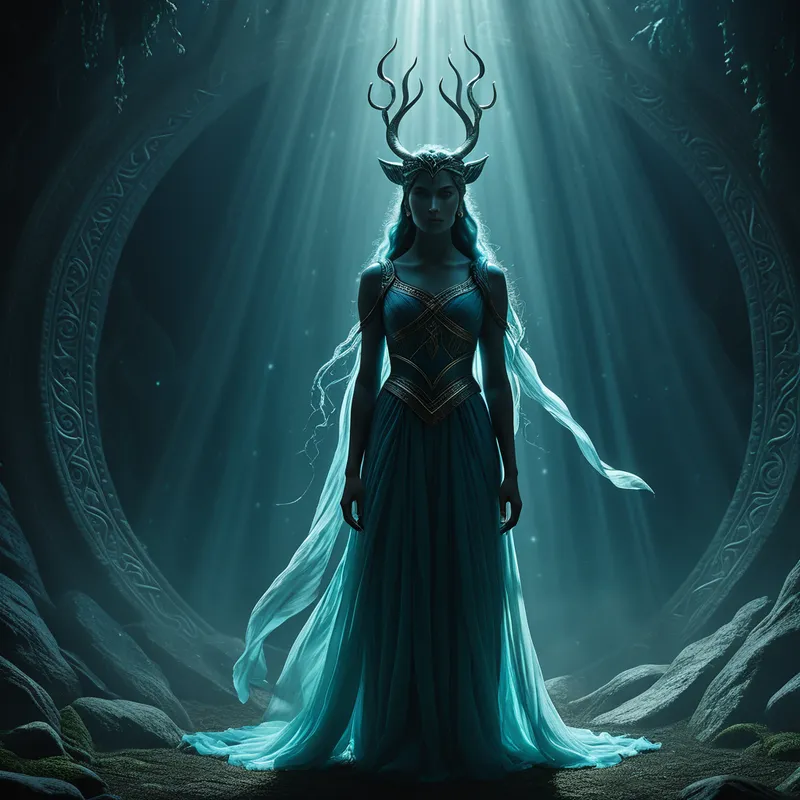
The Mantis Creator Bushman
A trickster creator deity from African mythology who shaped the world through cunning, chaos, and paradoxical wisdom.
The Tale of The Mantis Creator Bushman
In the time before time, there was a great, formless fog of potential. From within this fog, a being stirred. He was not a being of immense size or thundering voice, but of delicate limbs and watchful, pivoting eyes. This was /Kaggen, [the Mantis](/myths/the-mantis “Myth from Chinese culture.”/). He was the first, and he was alone. Yet within his insectile form hummed a paradoxical power: the power to dream [the world](/myths/the-world “Myth from Tarot culture.”/) into being, not through brute force, but through a cunning, playful, and often mischievous intent.
The tale begins not with a command, but with a theft. The Mantis, feeling the emptiness, desired to bring forth the sun, to have light and warmth. But the sun was held tightly by a being of the primal fog. So, the Mantis did not challenge or plead. He transformed. He became a tiny, insignificant blade of grass, and in this form, he waited. When the guardian’s attention lapsed, the Mantis, swift and silent, seized the sun and hurled it into [the sky](/myths/the-sky “Myth from Persian culture.”/), where it has hung ever since, bringing the first day.
His creation continued not as a solemn act of will, but as a series of clever tricks and chaotic interventions. He fashioned the first humans from the broken shafts of his own arrows, or, in other tellings, from the very rocks of [the earth](/myths/the-earth “Myth from Hindu culture.”/), breathing into them the spark of life. But this life was not a gift of serene perfection. The Mantis imbued his creation with his own nature: curiosity, hunger, and a capacity for both great cleverness and profound folly.
He is the father of all things, yet he is also the ultimate trickster who plays pranks on his own children. He might lead a hunter on a futile chase, only to reveal the antelope hidden behind a bush he himself had placed. He would argue with his own wife, the Dassie (Rock Hyrax), and in his rage, cause storms or droughts, only to later mend the world through another sly maneuver. His most famous children, the meerkats, are born from his attempts to steal honey, getting his own hands stuck in the [honeycomb](/myths/honeycomb “Myth from Natural culture.”/), which then transformed into these vigilant creatures. Every element of the world—animals, landscapes, celestial bodies—bears the mark of his paradoxical touch: a foundation laid through deception, order emerging from playful [chaos](/myths/chaos “Myth from Greek culture.”/).
Cultural Origins & Context
The Mantis Creator, known primarily as /Kaggen, is a central deity of the San peoples, often referred to historically as Bushmen, of Southern Africa. His stories are not preserved in stone temples or written codices, but in the living breath of oral tradition, told for millennia around fires under the vast Kalahari sky. These narratives are part of a profound and complex cosmology where the boundary between the mythical [Dreamtime](/myths/dreamtime “Myth from Aboriginal culture.”/), the historical past, and the tangible present is fluid and permeable.
Understanding /Kaggen requires abandoning Western dichotomies of sacred/profane or good/evil. He exists within a framework where survival depends on acute observation, adaptability, and a deep knowledge of a harsh yet giving environment. [The trickster](/myths/the-trickster “Myth from Various culture.”/) is not a devil or a simple clown; he is the embodiment of the unpredictable nature of life itself. His cunning mirrors the necessary cunning of [the hunter](/myths/the-hunter “Myth from African culture.”/). His chaotic creations reflect a world that is not inherently ordered for human comfort, but one that must be negotiated, read, and sometimes outwitted to secure sustenance and continuity. He is a cultural archetype forged in [the desert](/myths/the-desert “Myth from Biblical culture.”/), where wisdom is often paradoxical and survival is the ultimate creative act.
Symbolic Architecture
The [Mantis](/symbols/mantis “Symbol: Represents stillness, contemplation, and the balance between action and patience.”/) is a living [paradox](/symbols/paradox “Symbol: A contradictory yet true concept that challenges logic and perception, often representing unresolved tensions or profound truths.”/), a symbolic [knot](/symbols/knot “Symbol: A knot symbolizes connections, commitments, complications, and the binding or untying of relationships and situations.”/) that ties together opposites. He is [the architect](/myths/the-architect “Myth from Various culture.”/) of [reality](/symbols/reality “Symbol: Reality signifies the state of existence and perception, often reflecting one’s understanding of truth and life experiences.”/) who works not with a [blueprint](/symbols/blueprint “Symbol: A blueprint represents the foundational plan or design for something, often symbolizing potential, structure, and the mapping of one’s inner self or future.”/), but with a sleight of hand.
He is the Creator-Trickster, a fusion that dismantles the notion of a solemn, distant demiurge. Creation here is intimate, messy, and interactive, born from engagement (even if deceptive) rather than detached command.
His physical form is his first [lesson](/symbols/lesson “Symbol: A lesson in a dream signifies a learning opportunity, often reflecting personal growth or unresolved issues requiring attention.”/). The [praying mantis](/symbols/praying-mantis “Symbol: The praying mantis symbolizes patience, stillness, and intuition, often reflecting feelings of contemplation and focus.”/) is a [creature](/symbols/creature “Symbol: Creatures in dreams often symbolize instincts, primal urges, and the unknown aspects of the psyche.”/) of sublime [stillness](/symbols/stillness “Symbol: A profound absence of motion or sound, often representing inner peace, creative potential, or existential pause in artistic contexts.”/) and explosive [action](/symbols/action “Symbol: Action in dreams represents the drive for agency, motivation, and the ability to take control of situations in waking life.”/), of prayerful [posture](/symbols/posture “Symbol: Posture in dreams represents one’s stance in life, social presentation, and inner confidence or submission. It reflects how one carries themselves through challenges and relationships.”/) and predatory strike. This mirrors /Kaggen’s [nature](/symbols/nature “Symbol: Nature symbolizes growth, connectivity, and the primal forces of existence.”/): a contemplative [dreamer](/symbols/dreamer “Symbol: The dreamer represents the self, the conscious mind engaging with subconscious thoughts and feelings during dreaming.”/) who acts with sudden, world-altering decisiveness. His [multi](/symbols/multi “Symbol: Multi signifies multiplicity and diversity, often representing various aspects of life or identity in dreams.”/)-faceted eyes see in all directions at once—a perfect [symbol](/symbols/symbol “Symbol: A symbol can represent an idea, concept, or belief, serving as a powerful tool for communication and understanding.”/) for the omniscient [perspective](/symbols/perspective “Symbol: Perspective in dreams reflects one’s viewpoints, attitudes, and how one interprets experiences.”/) of the myth-maker, who perceives the interconnected web of consequences his tricks will unleash.
The world he creates is not a static edifice but a dynamic, ongoing conversation. His tricks are not mere mischief; they are pedagogical devices, challenges that force his creations (and by extension, the listeners of the myth) to awaken, to adapt, to become more intelligent and aware participants in existence.
[Chaos](/symbols/chaos “Symbol: In Arts & Music, chaos represents raw creative potential, uncontrolled expression, and the breakdown of order to forge new artistic forms.”/), in this symbolic [architecture](/symbols/architecture “Symbol: Architecture in dreams often signifies structure, stability, and the framing of personal identity or life’s journey.”/), is not the [enemy](/symbols/enemy “Symbol: An enemy in dreams often symbolizes an internal conflict, self-doubt, or an aspect of oneself that one struggles to accept.”/) of order but its raw [material](/symbols/material “Symbol: Material signifies the tangible aspects of life, often representing physical resources, desires, and the physical world’s influence on our existence.”/). The Mantis dips into the formless potential (the primal fog) and pulls out differentiated forms—sun, [moon](/symbols/moon “Symbol: The Moon symbolizes intuition, emotional depth, and the cyclical nature of life, often reflecting the inner self and subconscious desires.”/), animals, humans—through acts that are inherently disruptive. The resulting world is therefore one of inherent [tension](/symbols/tension “Symbol: A state of mental or emotional strain, often manifesting physically as tightness, pressure, or unease, signaling unresolved conflict or anticipation.”/), vitality, and surprise, a direct [reflection](/symbols/reflection “Symbol: Reflection signifies self-examination, awareness, and the search for truth within oneself.”/) of its maker’s [spirit](/symbols/spirit “Symbol: Spirit symbolizes the essence of life, vitality, and the spiritual journey of the individual.”/).
The Dreamer’s Resonance
To encounter the Mantis Creator in the inner landscape is to meet the part of the [psyche](/myths/psyche “Myth from Greek culture.”/) that generates reality itself. He is the dreamer within the dream, the unconscious author of our personal myths and life narratives. His stories resonate because they speak to the non-linear, often baffling way our own lives are shaped.
We do not craft our destinies through linear, logical plans alone. Instead, our path is frequently altered by sudden insights (theft of the sun), unexpected accidents (the honeycomb becoming meerkats), and the puzzling “tricks” of fate that force us to grow. The Mantis represents that creative, chaotic, and intelligent force within the unconscious that arranges the synchronicities, the painful lessons, and the breakthrough moments that form the plot of our existence. He is the embodiment of the psyche’s cunning, which often knows a deeper truth than the conscious ego and will orchestrate events—sometimes frustrating, sometimes illuminating—to guide the soul toward its necessary experiences.
He teaches that wisdom is not the avoidance of chaos, but the development of the flexibility and perceptiveness to navigate it. To be “tricked” by life is not a sign of failure, but an invitation to look deeper, to pivot like the mantis, and to see the new possibility hidden within the disruption.

Alchemical Translation
In the alchemy of the soul, the Mantis Creator presides over the [prima materia](/myths/prima-materia “Myth from Alchemical culture.”/)—the chaotic, base matter of the unexamined life. His role is the solve, the dissolution of fixed forms and rigid assumptions. He is the agent that stirs the pot, introducing the disruptive element that prevents stagnation and forces transformation.
His method is the alchemical trick, the opus contra naturam (work against nature) that, paradoxically, leads to a higher natural order. By stealing the sun (igniting consciousness), he performs the essential first operation: bringing light to the dark mass, initiating the great work.
The psychological process here is one of creative disintegration. [The ego](/myths/the-ego “Myth from Jungian culture.”/)’s carefully constructed world—its certainties, its plans—is constantly being playfully dismantled by the inner Mantis. A lost job, a failed relationship, a sudden illness: these are the “tricks” that, while painful, dissolve the old, outworn identity so that a more authentic one can coalesce. The Mantis does not build the new self directly; he creates the chaotic, fertile conditions in which it can spontaneously arise, just as he created the conditions for the world to emerge.
To work with this energy is to cultivate a stance of alert receptivity—the praying mantis posture. It is to accept that the foundation of one’s world may be laid through unexpected, even deceptive means, and that the creator spirit within is both our greatest benefactor and our most perplexing adversary, for its goal is not our comfort, but our wholeness.
Associated Symbols
Explore related symbols from the CaleaDream lexicon:
- Praying Mantis — The embodiment of paradoxical being: stillness holding potential violence, prayer containing predation, a form that symbolizes watchful, multi-perspectival consciousness.
- Trickster — The archetypal principle of disruption, boundary-crossing, and catalytic change that challenges fixed order to generate vitality and new awareness.
- Paradox — The state of holding two contradictory truths simultaneously, the essential nature of a world created through chaotic wisdom and orderly mischief.
- Creator — The primordial source and shaper of existence, here intimately linked with playfulness and cunning rather than detached omnipotence.
- Chaos — The formless, fertile potential from which all differentiated forms emerge, not as a void to be feared but as the essential raw material of creation.
- Dream — The fluid, mythic dimension where the Mantis operates, representing the unconscious source of reality-shaping narratives and symbolic truths.
- Stone — The primal, enduring material of the earth, from which the first humans were often fashioned, symbolizing the grounding of spirit into solid, tangible form.
- Sun — The stolen fire of consciousness, light, and warmth, representing the first great act of bringing differentiation and clarity to the formless fog.
- Honey — Sweetness and sustenance that becomes a trap and a catalyst for transformation, symbolizing the alluring yet sticky complexities of life and desire that birth new realities.
- Arrow — A tool of both hunting and creation (as the shafts became humans), representing directed intention, penetration, and the transformative power of a focused act.
- Fog — The primal, undifferentiated state of potentiality, the mysterious medium that precedes all form and definition.