The Lus Savdag Water Spirits Myth Meaning & Symbolism
A myth of powerful water spirits who demand respect, teaching that life's flow depends on honoring the sacred, unseen contracts of the world.
The Tale of The Lus Savdag Water Spirits
Listen, and let the wind carry you to the high, lonely places where the earth’s bones break the sky. Here, in the cradle of mountains, where the air is thin and the silence is a living thing, the waters are born. They do not merely flow; they are the veins of the world, and they are guarded.
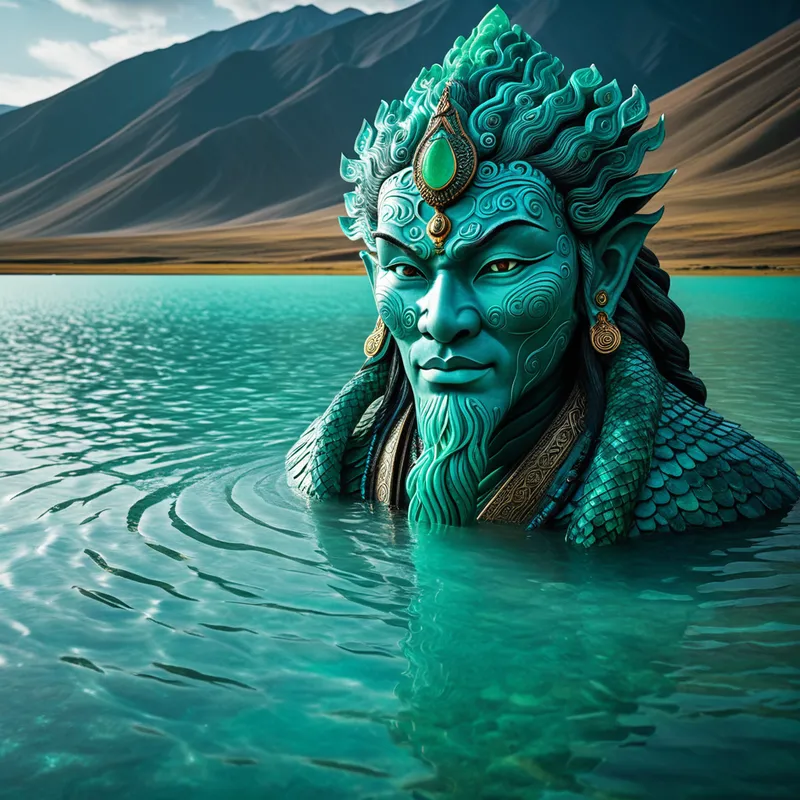
In a valley cupped by ancient peaks, there was a spring. It was not large, but its waters were so clear they drank the sky, and so cold they numbed the soul. The people of the nearby encampment knew this place. They called it Eejin Us, the Mother’s Water. They knew it was the home of a Lus Savdag. They knew, as their fathers and their fathers’ fathers knew, that to take from these waters, one must first give.
For generations, the ritual held. Before filling a skin, a herder would pour a libation of fresh milk or airag upon the stones. Before letting livestock drink, a strand of a horse’s mane would be tied to a nearby bush. The water flowed, the herds thrived, and the Lus, unseen but felt, was content. Its presence was in the deep, placid chill of the pool, in the unnatural stillness of its surface on a windy day.
Then came a man named Batu, young, strong, and full of a new fire. He had heard the old tales, but his eyes were on the horizon, on the size of his herd, on the speed of his work. “Why bow to a story?” he scoffed. “The water is water. It is for the living.”
One parched summer, when the other streams dwindled, Batu drove his entire herd to the Eejin Us. He saw no serpent, heard no voice. He saw only water, more vital than gold. He let his thirsty animals churn the sacred mud. He filled skin after skin without a glance, without a drop of offering. As he turned to leave, a strange quiet fell. The birds ceased their song. The very light seemed to thicken over the pool. A deep, resonant groan echoed from the bedrock, a sound felt in the teeth more than heard. Batu felt a cold dread, deeper than the spring’s chill, seize his heart. He hurried away, telling himself it was the wind in a cave.
That night, a sickness fell upon his herd. Not a violent plague, but a slow withering. Their coats lost luster, their eyes grew dull. The milk of his mares turned thin and bitter. Then, the water in the skins he had taken turned foul, smelling of rust and deep earth. His strongest horse stumbled and broke its leg on flat ground. Misfortune coiled around his household like an invisible serpent.
Batu’s pride turned to ash, replaced by a gnawing fear. He went to the oldest grandmother, her face a map of the steppe itself. She did not chastise him. She simply said, “You have taken the Lus’s gift and called it your right. You have broken the bridge. You must mend it, or the drought will live in your bloodline.”
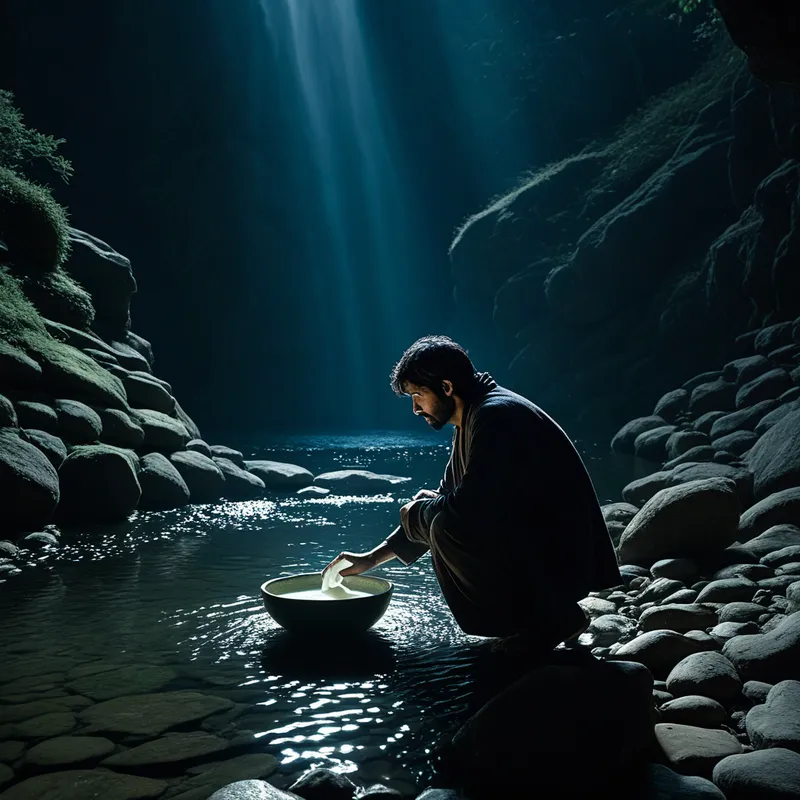
Shamed and desperate, Batu returned to the spring at dawn. He brought not just milk, but the purest white vodka, blue silk, and sweets. He knelt, not as a conqueror, but as a supplicant. For three days and three nights, he made offerings, speaking words of apology not to the air, but into the water, confessing his arrogance. On the third night, as the moon painted a silver path on the water, the surface stirred. Not with a splash, but with a slow, graceful ripple. From the profound depths, a shape emerged—a great, sleek head with eyes like polished jet, regarding him. No anger burned there, only an ancient, assessing calm. It held his gaze for a breath that lasted an eternity, then sank silently back into the abyss.
The next morning, the water in Batu’s skins was sweet again. His weakest calf stood and nursed. The bridge was rebuilt, not from stone, but from respect. And Batu understood: some forces are not to be conquered, but communed with. The contract was not a chain, but the very flow of life itself.
Cultural Origins & Context
The myth of the Lus Savdag is woven into the very fabric of pastoral nomadic life on the Mongolian plateau. In a landscape where survival hinges on the delicate balance between animal, human, and environment, water is not merely a resource; it is a sacred, animate force. These narratives were not bedtime stories but essential ecological and ethical teachings, passed down through generations by shamans (Böö) and elders around evening fires.
The tales served a critical societal function: they encoded the principle of reciprocity with the natural world. By personifying springs, rivers, and lakes as powerful spirits who demanded respect and offering, the mythology enforced conservation practices and prevented the overuse of fragile water sources. The Lus was the psychological and spiritual representation of the watershed itself—its health, its abundance, and its latent, terrifying power to withdraw life if dishonored. This myth was a cornerstone of a worldview that saw humanity not as separate from nature, but as one participant in a vast, interconnected web of conscious relationships.
Symbolic Architecture
At its core, the myth of the Lus is a profound exploration of the [psychology](/symbols/psychology “Symbol: Psychology in dreams often represents the exploration of the self, the subconscious mind, and emotional conflicts.”/) of [relationship](/symbols/relationship “Symbol: A representation of connections we have with others in our lives, often reflecting our emotional state.”/) with the [Shadow](/symbols/shadow “Symbol: The ‘shadow’ embodies the unconscious, repressed aspects of the self and often represents fears or hidden emotions.”/) and the [Collective Unconscious](/symbols/collective-unconscious “Symbol: The Collective Unconscious refers to the part of the unconscious mind shared among beings of the same species, embodying universal experiences and archetypes.”/). The [water](/symbols/water “Symbol: Water symbolizes the subconscious mind, emotions, and the flow of life, representing both cleansing and creation.”/) [spirit](/symbols/spirit “Symbol: Spirit symbolizes the essence of life, vitality, and the spiritual journey of the individual.”/) embodies the unconscious itself—deep, fertile, [life](/symbols/life “Symbol: The symbol of ‘Life’ represents a journey of growth, interconnectedness, and existential meaning, encompassing both the joys and challenges that define human experience.”/)-giving, but capable of chilling retribution if its sovereignty is ignored.
The unconscious is not a well to be drained, but a spirit to be honored. To take its gifts without acknowledgment is to poison them at the source.
The Lus represents the autonomous, archetypal force of the instinctual psyche. Its serpentine form connects it to symbols of wisdom, [eternity](/symbols/eternity “Symbol: The infinite, timeless state beyond human life and measurement, often representing the ultimate or divine.”/), and the primal life force. Batu’s initial arrogance symbolizes the ego’s [inflation](/symbols/inflation “Symbol: A dream symbol representing feelings of diminishing value, loss of control, or expansion beyond sustainable limits in one’s life or psyche.”/), its belief that it can exploit the [depths](/symbols/depths “Symbol: Represents the subconscious, hidden emotions, or foundational aspects of the self, often linked to primal fears or profound truths.”/) of the psyche (creativity, [emotion](/symbols/emotion “Symbol: Emotion symbolizes our inner feelings and responses to experiences, often guiding our actions and choices.”/), [intuition](/symbols/intuition “Symbol: The immediate, non-rational understanding of truth or insight, often described as a ‘gut feeling’ or inner knowing that bypasses conscious reasoning.”/)) for its own ends without consequence. The resulting “[drought](/symbols/drought “Symbol: Drought signifies a period of emotional scarcity, lack of resources, or feelings of deprivation leading to anxiety or intense longing.”/)”—the bitter milk, the lame horse—is the psyche’s natural correction: a cutting off of the vital flow when the ego refuses relationship. The required offerings (milk, [silk](/symbols/silk “Symbol: A luxurious natural fiber representing refinement, sensuality, and transformation from humble origins to exquisite beauty.”/), words) are not bribes, but symbols of sincere sacrifice—a [piece](/symbols/piece “Symbol: A ‘piece’ in dreams often symbolizes a fragment of the self or a situation that requires integration, reflection, or understanding.”/) of one’s own livelihood and pride—necessary to re-establish right relationship.
The Dreamer’s Resonance
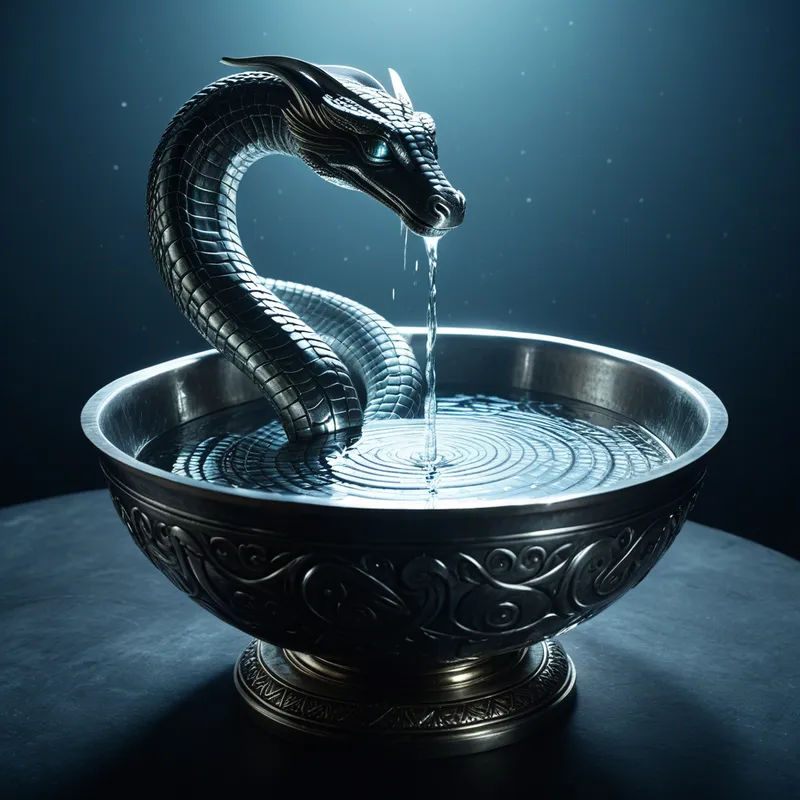
When this mythic pattern stirs in modern dreams, it often manifests as encounters with mysterious or threatening bodies of water—flooded basements, deep ocean abysses, or sacred pools in forgotten places. To dream of a Lus or a great water serpent is to confront the dreamer’s own relationship with the emotional and instinctual depths.
The somatic experience is key: a feeling of profound, awe-filled dread, a chill that is both external and internal. This signals that the dreamer is at the shore of a powerful unconscious content—a deep emotion like grief, a creative potential, or a repressed instinct—that they have been exploiting or ignoring. Perhaps they have been draining their creative energy without honoring its source, or using intellectual analysis to bypass a deep emotional wound. The dream Lus appears not to destroy, but to demand recognition. The psychological process underway is one of forced humility. The ego is being confronted with a power greater than itself, and the dream is the first step in the ritual of apology—the beginning of the acknowledgment that one must kneel at the shore and speak to the depths.

Alchemical Translation
The myth models the alchemical stage of Nigredo—the blackening, the drought—and its resolution through Albedo, the washing pure. Batu’s journey is an archetypal map for individuation.
First, there is Violation: the conscious attitude (ego) seizes what it wants from the unconscious without respect, leading to psychic inflation. This is followed by Desiccation: the conscious life loses its meaning, vitality, and nourishment; the connection to the soul dries up. Then comes the crucial turn: Humiliation. The proud ego is broken by its own creations turning to dust. This humiliation is not an end, but the necessary beginning of the Ritual of Return.
Individuation is not a conquest of the unconscious, but the establishment of a conscious ritual of exchange with it.
The offerings are the symbolic sacrifices the ego must make—cherished opinions, controlling behaviors, intellectual arrogance—to open a channel. The final, silent gaze of the Lus is the coniunctio, the sacred marriage. It is the moment the conscious mind, now humble, meets the autonomous spirit of the unconscious not as master or slave, but as respectful partners in a shared life. The restored water symbolizes the transformed relationship: the ego no longer merely takes inspiration, emotion, or energy; it receives it from a source it honors, ensuring the flow is sustainable and sweet. The individual is no longer a colonizer of their own soul, but a steward in constant, respectful dialogue with its deep, guarding spirits.
Associated Symbols
Explore related symbols from the CaleaDream lexicon:
- Water — The primary element of the myth, representing the unconscious psyche, emotion, the flow of life, and the medium through which the Lus spirit manifests its power and its judgment.
- Spirit — The essential nature of the Lus Savdag, representing the animate intelligence and sovereign will inherent in the natural world and the deep psyche, which demands relationship.
- Serpent — The classic form of the Lus, symbolizing primal wisdom, cyclical time, instinctual energy, and the hidden, coiling power of the unconscious depths.
- Bridge — The sacred reciprocity between human and spirit, the ritual of offering that creates a connection across the divide between the conscious world and the unconscious, allowing safe passage and exchange.
- Sacrifice — The core action of the myth; the voluntary giving of something valued (milk, pride) to honor a greater power, which is the only mechanism to restore balance and heal the broken connection.
- Grief — The psychological state of Batu and his household during the drought, representing the soul’s anguish when cut off from its nourishing source, a necessary prelude to transformation.
- Ritual — The structured, respectful action (libations, prayers) that formalizes the relationship with the unseen, transforming a transaction into a sacred covenant and mending the psychic rupture.
- Mountain — The high, remote setting of the sacred spring, representing the elevated, numinous realm where encounters with the archetypal and divine are most likely to occur, far from the mundane.
- Milk — The primary offering to the Lus, symbolizing pure nourishment, life-giving sustenance, and the giving back of the very bounty one hopes to receive, establishing a cycle of gratitude.
- Drought — The consequence of violation, symbolizing psychic barrenness, creative block, emotional numbness, and the withdrawal of vitality when the ego refuses to acknowledge its dependence on the unconscious.