The Loaves and Fishes Myth Meaning & Symbolism
A teacher multiplies five loaves and two fish to feed a multitude, revealing a world where scarcity is an illusion and grace is a boundless currency.
The Tale of The Loaves and Fishes
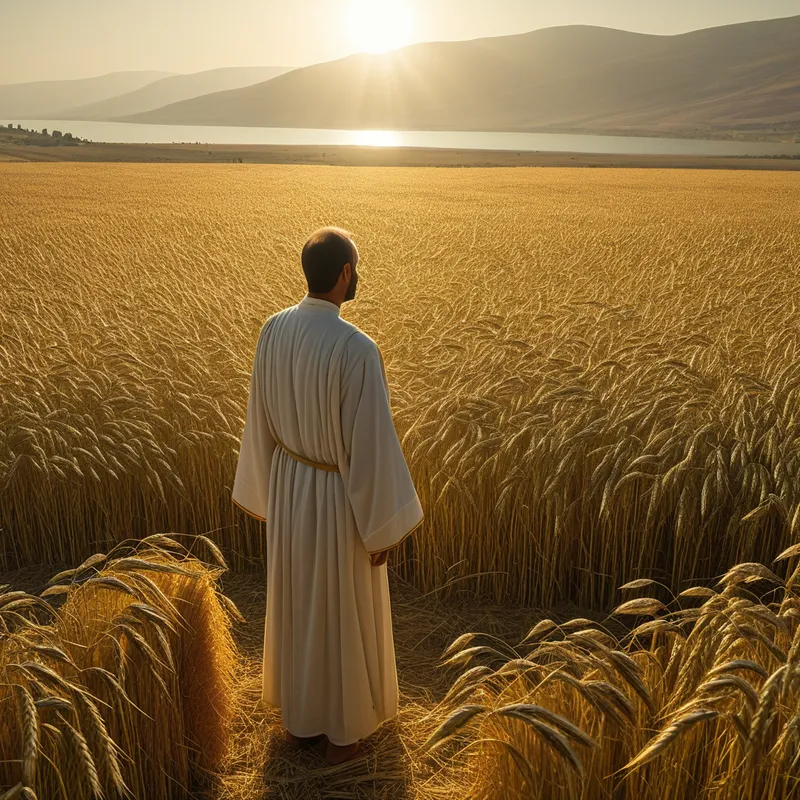
The sun was a hammer on the plains of Bethsaida, beating the green grass into a dusty gold. A great multitude, a river of human need, had followed the teacher out of the cities, drawn by a hunger deeper than the belly’s ache. They came with their fevers and their fears, their twisted limbs and their broken hearts, and he had spoken to them of a kingdom not of this world, a kingdom within. Hours passed. The sun began its long, slow fall toward the hills, and the shadow of a more practical hunger stretched across the crowd.
The disciples, men of the earth, felt the tension coil. They came to him, their voices low with urgency. “This is a deserted place,” they said, the wind carrying their worry. “Send the crowds away so they may go into the villages and buy food for themselves.” They saw only scarcity, a logistical nightmare on an empty shore.
But the teacher turned to Philip, his eyes holding a quiet, impossible question. “Where are we to buy bread, so that these may eat?” Philip saw only the arithmetic of despair: two hundred denarii worth of bread would not be enough for each to get a little. Then Andrew, ever the scout, spoke up, a note of helplessness in his voice. “There is a lad here who has five barley loaves and two fish. But what are they among so many?”
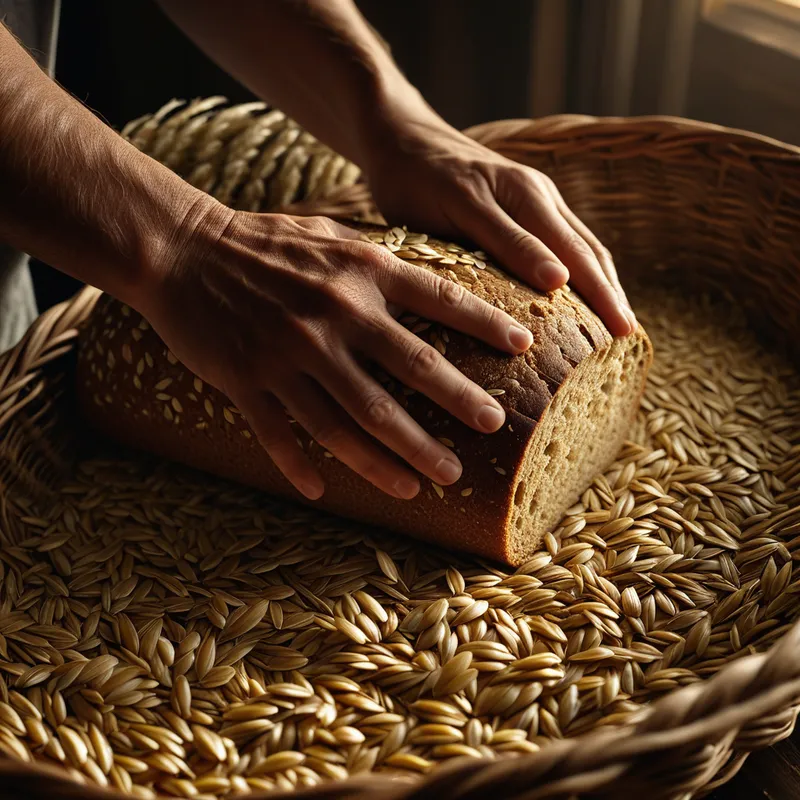
The teacher’s command was simple, a calm in the gathering storm. “Make the people sit down.” On the green grass, in groups of hundreds and fifties, the great, restless beast of the crowd settled, a sea of expectant faces turned toward the one man on the slope. He took the five loaves—small, coarse things of barley, the food of the poor—and the two salted fish. He looked up to the heavens, where the first stars were beginning to prick the violet sky, and gave thanks. The blessing was not a plea, but an acknowledgment.
Then, he began to break. The sound of the crust fracturing was small in the vastness. He broke the loaves, and gave the pieces to the disciples, and the disciples gave them to the crowds. He broke the fish in the same manner. He gave, and they distributed. And he gave again. And they distributed again. The rhythm was hypnotic, a sacrament of breaking and sharing. The basket passed from hand to hand, yet it never emptied. A fragment became a feast. The disciples walked among the thousands, their arms never tiring, their baskets always full. They moved through a miracle as tangible as the bread in their hands.
And they all ate. Not a taste, not a morsel, but they were filled. The quiet sounds of eating replaced the murmur of anxiety. When the hunger was satisfied, when the twilight deepened, he spoke again. “Gather up the leftover fragments, that nothing may be lost.” They went out into the gathering dark and filled twelve baskets with the broken pieces that remained from the five barley loaves. More was gathered in the end than had existed at the beginning. The multitude, their bodies and spirits nourished by a mystery they could not name, sat in the hushed awe of a world made new.
Cultural Origins & Context
This story is recorded in all four canonical Gospels, a rarity that underscores its foundational weight in early Christian memory. It is not a fable from the mists of time, but a reported event situated in the fraught political and social landscape of first-century Roman-occupied Judea. It was told and retold in clandestine house churches, whispered among communities who were often themselves poor, hungry, and persecuted. The tellers were evangelists like Mark, writing for an audience that knew real scarcity.
Its function was multifaceted. On one level, it served as a “sign,” a demonstration of the Christ’s authority over the natural order, echoing the prophet Elijah and prefiguring the central Christian rite of the Eucharist. Societally, it was a radical model of community: in the face of lack, the response is not hoarding or dismissal, but grateful sharing, which becomes the very mechanism of the miracle. It offered a divine critique of an economy of scarcity, proposing instead an economy of grace, where what is offered in faith is transformed into abundance for all.
Symbolic Architecture
At its heart, the myth is an alchemical drama of transformation, where the fixed, limited elements of the material world are transmuted into symbols of infinite spiritual sustenance.
The miracle is not in the multiplication of objects, but in the transformation of perception. Scarcity is a story we tell ourselves; abundance is the underlying reality waiting to be acknowledged through an act of thanksgiving and distribution.
The five loaves and two fish represent the painfully inadequate, finite resources of the ego-consciousness. They are our talents, our time, our energy, our love—always seeming too small for the immense demands of life and the world’s hunger. The “lad” who offers them is the nascent, often ignored aspect of the Self that is willing to offer what little it has without guarantee. The disciples represent the practical, skeptical mind that sees only the impossible arithmetic. The act of “looking up to heaven and giving thanks” is the critical pivot—it is the conscious act of relating the small ego to the greater, transcendent reality of the Self. It is an act of symbolic sacrifice, releasing the resource from the ego’s anxious grip and placing it into a larger, sacred context.
The breaking is essential. Wholeness must be fractured to be shared. This symbolizes the necessary dissolution of ego-boundaries and rigid forms for the sake of nourishment and community. The twelve baskets of leftovers point to a superabundance that exceeds the original need, symbolizing the psychic wealth that flows into consciousness once the principle of fearful hoarding is abandoned. The number twelve echoes the completeness of the tribes of Israel or the apostles, suggesting this process fulfills and sustains the entire structure of the psyche.
The Dreamer’s Resonance
When this myth stirs in the modern dreamer, it often surfaces during periods of profound anxiety about resources—be it financial strain, emotional burnout, or a feeling of creative emptiness. One might dream of an endless queue at a soup kitchen where the pot never runs dry, or of frantically trying to divide a single cookie among a room full of people, only to find it regenerating with each break.
Somatically, this can manifest as a tightness in the chest and gut—the clench of scarcity. The psychological process is one of confronting the “poverty consciousness,” the deeply ingrained belief that there is not enough, that one is not enough. The dream is presenting the archetypal solution: the act of offering. The dream-ego is being invited to identify its “five loaves and two fish”—what small, seemingly inadequate truth, feeling, or talent is it hiding? The miracle in the dream occurs not by magic, but through the dreamer’s shift from a stance of anxious calculation to one of grateful offering and distribution of their authentic self. The leftover baskets symbolize the surprising reserves of resilience and creativity discovered in the process.

Alchemical Translation
For the individual on the path of individuation, the Loaves and Fishes is a precise model of psychic transmutation. The prima materia, the leaden starting point, is the feeling of insufficiency and the world’s overwhelming demand.
The alchemical vessel is the open hand, not the clenched fist. The fire is the pressure of necessity. The transmuting agent is conscious, grateful relation to the transpersonal Self.
The first operation is Acknowledgement (Nigredo). The disciple must admit the apparent scarcity: “What are these among so many?” This is the dark night, the confrontation with limitation. The second is Offering and Consecration (Albedo). The “lad” offers his meager provisions. The teacher gives thanks. This is the whitening, the purification of motive. The small ego-resource is lifted out of its mundane context and symbolically sacrificed—its meaning is changed. The third is Breaking and Distribution (Citrinitas). The resource is fractured and shared. This is the yellowing, the dawn. The ego-structure is broken open so its contents can circulate in the larger psychic system (the community). The final stage is Multiplication and Integration (Rubedo). The act of conscious, related sharing catalyzes an unexpected abundance. The psyche discovers it is fed, and moreover, it has gathered more “leftovers”—more integrated complexity, more symbolic understanding—than it began with. The red gold of the fulfilled Self is not a hoarded treasure, but a nourishing, circulating substance that feeds the entire inner community. The individual learns that their true abundance is generated not in isolation, but in the courageous, thankful offering of their fragment to the whole.
Associated Symbols
Explore related symbols from the CaleaDream lexicon: