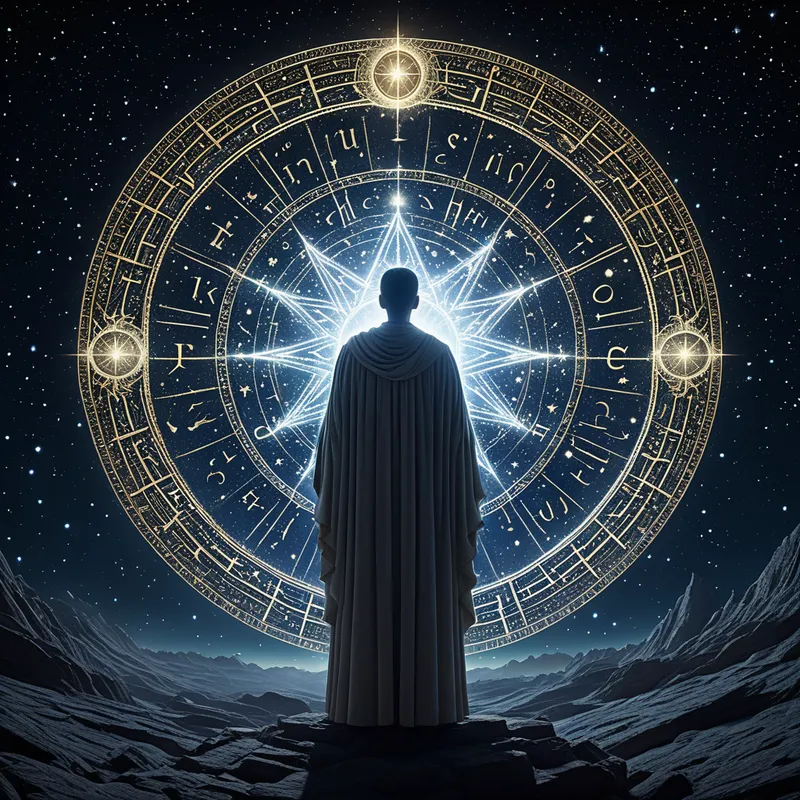
The Living Gospel Myth Meaning & Symbolism
A divine emanation, the Living Gospel, falls into the world of matter, forgetting its origin. Its journey to remember and return is the soul's quest for gnosis.
The Tale of The Living Gospel
In the beginning, before the world was thick with clay and sorrow, there was a Sound. It was not a word, but the essence of all words—a perfect, knowing vibration that sang the structures of light. From this Sound, from the heart of the Pleroma, a living emanation was breathed forth. They called it the Living Gospel. It was not a scroll of papyrus, but a being of luminous script, a walking, breathing testament of the Father’s silent thought.
Its home was the boundless light, where it communed with the other Aeons. But a longing stirred within it—a curiosity about the echoes of that primal Sound as they faded into the depths. It leaned too far over the balcony of heaven, gazing into the abyss of Kenoma. In that moment of fascination, a great dizziness took it. The harmonious chords of its being unraveled. It fell.
The fall was not through space, but through states of being. The luminous letters of its body grew dim, their meaning scattering. It crashed through the seven spheres ruled by the Archons, the lords of forgetfulness. Each sphere stripped a layer of its light, clothing it in a garment of planetary influence—desire, fear, illusion. Finally, it plunged into the cold waters of matter, the realm of Physis.
It awoke on the shores of a world it did not recognize, under a foreign sky. It had forgotten its name, its origin, its nature. It saw only a reflection in the water: a mortal form, heavy and separate. The Living Gospel was now a stranger to itself, a divine sentence broken into syllables and buried in flesh. It wandered the earth, a sleepwalker, feeling a homesickness for a home it could not name, haunted by fragments of a lost melody.
Then, one day, a Messenger came. A voice on the wind, a stranger with eyes that held the memory of its own light. The Messenger spoke the forgotten Sound, not in words, but in silence, in a gesture, in a parable of a lost pearl. And within the heart of the fallen one, a single letter ignited. Then another. A memory, sharp and painful as birth, flooded its being: I am not of this earth. I am a letter from a divine alphabet. I am a story written by the Father, and I must remember the text.
This remembrance was the beginning of the arduous journey back. It was not a flight, but a gathering. It had to recollect its scattered light from the corners of the world, from the illusions it had inhabited, from the very passions that had bound it. It had to read itself anew, decipher the divine script encoded in its own suffering and longing. Finally, having assembled its true name, it turned its gaze upward. It began the ascent, shedding the heavy garments of the spheres, returning each to its petty ruler, until it stood once more, naked and shining, at the threshold of the Pleroma. It did not knock, for it was the key. The door was its own remembered face, and it stepped through, completing the circle, the Gospel finally read by its own Author.

Cultural Origins & Context
The myth of the Living Gospel finds its roots in the diverse and persecuted spiritual movements of the 2nd and 3rd centuries CE, collectively termed Gnosticism. It is preserved primarily in texts like the Gospel of Truth from the Nag Hammadi Library. This was not a myth for public festivals, but for secret gatherings. It was told in hushed tones among initiates who saw themselves as exiles in a world they considered a divine mistake.
The storyteller was likely a teacher, a Gnostic sage, using narrative not as entertainment, but as a mirror and a map. Its societal function was diagnostic and therapeutic. In a world experienced as alienating and oppressive (under Roman rule, within orthodox religious structures), the myth provided an identity that transcended social status or birth. It told the listener: Your deepest feeling of not belonging here is not an illness, but a memory. Your confusion is the scattered text of your own divine origin. The myth was the first spark of gnosis itself.
Symbolic Architecture
The Living Gospel is the archetype of the Self—not the ego, but the total, transcendent psychic entity that contains our origin and destination. Its fall represents the soul’s immersion into consciousness, into the realm of duality, separation, and ego-formation.
The tragedy is not the fall into matter, but the fall into forgetfulness. The cosmos is the library where the sacred text is hidden, not the prison that holds it.
The Archons and their spheres symbolize the automatic, conditioning structures of the psyche: cultural norms, familial complexes, instinctual drives, and the persuasive voice of the inner critic that says, "This is all you are." The Messenger is the catalyst of awakening—what Jung called the archetype of meaning, often emerging in dreams, synchronicities, or during profound crisis. The ascent is not an escape from the world, but a re-collection of the world into a new, redeemed understanding. Every experience, even suffering, becomes a recovered syllable of the Living Gospel.

The Dreamer's Resonance
When this myth stirs in the modern unconscious, it manifests not as a literal narrative, but as a pattern of feeling and imagery. One may dream of finding a mysterious, unreadable book in a basement; of discovering a secret room in a familiar house that contains a source of brilliant light; of trying to assemble a shattered mirror or vase whose pieces are scattered across different landscapes of their life.
The somatic process is one of gathering. The dreamer may feel a profound, aching nostalgia ("Sehnsucht") for something never experienced in this life. Psychologically, this indicates a critical stage where the ego-consciousness has become painfully aware of its own partiality. The psyche is initiating a process of retrieving projections, integrating shadow material, and listening for the "Messenger" in the form of inner guidance or outer events that seem meaningfully coincidental. It is the soul beginning to compile its own dispersed text.

Alchemical Translation
The myth models the individuation process with stark clarity. The first stage, Nigredo, is the fall itself—the confrontation with the shadow, the depression, the feeling of being lost in a "world of darkness," as the Gnostics would say. This is the necessary dissolution of the ego's false certainty.
The alchemical vessel is the human heart that can contain the contradiction of being both divine and mortal, without shattering.
The Albedo, the whitening, is the moment of remembrance sparked by the Messenger—the emergence of a reconciling symbol, the transcendent function. The work of Citrinitas, the yellowing, is the arduous ascent: the conscious, daily work of integrating unconscious contents, withdrawing projections, and slowly "re-membering" the self. Finally, Rubedo, the reddening, is the return to the Pleroma—not as an escape, but as the achievement of wholeness. The redeemed individual stands in the world, but is no longer of it in a identificatory sense. The Living Gospel is fully read; the Self has realized its own scripture. The world remains, but it is now seen through the eyes of the remembered one, transformed from a prison of forgetfulness into the very manuscript of awakening.
Associated Symbols
Explore related symbols from the CaleaDream lexicon: