
The Little Fish Myth Meaning & Symbolism
A tiny fish, swallowed by a great whale, must journey through darkness to find the light, transforming its smallness into a power that saves the world.
The Tale of The Little Fish
Listen. In the time before memory, when the ocean was the only sky and the deep was a kingdom of whispers, there lived a fish. Not a great leviathan of the abyss, nor a swift hunter of the sunlit reefs, but a little fish. Its scales were the color of tarnished silver, its form no larger than a child’s thumb. It dwelt in the shadow of the great coral cities, a silent witness to the dramas of the deep.
The world of the waters grew cold. A creeping shadow, a silence that was not peace, began to bleed from the furthest trenches. The great currents slowed. The songs of the humpback whales faltered and fell into a dirge. The light from above grew thin and sickly. The council of the elders—the ancient turtle, the wise octopus, the stern marlin—conferred in despair. Their wisdom, vast as it was, could not name this blight. The ocean itself was forgetting how to be alive.
From the edge of the council, a voice, small and clear as a ringing bell. It was the little fish. “I have seen the source,” it said. “In my travels through the cold streams, I have felt it. It sleeps in the belly of the Leviathan of Forgetfulness, who slumbers in the Chasm of Origins. Its dreams are the shadow that chills our waters.”
The elders were silent. To rouse the Leviathan was unthinkable; its waking was said to bring whirlpools that could swallow islands. To enter its belly was to be erased from memory itself. The little fish saw their fear. It did not speak of courage, for it knew none. It spoke only of necessity. “I am small,” it said. “Too small for the Leviathan to notice. I will swim into its mouth as it breathes the deep water. I will find the shadow in its belly and… remind it of the light.”
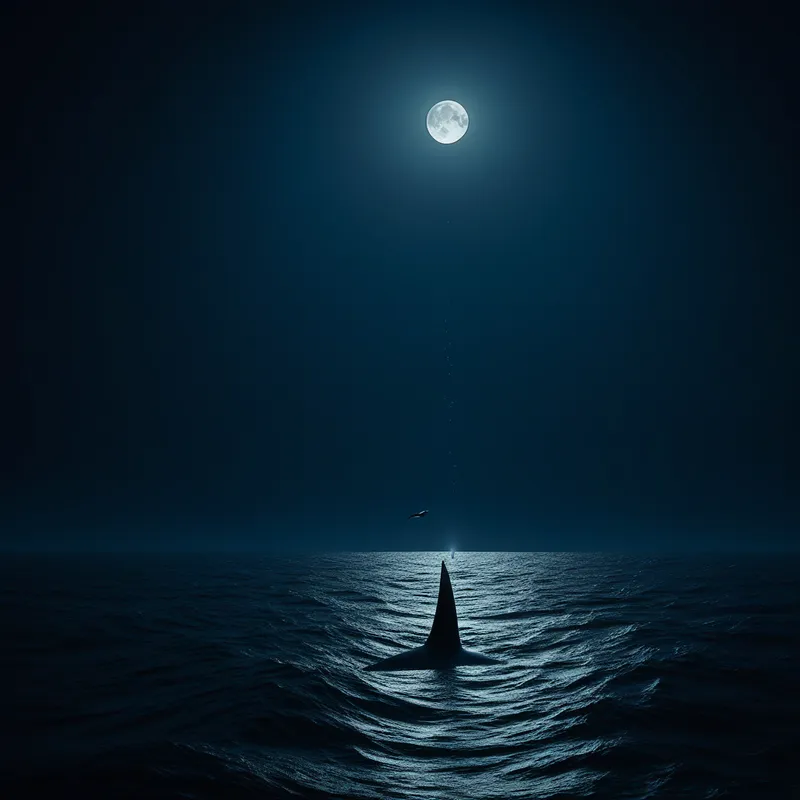
And so it journeyed, away from the fading coral, down past the realms of the lantern fish and the ghostly jellyfish, into the pressure where light is born and dies. There, in a cavern that was a living mountain, lay the Leviathan. Its sides were continents of ancient hide; its single eye, closed, was a sealed sea. With a breath that pulled at the fabric of the deep, it opened its maw—a cave of teeth like stalactites and stalagmites—and drew in the sea.
The little fish did not swim away. It let the current take it. Into the darkness it went, down the throat of the world. The sounds of the ocean vanished, replaced by the slow, terrible thunder of a heart the size of a storm. Here was a landscape of pure interior: forests of strange, pulsing growths, rivers of digestive stars, an atmosphere of potent gloom. The shadow was not a thing, but a condition—a deep, sucking apathy that sought to dissolve the little fish’s very purpose.
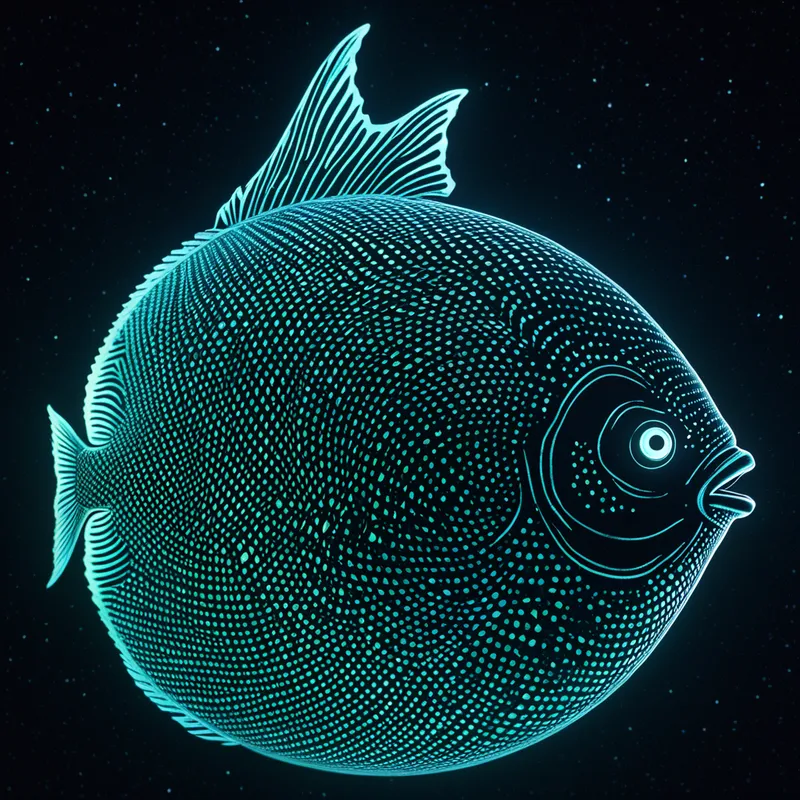
It remembered the light. Not just the sun’s light, but the bioluminescent spark of the anglerfish, the shimmer of the school of sardines, the cold fire of the deep-sea star. It began to glow. A feeble, silvery light at first, pushing back only inches of the thick dark. It swam deeper into the belly, its light a protest, a memory. The shadow coiled around it, whispering of the peace of dissolution, of the pointlessness of a single, tiny light in an eternal gut.
The little fish thought not of escape, but of the ocean it loved. It thought of the dance of the dolphins, the patience of the clam, the vast, singing journey of the whale. Its glow intensified, burning not with fuel, but with feeling. It became a beacon, a miniature star in the visceral night. Its light touched the walls of the Leviathan’s stomach, and where it touched, the shadow recoiled, not in pain, but in recognition.
For the shadow was a forgotten memory. The Leviathan, in its eons of slumber, had forgotten the world outside itself. The little fish’s persistent, loving light was an echo from that world. The shadow began to change, not to vanish, but to transform. It flowed into the little fish’s light, tempering it, making it not just bright, but wise. The little fish was no longer just a fish; it was a vessel, filled with the reconciled memory of darkness and light.
And the Leviathan stirred. Not in rage, but in a profound, seismic sigh. It opened its mouth, and a new current flowed—a warm, clear current brimming with vitality. The little fish was carried forth on this breath of renewal, emerging not as it entered, but radiant, its tarnished scales now holding the deep blue of the abyss and the gold of the sun. The shadow was gone, not destroyed, but woven back into the whole. The ocean shuddered, and then sang, as life remembered itself.
Cultural Origins & Context
The myth of The Little Fish is a profound example of a polygenetic myth, appearing in various forms across maritime and riverine cultures worldwide. From the Maui legends of the Pacific, where a small fish transforms into land, to tales among the coastal peoples of West Africa and the river tribes of the Amazon, the core narrative persists. It was never the property of priests or kings, but a story of the people, told by fishermen to their children at dusk, by elders to illustrate resilience, and by shamans to describe journeys of the soul.
Its primary societal function was twofold. For communities living at the mercy of the sea or great rivers, it modeled a relationship with the vast, often terrifying power of their environment—not one of conquest, but of intelligent, sacrificial engagement. The Leviathan is not slain; it is healed through remembrance. Secondly, it served as a foundational narrative for the marginalized. The hero is the smallest, the overlooked, the one without conventional power. The myth validated the idea that the fate of the whole could hinge on the courage and integrity of the seemingly insignificant, fostering a deep sense of individual responsibility and potential within a collective framework.
Symbolic Architecture
Psychologically, the myth maps the journey of the conscious ego (the little fish) into the depths of the personal and collective unconscious (the Leviathan and the Chasm of Origins). The “ocean growing cold” represents a state of psychic stagnation, depression, or spiritual famine, where the animating energy of life (libido) has receded.
The belly of the beast is not a prison, but the crucible. To be swallowed is to be fully immersed in the unresolved material of the Self.
The little fish’s smallness is its greatest asset, symbolizing a focused consciousness, a pinpoint of awareness that can navigate the overwhelming complexity of the inner world without being immediately crushed or dissolved by it. The shadow in the belly is the ultimate Shadow—not just personal failings, but the primordial, formless dread of non-being, the “cold mother” aspect of the unconscious that threatens to negate individuality.
The transformation occurs not through battle, but through illumination. The fish’s light is the light of consciousness itself—fragile, loving, and persistent. It does not destroy the shadow; it re-members it, integrating the forgotten, feared darkness back into the psychic ecosystem. The resulting renewal—the warm current—symbolizes the transcendent function, the new, vital attitude that emerges from the conscious assimilation of unconscious contents.
The Dreamer’s Resonance
When this myth activates in the modern dreamer, it often manifests as dreams of being swallowed, of entering caves, submarines, or vast interior spaces like enormous buildings or the roots of a giant tree. There is a somatic sense of pressure, of being in a digestive or transformative space. The dreamer may be small, navigating these enormities.
Psychologically, this signals a profound process of introversion. The conscious personality is being drawn into a deep, self-contained process of incubation. It is the psyche’s way of forcing a confrontation with what has been “swallowed” and forgotten—repressed traumas, neglected potentials, or a core sense of meaninglessness. The feeling of coldness or stagnation in the dream reflects a real-life experience of depression, burnout, or creative block.
The dreamer is the little fish. The process feels isolating and perilous. The triumph in such dreams is rarely explosive; it is the moment the dreamer finds a small, inner light—a memory of love, a spark of creativity, a stubborn sense of self—and chooses to tend to it despite the overwhelming inner environment. Waking from such a dream cycle, one often feels a subtle but fundamental shift, a quiet warmth returning to one’s emotional life, signaling the beginning of the psyche’s “renewal current.”

Alchemical Translation
In the alchemy of individuation, The Little Fish myth perfectly models the stages of nigredo and albedo. The descent into the belly is the nigredo: the descent into darkness, the confrontation with the massa confusa of the unconscious, where all seems lost and the ego feels annihilated.
The goal is not to escape the whale, but to heal it from within. The salvation of the world is a byproduct of the salvation of the Self.
The little fish’s glow is the first appearance of the albedo, the silver light of the moon, representing the reflective, feminine consciousness that can endure the dark without being extinguished. This is not the solar hero’s blazing sword, but the patient, luminescent knowing of the soul. The fish does not fight the substance of the whale; it transforms the condition inside it through its presence.
For the modern individual, this translates to those periods of life when we are “swallowed” by a crisis—of meaning, relationship, health, or identity. The alchemical instruction is to cease struggling against the container of the crisis (the job, the depression, the illness) and instead turn inward with focused, loving attention (the light). The task is to find what within this “belly” has been forgotten, what shadowy aspect of ourselves we have been digesting in darkness. By bringing the light of non-judgmental awareness to it, we perform the psychic transmutation. The crisis (the Leviathan) is not defeated; it is fundamentally altered, and in releasing us, it releases a new, life-giving current—a rediscovered passion, a deeper compassion, a more authentic way of being in the world. The little fish emerges not just saved, but sanctified, carrying the reconciled duality of dark and light within its very scales.
Associated Symbols
Explore related symbols from the CaleaDream lexicon: