The Liminal Hour Myth Meaning & Symbolism
A mythic tale of the twilight hour where fate is woven, boundaries dissolve, and the Norns reveal the hidden patterns of destiny and the self.
The Tale of The Liminal Hour
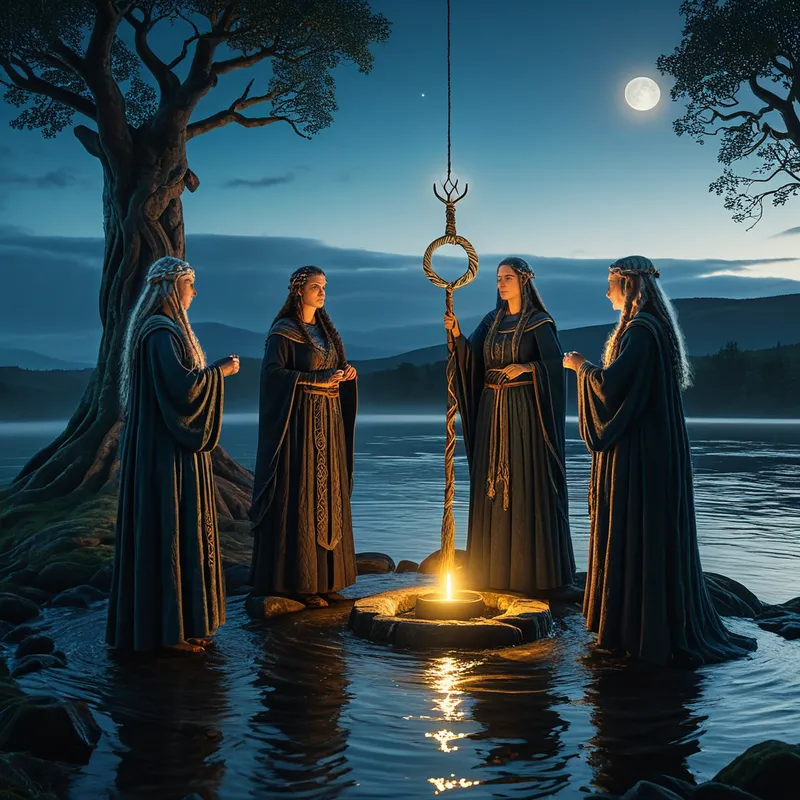
Listen, and let the fire’s crackle become the whisper of ancient roots. There is an hour that belongs neither to day nor to night, when the sun’s chariot has plunged below the rim of the world but the stars have not yet dared to show their faces. This is the Liminal Hour, the breath held between two worlds.
In this hushed gloaming, all paths become one path, and all sounds are swallowed by a profound, listening silence. It is to this place, to the very foot of the Yggdrasil, that the three sisters come. They are the Norns: Urd of the past, whose face is carved from memory; Verdandi of the present, whose eyes hold the flickering now; and Skuld of the future, who wears a veil over what must be.
They gather not at the tree’s mighty trunk, but where its three great roots drink from three separate springs. Here, at the Well of Urd, the water is not clear but dark as polished obsidian, and in its depths swim the reflections of all that was, is, and shall be. The air smells of damp earth, of cold stone, and of the faint, metallic scent of stars.
Urd, her movements slow as continents shifting, dips an ancient urn into the well. She does not draw water, but a substance like liquid moonlight and liquid shadow, mingled. This she pours onto the roots of Yggdrasil, and the tree shivers, its leaves whispering secrets in a tongue no mortal ear can comprehend. From the damp bark where the liquid pools, Verdandi gathers threads. They are not spun from wool or flax, but from the breath of giants, the laughter of gods, the silent hopes of men, and the slow decay of stones. Her fingers, swift and sure, work the spindle. She weaves a tapestry that is never still, its patterns shifting like clouds, depicting battles not yet fought, loves not yet kindled, words not yet spoken.
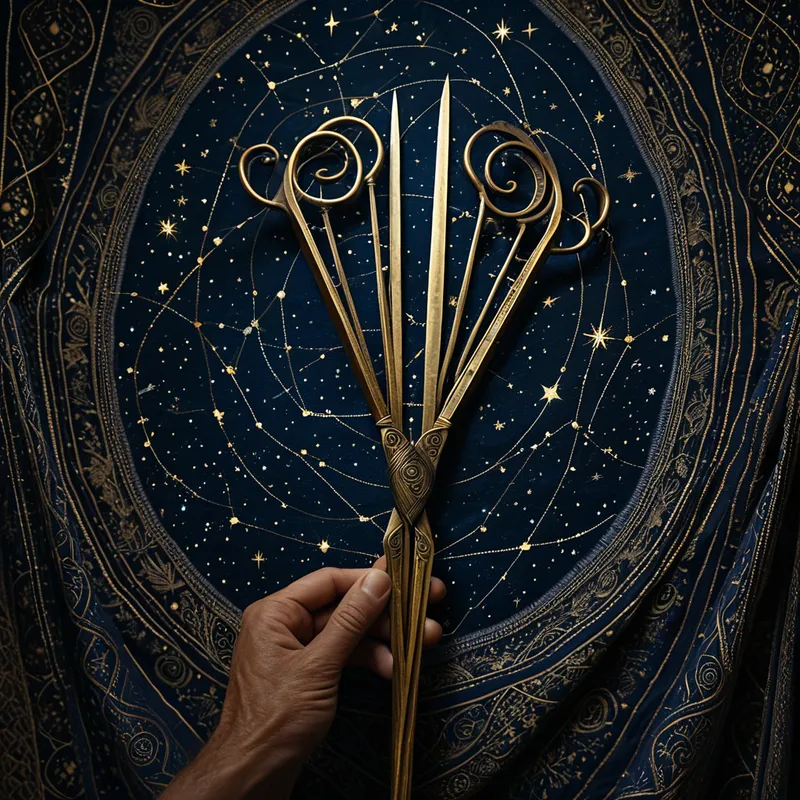
And then comes Skuld. She holds not a spindle, but a pair of shears, their blades cold and sharp, forged in a place before light. She watches the tapestry unspool from Verdandi’s hands. She does not cut with malice, nor with mercy, but with an inevitability that is the universe’s own heartbeat. A thread glimmers, strong and bright—she lets it run. Another, thin and frayed, tangles upon itself—snip. The severed end falls silently, absorbed by the roots below. Each cut is a death, a turning point, a door closed. Each thread allowed to continue is a life extended, a choice made, a destiny unfolding.
For the span of this one, fragile hour, the great loom of existence is bare before them. The gods themselves, even Odin in his high seat, dare not look directly upon this work. For in this weaving and cutting is contained the subtle architecture of ørlög, the primal law that even they must obey. As the last sliver of twilight bleeds from the sky and the first true star pierces the veil, the Norns cease. The tapestry vanishes, absorbed back into the tree, the well, the soil. The Liminal Hour passes. The world breathes out, and destiny is once again hidden, woven into the very fabric of the coming night and the day that will follow.
Cultural Origins & Context
The mythic motif of the Norns at their twilight work is not a single, codified story from a sacred text, but a pervasive atmospheric truth woven through the Poetic Edda and Snorri’s Edda. It was likely not a tale told to children for simple moral instruction, but a profound cosmological concept shared in the hall during the long winter nights, or contemplated by the individual sitting at the boundary of a forest as day failed.
Its tellers were the skalds and the wise women, those who understood that time was not a straight line but a cycle, and that the most potent moments were the transitions. The societal function was one of grounding and awe. It answered the human need to understand causality—why some plans flourish and others wither, why life is given and taken. It placed the individual’s life within a vast, interconnected web (wyrd) that included gods, giants, and the natural world. This was not a doctrine of helpless predestination, but a map of a universe governed by deep, flowing patterns. To know of the Liminal Hour was to know that one’s actions contributed threads to Verdandi’s spindle, and that Skuld’s shears respected the strength and quality of what was woven.
Symbolic Architecture
The Liminal Hour is the ultimate symbol of the threshold, the temenos where reality is most fluid and therefore most potent. The three Norns represent the irreducible triad of time—Past (the source, the given conditions), Present (the act of creation and choice), and Future (the necessary consequence, the closing of possibilities).
The past is the water drawn from the well, the inherited, often unconscious material of our being. The present is the active weaving of that material into the pattern of our current life. The future is the necessary pruning, the death of potentials that do not serve the integrity of the whole tapestry.
The Well of Urd is the collective and personal unconscious, the dark pool holding all memory, trauma, and ancestral wisdom. Yggdrasil is the axis of the Self, the structure of the psyche that connects the depths (the roots), the conscious world (the middle realm), and the transcendent or spiritual aspirations (the heights). The act of pouring the well-water onto the roots signifies that the unconscious constantly nourishes and informs the structure of the Self, often outside our conscious awareness.
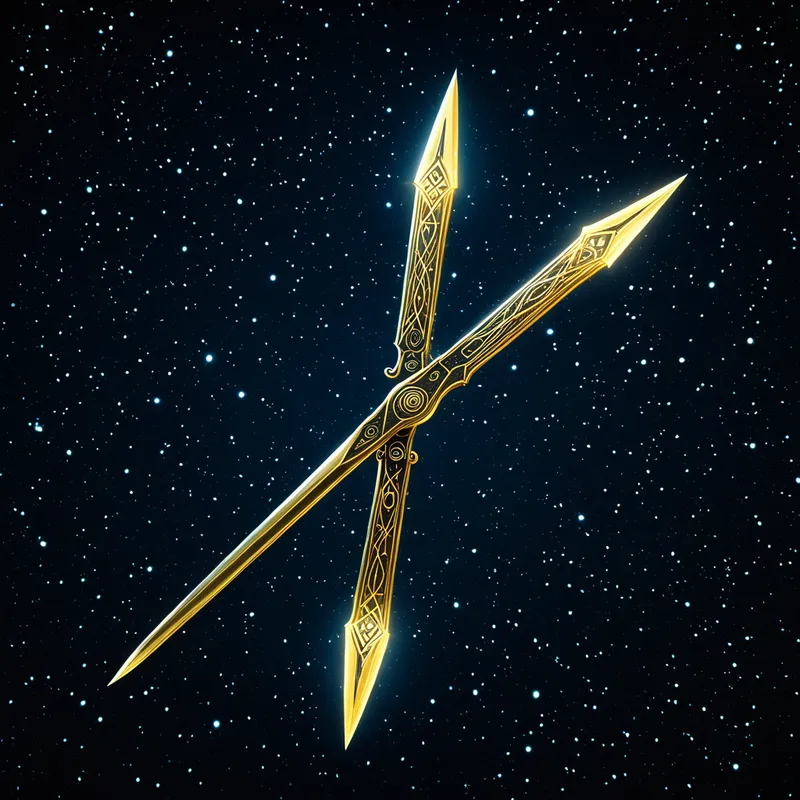
The shears of Skuld are perhaps the most challenging symbol. They represent the principle of limitation, which makes form and life possible. Without the cut, there is only undifferentiated, chaotic potential—no story, no identity, no death, and therefore no meaning.
The Dreamer’s Resonance
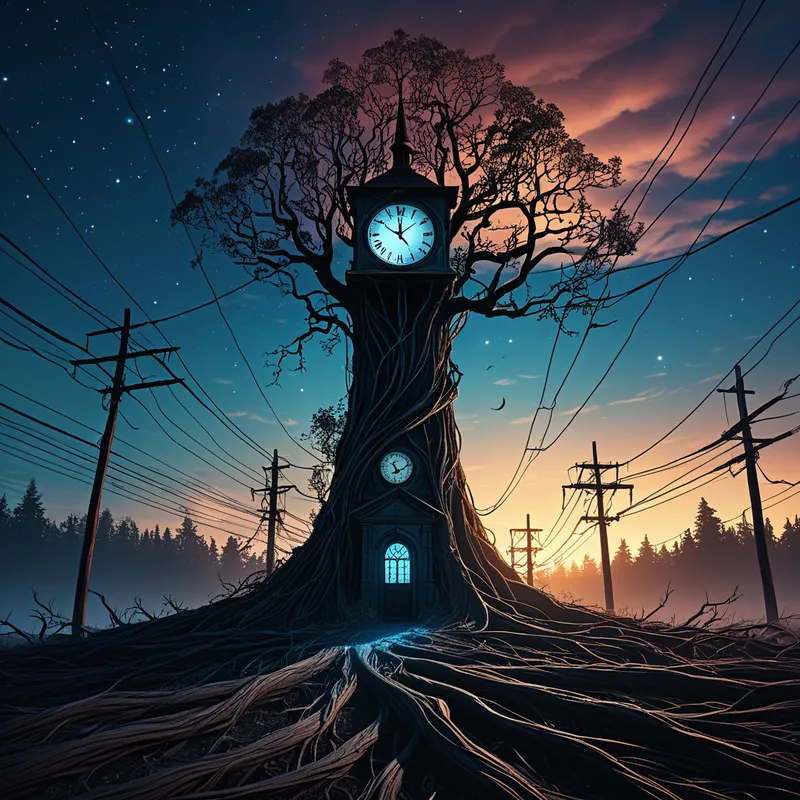
When the pattern of the Liminal Hour stirs in modern dreams, the dreamer is standing at a psychic crossroads where a fateful integration or severance is occurring. Common motifs include: standing in a doorway between two radically different landscapes; watching a spider weave or mend a web in dim light; encountering a triad of wise, often silent, feminine figures; or finding an old, complex clock stopped at twilight.
Somatically, this may accompany a period of intense transition—a career change, the end of a relationship, a health diagnosis, or a profound inner realization. The psychological process is one of confronting one’s own ørlög—the deep, often hidden pattern of one’s life. The dream asks: What threads from my past (Urd) am I currently weaving with (Verdandi)? And what possibilities, habits, or identities must I allow to be cut away (Skuld) for my essential pattern to emerge? The anxiety in such dreams is the terror of the shears. The potential liberation is the recognition that one is both the weaver and the pattern, participating in a destiny that is both given and chosen.
Alchemical Translation
The alchemical process mirrored in the Liminal Hour is the solutio and coagulatio—the dissolution of old forms and the coagulation of the new. The twilight is the nigredo, the dark night of the soul where all certainties blur. The well-water is the prima materia, the primal, chaotic stuff of the psyche.
The individuation journey requires us to sit at our own personal Well of Urd, to draw up the dark waters of our unconscious history without flinching. We must then take up the spindle of consciousness (Verdandi) and actively, deliberately, weave with these threads. This is the hard, daily work of making meaning from our memory and our pain.
The most critical, and often most resisted, stage is the embrace of Skuld’s shears. This is the alchemical separatio. Psychic transmutation demands sacrifice. We must sever the thread of the victim identity, the outdated ambition, the toxic loyalty, the comforting illusion. This cut is not an act of violence against the self, but an act of ruthless integrity for the sake of the Self. It makes space for the new golden thread to be woven in.
The ultimate goal is not to avoid the shears, but to weave a tapestry so coherent, so true to one’s deepest nature, that when Skuld examines it, her cut is not an amputation but a release, a shaping that reveals the essential image hidden within the cloth. To live in awareness of the Liminal Hour is to become a conscious collaborator with fate, honoring the past, acting with presence in the now, and accepting the necessary endings that allow the future to be born.
Associated Symbols
Explore related symbols from the CaleaDream lexicon: