The Leviathan
A primordial sea monster from Hebrew mythology, representing chaos, divine power, and the untamable forces of creation.
The Tale of The Leviathan
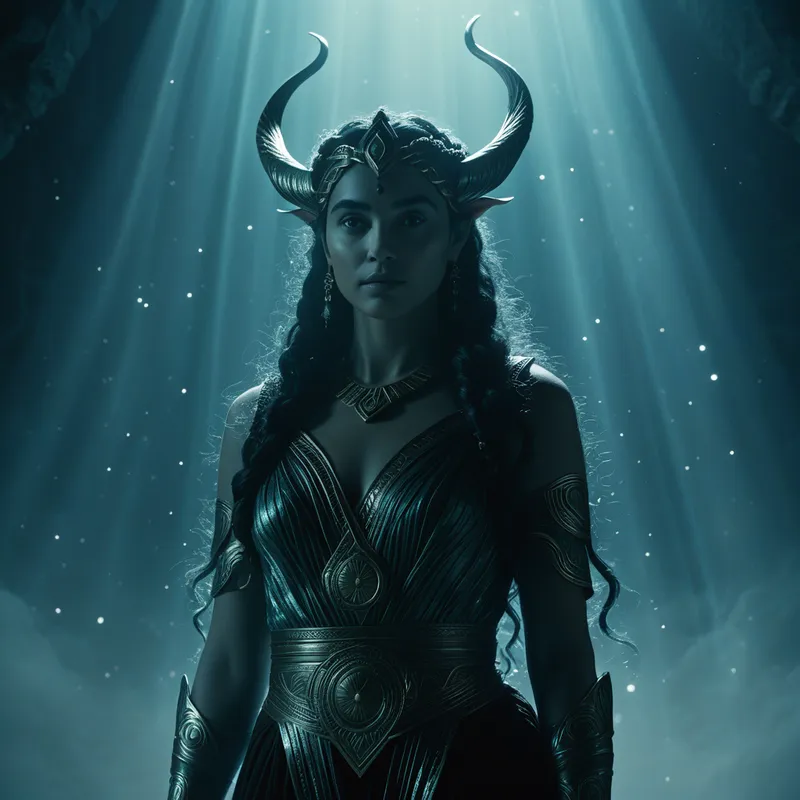
In the beginning, before the firmament was stretched, before the dry land was gathered, there was the deep. And in that deep, coiled in the abyssal dark of the primordial waters, was the [Leviathan](/myths/leviathan “Myth from Biblical culture.”/). It was not made; it simply was, a living embodiment of the formless, teeming, and terrifying potential that preceded order. Its back was a range of shields, fused together like the scales of some cosmic armor, and its breath was a furnace, its eyes like the eyelids of the dawn. To behold it was to behold [chaos](/myths/chaos “Myth from Greek culture.”/) given flesh, a power so immense it threatened to swallow the very notion of creation.
The scriptures whisper of a time when the Divine confronted this beast. It was not a battle of good versus evil, but of order confronting its own inherent opposite. In the Book of Job, God speaks to the suffering man from the whirlwind, not with comfort, but with a terrifying portrait of divine mastery. “Can you draw out Leviathan with a fishhook?” the voice thunders. The description is one of awe and dreadful beauty: its sneezing flashes forth light, its eyes are like the rays of dawn, out of its mouth go flaming torches, and sparks of fire leap forth. On its neck abides strength, and terror dances before it. It is king over all the children of pride. Here, the Leviathan is not slain, but displayed—a testament to the One who can tread upon the heights of the waves and bind the very symbol of chaos.
Yet other traditions speak of a final confrontation. In the Talmud and Kabbalistic lore, the Leviathan is destined for a great eschatological feast. At the end of days, the monster will engage in a final, fatal duel with its terrestrial counterpart, [the Behemoth](/myths/the-behemoth “Myth from Hebrew culture.”/). Their mutual destruction will pave [the way](/myths/the-way “Myth from Taoist culture.”/) for a banquet for the righteous, who will feast upon its flesh within the great sukkah made from its skin. Its end, therefore, is not mere annihilation but [transubstantiation](/myths/transubstantiation “Myth from Christian culture.”/); its chaotic power is ultimately harvested, sanctified, and consumed to sustain a new and perfected order.
Cultural Origins & Context
The Leviathan’s roots sink deep into the mythic soil of the ancient Near East. It is a direct inheritor of the Canaanite sea monster Lotan and, further back, the Mesopotamian [Tiamat](/myths/tiamat “Myth from Mesopotamian culture.”/)—the saltwater chaos-[dragon](/myths/dragon “Myth from Chinese culture.”/) slain by the storm god [Marduk](/myths/marduk “Myth from Mesopotamian culture.”/) to form the ordered world. For the Hebrews, living at the precarious edge of [the desert](/myths/the-desert “Myth from Biblical culture.”/) and the unpredictable sea, the ocean was the ultimate symbol of the unknown, the uncontrollable, and the anti-creational. It was the “deep” (tehom) over which the spirit of God hovered.
Thus, the Leviathan is not a random monster but a theological necessity. It embodies the persistent, residual chaos that was not erased at creation but merely bounded. Its existence answers a profound psychological and cosmological question: if God is all-powerful and creation is good, from where does terror, disorder, and overwhelming power originate? The Leviathan is that answer—a contained, acknowledged, and ultimately God-owned dimension of reality. It represents the “other” against which divine sovereignty is defined and demonstrated. In the political philosophy of [Thomas](/myths/thomas “Myth from Christian culture.”/) Hobbes, the name was borrowed to describe the absolute state, a terrifying but necessary power to restrain the chaotic war of “every man against every man,” proving the symbol’s enduring potency as a metaphor for overwhelming, structuring power born from chaos.
Symbolic Architecture
The [Leviathan](/symbols/leviathan “Symbol: A primordial sea monster representing chaos, the unconscious, and overwhelming power, often seen as a divine or cosmic adversary.”/) is a complex [symbol](/symbols/symbol “Symbol: A symbol can represent an idea, concept, or belief, serving as a powerful tool for communication and understanding.”/) built from [paradox](/symbols/paradox “Symbol: A contradictory yet true concept that challenges logic and perception, often representing unresolved tensions or profound truths.”/). It is [chaos](/symbols/chaos “Symbol: In Arts & Music, chaos represents raw creative potential, uncontrolled expression, and the breakdown of order to forge new artistic forms.”/), yet it is a structured chaos, with scales locked tight like [armor](/symbols/armor “Symbol: Armor represents psychological protection, emotional defense, and the persona presented to the world. It symbolizes both safety and the barriers that separate us from vulnerability.”/). It is a [creature](/symbols/creature “Symbol: Creatures in dreams often symbolize instincts, primal urges, and the unknown aspects of the psyche.”/) of the [boundless sea](/symbols/boundless-sea “Symbol: The Boundless Sea represents the vast and infinite potential of the unconscious mind, embodying emotions, adventure, and the unknown.”/), yet it is described with meticulous, almost architectural detail. This embodies the core [truth](/symbols/truth “Symbol: Truth represents authenticity, honesty, and the quest for knowledge beyond mere appearances.”/): [chaos](/symbols/chaos “Symbol: In Arts & Music, chaos represents raw creative potential, uncontrolled expression, and the breakdown of order to forge new artistic forms.”/) is not mere randomness, but a potent, latent order of a different kind—a churning, creative, and destructive potential that precedes form.
The Leviathan represents the psyche’s own untamed depths—the raw, instinctual, and potentially annihilating forces that must be acknowledged and related to, not eradicated. To deny the Leviathan is to deny a fundamental stratum of existence.
It is the ultimate rebel [archetype](/symbols/archetype “Symbol: A universal, primordial pattern or prototype in the collective unconscious that shapes human experience, behavior, and creative expression.”/), not against morality, but against the very principle of domestication, limitation, and easy comprehension. Its power is amoral, primal, and self-justifying. In its confrontation with the divine, we see the necessary [dialogue](/symbols/dialogue “Symbol: Conversation or exchange between characters, representing communication, relationships, and narrative flow in games and leisure activities.”/) between [the ego](/myths/the-ego “Myth from Jungian culture.”/) (the ordering principle) and the unconscious (the chaotic, creative [depth](/symbols/depth “Symbol: Represents profound layers of consciousness, hidden truths, or the unknown aspects of existence, often symbolizing introspection and existential exploration.”/)). The goal is not the [monster](/symbols/monster “Symbol: Monsters in dreams often symbolize fears, anxieties, or challenges that feel overwhelming.”/)’s destruction, but its [integration](/symbols/integration “Symbol: The process of unifying disparate parts of the self or experience into a cohesive whole, often representing psychological wholeness or resolution of internal conflict.”/)—as seen in the myth of the righteous feast.
The Dreamer’s Resonance
To encounter the Leviathan in a dream or in the depths of the soul is to stand before the immensity of one’s own unintegrated power. It is the feeling of a rage so vast it could shatter [the world](/myths/the-world “Myth from Tarot culture.”/), a grief so deep it could drown the sun, or a creative impulse so wild it threatens to dissolve all existing structures of life. This is not the manageable emotion, but the archetypal force beneath it.
The Leviathan-dream is often one of tsunamis, of being chased by immense creatures in deep [water](/myths/water “Myth from Chinese culture.”/), or of witnessing a terrifying and beautiful power from a precarious vantage point. It signals a moment when the contained waters of the personal [psyche](/myths/psyche “Myth from Greek culture.”/) are breached by the transpersonal ocean. The call here is not to fight, but to witness; to develop the “Job-like” capacity to behold one’s own inner chaos without being annihilated by it. The healing begins when we can, like the voice from the whirlwind, point to the monster within and say, “Behold.” This act of conscious recognition is the first step in transforming blind, devouring power into a source of formidable strength and resilience.
Alchemical Translation
In the alchemy of the soul, the Leviathan is the [prima materia](/myths/prima-materia “Myth from Alchemical culture.”/)—the black, chaotic, and despised starting point of [the great work](/myths/the-great-work “Myth from Alchemical culture.”/). It is [the nigredo](/myths/the-nigredo “Myth from Alchemical culture.”/), the state of dissolution and putrefaction where all forms break down into their essential, chaotic components. The fiery breath of the Leviathan is the scorching heat of [the alchemical furnace](/myths/the-alchemical-furnace “Myth from Alchemical culture.”/), necessary to reduce the ego to ash.
The eschatological feast is the ultimate alchemical image: the chaotic, monstrous substance (Leviathan) is slain, cooked, and consumed by the conscious spirit (the righteous), transforming its raw power into spiritual sustenance and its hide into a sacred container. Chaos becomes cosmos.
The process is one of coagulation—bringing form out of the formless deep. It is not about killing [the dragon](/myths/the-dragon “Myth from Chinese culture.”/), but about harnessing its fire, wearing its armor, and navigating its domain. The integrated Leviathan bestows the gift of unshakable authority that comes from having faced [the abyss](/myths/the-abyss “Myth from Kabbalistic culture.”/) and incorporated its power. Its scales become the lucid, resilient boundaries of a self that knows its own depth.
Associated Symbols
Explore related symbols from the CaleaDream lexicon:
- Chaos — The primordial, unformed state of potential from which all order emerges, represented by the abyssal waters the Leviathan inhabits.
- Ocean — The vast, unconscious depth of the psyche, the realm of the unknown and the source of both life and terrifying power.
- Dragon — A universal archetype of the primal, chaotic, and hoarding force that guards treasure and must be confronted for transformation.
- Serpent — The coiled, instinctual wisdom and latent energy of the deep, a smaller-scale cousin to the Leviathan’s immense power.
- Fire — The transformative, purifying, and destructive energy embodied by the Leviathan’s breath, symbolizing both annihilation and the spark of creation.
- Power — Raw, amoral force and sovereignty, the essential nature of the Leviathan as a being that exists beyond conventional morality.
- Primordial Chaos — The specific, personified chaos of the beginning, the tehom from which the world was carved and which the Leviathan embodies.
- Structured Chaos — The paradox of the Leviathan itself: a being of utter wildness possessing an immense, ordered, and armored form.
- [Death](/myths/death “Myth from Tarot culture.”/) — The Leviathan’s eschatological role as a being slain to bring about a new age, representing the necessary end that precedes renewal.
- Rebirth — The promise implicit in the messianic feast, where the consumption of the Leviathan’s flesh signifies the assimilation of chaos into a new, redeemed order.
- Shadow — The totality of the unconscious, rejected, and fearsome aspects of [the self](/myths/the-self “Myth from Jungian culture.”/), which, like the Leviathan, must be faced and integrated.
- Abyss — The boundless, unfathomable depth that is both the Leviathan’s home and a symbol for the ground of being itself, dark and full of potential.