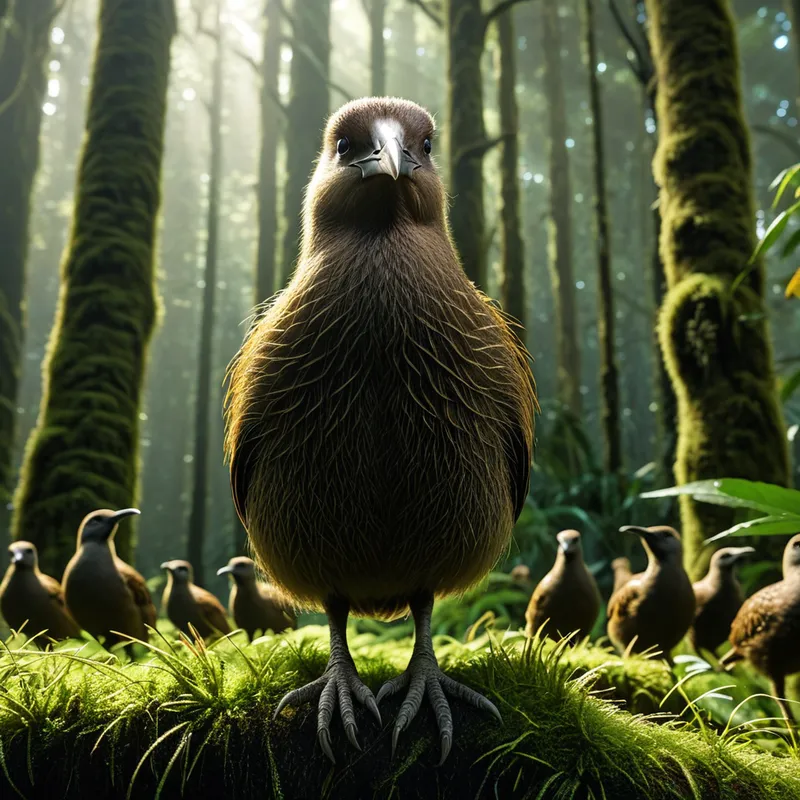
The Legend of the Kiwi Bird Myth Meaning & Symbolism
A myth of sacrifice where the kiwi bird gives up flight to save the forest, becoming a humble, nocturnal guardian of the earth.
The Tale of The Legend of the Kiwi Bird
Listen. In the first, deep breaths of the world, when Aotearoa was young and the trees whispered secrets to the sky, a shadow fell upon the great forests. The children of [Ranginui](/myths/ranginui “Myth from Maori culture.”/) and Papatūānuku walked the land, but a creeping sickness threatened the very roots of life. Insects, born of decay, multiplied in the darkness of the soil. They gnawed at the sacred roots of the trees, the children of Tāne Mahuta. The great trees, the Tāne and the Ponga, began to sicken, their leaves turning pale, their mighty forms trembling.
Tāne Mahuta, his heart heavy with the sorrow of his children, called a great council of the iwi of the air. To the highest branches he summoned them all. The Korimako, whose song was like clear water. The mighty Kārearea, lord of the winds. The elegant Kōtuku, stately and pure. The boisterous Kererū. All gathered, their feathers a riot of color against the green canopy.
“Hear me, my children,” Tāne’s voice rustled through every leaf. “A great task is upon us. The insects of the night are devouring the forest from below. If they are not stopped, all will return to the darkness. The trees will fall, and you will have no home. One of you must descend. One of you must forsake the light and the sky. One of you must live on the dark, damp earth, hunt these creatures in the black of night, and become the guardian of the roots.”
A silence, cold and deep, settled over the assembly. The Korimako looked at its beautiful feathers, meant for sun-dappled leaves. “Who will hear my song in the darkness?” it pleaded. The Kārearea spread its powerful wings. “My domain is the open sky, the chase on the wind. I cannot be bound to the earth.” The Kōtuku stood on one leg, aloof. “The mud would stain my purity.” The Kererū cooed nervously, thinking of the forest fruits it would miss.
One by one, the birds of the day gave their reasons, their fears. The sky was their identity; the earth was a prison, a realm of shadows and decay. Despair began to cloud Tāne’s eyes. Then, a small, quiet movement. From the lower branches, a plain, brown bird stepped forward. It was Tokoeka, the kiwi. Its voice was a soft whisper in the gathering gloom.
“I will go,” it said.
The other birds gasped. “But your wings?” asked the falcon. “The sun?” sang the bellbird.
The kiwi looked at its own small, functional wings. It looked at the distant forest floor, a world away. It felt the weight of the silent, suffering trees. “If no one goes, we all perish,” it said simply. “I may be small and plain, but I am of this forest. I will go to the earth.”
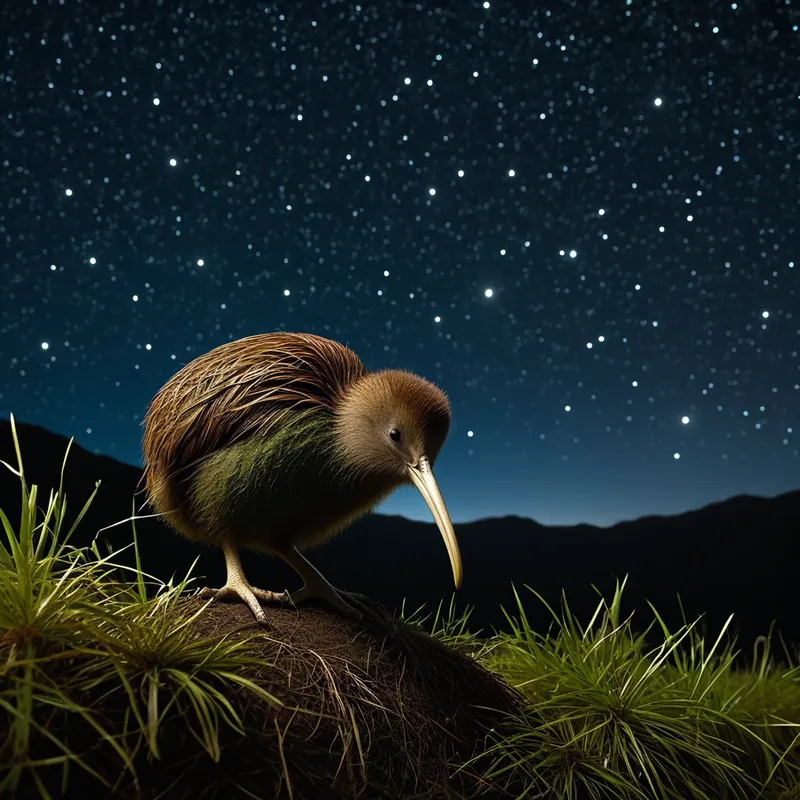
And so, Tāne Mahuta, with tears like morning dew, bestowed the great and terrible gift. He touched the kiwi, and its wings shrank, becoming useless for flight. Its feathers grew coarse and hair-like, perfect for pushing through dense undergrowth. Its eyes grew small, for it would no longer need to see the vast horizon, but its sense of smell grew powerful, and its beak grew long to probe the soft earth. It was given strong, clawed feet to walk the hidden paths. It was cloaked in the colors of the night and the soil.
The kiwi did not look back at the canopy. It turned, and with a solemn step, began its descent down the great trunk of the world, leaving the light behind forever. That night, and every night since, its soft call echoes in the darkness—not a song of the sun, but a whisper of guardianship, a promise kept in the realm of roots and shadows.
Cultural Origins & Context
This pūrākau is a foundational narrative from the oral traditions of Māori. It belongs to the rich corpus of stories that explain the origins of natural phenomena, the characteristics of native species, and the core values of the people. Passed down through generations by tohunga and storytellers, it was not merely a tale for children but a pedagogical tool. It functioned to instill the societal virtues of tika (rightness) and selfless duty to the community and the environment. The kiwi, in its humble sacrifice, models the ideal of putting the collective good—the health of the ngahere—above individual desire or glory. This myth directly connects the people to their environment through whakapapa, establishing the kiwi not just as a bird, but as a relative who performed a critical service for the family of life.
Symbolic Architecture
At its [heart](/symbols/heart “Symbol: The heart symbolizes love, emotion, and the core of one’s existence, representing deep connections with others and self.”/), this is a myth of profound inversion and sacred contract. The kiwi’s [journey](/symbols/journey “Symbol: A journey in dreams typically signifies adventure, growth, or a significant life transition.”/) is a descent not into degradation, but into a different order of sovereignty.
The greatest power is often found not in rising above, but in choosing to go below, to become the foundation others take for granted.
The sky represents [consciousness](/symbols/consciousness “Symbol: Consciousness represents the state of awareness and perception, encompassing thoughts, feelings, and experiences.”/), [identity](/symbols/identity “Symbol: Identity represents the sense of self, encompassing personal beliefs, cultural background, and social roles.”/), freedom, and visibility. The [earth](/symbols/earth “Symbol: The symbol of Earth often represents grounding, stability, and the physical realm, embodying a connection to nature and the innate support it provides.”/) represents the unconscious, the hidden, the [realm](/symbols/realm “Symbol: The symbol of ‘Realm’ often signifies the boundaries of one’s consciousness, experiences, or emotional states, suggesting aspects of reality that are either explored or ignored.”/) of instinct, decay, and nourishment. The kiwi’s sacrifice is a voluntary journey from the known world of light (the ego’s domain) into the unknown world of darkness (the realm of the [shadow](/symbols/shadow “Symbol: The ‘shadow’ embodies the unconscious, repressed aspects of the self and often represents fears or hidden emotions.”/) and the psyche’s roots). Its transformed [body](/symbols/body “Symbol: The body in dreams often symbolizes the dreamer’s self-identity, personal health, and the relationship they have with their physical existence.”/) is a perfect [symbol](/symbols/symbol “Symbol: A symbol can represent an idea, concept, or belief, serving as a powerful tool for communication and understanding.”/) of [adaptation](/symbols/adaptation “Symbol: The process of adjusting to new conditions, often involving psychological or physical change to survive or thrive.”/) to this new [purpose](/symbols/purpose “Symbol: Purpose signifies direction, meaning, and intention in life, often reflecting personal ambitions and core values.”/): useless wings signify the surrender of an old [identity](/symbols/identity “Symbol: Identity represents the sense of self, encompassing personal beliefs, cultural background, and social roles.”/); powerful [legs](/symbols/legs “Symbol: Legs in dreams often symbolize movement, freedom, and the ability to progress in life, representing both physical and emotional support.”/) and beak signify the development of new capacities for navigating the unseen. The kiwi becomes the psychopomp of the [forest](/symbols/forest “Symbol: The forest symbolizes a complex domain of the unconscious mind, representing both mystery and potential for personal growth.”/) [floor](/symbols/floor “Symbol: The floor in dreams often symbolizes the foundation of one’s life or psyche, representing stability, grounding, and the underlying structures of our experiences.”/), mediating between the decaying matter (the insects, the [shadow](/symbols/shadow “Symbol: The ‘shadow’ embodies the unconscious, repressed aspects of the self and often represents fears or hidden emotions.”/)) and the [health](/symbols/health “Symbol: Health embodies well-being, vitality, and the balance between physical, mental, and spiritual states.”/) of the whole [system](/symbols/system “Symbol: A system represents structure, organization, and interrelated components functioning together, often reflecting personal or social order.”/) (the trees). It represents [the principle](/symbols/the-principle “Symbol: A fundamental truth, law, or doctrine that serves as a foundation for a system of belief, behavior, or reasoning, often representing moral or ethical standards.”/) that the vitality of the conscious self is utterly dependent on the often-unseen work done in the dark [soil](/symbols/soil “Symbol: Soil symbolizes fertility, nourishment, and the foundation of life, serving as a metaphor for growth and stability.”/) of the unconscious.
The Dreamer’s Resonance
When this myth pattern stirs in the modern dreamer, it often signals a profound somatic and psychological crossroads. To dream of being grounded, of having wings that no longer lift you, or of being called to a dark, earthy task you feel ill-equipped for, is to feel the kiwi’s call. This is not a dream of failure, but of a fateful choice presenting itself.
Somatically, one might feel a heaviness in the legs, a pressure on the crown of the head (as if the sky is closing), or a peculiar alertness in the senses of smell and hearing. Psychologically, it is the process of confronting a duty that requires the surrender of a cherished self-image—the glamorous job, the social identity, the dream of freedom—for a responsibility that feels humble, hidden, yet utterly essential. It is the mother who puts her career on hold, the caregiver who tends to a sick relative, the individual who begins the unglamorous work of therapy to heal generational wounds. The dream evokes the grief of the lost sky, the fear of the dark earth, and the nascent dignity of accepting a guardianship no one else will see.
Alchemical Translation
The kiwi’s legend is a perfect map for the alchemical process of individuation, specifically the stage of nigredo—the blackening, the descent into the primal matter. The conscious ego, identified with flight and the sun (the bright, admired aspects of the self), is confronted with a collective need that resides in the shadow.
The transmutation begins when the spirit agrees to be clothed in the humility of earth, for within that humility lies the gold of authentic being.
The refusal of the other birds symbolizes the ego’s various resistances: vanity (the heron), hedonism (the pigeon), grandiosity (the falcon). The kiwi represents that part of the psyche—perhaps the emerging Self—that recognizes the necessity of the descent. The act of agreement is the first alchemical step. The physical transformation by Tāne is the psychic dissolution and mortificatio; the old form (the flying bird-ego) must die for the new, grounded Self to be born.
The resulting creature is the lapis, the philosopher’s stone, of this process. It is not glorious, but functional and essential. Its gold is not glitter but resilience, its light not solar but nocturnal—a guiding whisper in the dark. For the modern individual, this myth teaches that individuation is not about soaring above others in enlightenment, but often about becoming deeply, responsibly rooted. It is about developing the “beak” to probe one’s own dark, instinctual soil (the personal and collective shadow), to confront the “insects” of fear, shame, and unresolved grief that eat at our roots, and in doing so, secure the health of our entire inner forest. The kiwi’s call is the sound of the integrated Self, at home in the darkness it has chosen to serve.
Associated Symbols
Explore related symbols from the CaleaDream lexicon:
- Bird — The universal symbol of spirit, freedom, and the aspiration of consciousness, here radically transformed into a creature of earthly duty.
- Forest — Represents the complex, interconnected system of life, the psyche, and the community whose health depends on unseen, foundational work.
- Earth — The realm of the kiwi’s sacrifice, symbolizing the unconscious, the physical body, instinct, grounding, and the fertile darkness from which all growth ultimately springs.
- Sacrifice — The core action of the myth; the voluntary surrender of a prized attribute or freedom for a greater, often hidden, good that sustains the whole.
- Shadow — The kiwi willingly enters the realm of the shadow, representing the repressed, unseen, and instinctual parts of the self and the world that must be integrated.
- Guardian — The kiwi’s ultimate role; it becomes the protector not of heights, but of depths, modeling a protective, caring duty towards the vulnerable foundations.
- Journey — Specifically, a descent or downward journey, which in mythology is always a journey into the underworld of the psyche to retrieve essential knowledge or perform essential service.
- Duty — The driving force behind the sacrifice; a sense of responsibility and correct action (tika) that overrides personal desire.
- Root — What the kiwi protects; the hidden, nourishing foundation of life, identity, and the psyche, which is vulnerable to decay if unattended.
- Night — The kiwi’s new domain, representing the unconscious, the unknown, introspection, and the time when hidden truths and creatures emerge.
- Transformation — The radical physical and existential change the kiwi undergoes, symbolizing the total psychic reorganization required for true growth.
- Hero — An unconventional hero who triumphs not through conquest, but through acceptance, humility, and steadfast service in obscurity.