The Legend of the Breadfruit Myth Meaning & Symbolism
A story of the god Kū sacrificing his human form to become the first breadfruit tree, feeding his family and the people.
The Tale of The Legend of the Breadfruit
Listen. In the time when the gods walked as men and the islands were young, a shadow fell upon the land. It was not a shadow of cloud, but of emptiness. The kalo grew thin in the lo‘i, the fish grew scarce in the reefs, and a great hunger settled over the people. Their bellies were hollow drums, their children’s cries a constant wind.
In a humble home by the shore lived a man named Kū. But he was no ordinary man. A stillness of great power lay upon him, the stillness of deep earth and standing stone. He looked upon his weeping wife and his children, whose ribs showed like the struts of a canoe. His heart, a heavy stone in his chest, knew a terrible truth.
He called his family to him. The air was thick with the salt of the sea and the salt of tears. “My love,” he said to his wife, his voice the low rumble of distant thunder. “My children. The hunger will not release its grip. But I know a way.”
He instructed them with a calm that was more frightening than any storm. “You must take me to the kula, the open field. You must dig a deep pit. And there, you must bury me.”
Their wails tore at the sky. To bury a living man? To commit such an act against their own father, their husband? It was unthinkable. But the love in Kū’s eyes was an unshakable cliff, and the certainty in his voice was the pull of the moon on the tide. Love, in its most devastating form, demanded obedience.
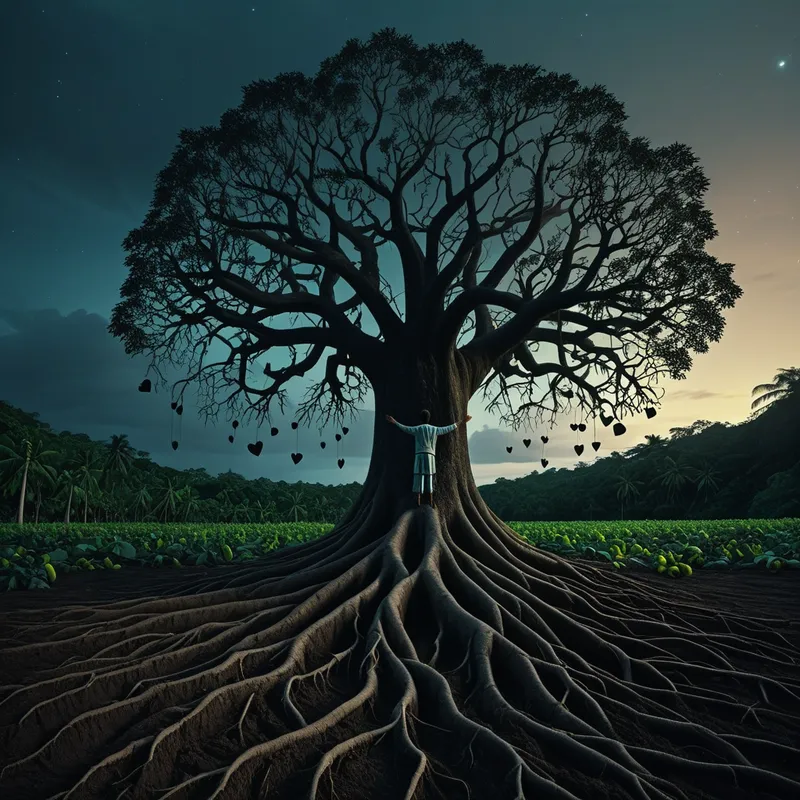
With hands that shook like leaves in the wind, they did as he asked. They dug into the red earth until the hole was deep and dark. Kū stood at the edge, a figure of profound solitude. He embraced them each, his touch lingering, a final imprint. Then, without a sound, he stepped down into the earth. They covered him, their tears watering the soil that now held their heart.
For days, they kept vigil, their grief a raw, open wound. They watered the mound with their sorrow. Then, on the morning when despair was deepest, a miracle pierced the ground. A tender green shoot, vibrant with impossible life, pushed through the soil. It grew with a speed that stole the breath, stretching toward the sun, thickening, branching.
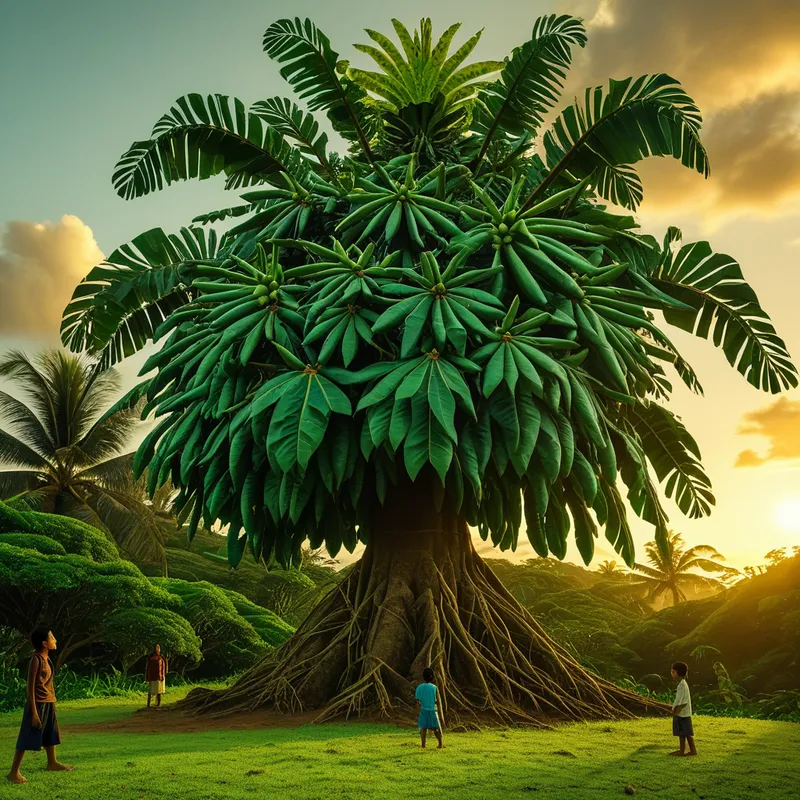
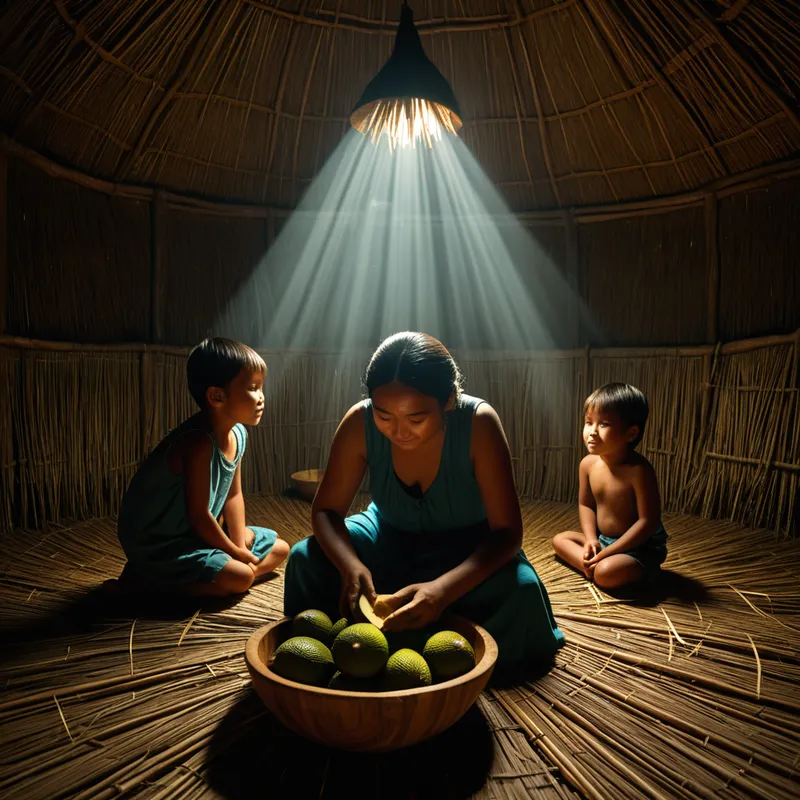
Where their husband and father had lain, a magnificent tree now stood. Its leaves were broad and dark green, like hands held up to the sky. And from its branches hung strange, wondrous fruits—round, green, and covered in a textured skin. The tree seemed to pulse with a gentle, nourishing energy. Tentatively, the wife reached up, took a fruit, and broke it open. The flesh within was soft, starchy, and sweet. She fed it to her children. The hunger that had gnawed at them for so long vanished, replaced by a profound, satisfying fullness.
The news spread like a wave across the sea. The tree, which they named ‘Ulu’, after Kū’s full name, Kū-ka-‘ulu-moku, gave and gave. Its fruit could be roasted, baked, or pounded into a sustaining paste. The god had not left them. He had transformed. He had become the food that would save them all.
Cultural Origins & Context
This myth, known as “Ka Mo‘olelo o ka ‘Ulu,” is a foundational mo‘olelo of Hawai‘i. It was not merely a story of origin, but a sacred narrative that encoded ecological wisdom, social values, and spiritual law. Passed down orally through generations by kāhuna and storytellers, it was recited during rituals and taught to children to explain the profound interconnectedness of life, death, and sustenance.
The breadfruit (‘ulu) was a staple carbohydrate, a literal life-giver. The myth provided its divine pedigree, making every harvest a sacred act, a communion with the sacrificed god. It established a familial relationship with the natural world; the tree was not just a plant, but an ancestor. This story functioned as a moral and practical guide, teaching the ethics of sacrifice for the community, the responsibility of stewardship, and the belief that true abundance often springs from profound loss. It grounded the people in the understanding that their survival was literally rooted in a divine act of love.
Symbolic Architecture
At its core, this is a myth of alchemical [transmutation](/symbols/transmutation “Symbol: A profound, alchemical process of fundamental change where one substance or state transforms into another, often representing spiritual evolution or personal metamorphosis.”/). The god Kū represents [the principle](/symbols/the-principle “Symbol: A fundamental truth, law, or doctrine that serves as a foundation for a system of belief, behavior, or reasoning, often representing moral or ethical standards.”/) of standing firm, of [foundation](/symbols/foundation “Symbol: A foundation symbolizes the underlying support systems, values, and beliefs that shape one’s life, serving as the bedrock for growth and development.”/). His sacrifice is the ultimate de-structuring of one form of being to give [birth](/symbols/birth “Symbol: Birth symbolizes new beginnings, transformation, and the potential for growth and development.”/) to another.
The most profound nourishment does not come from taking, but from a willing dissolution of the self into a new state of being.
The pit is the [womb](/symbols/womb “Symbol: A symbol of origin, potential, and profound transformation, representing the beginning of life’s journey and the unconscious source of creation.”/) of the [Earth](/symbols/earth “Symbol: The symbol of Earth often represents grounding, stability, and the physical realm, embodying a connection to nature and the innate support it provides.”/) [Mother](/symbols/mother “Symbol: The symbol of ‘Mother’ represents nurturing, protection, and the foundational aspect of one’s emotional being, often associated with comfort and unconditional love.”/), Papahānaumoku. The act of [burial](/symbols/burial “Symbol: A symbolic act of laying something to rest, often representing closure, transformation, or the release of past burdens.”/) is not an end, but a planting. Kū becomes the ultimate seed. His [human](/symbols/human “Symbol: The symbol of a human represents individuality, complexity of emotions, and social relationships.”/) [identity](/symbols/identity “Symbol: Identity represents the sense of self, encompassing personal beliefs, cultural background, and social roles.”/) dies so that his essence may [sprout](/symbols/sprout “Symbol: A new beginning emerging from potential, representing growth, vulnerability, and the earliest stage of development.”/) as the [tree](/symbols/tree “Symbol: In dreams, the tree often symbolizes growth, stability, and the interconnectedness of life.”/). The [fruit](/symbols/fruit “Symbol: Fruit symbolizes abundance, nourishment, and the fruits of one’s labor in dreams.”/) is the tangible manifestation of this psychic and spiritual process—[grief](/symbols/grief “Symbol: A profound emotional response to loss, often manifesting as deep sorrow, yearning, and a sense of emptiness.”/) metabolized into sustenance, personal [identity](/symbols/identity “Symbol: Identity represents the sense of self, encompassing personal beliefs, cultural background, and social roles.”/) sacrificed for communal [life](/symbols/life “Symbol: The symbol of ‘Life’ represents a journey of growth, interconnectedness, and existential meaning, encompassing both the joys and challenges that define human experience.”/).
Psychologically, Kū embodies the archetypal [caregiver](/symbols/caregiver “Symbol: A spiritual or mythical figure representing nurturing, protection, and unconditional support, often embodying divine or archetypal parental energy.”/) who understands that true provision may require the ultimate gift. The [family](/symbols/family “Symbol: The symbol of ‘family’ represents foundational relationships and emotional connections that shape an individual’s identity and personal development.”/)’s forced participation in the burial [ritual](/symbols/ritual “Symbol: Rituals signify structured, meaningful actions carried out regularly, reflecting cultural beliefs and emotional needs.”/) mirrors the painful but necessary human experiences where we must actively participate in the end of one [chapter](/symbols/chapter “Symbol: Chapters symbolize phases or segments of life, often representing transitions or new beginnings.”/) to allow a new one to begin.
The Dreamer’s Resonance
When this myth stirs in the modern dream, it often signals a profound somatic and psychological process of necessary sacrifice. You may dream of burying a cherished possession, a part of your body, or a loved one, only to see a tree grow from that spot. You might dream of being incredibly hungry, only to find a strange, unfamiliar fruit that satiates you completely.
These dreams point to a deep, often painful, restructuring of the psyche. The “hunger” is not for food, but for meaning, purpose, or emotional fulfillment. The dream is presenting the solution: something within your current identity, a cherished role, a long-held self-concept, or an old wound, must be consciously “buried”—released back to the unconscious—so that a new form of psychic nourishment can grow. The grief felt in the dream is real; it is the somatic cost of transformation. The dream is the inner family witnessing and participating in your own symbolic death and rebirth.
Alchemical Translation
For the individual on the path of individuation, the Legend of the Breadfruit is a master blueprint for psychic transmutation. It models the movement from ego-centric survival to a transpersonal state of generative abundance.
The first stage is recognizing the “famine”—the feeling that your current mode of being is unsustainable, leaving you spiritually or emotionally starved. The Kū within is that part of you capable of making the hard, foundational decision for change. The “burial” is the active, often terrifying, work of shadow integration, of letting go of outworn identities, pride, or narratives. You must, with conscious intent, lower these parts into the dark earth of the unconscious.
The fruit of the soul only ripens after the seed of the ego has been broken open in the dark soil of the unconscious.
The vigil—the period of grief, confusion, and apparent stagnation—is the incubation. This is where the alchemy happens unseen. Then, the “shoot” emerges: a new insight, a creative impulse, a healthier pattern, a deepened capacity for love. This new growth is nourished by the decomposed matter of the old self. The final stage is bearing “fruit”—not for yourself alone, but offering the wisdom, creativity, or healing born of your sacrifice to your wider community. You become a source of sustenance. The individuated Self is not a fortified tower, but a giving tree, its roots deep in the personal and collective unconscious, its branches offering shade and nourishment to the world.
Associated Symbols
Explore related symbols from the CaleaDream lexicon:
- Sacrifice — The central, voluntary act of Kū giving up his form, representing the necessary surrender of one state of being to generate life for others.
- Tree — The ‘Ulu itself, a symbol of life, connection, ancestry, and the visible growth that springs from invisible sacrifice.
- Fruit — The breadfruit, the tangible result and bounty of the sacrifice, symbolizing nourishment, abundance, and the fruition of a transformative process.
- Earth — The element that receives the sacrifice, the dark, fertile womb of Papahānaumoku where dissolution becomes the precondition for new life.
- Grief — The emotional landscape of the family, representing the essential, watering tears that must accompany any true and profound transformation.
- Seed — Kū as the ultimate seed, containing the potential for the tree, symbolizing latent potential activated only through burial.
- Transformation — The core process of the myth: god to man, man to seed, seed to tree, a continuous alchemy of form and function.
- Hunger — The initial state of lack that drives the entire narrative, symbolizing a deep spiritual, emotional, or physical need that demands a radical solution.
- Family — The witnesses and beneficiaries of the sacrifice, representing the community, future generations, or parts of the self that are preserved and fed by the act.
- Root — The hidden, anchoring system of the tree, representing the connection to the source, to the sacrificed ancestor, and to the foundational truth beneath the surface.