The Legend of Mulan Myth Meaning & Symbolism
A daughter disguises herself as a son to take her father's place in the army, navigating war and identity to return home transformed.
The Tale of The Legend of Mulan
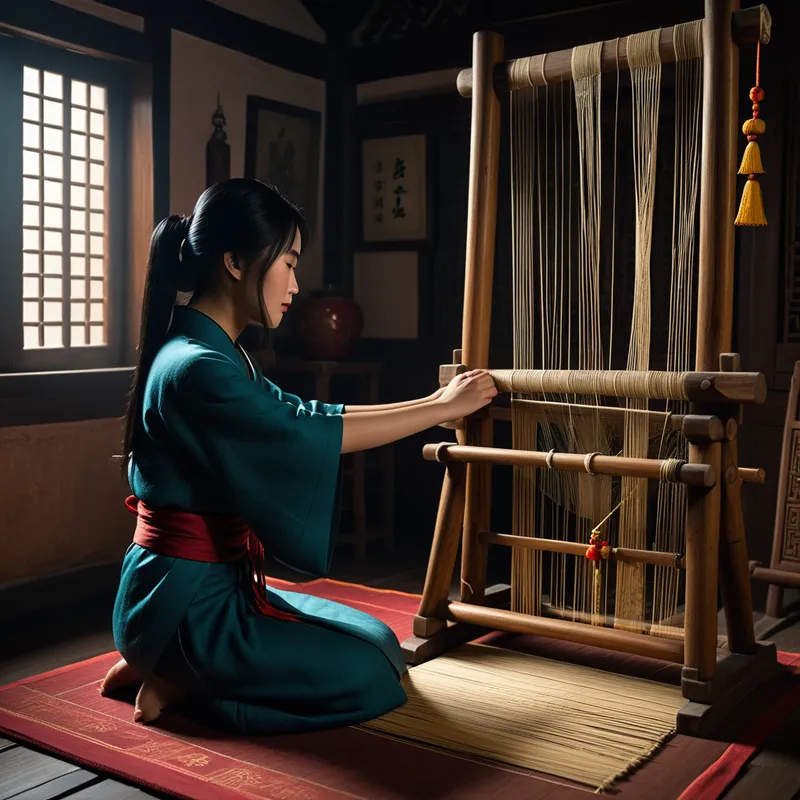
Listen, and hear a tale not of gods on high mountains, but of a human heart in a humble home. The air is thick with the scent of mulberry leaves and the soft, relentless clack-clack-clack of the loom. Here sits Hua Mulan, her fingers flying, yet her spirit is far from the shuttle and thread. The sound that fills the house is not of weaving, but of her father’s sigh—a ragged, painful thing that speaks of old wounds and a body bent by time. Outside, the imperial conscription notices have been nailed to the village gate. One bears her family name.
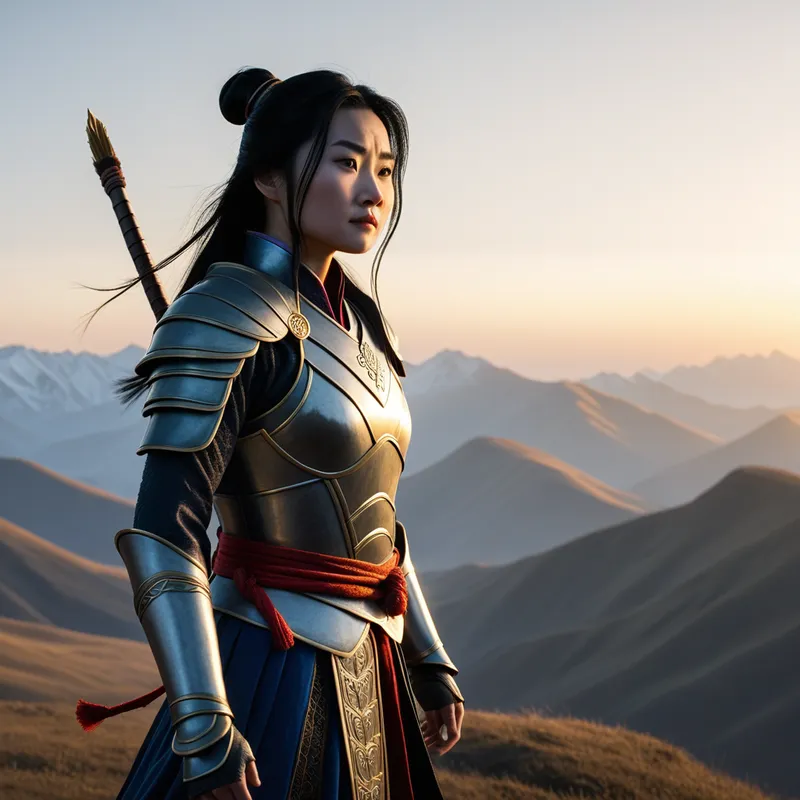
That night, under a moon like a sliver of cold jade, a decision crystallizes in the silent dark. No heavenly mandate, no ghostly visitation—just the fierce, quiet love of a daughter. Before the rooster crows, she is in the marketplace. A fine steed, a sturdy saddle. In her father’s chamber, she takes the armor that smells of dust and memory. The sword is heavy in a hand used to holding a needle. With shears, she cuts her long, dark hair. The strands fall silently to the earthen floor. When she looks into the bronze mirror, a stranger—a young man—looks back.
For twelve long years, she is that stranger. She becomes Hua Hu, a soldier among thousands. The North wind is a knife on the Yellow River sands; the cold seeps into bone. She learns the language of the campfire and the battle cry, the weight of a comrade falling beside her. She fights not for glory, but for survival and the promise of home. Through blood and ice, through seasons that turn without ceremony, she guards her secret as closely as her life. Her excellence in battle becomes legend among her fellows, a testament to the “son” of the Hua family.
Victory, when it comes, is a hollow echo in a field of silence. The Khan himself offers high office, treasures beyond counting. The warrior kneels but asks for none of it. “I have no need for a minister’s post,” the disguised voice says. “Only a swift horse, to carry me back to my family.”
The journey home is a shedding of skin. The familiar village path, the courtyard wall. Her parents, older, frailer, rush out, supported by each other. Her sister dons her finest robes; her brother sharpens the knife for the celebratory pig. In her old room, she removes the armor plate by plate. She washes the grime of war from her body, lets her hair, grown long again, fall free. She dons the old skirt and jacket, applies the yellow flower to her forehead.
When she emerges to greet her former comrades, who have come to visit the famed “Hua Hu,” they stare in stunned silence. The warrior they drank and bled with stands before them as a woman, graceful and smiling. “How can this be?” they gasp. For twelve years, marching and sleeping side by side, they never knew. The poem ends with a simple, profound truth: “The male hare has heavy front paws. The female hare has misty eyes. But when the two run side by side, who can tell me which is the male and which is the female?”
Cultural Origins & Context
The story of Mulan is a folk legend, not a state-sanctioned myth, born from the Northern and Southern Dynasties (4th to 6th centuries CE). It first appears as a ballad, the “Ballad of Mulan” (Mulan Shi), within an anthology of yuefu—folk songs and poems collected by the music bureau. This origin is crucial: it is a story from and for the people, circulating orally before being inscribed.
Its societal function was multifaceted. In a Confucian patriarchal society with strict gender roles and a deep value of xiao (filial piety), Mulan’s tale presented a breathtaking paradox. She upholds the highest virtue—sacrificing herself for her father—by transgressing the most fundamental social boundary: gender. The story served as a safe container to explore this tension, celebrating filial devotion so utterly complete it could shatter convention, while ultimately restoring order through her return to domestic life. It was a narrative salve for the countless families torn apart by the constant frontier wars of the era, offering a fantasy of agency, survival, and triumphant homecoming.
Symbolic Architecture
At its core, Mulan is not a story about becoming a man, but about transcending the limitations of persona—the social mask we all wear—to touch a deeper layer of Self. The armor is her first persona: the dutiful son/warrior. But beneath it, she must integrate the very qualities her culture splits apart.
The journey to wholeness requires us to wear a disguise that reveals our true face.
Her act symbolizes the integration of animus and anima. In Jungian terms, the animus (logical, strategic, assertive) and the anima (relational, nurturing, intuitive) are contrasexual inner figures. Mulan’s conscious identification with her feminine, filial love (anima) drives her to consciously embody and develop her animus (the warrior) to an extraordinary degree. The battlefield is the crucible where these opposites—strength and compassion, strategy and sacrifice—are forged into a unified capability.
The loom, from which she rises, and the home, to which she returns, are symbols of the Self. Her journey is circular, not linear. She leaves not to conquer a kingdom, but to preserve the sacred center (home/family). Her ultimate triumph is not military victory, but her ability to return, to reassume her place, now knowing she is more than any single role society assigns.

The Dreamer’s Resonance
When the pattern of Mulan’s myth stirs in the modern dreamer, it signals a profound psychological pressure to step into a role for which one feels fundamentally unprepared or “disguised.” One may dream of wearing another’s uniform, speaking in a voice not their own, or hiding a vital secret in a group setting.
Somatically, this can feel like a constant, low-grade tension in the body—the armoring of the true self. Psychologically, it is the process of carrying a burden (a family expectation, a professional demand, a personal responsibility) that feels too heavy, yet must be borne out of love or duty. The dreamer is in the “twelve-year campaign,” a long, grinding phase of life where authenticity is suspended for the sake of a greater goal. The dream may highlight the exhaustion of maintaining the disguise, or the poignant loneliness of being truly seen by no one.
Alchemical Translation
The alchemy of Mulan’s legend is the transmutation of obligation into authenticity, and sacrifice into sovereignty. The base metal is the raw, conflicted duty of the daughter. The fire is the crucible of war and disguise—the nigredo or darkening, where all previous identities dissolve in hardship.
The true gold forged is not public honor, but private wholeness—the earned knowledge that one’s essence is vaster than any category.
Her refusal of the Khan’s rewards is the critical separatio—the conscious separation from the inflated identity of the “hero.” She rejects the collective’s projection and reclaims her narrative. The return home and the change of clothes is the coniunctio oppositorum—the sacred marriage of opposites. The warrior and the weaver, the public and the private, the masculine and the feminine are united within one being. She does not abandon the strength gained on the battlefield; she brings it home. The final, transformed substance is a person who has navigated the extremes of human experience and returned to the center, not as she left it, but as a complete individual. Her individuation is complete not when she wins the war, but when she is able to stand before her comrades, in her full complexity, and reveal, “This too, is me.”
Associated Symbols
Explore related symbols from the CaleaDream lexicon: