
The Legend of Lohi'au Myth Meaning & Symbolism
A mortal chief's love for the volcano goddess Pele leads him through death and resurrection, guided by the hula goddess Hiʻiaka.
The Tale of The Legend of Lohi’au
Listen, and let the scent of salt and plumeria carry you to the time when the earth was still singing its first songs. On the mist-wrapped cliffs of Kauaʻi, where the green mountains plunge into the thunderous sea, there lived a chief named Lohiʻau. He was not just a man of noble blood, but a man whose spirit was a finely struted ʻukulele, whose voice could calm the wild waves and whose dance, the hula, could make the flowers turn their faces to him.
One night, as the moon painted a silver path on the black water, a sound drifted across the channel—a sound of distant, mesmerizing drumbeats and a voice of impossible sweetness. It was the voice of Pele, the creator and destroyer, she who shapes the land with her fiery breath. Traveling in her spirit form, her kino lau, her essence was drawn to the beauty of Lohiʻau’s dance. She appeared to him not as a goddess of terror, but as a woman of breathtaking beauty, and in that single night, a love as fierce and sudden as a lava flow consumed them both.
But dawn is a divider of realms. Pele, bound to her fiery body in the pit of Kīlauea on distant Hawaiʻi Island, was compelled to return. Her parting was a tearing of the soul. Lohiʻau, his heart now a hollow drum without its rhythm, could not bear the separation. The memory of her was a fire he could not quench, and in his despair, he took his own life, his spirit fleeing to the dark shores of Milu.
The world grew dim for Pele. Her fires burned cold with a grief that steamed and hissed. She could not journey to the land of the dead herself, for her presence would scorch the very path. So she turned to her most beloved sister, Hiʻiakaikapoliopele—Hiʻiaka in the bosom of Pele. “Go,” Pele commanded, her voice like cracking stone. “Go to Kauaʻi, revive Lohiʻau, and bring him to me. You have forty days. But touch him not as a lover, or you will know my wrath.”
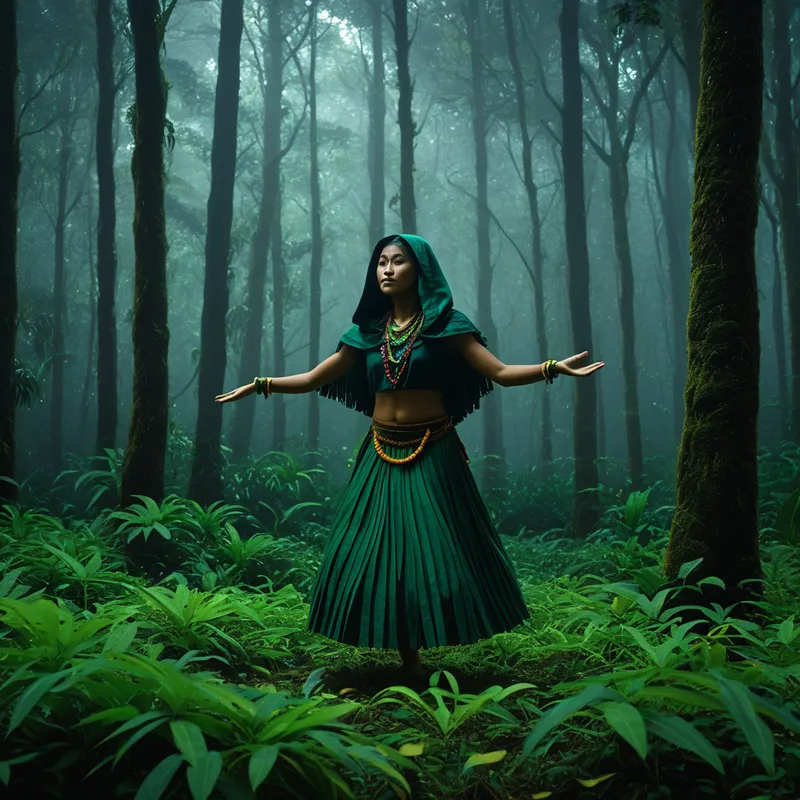
Hiʻiaka, cloaked not in fire but in the verdant power of the forest, agreed, for her love for her sister was deep. Her journey was an epic of its own, facing down vengeful moʻo (lizard guardians) and treacherous spirits with the power of her chants and her unwavering courage. She found Lohiʻau’s spirit in Milu, a shadow among shadows. With potent oli and life-giving breath, ha, she wrested him back from the clutches of death, restoring his body from the bones.
Their return journey was a slow re-kindling. Hiʻiaka, witnessing Lohiʻau’s nobility and grace, found her own heart stirring—a forbidden flower blooming in the volcanic ash. They were delayed, and the forty days passed. Pele, in her jealous fury, imagining betrayal, unleashed her fire, scorching Hiʻiaka’s beloved lehua groves and killing Hiʻiaka’s dear friend Hopoe.
Hiʻiaka, arriving at the crater’s edge with Lohiʻau, witnessed the destruction. A cold fury, different from her sister’s heat, settled in her heart. In defiance, and perhaps in genuine love, she embraced Lohiʻau before Pele’s very eyes. The volcano erupted in cataclysm. In some tellings, Pele’s rage consumed Lohiʻau, turning him to stone. In others, he was spared, but the triangle of love, duty, and betrayal was forever seared into the landscape. Hiʻiaka and Pele were reconciled, but the cost was etched in burned forests and a love that could not live in the mortal world. Lohiʻau remained, a testament to the human heart that dared to love a force of nature.
Cultural Origins & Context
This epic, known as the Hiʻiakaikapoliopele cycle, is one of the great foundational narratives of Hawaiian culture. It was not merely a story but a kapu tradition, passed down through generations of trained chanters (kumu hula and kahuna). Its recitation was a sacred act, a weaving of history, genealogy, and spiritual instruction. The myth served as a cosmic map, explaining the origins of the hula (from Hiʻiaka), the specific landscapes and place names (kaʻao) the sisters traversed, and the ever-present, volatile nature of the volcanic islands themselves. It functioned as a societal guide, exploring the tensions between uncompromising passion (Pele), steadfast duty and growth (Hiʻiaka), and mortal devotion (Lohiʻau).
Symbolic Architecture
At its core, the legend is a profound [allegory](/symbols/allegory “Symbol: A narrative device where characters, events, or settings represent abstract ideas or moral qualities, conveying deeper meanings through symbolic storytelling.”/) of the psyche’s [relationship](/symbols/relationship “Symbol: A representation of connections we have with others in our lives, often reflecting our emotional state.”/) with transformative, often destructive, [passion](/symbols/passion “Symbol: Intense emotional or physical desire, often linked to love, creativity, or purpose. Represents life force and deep engagement.”/). Pele is not a [character](/symbols/character “Symbol: Characters in dreams often signify different aspects of the dreamer’s personality or influences in their life.”/) but an archetypal force—the unstoppable, creative/destructive urge of the libido or [life](/symbols/life “Symbol: The symbol of ‘Life’ represents a journey of growth, interconnectedness, and existential meaning, encompassing both the joys and challenges that define human experience.”/) force itself. She is the fire in the belly, the inspiration that simultaneously enthralls and threatens to consume.
To love the fire is to accept the possibility of being burned to ash, and in that ash, finding the shape of a new self.
Lohiʻau represents the mortal ego, the individual [consciousness](/symbols/consciousness “Symbol: Consciousness represents the state of awareness and perception, encompassing thoughts, feelings, and experiences.”/) that encounters this overwhelming archetypal [energy](/symbols/energy “Symbol: Energy symbolizes vitality, motivation, and the drive that fuels actions and ambitions.”/). His initial “[death](/symbols/death “Symbol: Symbolizes transformation, endings, and new beginnings; often associated with fear of the unknown.”/)” is the inevitable [fate](/symbols/fate “Symbol: Fate represents the belief in predetermined outcomes, suggesting that some aspects of life are beyond human control.”/) of the ego that tries to possess or cling to such a force—it is annihilated. His [journey](/symbols/journey “Symbol: A journey in dreams typically signifies adventure, growth, or a significant life transition.”/) to Milu is a descent into the unconscious, a necessary pō ([night](/symbols/night “Symbol: Night often symbolizes the unconscious, mystery, and the unknown, representing the realm of dreams and intuition.”/)/darkness) of the [soul](/symbols/soul “Symbol: The soul represents the essence of a person, encompassing their spirit, identity, and connection to the universe.”/).
Hiʻiaka is the critical mediating principle. She is the transformative function—the psyche’s [capacity](/symbols/capacity “Symbol: A measure of one’s potential, limits, or ability to contain, process, or achieve something, often reflecting self-assessment or external demands.”/) for [ritual](/symbols/ritual “Symbol: Rituals signify structured, meaningful actions carried out regularly, reflecting cultural beliefs and emotional needs.”/), art ([hula](/symbols/hula “Symbol: Hula represents cultural expression and connection to tradition, often reflecting the dreamer’s relationship with storytelling and community.”/)), [medicine](/symbols/medicine “Symbol: Medicine symbolizes healing, transformation, and the pursuit of knowledge, addressing both physical and spiritual health.”/), and patient journeying. She is the one who can navigate the shadowlands (Milu) and restore life, not through raw force, but through sacred technique and compassionate [connection](/symbols/connection “Symbol: Connection symbolizes relationships, communication, and bonds among individuals.”/). Her love for Lohiʻau symbolizes the ego’s alignment with this mediating, life-giving principle, rather than with the raw, divine force directly—a crucial step in psychological [maturation](/symbols/maturation “Symbol: The process of developing toward a more advanced, complete, or effective state, often involving growth, learning, and integration of experiences.”/).

The Dreamer’s Resonance
When this myth stirs in the modern dreamer, it signals a profound encounter with the Pele-force within. Dreaming of a captivating, irresistible, yet terrifying lover may point to being “possessed” by a powerful complex or creative drive that feels divine in origin but threatens one’s stable identity (Lohiʻau’s despair). Dreams of journeying through dark, strange landscapes with a determined guide echo Hiʻiaka’s quest—the Self organizing a rescue mission for a part of the psyche that has been lost to depression, addiction, or despair (the land of Milu).
Somatically, this can feel like a burning in the chest, a restless energy, or a deep, melancholic hollowing—the physical echo of volcanic fire and spiritual absence. The psyche is enacting its own ritual of death and revival, demanding the dreamer find their “Hiʻiaka”—the therapeutic practice, artistic outlet, or disciplined path that can safely conduct this transformative energy.
Alchemical Translation
The legend models the complete alchemical cycle of psychic transmutation, or individuation. The prima materia is the naive ego (Lohiʻau) in its initial, enthralled state (nigredo). The encounter with Pele is the calcinatio—a reduction to ash by the fires of passion or crisis.
The descent into the underworld is not a defeat, but the soul’s necessary apprenticeship in darkness.
Hiʻiaka’s journey is the laborious ablutio and albedo, purifying and spiritualizing the material. Her revival of Lohiʻau is the coniunctio of the once-mortal ego with the transformative, mediating principle of the soul. The final confrontation at the crater represents the rubedo—the ultimate, often fiery integration. The old, possessive relationship with the divine force (Pele’s demand) dies, but a new, more conscious relationship is forged, even if it is one of respectful distance. The individual is no longer consumed by the inner fire but has learned to tend it, respect its power, and channel it through the artful, life-affirming means Hiʻiaka embodies. One does not become the volcano, but one learns to live on its fertile, dangerous slopes.
Associated Symbols
Explore related symbols from the CaleaDream lexicon:
- Fire — Represents Pele’s raw, creative-destructive passion, the libidinal energy that both forges and incinerates the structures of the self.
- Journey — The central motif of Hiʻiaka’s epic quest, symbolizing the long, arduous, and necessary process of psychological retrieval and integration.
- Death — Lohiʻau’s fate signifies the essential death of the naive ego that must occur before a more conscious self can be resurrected.
- Rebirth — Embodied in Hiʻiaka’s revival of Lohiʻau, representing the psyche’s miraculous capacity to restore life to what was thought lost in the unconscious.
- Love — The triple-force that drives the myth: possessive, divine love (Pele); compassionate, mediating love (Hiʻiaka); and devoted, mortal love (Lohiʻau).
- Ocean — The vast, separating channel between Kauaʻi and Hawaiʻi, representing the great divide between the mortal realm and the realm of archetypal forces.
- Dance — The sacred hula, born from this myth, symbolizes the ritualized, artful expression of deep forces that cannot be contained in ordinary speech.
- Forest — Hiʻiaka’s domain, representing the lush, growing, mediating realm of the soul that stands between the raw earth (Pele) and the human world.
- Spirit — The uhane or ʻuhane, the spirit that travels, loves, and is rescued from Milu, representing the essential core of identity that survives transformation.
- Sacrifice — The cost of transformation: Lohiʻau’s life, Hiʻiaka’s obedience and loss, Pele’s peace—all are offered up in the alchemical process.
- Healing — Hiʻiaka’s primary function as a goddess of medicine, performing the ultimate healing by restoring life from death through chant and breath.