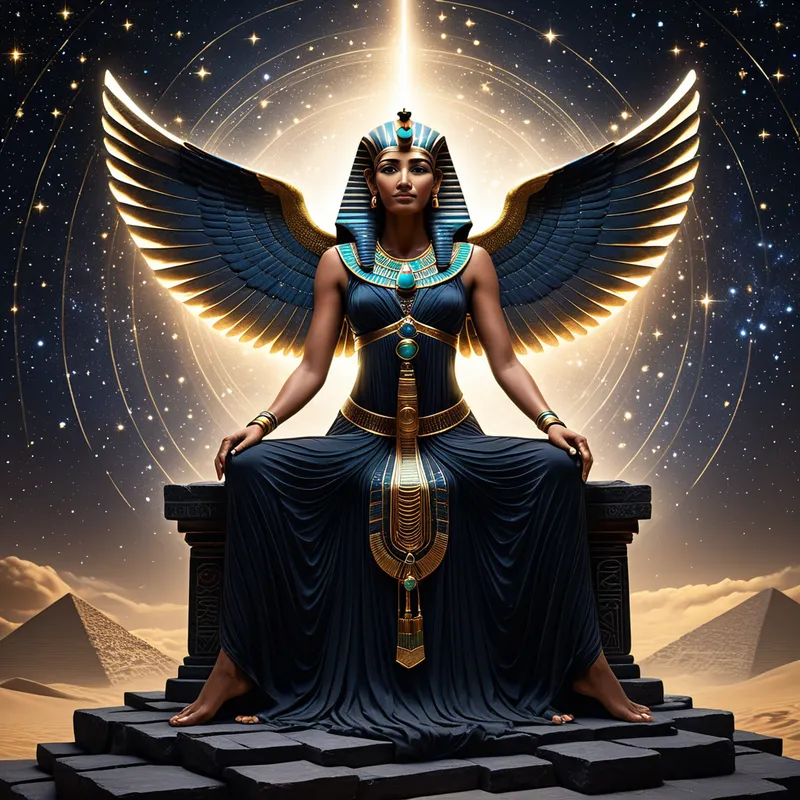
The lap of Isis in Egyptian my Myth Meaning & Symbolism
A myth of divine reassembly where the fragmented self is gathered, mourned, and restored through the sacred, containing embrace of the Goddess.
The Tale of The lap of Isis in Egyptian my
Hear now a tale woven from the silence before dawn, a story not of a single battle, but of a gathering. The world was young in its grief. The green life along the Nile trembled, for the sun, the great Osiris, had been cast down. Tricked, betrayed, dismembered, his divine body was scattered like forgotten seeds across the black soil of the Two Lands. His light was extinguished, his voice silenced in the hall of the living. Despair, a cold wind, blew through the reeds.
But where there is scattering, there is also a force that gathers. She is Isis, the throne herself, she whose name means seat of power. With a cry that was both a lament and a summoning, she cast off her royal diadem and became a kite, a bird of piercing sorrow and sharper sight. Her sister, Nephthys, became her shadow, her echo in the search.
Their journey was not across maps, but through the anatomy of loss. They waded into the delta’s murky embrace, where the finger of the god had been thrown. Isis did not grasp with fury, but with the reverence of a midwife. She lifted it from the mud, cradled it in her palm, and her tears were not of weakness, but of recognition—a sacred anointing. To the western desert, where the heat-haze danced over the limb buried in the sand. To the deep river, where the current had carried an inner part. To the barren wadi, the lush field, the lonely cliff.
For each fragment, a ritual of finding. Not a reclaiming of property, but a restoration of relationship. Her lap, the fold of her skirt, became the first and most sacred temple. It was not a passive receptacle, but an active, containing space—a living heka of flesh and devotion. Here, the piece of arm learned it was connected to a shoulder. The fragment of heart remembered its beat. In her lap, the scattered learned they were once a whole.
And when the last piece was gathered—all but one, the vital seed, lost to the fish of the Nile—she did not despair. With Nephthys as her shield, with the magic of the great Thoth and the strength of the jackal-headed Anubis, she enacted the ultimate spell. She fanned the air with her great wings, the breath of life and the breath of magic becoming one. She hovered over the reassembled form, and from the memory of wholeness in her own being, from the love held in the vessel of her lap, she called forth a new breath.
Osiris stirred. Not to walk the earth again in daylight, but to rise complete, sovereign in the kingdom of the night. The sun had set, but it was not destroyed; it was translated. And from their sacred union, conceived in the space between death and resurrection, the new sun, Horus, was born—in her lap. The circle closed. The seat of power had become the cradle of the future.

Cultural Origins & Context
This is the core narrative of the Osirian cycle, the most profound and enduring mythic complex in ancient Egyptian religion. It was not a single “story” told from beginning to end for entertainment, but a living, ritual reality embedded in the very fabric of kingship, agriculture, and the soul’s journey. The tale was enacted in temple mysteries, alluded to in funerary texts like the Book of the Dead, and was the theological bedrock for the pharaoh’s identity as the living Horus, son of the resurrected Osiris.
The “lap of Isis” is both a literal and supremely symbolic image. It represents the function of the goddess as the essential container for the process of cosmic and personal restoration. This myth provided the script for the most critical human passage: death. It assured the individual that fragmentation was not the end, that a divine, maternal principle existed whose purpose was to seek, recognize, and reconstitute the essence of the being. It was a myth told by priests to the god-king, by mothers to children, and by the culture to itself, to make meaning of the Nile’s annual flood (Osiris’s death) and rebirth (the new crop), and of the human hope for coherence beyond the grave.
Symbolic Architecture
At its heart, this myth is not about physical resurrection, but about the psychology of integration. Osiris represents the fragmented Self—the psyche shattered by trauma, betrayal, or the sheer entropy of life’s experiences. He is the principle of order and consciousness that has been dismantled.
The lap is not a place of rest, but the active, holding matrix where dissociation ends and relationship begins.
Isis is the archetypal function of the containing consciousness. She is not the “savior” who does the work for the fragmented one, but the necessary, attentive presence that makes reassembly possible. Her search is the work of recollection—literally, re-collecting the lost parts of the soul. Each tear she sheds is an act of valuation, stating that this lost piece matters. Her magic (heka) is the focused intention of love and memory, which alone can re-animate a structure that has been broken. The missing phallus, swallowed by the fish, signifies the irreversible loss that must be integrated into the new wholeness; the restored Osiris is king of the Duat, the underworld, meaning the integrated Self rules the inner, unconscious realm, not the outer world of the persona.
The Dreamer’s Resonance
When this myth stirs in the modern dreamer, it signals a profound process of psychic reassembly. One may dream of gathering pieces—of a broken vase, a scattered document, a dismembered toy. The setting is often liminal: shorelines, attics, foggy streets, representing the borderlands of conscious awareness.
The somatic experience is crucial. The dreamer may feel a deep, almost gravitational pull towards collecting these fragments, accompanied by a bittersweet pang of grief or nostalgia. This is the Isis-function activating within the psyche. The dream may feature a nurturing, often silent feminine presence (not necessarily a person, it could be a room, a pool of light, a particular quality of silence) that holds the activity without interfering. This is the “lap.” The conflict in such dreams is rarely a monster, but the overwhelming scale of the scattering, the fear that a vital piece is lost forever. To dream this is to be in the midst of the search, your own psyche initiating the slow, painful, sacred work of making yourself whole again after a shattering.

Alchemical Translation
The alchemical parallel is the stage of nigredo—the black, chaotic dissolution of the old, rigid form. Osiris in the coffin is the prima materia subjected to disintegration. Isis’s search is the albedo, the washing and purifying of each separated part. Her lap is the alchemical vessel, the vas hermeticum, where the impossible reunion occurs.
Individuation is the process of becoming your own Isis for your own scattered Osiris—developing the capacity to hold your fragments in compassionate awareness until they re-member their connection.
For the modern individual, the myth models the path from trauma to sovereignty. We are all, in some way, scattered Osiris-figures, our wholeness compromised by life’s betrayals and losses. The “work” is to cultivate the Isis within: the patient, seeking, mourning, magically intentional aspect of consciousness that refuses to let any part of the self be abandoned as worthless. It teaches that healing is not an erasure of wounds, but a sacred reassembly where the scars become the seams of a new, more resilient integrity. The final product is not a return to a naive, previous state, but the birth of Horus—the conscious, embodied Self (the “child” of the union between our enduring essence and our containing awareness), capable of engaging the world from a place of redeemed wholeness. We do not avoid the underworld; we learn to rule it from a throne rebuilt in the lap of our own compassion.
Associated Symbols
Explore related symbols from the CaleaDream lexicon: