The Lantern Festival Myth Meaning & Symbolism
A mortal's act of defiance against a vengeful sky god saves humanity, commemorated by the release of lanterns into the night.
The Tale of The Lantern Festival
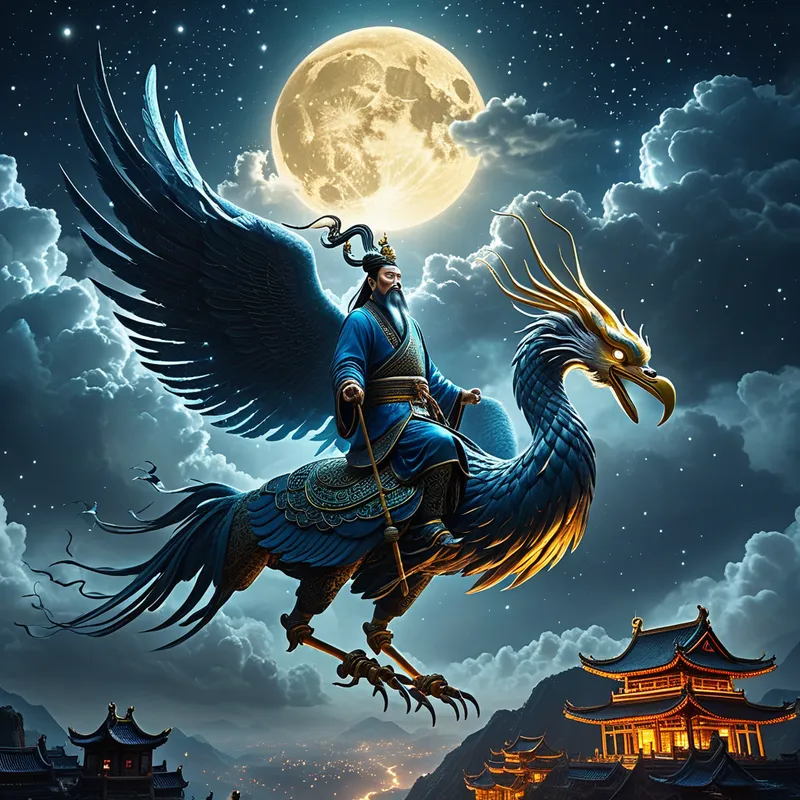
Hear now a tale from when the vault of heaven was closer to [the earth](/myths/the-earth “Myth from Hindu culture.”/), and the whims of the gods were as immediate as the changing wind. In those days, there was a [Jade Emperor](/myths/jade-emperor “Myth from Chinese culture.”/), ruler of all under [the sky](/myths/the-sky “Myth from Persian culture.”/), whose heart was as vast as the cosmos but whose temper could be as sharp as winter’s first frost. He dwelled in a palace of moon-[pearl](/myths/pearl “Myth from Chinese culture.”/) and sun-gold, attended by spirits of cloud and star.
All was in celestial harmony until a fateful day when his most beloved, a creature of pure light and grace—some say a crane, others a [phoenix](/myths/phoenix “Myth from Egyptian culture.”/)—ventured too far from the heavenly gardens. It descended to the mortal world, drawn by the vibrant chaos of human life. But [the world](/myths/the-world “Myth from Tarot culture.”/) of men was not kind to divine things. A foolish hunter, seeing only rare plumage, let fly an arrow. The celestial bird fell, its light guttering out on the cold, uncomprehending earth.
When the news reached the high palace, a silence fell that was colder than [the void](/myths/the-void “Myth from Buddhist culture.”/) between stars. The Jade Emperor’s grief curdled into a wrath that shook the pillars of heaven. He would scourge the earth. On the fifteenth day of the first lunar month, he declared, he would send a legion of fire shen to descend from the sky. Their task: to set every village, every field, every last hovel of ungrateful humanity ablaze. The world would burn for its transgression.
In a small village at the foot of a mist-wrapped mountain, the decree was heard as a whisper on [the wind](/myths/the-wind “Myth from Various culture.”/), a creeping dread that stilled the New Year’s joy. Panic, thick and sour, filled every home. All seemed lost. But in this village lived a humble, quick-witted old gardener. While others wailed, he sat in his modest hut, watching the last embers of his hearth fire dance. He saw not just destruction in the emperor’s plan, but a pattern, a celestial logic bound by heavenly law.
On the night of the promised doom, as a blood-red sun sank behind the mountains, he gathered the terrified villagers. “The fire shen,” he said, his voice quiet but firm, “are servants of order. They will come for our homes, for the structures of wood and thatch. But they are born of heaven’s command. What if we give heaven a different sight to behold?”
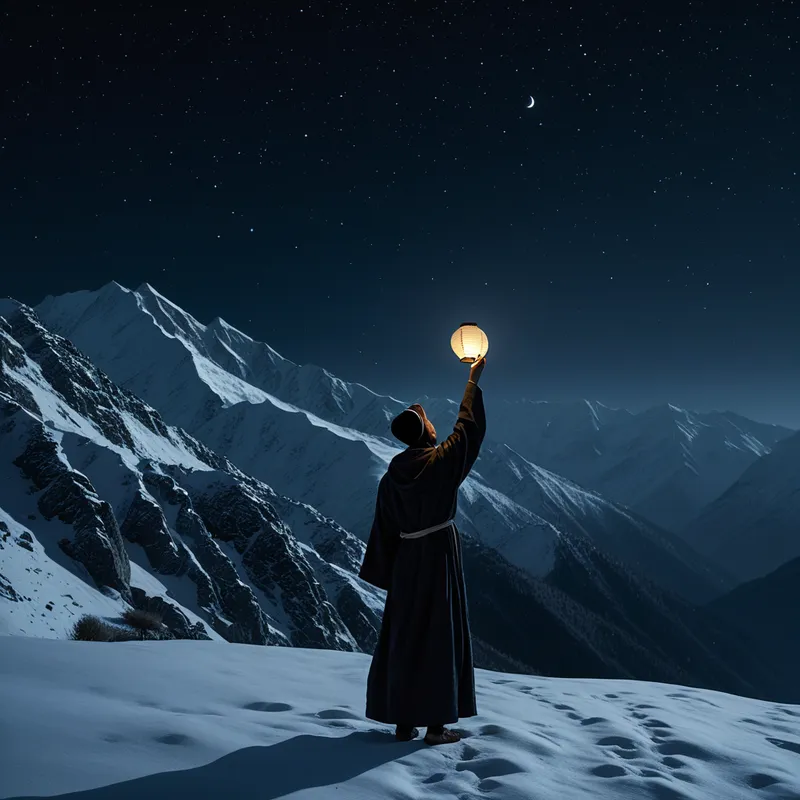
He bid every family to bring forth all they had: oil, cloth, bamboo, paper. Through the deepening twilight, the village worked as one. They did not build barricades. They crafted lanterns. Hundreds of them. From simple cups holding a wick to elaborate paper spheres painted with lucky symbols. As the sky deepened to an ominous black, the old man gave the order. All fires in hearths and stoves were extinguished. Every door was flung open. And into the vast, expectant darkness, they lit their countless lanterns and placed them outside, on walls, in trees, upon the frozen river.
The village vanished, swallowed by the night. In its place was a galaxy of gentle, man-made stars resting upon the earth. Then, a rumble in the sky. The fire shen descended, a wave of crimson heat and fury. They looked down, ready to unleash their celestial flames. But they saw no village. They saw only a breathtaking, shimmering field of light mirroring their own heavenly home. Confused, they circled. This was not a target; this was an offering, a tribute of brilliance. Believing the mortal world was already ablaze with a glorious, self-made fire, they turned their steeds and ascended back to the heavens, their duty fulfilled.
When dawn’s first light finally touched the earth, the villagers emerged. Their homes stood untouched. The air was cold and clean, smelling of spent wax and hope. They had faced the wrath of heaven not with a sword, but with a spark. Not with defiance, but with dazzling imitation. And so, every year since, on that same night, lanterns are raised to the sky—not in fear, but in remembrance of the light that outwitted darkness, and the cleverness that turned annihilation into celebration.
Cultural Origins & Context
The myth of the Lantern Festival’s origin is a folk narrative, one of several that explain the Shangyuan Festival. Unlike state-sanctioned histories, this tale was carried on the breath of grandmothers and the lips of traveling storytellers in village squares. It served a profound societal function beyond mere entertainment. In a culture deeply interwoven with celestial cycles and ancestor veneration, the story explained a potentially terrifying celestial event (a sky-god’s wrath) and transformed it into a ritual of communal safety and control.
The tale legitimized the festival’s practices—lighting lanterns, being outdoors at night—by rooting them in a foundational act of survival. It taught that human ingenuity (zhi hui) could harmonize with, and even redirect, celestial forces (tian yi). The story was told during the festival itself, making the participants not just observers, but re-enactors of a sacred, saving drama. It reinforced social cohesion, showing that salvation came not from a lone hero, but from a collective following a wise plan.
Symbolic Architecture
At its [heart](/symbols/heart “Symbol: The heart symbolizes love, emotion, and the core of one’s existence, representing deep connections with others and self.”/), this is a myth about the [psyche](/myths/psyche “Myth from Greek culture.”/) confronting an annihilating, absolute [authority](/symbols/authority “Symbol: A symbol representing power structures, rules, and control, often reflecting one’s relationship with societal or personal governance.”/)—the unconscious rage of the [Senex](/symbols/senex “Symbol: The wise old man archetype representing spiritual authority, ancestral wisdom, and the integration of life experience into transcendent knowledge.”/) or [Father](/symbols/father “Symbol: The father figure in dreams often symbolizes authority, protection, guidance, and the quest for approval or validation.”/) [archetype](/symbols/archetype “Symbol: A universal, primordial pattern or prototype in the collective unconscious that shapes human experience, behavior, and creative expression.”/), which can become tyrannical when its attachments are wounded. The celestial [bird](/symbols/bird “Symbol: Birds symbolize freedom, perspective, and the connection between the earthly and spiritual realms, often representing the soul’s aspirations or personal growth.”/) represents a transcendent value or [beauty](/symbols/beauty “Symbol: This symbol embodies aesthetics, harmony, and the appreciation of life’s finer qualities.”/) that the immature ego ([the hunter](/myths/the-hunter “Myth from African culture.”/)) destroys through ignorance, invoking a catastrophic psychic [reaction](/symbols/reaction “Symbol: A reaction in a dream signifies the subconscious emotional responses to situations we face, often revealing our coping mechanisms and fears.”/).
The lantern is not a shield, but a mirror. It does not fight the god’s fire; it reflects the god’s own nature back to him, revealing a hidden unity.
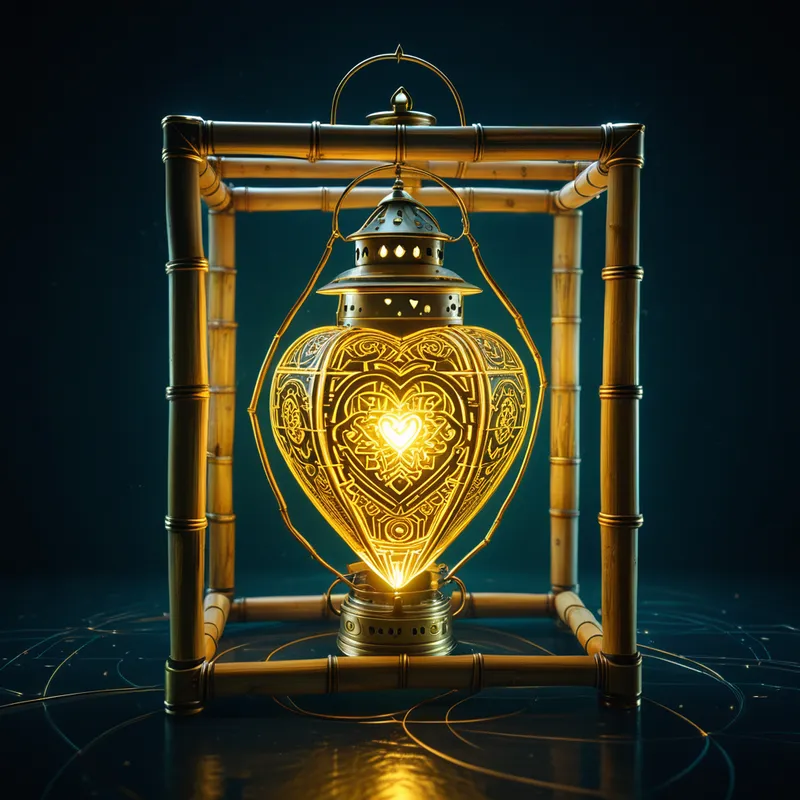
The [village](/symbols/village “Symbol: Symbolizes community, connection, and a reflection of one’s roots or origins.”/)’s [solution](/symbols/solution “Symbol: A solution symbolizes resolution, clarity, and the overcoming of obstacles, often representing a sense of accomplishment.”/) is a masterpiece of symbolic intelligence. Extinguishing the [interior](/symbols/interior “Symbol: The interior symbolizes one’s inner self, thoughts, and emotions, often reflecting personal growth, vulnerabilities, and secrets.”/) hearth fires represents a voluntary ego-surrender, a quenching of the small, personal self. Opening all the doors signifies radical openness and [vulnerability](/symbols/vulnerability “Symbol: A state of emotional or physical exposure, often involving risk of harm, that reveals authentic self beneath protective layers.”/). The lanterns themselves are profound symbols: fragile, temporary vessels (the [body](/symbols/body “Symbol: The body in dreams often symbolizes the dreamer’s self-identity, personal health, and the relationship they have with their physical existence.”/), the individual [life](/symbols/life “Symbol: The symbol of ‘Life’ represents a journey of growth, interconnectedness, and existential meaning, encompassing both the joys and challenges that define human experience.”/)) containing a borrowed, fleeting flame ([consciousness](/symbols/consciousness “Symbol: Consciousness represents the state of awareness and perception, encompassing thoughts, feelings, and experiences.”/), [spirit](/symbols/spirit “Symbol: Spirit symbolizes the essence of life, vitality, and the spiritual journey of the individual.”/)). By massing them together, they create an illusion of a greater, unified consciousness—a [vision](/symbols/vision “Symbol: Vision reflects perception, insight, and clarity — often signifying the ability to foresee or understand deeper truths.”/) of [the Self](/myths/the-self “Myth from Jungian culture.”/) that the punitive father-god recognizes as his own kin, and thus spares.
The old gardener is the archetypal Senex** in its positive [aspect](/symbols/aspect “Symbol: A distinct feature, quality, or perspective of something, often representing a partial view of a larger whole.”/): not the raging ruler, but the wise elder whose [insight](/symbols/insight “Symbol: A sudden, deep understanding of a complex situation or truth, often arriving unexpectedly and illuminating hidden connections.”/) comes from observing natural patterns. He understands the [logic](/symbols/logic “Symbol: The principle of reasoning and rational thought, often representing order, structure, and intellectual clarity in dreams.”/) of the [realm](/symbols/realm “Symbol: The symbol of ‘Realm’ often signifies the boundaries of one’s consciousness, experiences, or emotional states, suggesting aspects of reality that are either explored or ignored.”/) he is in, and works within its laws to transform the [situation](/symbols/situation “Symbol: The ‘situation’ symbolizes the junction between the subconscious and conscious realms, often reflecting the current challenges or dynamics in the dreamer’s waking life.”/).
The Dreamer’s Resonance
When this mythic pattern stirs in the modern dreamer, it often manifests as dreams of impending, inescapable doom—a wildfire, a flood, a descending army. The dream ego feels small, helpless, and guilty. This is the psyche’s experience of a profound inner crisis, where an old, ruling complex (a rigid inner critic, a crushing parental introject, a dogma) has been “wounded” by some new awareness or life choice, and is now threatening to burn down the entire psychic landscape in retaliation.
The somatic feeling is one of paralysis and dread in the chest and gut. Psychologically, the dreamer is at the precipice where depression or explosive anger seem like the only outcomes. The myth signals that the solution does not lie in direct confrontation (which would be psychic civil war) nor in abject submission (which would be annihilation of the new). The dream is presenting the necessity for a symbolic act—a creative, indirect response that speaks the language of the very force that threatens you.

Alchemical Translation
The process modeled here is the alchemical coniunctio—not of lovers, but of the mortal and the divine, [the ego](/myths/the-ego “Myth from Jungian culture.”/) and the tyrannical archetype. The psychic transmutation occurs in three stages.
First, the Sacrifice of the Old Identity (Extinguishing [the Hearth](/myths/the-hearth “Myth from Norse culture.”/)): The ego must willingly let go of its habitual, defensive structures—its “home fires.” This is a conscious surrender, a move into a cold, dark, and unknown interior space.
Second, the Crafting of the Symbol (Making the Lanterns): From the raw materials of one’s life (memories, talents, wounds, hopes), one must fashion a vessel for consciousness that is both true to oneself and recognizable to the opposing force. This is the work of active imagination, art, or deep reflection—creating an image that holds the tension.
Individuation often requires us to fool the gods within us, to show the raging father the face of the son he cannot destroy, because it is his own reflection.
Finally, the Illuminated Display (Raising the Lanterns): This is the act of “showing your work” to the psyche. It is the courageous, vulnerable exposure of this new symbolic attitude. One places their fragile, illuminated truth outside in the dark. The miracle is that when the punitive complex sees its own nature reflected in this carefully crafted light, its energy is re-contained. It is not defeated; it is recognized, and in recognizing, its destructive intent is transformed. The fire of wrath becomes the fire of illumination. What sought to annihilate now stands as a witnessed part of the whole. The festival that follows is the joy of a psyche that has passed through its own potential annihilation and found, in cleverness and collective courage, a new and more luminous order.
Associated Symbols
Explore related symbols from the CaleaDream lexicon: