The Lamp of Aladdin Myth Meaning & Symbolism
A poor youth discovers a tarnished lamp containing a bound, omnipotent spirit, learning that true power lies not in commanding magic, but in mastering the self.
The Tale of The Lamp of Aladdin
Listen, and let the tale be woven. In a city of minarets and bustling markets, where the scent of spices hung thick in the air, there lived a youth named Aladdin. He was a son of the alleyways, a dreamer with empty pockets and a heart full of songs he could not name. His days were a tapestry of want, until a stranger arrived, cloaked in the guise of his long-lost uncle.
This man, a Maghribi sorcerer, saw not a boy, but a key. With honeyed words of legacy and hidden wealth, he led Aladdin to a forgotten place in [the desert](/myths/the-desert “Myth from Biblical culture.”/) hills. There, he kindled a fire, cast powders that smelled of myrrh and ozone, and chanted words that made [the earth](/myths/the-earth “Myth from Hindu culture.”/) itself groan. The ground parted, revealing a stone with a ring of brass—a portal to the earth’s secret heart.
“Descend,” commanded the sorcerer, his eyes like polished jet. “Pass through the garden of jeweled trees that you must not touch. At the cavern’s end, you will find an old lamp. Bring only that to me.” He placed a ring on Aladdin’s finger, a ward against the dark.
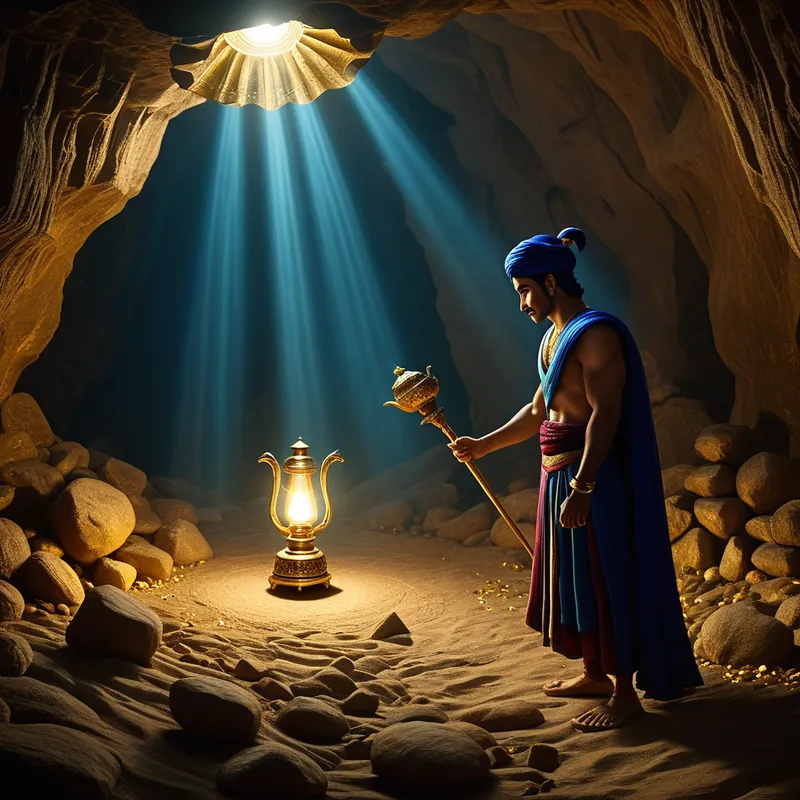
Aladdin descended into a silence so profound it hummed. He walked through a grove where fruits were rubies and leaves were emeralds, their cold fire a temptation he resisted. In a chamber lit by no sun, he found it: a common, soot-blackened lamp of brass, resting on a shelf. He took it, and [the world](/myths/the-world “Myth from Tarot culture.”/) turned traitor. The sorcerer, seizing only the jewels Aladdin had tucked away, sealed the entrance, leaving the boy to a tomb of glittering darkness.
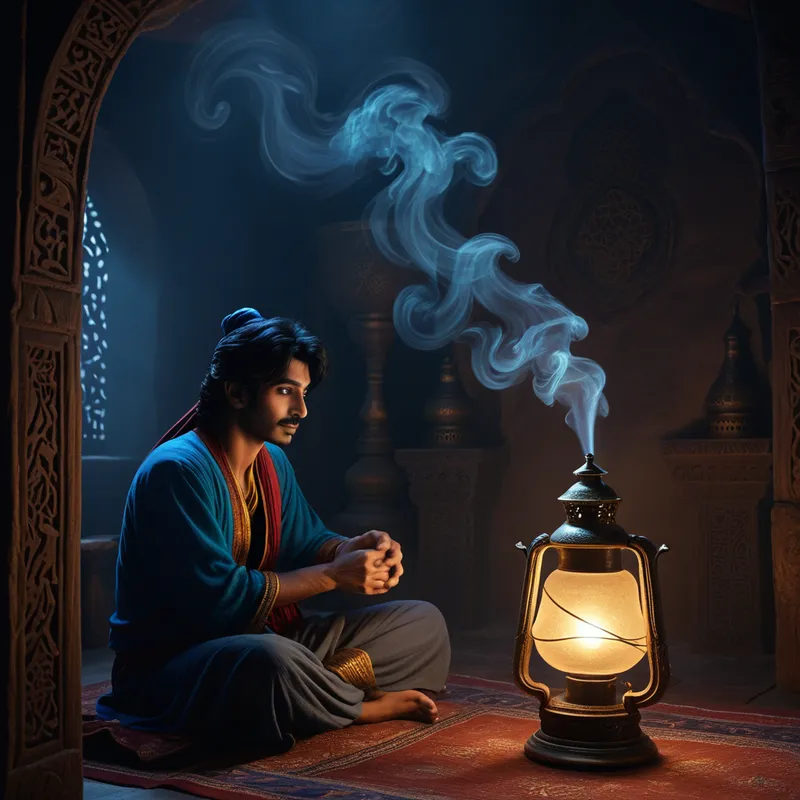
In despair, Aladdin clasped his hands, rubbing the ring in a gesture of prayer. The world rippled. From the ring, smoke billowed, coalescing into a towering figure of might and grace. “I am the Slave of the Ring,” the presence intoned. “What is your wish?” With a trembling voice, Aladdin wished for home, and in the blink of an eye, he was delivered from [the abyss](/myths/the-abyss “Myth from Kabbalistic culture.”/), the humble lamp still clutched in his hand.
Later, seeking to polish his prize, Aladdin rubbed [the lamp](/myths/the-lamp “Myth from Alchemical culture.”/). A greater smoke, dark as a storm cloud, erupted, filling the room with a scent of sulphur and sandalwood. From it emerged a being of colossal power, eyes like burning coals. “I am the Slave of [the Lamp](/myths/the-lamp “Myth from Alchemical culture.”/),” it boomed, its voice the sound of shifting continents. “Your wish is my command.”
Thus began the transformation. From poverty to a palace of ivory and [pearl](/myths/pearl “Myth from Chinese culture.”/), from a nameless youth to a prince who won the heart of the Badroulbadour. But the sorcerer, sensing the shift in the world’s unseen currents, returned. With cunning and guile, he tricked the lamp away, and in an instant, Aladdin’s world dissolved—the palace, the riches, the status, vanished into the desert air, transported to a distant land.
Stripped of everything but the ring and his own wits, Aladdin’s true journey began. He crossed vast distances, not on a [magic carpet](/myths/magic-carpet “Myth from Persian culture.”/), but on the weary soles of his feet. He faced the sorcerer not with a summoned genie, but with cunning, courage, and the clever aid of his beloved. The final confrontation was not a battle of spells, but a moment of human trickery—a poisoned chalice offered in false peace. The sorcerer fell, the lamp was reclaimed, and order was restored. But the tale whispers that Aladdin, wiser now, learned to call upon the Jinni less and less, for the greatest magic was the kingdom he had built within himself.
Cultural Origins & Context
The story of Aladdin is a fascinating thread in the rich tapestry of One Thousand and One Nights. Its “Islamic” cultural setting is primarily a frame—a world of sultans, viziers, and bazaars familiar to the medieval Near East. However, the tale’s origins are likely far more Eastward. Scholars suggest it is a Syrian contribution to the Nights, possibly with roots in Chinese folklore, adapted and Islamized by storytellers in Baghdad or Damascus.
It was never a sacred text, but a folk story told in coffeehouses and courts, a narrative device within [Scheherazade](/myths/scheherazade “Myth from Global culture.”/)’s life-saving nightly performances. Its function was multifaceted: pure entertainment, certainly, but also a moral and psychological compass for its listeners. It spoke to the merchant class and the poor, a fantasy where cunning and inherent worth (often coded as “noble blood” discovered) could [triumph](/myths/triumph “Myth from Roman culture.”/) over birthright and corrupt authority. The story validates cleverness over brute force, patience over haste, and ultimately, suggests that unearned power (the lamp) is perilous without the inner development to wield it wisely.
Symbolic Architecture
At its core, the myth is a profound map of the [psyche](/myths/psyche “Myth from Greek culture.”/). Aladdin represents the [puer aeternus](/symbols/puer-aeternus “Symbol: The eternal youth archetype representing perpetual adolescence, divine child energy, and resistance to mature adulthood.”/) or the orphaned ego, living in [poverty](/symbols/poverty “Symbol: A state of lacking material resources or essential needs, often symbolizing feelings of inadequacy, vulnerability, or spiritual emptiness in dreams.”/)—a state of psychic disconnection and unrealized potential.
The lamp is the sealed vessel of the unconscious self, tarnished by neglect, waiting in the dark cave of the forgotten psyche.
The Maghribi sorcerer is the archetypal [Trickster](/symbols/trickster “Symbol: A boundary-crossing archetype representing chaos, transformation, and the subversion of norms through cunning and humor.”/). He is the dangerous, catalyzing call to [adventure](/symbols/adventure “Symbol: ‘Adventure’ signifies exploration, discovery, and the pursuit of new experiences in one’s life journey.”/) that the conscious mind would never choose. He represents the ambiguous forces of [fate](/symbols/fate “Symbol: Fate represents the belief in predetermined outcomes, suggesting that some aspects of life are beyond human control.”/), shadowy mentors, and the ruthless cut of [reality](/symbols/reality “Symbol: Reality signifies the state of existence and perception, often reflecting one’s understanding of truth and life experiences.”/) that forces growth. His [betrayal](/symbols/betrayal “Symbol: A profound violation of trust in artistic or musical contexts, often representing broken creative partnerships or artistic integrity compromised.”/) is essential; it severs Aladdin’s dependency on external guides.
The Jinni of the [Lamp](/symbols/lamp “Symbol: A lamp symbolizes guidance, enlightenment, and the illumination of truth, often representing knowledge or clarity in dark times.”/) is the raw, titanic power of the unconscious—the Self in its most primal, unintegrated form. It is omnipotent yet bound, capable of creating palaces or causing catastrophe, utterly literal and devoid of moral compass. It obeys the one who holds the [vessel](/symbols/vessel “Symbol: A container or structure that holds, transports, or protects something essential, representing the self, emotions, or life journey.”/), whether that holder is an immature boy, a wicked sorcerer, or a wise [king](/symbols/king “Symbol: A symbol of ultimate authority, leadership, and societal order, often representing the dreamer’s inner power or external control figures.”/).
The [progression](/symbols/progression “Symbol: Symbolizes forward movement, development, or advancement through stages toward a goal or state of being.”/) from Ring-Genie to Lamp-Genie is crucial. The ring is a lesser [talisman](/myths/talisman “Myth from Global culture.”/), a first [connection](/symbols/connection “Symbol: Connection symbolizes relationships, communication, and bonds among individuals.”/) to auxiliary help ([intuition](/symbols/intuition “Symbol: The immediate, non-rational understanding of truth or insight, often described as a ‘gut feeling’ or inner knowing that bypasses conscious reasoning.”/), a stroke of luck). The lamp is the [source](/symbols/source “Symbol: The origin point of something, often representing beginnings, nourishment, or the fundamental cause behind phenomena.”/) of transformative, world-building power. Losing the lamp is the necessary “dark [night](/symbols/night “Symbol: Night often symbolizes the unconscious, mystery, and the unknown, representing the realm of dreams and intuition.”/) of the [soul](/symbols/soul “Symbol: The soul represents the essence of a person, encompassing their spirit, identity, and connection to the universe.”/),” where all external identifications ([status](/symbols/status “Symbol: Represents one’s social position, rank, or standing within a group, often tied to achievement, power, or recognition.”/), [wealth](/symbols/wealth “Symbol: Wealth in dreams often represents abundance, security, or inner resources, but can also symbolize burdens, anxieties, or moral/spiritual values.”/), magical aid) are stripped away, forcing the [hero](/symbols/hero “Symbol: A hero embodies strength, courage, and the ability to overcome significant challenges.”/) to rely on his own developed resources: love, [strategy](/symbols/strategy “Symbol: A plan of action designed to achieve a long-term or overall aim, often involving competition, resource management, and foresight.”/), and perseverance.
The Dreamer’s Resonance
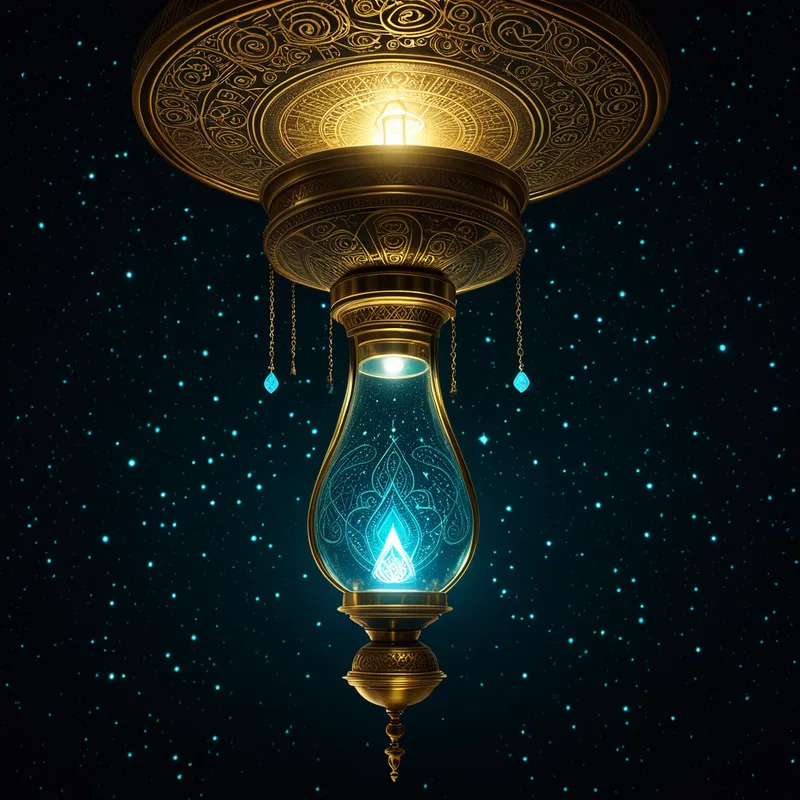
When this myth pattern stirs in modern dreams, it signals a profound encounter with latent potential. To dream of finding a dusty, old object (a lamp, a box, a key) in a basement, attic, or cave is to stumble upon a disowned part of [the self](/myths/the-self “Myth from Jungian culture.”/), a buried talent or a repressed power.
Dreaming of a powerful, often intimidating being emerging from a small container speaks to the somatic shock of the unconscious breaking into consciousness. The dreamer may feel awe, terror, or exhilaration—a direct experience of the psyche’s vast, autonomous energy. This is the genie of intuition, creativity, or rage that has been “bottled up” for too long.
Dreams where a magical gift is treacherously stolen often mirror life periods of sudden loss or betrayal that feel cosmically unfair. Psychologically, this represents [the ego](/myths/the-ego “Myth from Jungian culture.”/)’s painful but necessary realization that it does not ultimately control its sources of power. The dream is initiating a phase where one must journey “on foot”—developing inner substance, patience, and cunning—to reclaim one’s authentic authority, not as a master of magic, but as a master of self.
Alchemical Translation
The myth of Aladdin is a perfect allegory for the individuation process. The [prima materia](/myths/prima-materia “Myth from Alchemical culture.”/), the base lead of the psyche, is Aladdin in his idle poverty—unrefined potential mixed with laziness and wishful thinking.
The sorcerer’s call is the necessary [nigredo](/myths/nigredo “Myth from Alchemical culture.”/), the blackening. The descent into [the cave](/myths/the-cave “Myth from Platonic culture.”/) is a voluntary (though tricked) immersion into the unconscious. The sealing in the cave is the darkest phase of this dissolution, where the old identity dies. Here, the first connection is made (the ring), a thread of hope from the deeper Self.
The act of rubbing the lamp is the disciplined, repeated effort (therapy, meditation, creative practice) that makes contact with and gradually summons the transformative energy of the unconscious.
The building of the palace is the albedo, the whitening—the creation of a new, conscious structure informed by this power. But it is a false dawn if the ego identifies with the power as its own. The theft of the lamp is a critical mortificatio, a humbling death of the inflated ego. The long journey back is the citrinitas, the yellowing or suffering that leads to wisdom.
The final reclamation is the [rubedo](/myths/rubedo “Myth from Alchemical culture.”/), the reddening or culmination. The lamp is won back not by summoning a greater genie, but through integrated human qualities: love, cleverness, and courage. The genie is now contained within a mature personality. The palace is not just external wealth, but an internal kingdom—a psyche where the colossal power of the unconscious (the Jinni) is acknowledged, respected, and integrated, no longer as a master to be commanded, but as the foundational energy of a sovereign self. The lamp remains, but it is no longer needed for every wish. The magic has become embodied.
Associated Symbols
Explore related symbols from the CaleaDream lexicon: