
The Lady of the Lake Myth Meaning & Symbolism
A mysterious goddess of the deep waters grants the sword of sovereignty and demands its return, embodying the unconscious source of power and its sacred cycle.
The Tale of The Lady of the Lake
Listen, and let the mists of Avalon gather. In the time after the fall of Rome, when the old gods had retreated into hill and stream, the land of Logres was a wound waiting for a king. In the deep, silent heart of the forest, where sunlight fell in dappled pools, there lay a lake that was not like other lakes. Its waters were preternaturally still, a mirror to the sky that held the clouds captive. It was said to have no bottom, that its depths connected to the Otherworld itself.
From these waters, she came. They did not know her name, only her title: the Lady of the Lake. She was the spirit of the place—her skin the pallor of water-lilies, her hair the dark green of deep water, her gown woven from mist and twilight. She was attended not by mortal handmaidens, but by the sigh of the wind through reeds and the silent glide of fish. Her court was the reflected sky, her throne the hidden stones beneath the waves.
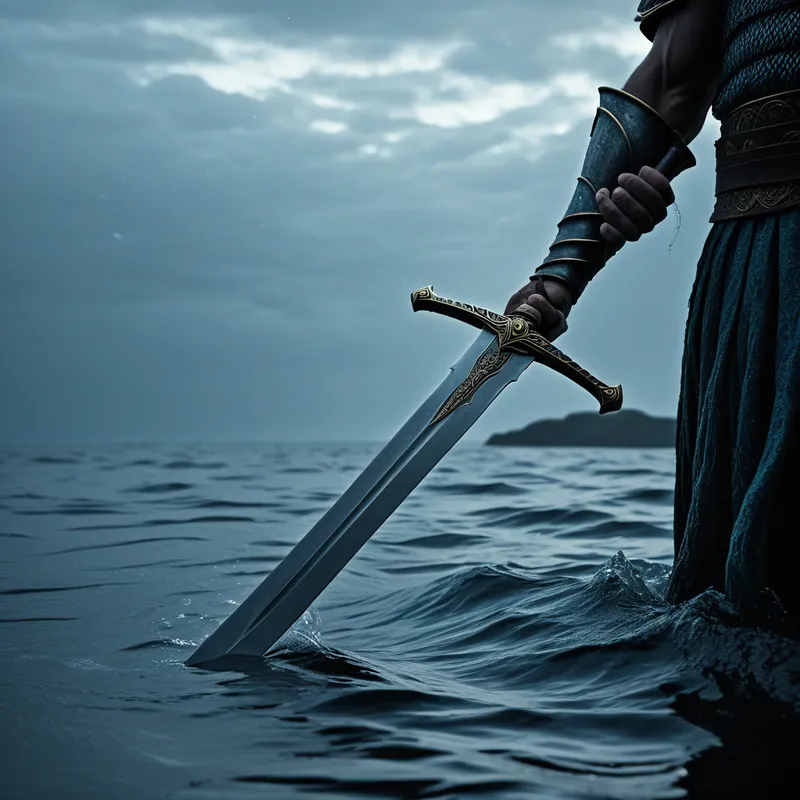
The drama began not with her, but with a desperate man. Merlin, the prophet whose sight was both gift and curse, led a young, untested Arthur Pendragon to the lake’s edge. Arthur’s claim to the throne was contested, his right unproven. He needed a sign, a weapon of such undeniable power that it would silence all doubt. As they stood on the mossy bank, the placid surface of the lake shattered. Not by ripple, but by a hand. An arm clad in samite, mystic, white, rose from the deep, and in its grasp was a sword. It was not merely a weapon of steel; it seemed forged from captured light, its pommel a jewel that held the cold fire of stars. Excalibur. The arm held it aloft, an offering and a test.
At Merlin’s urging, Arthur waded into the chill water. The moment his fingers closed around the hilt, a shock, not of electricity, but of destiny, coursed through him. The sword was his. The Lady’s hand slipped silently back into the depths, the bargain unspoken but absolute: this power was lent, not given. For years, Excalibur was the symbol of Arthur’s sovereignty and justice, its scabbard protecting him from mortal wound.
But all cycles turn. In Arthur’s final, tragic battle at Camlan, the world was out of joint. Betrayed and mortally wounded, Arthur commanded his last loyal knight, Bedivere, to return the sword to the water. Twice, Bedivere, dazzled by the jeweled hilt, could not bring himself to cast away such beauty and power. He lied to his dying king. The third time, driven by duty and love, he hurled Excalibur far out over the moonlit lake. And again, the samite-clad arm emerged, caught the sword by the hilt, brandished it three times, and drew it down into the eternal dark. The Lady had reclaimed her own. Only then, her debt fulfilled, did the barge arrive to carry the wounded king to Avalon. The power had returned to the source, completing the sacred circle.
Cultural Origins & Context
The figure of the Lady of the Lake is a late and potent flowering on the ancient tree of Celtic myth. She does not appear in the earliest Welsh texts but emerges in the 13th-century French Vulgate Cycle and Sir Thomas Malory’s seminal Le Morte d’Arthur. Her roots, however, sink deep into pre-Christian soil. She is a direct descendant of the Celtic sovereignty goddesses and river deities—figures like Boann or the Modron—who embodied the spirit of the land itself. To receive a token from such a being was to receive the land’s endorsement.
In the societal function of the Arthurian romances, told in courts by bards and clerks, she serves a crucial narrative and symbolic role. She exists outside the feudal, patriarchal, and Christian structures of Camelot. Her realm is the wild, the unconscious, the magical. She is the necessary bridge between the human world of kings and knights and the older, more potent world of natural and supernatural law. By giving the sword, she legitimizes Arthur’s rule not by bloodline, but by a deeper, mythic right. By taking it back, she asserts that all temporal power is transient and must ultimately answer to a more ancient authority.
Symbolic Architecture
Psychologically, the Lady and her lake constitute one of the most profound symbols of the unconscious in Western myth. The lake is the collective unconscious itself—a vast, still, depthless repository of ancestral wisdom, instinct, and primordial patterns. The Lady is the personification of its guiding, organizing intelligence, what Jung might term the anima in her most transcendent, spiritual form.
The sword from the stone establishes a king by law; the sword from the lake crowns a king by soul.
Excalibur is not mere military might. It is discernment—the sharp, focused power of consciousness, will, and ethical clarity drawn from the unconscious. To receive it, Arthur must venture into the water (engage with the unknown), accept the gift from a feminine source (integrate the anima), and wield it with responsibility. The scabbard’s protective magic symbolizes the wholeness and resilience that comes when conscious power (the sword) remains sheathed in, and connected to, its unconscious source.
The return of the sword is the myth’s most critical alchemical instruction. It represents the necessary dissolution of egoic structures. The power we are given is not ours to possess, but to steward.
All conscious achievement must eventually be surrendered back to the unconscious from which it sprang, completing the cycle of renewal.
The Dreamer’s Resonance
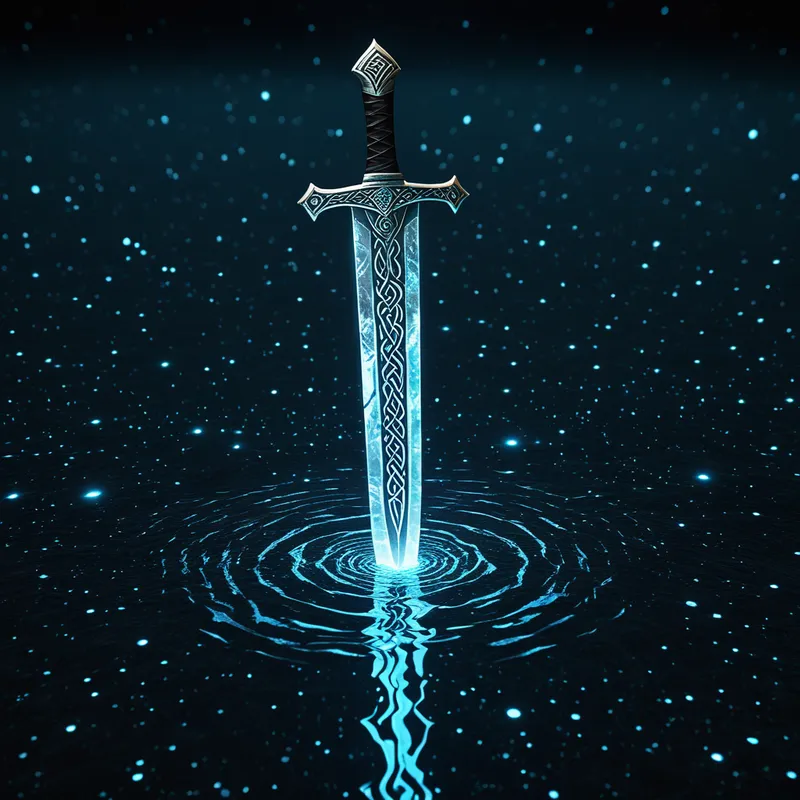
When this myth stirs in the modern psyche, it often manifests in dreams of profound transition. To dream of a hand offering a tool, key, or weapon from water signifies a moment of readiness to accept a new capacity or responsibility from a deeper part of oneself. The somatic feeling is often one of awe mixed with trepidation—a chill, a gasp, a sense of momentous weight.
Conversely, dreams of being commanded to throw something precious into a body of water speak to a necessary, painful surrender. This is the psyche’s enactment of the Bedivere/Arthur moment. The dreamer is being guided to relinquish an outdated identity, a source of pride, or a hardened defense mechanism (the “sword” they have clung to) so that a deeper healing (the journey to Avalon) can begin. The resistance felt in the dream—the inability to let go—mirrors our waking clinging to what has already served its purpose. The dream urges completion, the closing of a circle so a new one may begin.

Alchemical Translation
The myth of the Lady of the Lake is a perfect map of the individuation process. The initial state is one of lack and seeking (Arthur without a true kingly power). The first alchemical stage, nigredo, is symbolized by the dark, mysterious lake—the confrontation with the shadowy, unknown depths of the self.
The gift of the sword is the albedo, the dawning of conscious insight and purpose, extracted from the unconscious. The long reign of Arthur represents the conscious development and application of this power in the world, the building of the personality around this new center.
The final battle and the return of the sword constitute the rubedo and the ultimate coniunctio. Here, the conscious ego, having been stretched to its limit, must willingly offer its greatest achievement back to the source. This is not defeat, but sublime integration. The power is not lost; it is transmuted. By surrendering Excalibur (the differentiated ego), the king gains passage to Avalon (the symbolic state of wholeness or the Self). For the modern individual, this translates to the hard-won wisdom that our talents, our intellect, our very sense of “I” are gifts on loan from a vaster psyche. Our life’s work is to use the sword well, and then, when the time comes, to have the courage to let the water take it back, trusting that in that surrender lies not an end, but a transformation into a different, more complete state of being.
Associated Symbols
Explore related symbols from the CaleaDream lexicon: