The Lady of Shalott's Web Myth Meaning & Symbolism
An artist, cursed to perceive life only through a mirror, weaves a web of visions until love's direct gaze shatters her world and her fate.
The Tale of The Lady of Shalott’s Web
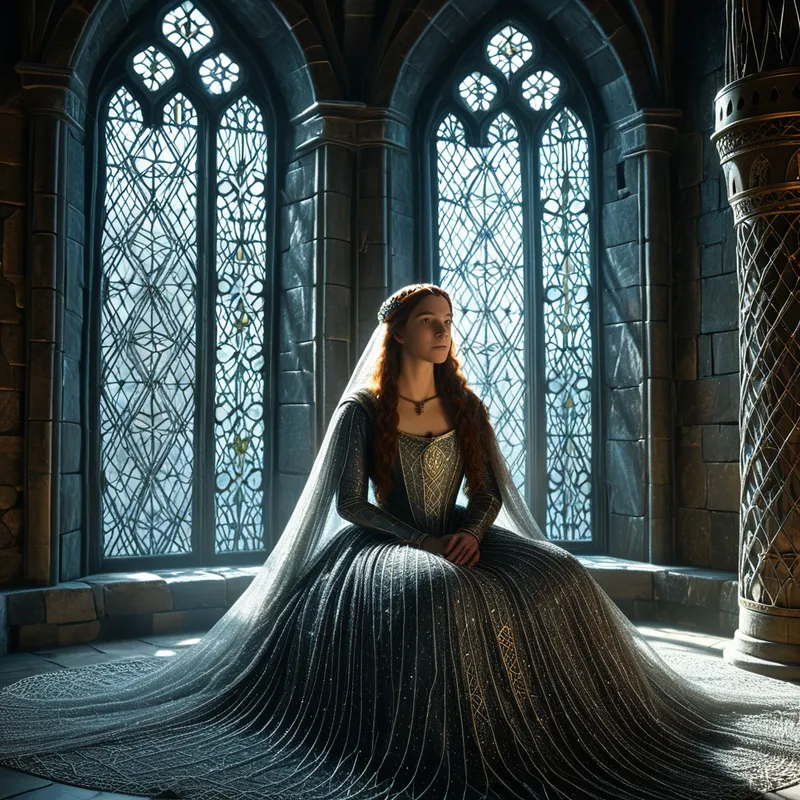
Hear now a tale woven not in wool, but in will and woe, sung by the reeds along the river that flows to Camelot. On a silent isle, set in the midst of the flowing water, stands a grey tower, windowless but for a single slit. Within dwells a lady, known only as the Lady of Shalott. No soul from the town or the glittering fields has seen her face, for she lives under a curse of terrible clarity.
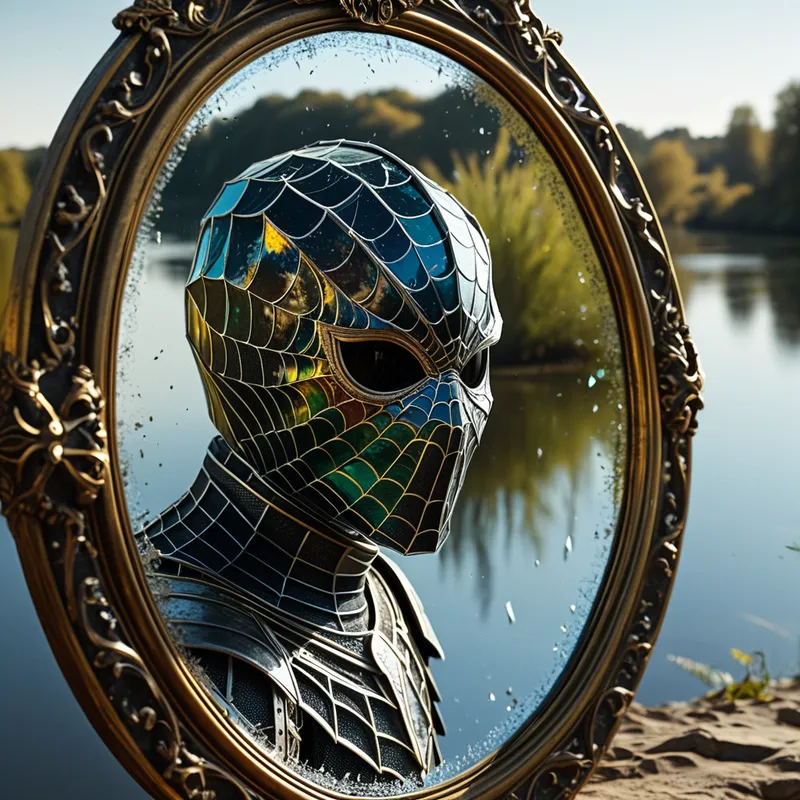
She may not look upon the world directly. To do so is to invite a doom unknown but certain. So, she lives by a mirror’s truth—a great, round glass of polished silver that hangs before her, capturing all the comings and goings of the world outside. She sees the highway winding down to Camelot. She sees the market girls in their red cloaks, the bearded barley in the wind, and the heavy barges trailed by slow horses. And she sees, most of all, the knights. They pass like flashes of color: shields of crimson and gold, plumes of white, the glint of spear-tips in the sun.
And what she sees, she must weave. This is her task, her art, her prison. A great loom stands beside the mirror, and upon it, she weaves a web—a vast, endless tapestry not of scenes, but of the essence of scenes. She weaves the shadow of a cloud passing over a field. She weaves the melancholy of a reaper’s song at dusk. She weaves the bold, bright courage of Sir Lancelot as he rides by, a sunbeam given human form. Her web grows, a magical record of a life observed but never lived, a world twice-removed: first by the mirror, then by the thread.
She sings as she weaves, a low, lonely song that the reeds echo. “I am half-sick of shadows,” she sighs to the empty air, her fingers never ceasing their dance. The web is beautiful, but it is a tomb of beauty, a palace of reflections.
Then comes the day. The sun is high, and the brass of his bridle rings in her mirror. It is Lancelot, riding to Camelot. He is not a flash of color this time, but a blaze. He sings, his voice a bold baritone that cracks the silent surface of her mirrored world. “Tirra lirra,” by the river. And she stops. She turns from the loom. The curse whispers in her ear, but the song is louder. For one eternal moment, she chooses. She turns her back on the mirror and looks, for the first and last time, directly out of the window slit.
The curse is swift. The mirror cracks from side to side. “The curse is come upon me!” she cries, and the beautiful, imprisoning web flies from the loom, the threads snapping, the woven visions unraveling into meaningless tangles. She knows what she must do. She leaves the tower, finds a boat at the isle’s edge, and writes her name upon its prow. She lies down in the boat, clad in white, and loosens the chain. The river current takes her, bearing her down to Camelot, past the staring crowds, her face finally revealed, pale and beautiful in death. They find her, a mystery at their gates, and Lancelot himself, looking upon her, says only, “She has a lovely face.”
Cultural Origins & Context
This poignant myth comes to us not from the medieval chronicles of Geoffrey of Monmouth, but from the Romantic poetry of the 19th century, most famously in Alfred, Lord Tennyson’s 1832 and 1842 poems. Tennyson drew upon Italian sources about a maiden named “the Lady of Scalot,” but he transformed the tale into a foundational Arthurian allegory. Its societal function was dual. For the Victorians, it was a tragic romance about artistic sensitivity crushed by the harshness of the real world. Within the broader, evolving Arthurian canon, it serves as a crucial shadow narrative. While the knights quest for holy grails and fight epic battles in the sunlight, the Lady’s story speaks of the unseen cost, the interior life of observation and creation that exists in the margins of the grand legend. It is a myth passed down not by bards in halls, but by poets in books, a modern addition that feels ancient because it touches an eternal nerve: the conflict between the curated life of the mind and the dangerous, beautiful call of direct experience.
Symbolic Architecture
The myth is a perfect symbolic vessel for the psyche’s relationship with reality, perception, and the Self. The Lady represents the ego in a state of pristine, isolated consciousness. She is the creative spirit, the artist, or the introverted soul who processes the world through a lens of reflection and interpretation.
The mirror is the symbol of indirect living. It is the persona, the theory, the ideology, the screen, the filter of memory and expectation through which we safely view the tumult of life.
The web is her life’s work—the art, the intellectual constructs, the identity, even the neurotic patterns—woven from these second-hand perceptions. It is elaborate, meaningful to her, but ultimately insubstantial, a proxy for lived existence. The curse is the unconscious law that maintains this fragile equilibrium: the fear of the direct impact of life, of trauma, of love, of the unmediated power of the Self.
Lancelot, shining and singing, is the catalyst—the symbol of the animus (in a woman’s psychology) or simply the call of the vital, embodied world. He is not merely a man, but the irresistible pull toward Eros, connection, and wholeness. To look directly is to choose consciousness, even if it is fatal to the old, isolated self. The cracking mirror signifies the irreversible shattering of the defensive ego-structure. The journey down the river is the final, passive surrender to the process of transformation, guided now by the unconscious (the river) toward integration (Camelot), even if that integration is posthumous.
The Dreamer’s Resonance
When this myth pattern stirs in modern dreams, the dreamer is often at a critical juncture between a constructed life and an authentic one. One might dream of being trapped in a room with monitors showing a vibrant world outside, of weaving a project that feels meaningless, or of a mirror suddenly shattering without touch.
Somatically, this can feel like a tightness in the chest—the “half-sick” feeling—a claustrophobia within one’s own mind. Psychologically, it is the process of the psyche forcing a confrontation with its own indirectness. The dream is highlighting a life lived through filters: the curated social media persona, the career identity that masks the true passion, the intellectual understanding of emotion that has replaced feeling itself. The rising action in the dream mirrors the Lady’s crisis: a growing, unbearable tension between the safety of the web and the terrifying allure of the direct gaze. The resolution—the shattering, the journey—signifies the psyche’s willingness to endure the death of the old self for the chance, however brief, of being real.

Alchemical Translation
The alchemical process mirrored here is the nigredo, the blackening, the descent into chaos necessary for transformation. The Lady’s pristine tower is the vas or vessel of her old consciousness.
The act of turning from the mirror is the supreme act of psychic courage. It is the moment the ego chooses to sacrifice its own sovereignty to the unknown demands of the Self.
Her art, the web, is the prized prima materia that must be destroyed to begin the work. The cracking of the mirror is the necessary solutio (dissolution) and calcinatio (burning) of old structures. Her passive float downriver is the ablutio—a purification by the waters of the unconscious.
For the modern individual, the alchemical translation is clear. We all weave webs from the reflections we are given by family, culture, and trauma. Individuation requires the fatal, Lancelot-like call from the depths of our own spirit to turn and look directly at what we have only dared see reflected. It demands we let our carefully woven identity—our career, our reputation, our self-concept—shatter and unravel. The journey to Camelot is not about achieving worldly glory, but about allowing the current of the Self to carry the remnants of our old life to a place of witness, where our true face, in all its lovely, mortal reality, can finally be seen. The triumph is not in survival, but in authenticity. The Lady dies, but the one who was half-sick of shadows does not. She is, at last, made whole.
Associated Symbols
Explore related symbols from the CaleaDream lexicon: