The Labyrinth Thread Myth Meaning & Symbolism
A hero enters a monstrous maze with only a thread to guide him, confronting the beast within to reclaim his people and his own soul.
The Tale of The Labyrinth Thread
Hear now the tale of the maze beneath [the earth](/myths/the-earth “Myth from Hindu culture.”/), and the thread that was a lifeline. It begins not with a hero, but with a king’s shame. In the great palace of [Minos](/myths/minos “Myth from Greek culture.”/), a monstrous secret grew. His queen, Pasiphaë, cursed by the gods, bore a child that was no child: a creature with the body of a man and the head of a bull, ravenous and roaring. This was the [Minotaur](/myths/minotaur “Myth from Greek culture.”/), Asterion.
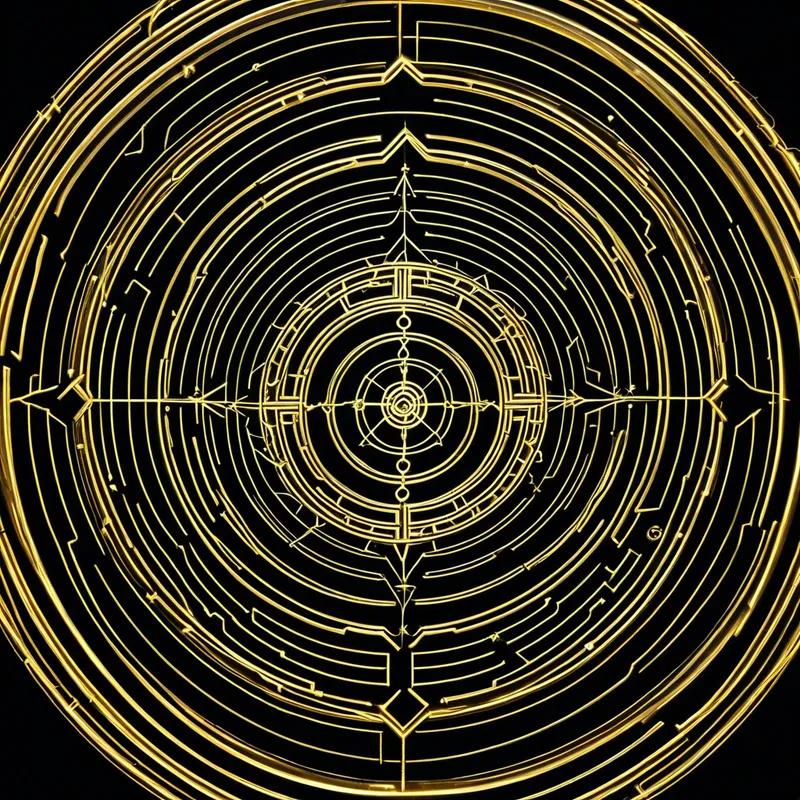
To hide his disgrace, Minos commanded the genius Daedalus to build a prison from which none could escape. And so Daedalus built [the Labyrinth](/myths/the-labyrinth “Myth from Greek culture.”/), a winding, turning, confounding maze of stone, a puzzle without a solution, its heart a chamber of echoing darkness where the beast was fed.
And the feeding came from Athens. In retribution for the death of his son, Minos demanded a terrible tribute: every nine years, seven youths and seven maidens were sent across the wine-dark sea to be cast into the [Labyrinth](/myths/labyrinth “Myth from Various culture.”/), lost and then devoured. The third tribute was due. The black-sailed ship was readied, and among the chosen lot was the son of the Athenian king: [Theseus](/myths/theseus “Myth from Greek culture.”/). He volunteered, not as a victim, but as a would-be savior, vowing to his father, Aegeus, that he would slay the monster and return under white sails.
The ship landed on Crete. In the court of Minos, a princess watched. Ariadne saw Theseus, and in his bearing she saw not just a handsome youth, but an end to the endless cycle of blood. Love, or perhaps a deeper compassion, moved her. She sought him out in secret, under the cloak of a Cretan night scented with sea salt and cypress.
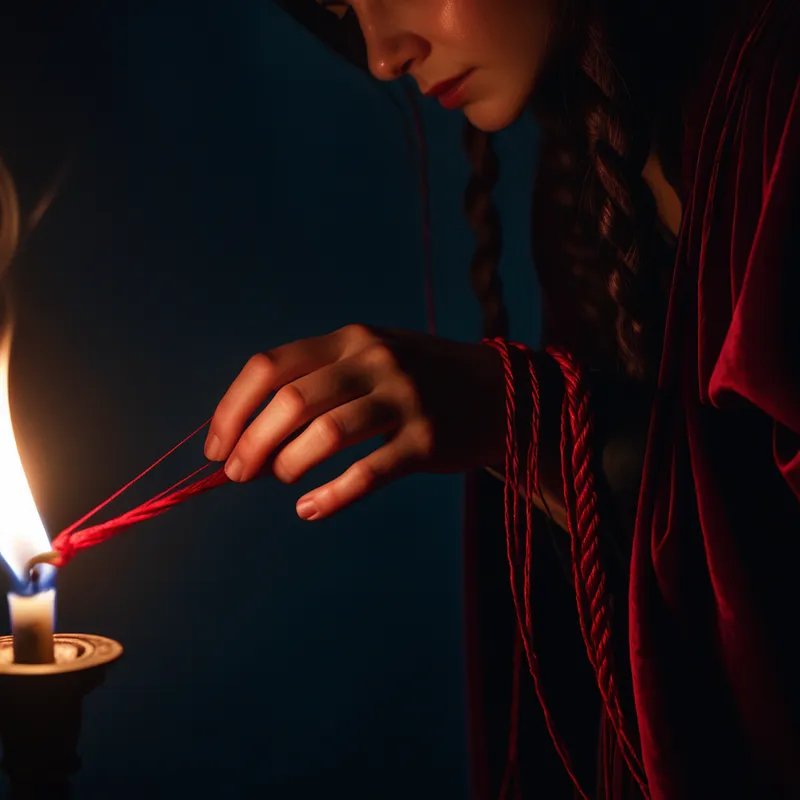
“You will go into the house that has no door,” she whispered. “Its walls are confusion, its floors are forgetfulness. To enter is to be lost forever. But I will give you the means to return.” From her robes, she produced a simple ball of thread. “Tie this to the lintel of the entrance. Unwind it as you go. It will be your memory. It will be your path back to [the world](/myths/the-world “Myth from Tarot culture.”/) of light.”
Theseus took the thread. At dawn, he was thrust into the dark mouth of the Labyrinth with the other tributes. The great stone door groaned shut. In the stifling blackness, he fastened the thread. Then, with only the sound of his breath and the scuff of his feet on dust, he began his descent. The thread spun from his hand, a slender, trembling connection to life. He walked for hours, days—time dissolved in the maze. He heard the distant, panicked cries of his companions, swallowed by branching corridors. He heard the heavy, snorting breath of something that was not human, and the scrape of horn on stone.
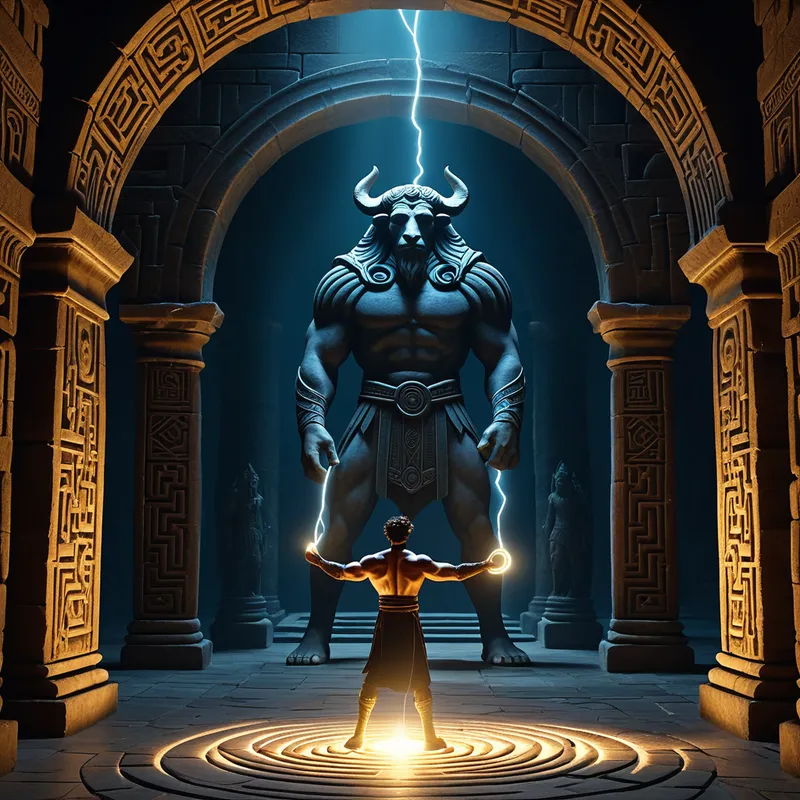
Finally, he entered the central chamber. There, in the gloom, stood [the Minotaur](/myths/the-minotaur “Myth from Greek culture.”/). It was not just a beast; it was a tragedy made flesh, a roaring embodiment of unnatural desire and royal shame. The fight was brutal, a primal struggle in the absolute dark, illuminated only by the faint glow of the thread that led back to Ariadne. Theseus prevailed. With the monster slain, he did the only [thing](/myths/thing “Myth from Norse culture.”/) he could do: he took up the thread and followed it, hand over hand, through the winding insanity of the maze, retracing his steps, pulling himself back from the belly of the nightmare, until he saw a sliver of daylight. He emerged, bloodied and triumphant, into the blinding sun, the thread coiled once more in his hand, a spiral path made linear, a chaos made into order.
He gathered the surviving Athenians, found Ariadne, and fled Crete. But that is another story. The core tale ends here, at [the threshold](/myths/the-threshold “Myth from Folklore culture.”/) of the Labyrinth, with a hero who entered the ultimate darkness and returned, guided by nothing more than a princess’s foresight and a slender, unbroken line.
Cultural Origins & Context
This myth comes to us primarily from the later literary sources of the classical era, such as Plutarch’s Life of Theseus, but its roots are far older, woven into the pre-Greek Minoan civilization of Bronze Age Crete. The palace complexes of Knossos, with their complex, multi-level layouts, likely inspired the idea of the Labyrinth itself. The myth functioned as an etiological story for Athenian supremacy, explaining and justifying Athens’s historical influence over the Aegean by framing it as a heroic liberation from Cretan tyranny.
It was a foundational national myth for Athens, recited and performed, reminding citizens of their civic hero and the price of freedom. The story was not static; it evolved. In earlier tellings, the Minotaur may have been a more abstract, chthonic power, a bull-god of the earth that the king or hero had to ritually confront. By the classical period, it had been moralized into a tale of civilized Greek heroism overcoming monstrous barbarism. It was passed down by bards, depicted on vases and in frescoes, and served as a powerful metaphor for the perils of [the sea](/myths/the-sea “Myth from Greek culture.”/), the mysteries of [the underworld](/myths/the-underworld “Myth from Greek culture.”/), and the intellectual [triumph](/myths/triumph “Myth from Roman culture.”/) of reason (the thread) over chaos (the maze).
Symbolic Architecture
The myth is a perfect symbolic [blueprint](/symbols/blueprint “Symbol: A blueprint represents the foundational plan or design for something, often symbolizing potential, structure, and the mapping of one’s inner self or future.”/) for the [psyche](/myths/psyche “Myth from Greek culture.”/)’s encounter with the unconscious. The [Labyrinth](/symbols/labyrinth “Symbol: The labyrinth represents a complex journey, symbolizing the intricate path toward self-discovery and understanding one’s life’s direction.”/) is not just a [prison](/symbols/prison “Symbol: Prison in dreams typically represents feelings of restriction, confinement, or a lack of freedom in one’s life or mind.”/); it is the [structure](/symbols/structure “Symbol: Structure in dreams often symbolizes stability, organization, and the framework of one’s life, reflecting how one perceives their environment and personal life.”/) of the unconscious itself—winding, recursive, easy to get lost in, housing our most primal and terrifying contents. The [Minotaur](/symbols/minotaur “Symbol: The Minotaur, a creature from Greek mythology, is often interpreted as a symbol of inner turmoil and the struggle between human and beast.”/) is the ultimate [shadow](/symbols/shadow “Symbol: The ‘shadow’ embodies the unconscious, repressed aspects of the self and often represents fears or hidden emotions.”/) figure: the bestial, untamed, and shameful [aspect](/symbols/aspect “Symbol: A distinct feature, quality, or perspective of something, often representing a partial view of a larger whole.”/) of [the self](/myths/the-self “Myth from Jungian culture.”/) that we have locked away. It is the [product](/symbols/product “Symbol: This symbol represents tangible outcomes of one’s efforts and creativity, often reflecting personal value and identity.”/) of a “unnatural” union, representing the consequences of unintegrated desires or cultural secrets.
The thread is not a weapon, but a witness. It does not fight the darkness; it remembers the path through it.
Theseus represents the conscious ego, the part of us that must voluntarily descend into our own complexity to confront what we have hidden. His victory is not a destruction of [the shadow](/myths/the-shadow “Myth from Jungian culture.”/), but a necessary engagement with it. He integrates its power (becoming the heroic [king](/symbols/king “Symbol: A symbol of ultimate authority, leadership, and societal order, often representing the dreamer’s inner power or external control figures.”/)) by facing it. Most crucial is Ariadne’s thread. It is the [symbol](/symbols/symbol “Symbol: A symbol can represent an idea, concept, or belief, serving as a powerful tool for communication and understanding.”/) of relatedness, of the connective principle. It is [intuition](/symbols/intuition “Symbol: The immediate, non-rational understanding of truth or insight, often described as a ‘gut feeling’ or inner knowing that bypasses conscious reasoning.”/), the helping other (the [anima](/symbols/anima “Symbol: The feminine archetype within the male unconscious, representing soul, creativity, and connection to the inner world.”/), in Jungian terms), [memory](/symbols/memory “Symbol: Memory symbolizes the past, lessons learned, and the narratives we construct about our identities.”/), the analytic function, or simply love. It is the thin, vital link that prevents [the ego](/myths/the-ego “Myth from Jungian culture.”/) from being utterly dissolved in the unconscious. It is the promise that one can go into the [depths](/symbols/depths “Symbol: Represents the subconscious, hidden emotions, or foundational aspects of the self, often linked to primal fears or profound truths.”/) and return, transformed but intact.
The Dreamer’s Resonance
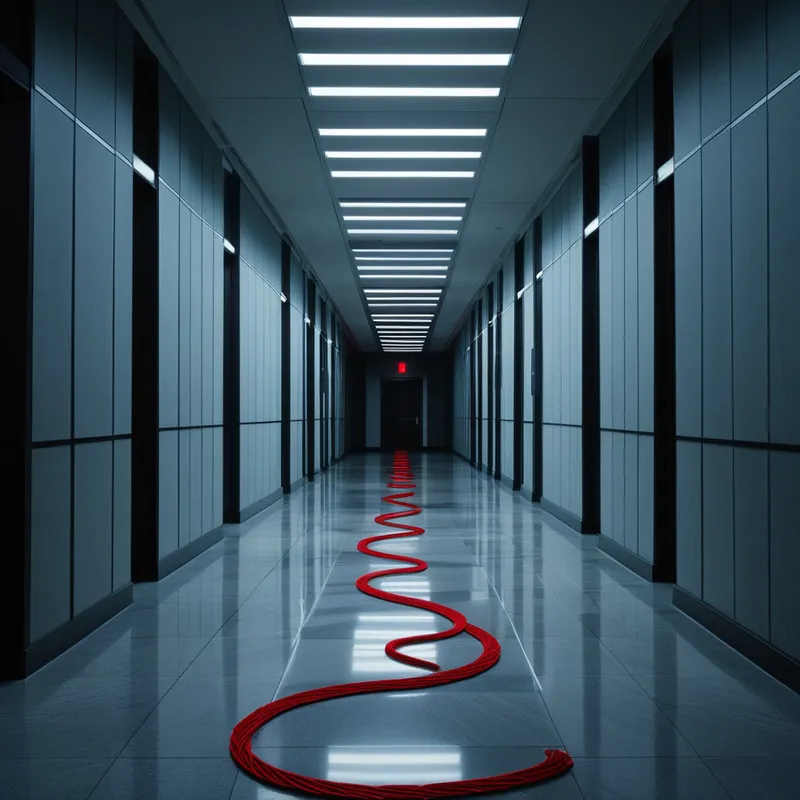
When this myth pattern appears in modern dreams, the dreamer is almost always at a critical juncture of inner navigation. Dreaming of being lost in a maze, office complex, or endless hallway signals a feeling of being trapped in a complex problem, a confusing life transition, or the winding corridors of one’s own mind without a clear direction. The somatic experience is one of anxiety, tightening in the chest, a desperate searching.
If a thread, string, or cord appears in such a dream, it indicates the nascent emergence of a guiding principle. The psyche is offering a tool. The dreamer is in the process of finding their “Ariadne”—which could be a newfound insight, a therapeutic relationship, a creative practice, or a reconnection to intuition. Dreaming of a monster at the center of the maze marks the moment of confronting a repressed fear, a long-held shame, or a powerful, unacknowledged aspect of the self. The dream is not a warning, but an invitation to the heroic task of integration. The psychological process is one of orientation within disorientation, of developing trust in a fragile, internal guidance system to face what must be faced.
Alchemical Translation
The alchemical process mirrored here is the [nigredo](/myths/nigredo “Myth from Alchemical culture.”/), the blackening, the descent into the prime matter of the soul. The Labyrinth is the alchemical vessel, the sealed space where transformation must occur. The ego (Theseus) willingly enters this vessel, submitting to confusion and darkness. The confrontation with the Minotaur is the violent, necessary stage of [separatio](/myths/separatio “Myth from Alchemical culture.”/) and mortificatio—the separating out and “killing” of an outmoded, autonomous complex.
The thread is the filum Ariadis, the Ariadne-thread of the alchemists, the secret guiding principle that allows the adept to navigate the perilous stages of the work without going mad.
Following the thread back out is the stage of albedo, the whitening. The hero emerges purified, having transmuted the base, monstrous material (the shadow) into a source of sovereign power (kingly consciousness). For the modern individual, this models the full journey of individuation. We must all, at some point, enter our personal labyrinth—the tangled web of our history, traumas, and unconscious patterns. We must confront the Minotaur we have fed with our avoidance. We cannot do it alone; we need the thread. That thread is whatever connects us to meaning, to another, to our own core Self. It is the slender, unbreakable connection to consciousness that allows us to traverse the deepest chaos and return, not as we were, but as who we are meant to be: the ruler of our own inner kingdom.
Associated Symbols
Explore related symbols from the CaleaDream lexicon: