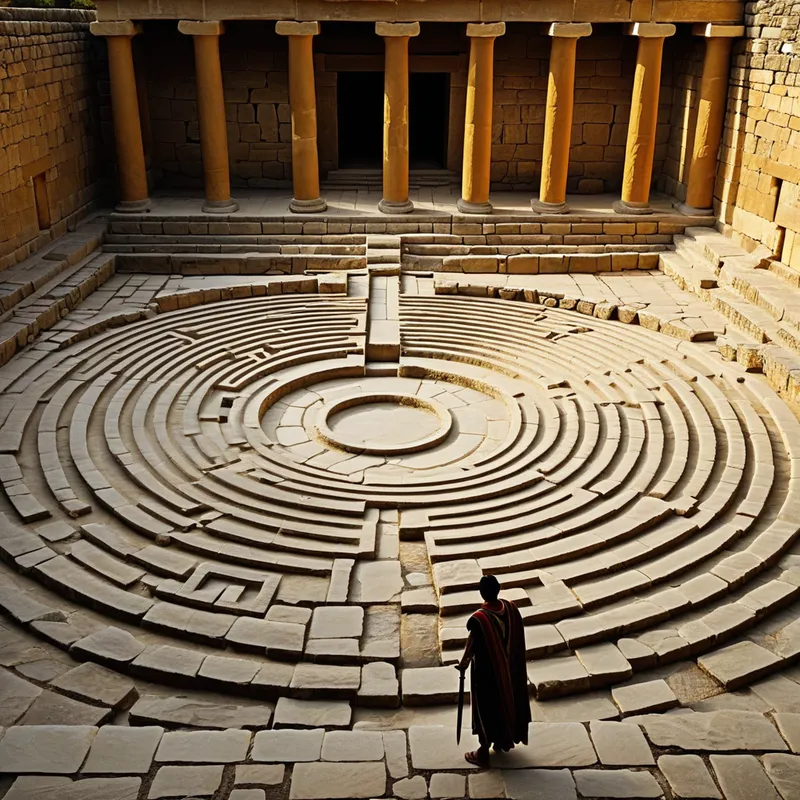
The Labyrinth & Theseus's Thread Myth Meaning & Symbolism
A hero enters a maze to slay a beast, guided by a thread. This ancient tale maps the journey into the unconscious to confront the monstrous self.
The Tale of The Labyrinth & Theseus’s Thread
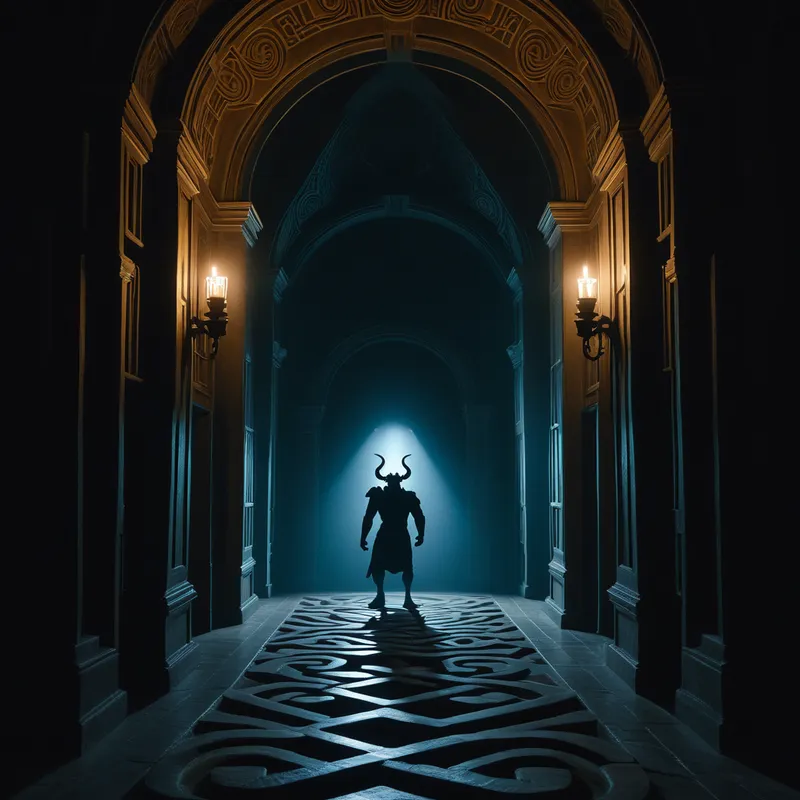
Hear now the tale of the turning walls and the golden thread, a story of stone and shadow, of a debt written in blood and paid in courage. It begins not in Athens, but in [the sea](/myths/the-sea “Myth from Greek culture.”/)-salt halls of [Minos](/myths/minos “Myth from Greek culture.”/). His pride was a palace, and his shame was a son, born of a curse from [the sea](/myths/the-sea “Myth from Greek culture.”/)-god [Poseidon](/myths/poseidon “Myth from Greek culture.”/)—a creature with the body of a man and the head of a bull, the [Minotaur](/myths/minotaur “Myth from Greek culture.”/). To hide his monstrous shame, [Minos](/myths/minos “Myth from Greek culture.”/) commanded the divine craftsman Daedalus to build a prison from which none could escape: [the Labyrinth](/myths/the-labyrinth “Myth from Greek culture.”/). Its paths coiled upon themselves like the entrails of a beast, a stone confusion where [the Minotaur](/myths/the-minotaur “Myth from Greek culture.”/) roamed, fed on human flesh.
And the flesh was provided by Athens, conquered by Minos. Every nine years, seven youths and seven maidens were sent across the wine-dark sea, forced into the maze as tribute, a harvest for the monster. The air in Athens grew thick with mourning. Then came [Theseus](/myths/theseus “Myth from Greek culture.”/), son of Poseidon or perhaps of the mortal king Aegeus, his heart burning with the fire of a hero. He volunteered to be among the tribute, vowing to his father that he would slay the beast and end the cycle of terror. He would sail under black sails of mourning, but promised to raise white sails upon his victorious return.
The ship landed on Crete. In the court of Minos, the king’s daughter, Ariadne, saw Theseus. In his eyes, she saw not the resignation of a victim, but the fierce light of purpose. Love, or perhaps a deeper wisdom, stirred in her. She came to him in secret, her hands offering salvation: a ball of thread and a sword. “Tie this end to the entrance,” she whispered, her voice a thread itself in the palace silence. “Unwind it as you go. It will be your memory in stone, your path back from forgetting.”
Theseus entered the mouth of the [Labyrinth](/myths/labyrinth “Myth from Various culture.”/). [The world](/myths/the-world “Myth from Tarot culture.”/) of sun and sky vanished. The only sounds were his own breath, the scrape of his sandals, and the distant, echoing snort of the beast. The walls, slick and cold, seemed to breathe. He moved deeper, the thread spooling out behind him, a fragile tether to life. The stench of old blood and damp stone grew. Then, in a chamber wider than the rest, he found it—the Minotaur, a mountain of muscle and rage, its eyes holding a terrible, trapped intelligence. The battle was not elegant; it was primal, a clash of desperation and monstrous strength. With Ariadne’s sword, Theseus struck the final blow. The beast fell, and the labyrinth seemed to sigh.
Now came the true test: not the finding, but the returning. He followed the thread, his golden guide through the amnesia of the maze. It led him, step by faithful step, past identical corridors and dead ends, back to the light, to Ariadne’s waiting arms. He took her and the Athenian youths, fleeing Crete for the open sea. But the story’s weave is complex. On the island of Dionysus, Ariadne was left behind, her thread cut by fate or divine design. And in his triumphant haste, Theseus forgot his promise to his father. The black sails remained aloft. King Aegeus, watching from the cliffs of Athens, saw the dark cloth and, believing his son dead, cast himself into the sea that bears his name to this day.
Cultural Origins & Context
This myth is a foundational narrative of Athenian identity, recorded most famously in the works of later writers like Plutarch, but its roots are far older, echoing through the oral traditions of the Bronze Age. It sits at [the crossroads](/myths/the-crossroads “Myth from Celtic culture.”/) of history and [psyche](/myths/psyche “Myth from Greek culture.”/), possibly reflecting the real political tension between Minoan Crete and mainland Mycenaean cultures. The tribute of youths may symbolize a historical subjugation, while Theseus’s victory represents Athenian ascendancy.
The story was not mere entertainment; it was a societal script. It was performed, painted on pottery, and carved into stone, serving as a parable of civic duty, cunning over brute force, and the transition from a chaotic, sacrificial past to a rational, heroic order. Theseus became the archetypal unifier and lawgiver of Athens. The labyrinth itself may find echoes in the complex palace architecture of Knossos, which later Greeks, seeing its ruins, imagined as the literal maze. The myth was a tool for making sense of the world—explaining the origins of the Aegean Sea, validating Athenian rituals, and illustrating the perilous journey from adolescence to responsible adulthood.
Symbolic Architecture
The [Labyrinth](/symbols/labyrinth “Symbol: The labyrinth represents a complex journey, symbolizing the intricate path toward self-discovery and understanding one’s life’s direction.”/) is the ultimate [symbol](/symbols/symbol “Symbol: A symbol can represent an idea, concept, or belief, serving as a powerful tool for communication and understanding.”/) of the unconscious. It is not a [prison](/symbols/prison “Symbol: Prison in dreams typically represents feelings of restriction, confinement, or a lack of freedom in one’s life or mind.”/) with walls, but a prison of the mind—a convoluted, disorienting inner [landscape](/symbols/landscape “Symbol: Landscapes in dreams are powerful symbols representing the dreamer’s emotional state, personal journey, and the broader context of life situations.”/) where [logic](/symbols/logic “Symbol: The principle of reasoning and rational thought, often representing order, structure, and intellectual clarity in dreams.”/) fails and the primal self resides. To enter voluntarily is to embark on the heroic [journey](/symbols/journey “Symbol: A journey in dreams typically signifies adventure, growth, or a significant life transition.”/) of self-[discovery](/symbols/discovery “Symbol: The act of finding something previously unknown, hidden, or lost, often representing personal growth, new opportunities, or hidden aspects of the self.”/), a descent into the nekyia.
The Minotaur is not merely a monster to be slain, but the shadow, the unlived life, the bestial and untamed aspect of one’s own nature that has been hidden away in shame.
Theseus represents the conscious ego, the part of us that must venture into this inner [chaos](/symbols/chaos “Symbol: In Arts & Music, chaos represents raw creative potential, uncontrolled expression, and the breakdown of order to forge new artistic forms.”/) with [purpose](/symbols/purpose “Symbol: Purpose signifies direction, meaning, and intention in life, often reflecting personal ambitions and core values.”/). His sword is discernment, the cutting power of [consciousness](/symbols/consciousness “Symbol: Consciousness represents the state of awareness and perception, encompassing thoughts, feelings, and experiences.”/). But the critical element, the true magic, is Ariadne’s Thread.
The thread is the symbol of connection, of memory, and of the guiding principle—be it love, intuition, or a trusted analytical process—that prevents total dissolution in the unconscious. It is the logos that can navigate the mythos.
Ariadne herself embodies the [anima](/symbols/anima “Symbol: The feminine archetype within the male unconscious, representing soul, creativity, and connection to the inner world.”/), the mediating, connective feminine wisdom that the masculine-oriented [hero](/symbols/hero “Symbol: A hero embodies strength, courage, and the ability to overcome significant challenges.”/) must recognize and heed to succeed. Her later [abandonment](/symbols/abandonment “Symbol: A dream symbol representing feelings of being left behind, isolated, or emotionally deserted, often tied to primal fears of separation and loss of support.”/) is the tragic cost often paid when the [hero](/symbols/hero “Symbol: A hero embodies strength, courage, and the ability to overcome significant challenges.”/), having used the wisdom for his goal, fails to integrate it fully into his [life](/symbols/life “Symbol: The symbol of ‘Life’ represents a journey of growth, interconnectedness, and existential meaning, encompassing both the joys and challenges that define human experience.”/). The forgotten black sails and Aegeus’s [death](/symbols/death “Symbol: Symbolizes transformation, endings, and new beginnings; often associated with fear of the unknown.”/) remind us that [triumph](/myths/triumph “Myth from Roman culture.”/) in the inner world can still cause catastrophe in the outer if one loses the thread of one’s promises and relationships.
The Dreamer’s Resonance
When the labyrinth appears in modern dreams, it signals a profound psychological process is underway. The dreamer is not lost in a building, but in a state of mind. The somatic feeling is one of constriction, anxiety, of turning in circles with a rising heartbeat—a direct experience of the autonomic nervous system responding to perceived entrapment.
This dream motif arises during life transitions, creative blocks, or periods of deep introspection, when the conscious mind feels overwhelmed by the complexity of an inner conflict or an unsolvable problem. The Minotaur in the dream may not be a literal monster, but a looming deadline, a repressed memory, a feared aspect of one’s personality, or a relationship that feels consuming. The dream is the psyche’s way of insisting: You must go in. You must confront what is at the center. The absence of a thread in the dream highlights a feeling of being unprepared, lacking guidance or a coherent strategy to navigate the inner turmoil. The emergence of a thread, a guide, or a tool in the dream marks a turning point, the dream-ego accessing the resources needed for the journey.

Alchemical Translation
The myth is a perfect map for the Jungian process of individuation. The alchemical work begins with the [nigredo](/myths/nigredo “Myth from Alchemical culture.”/), the blackening: Theseus volunteering, the voyage under black sails, the entry into darkness. This is the conscious decision to engage with one’s own shadow material, to face the depression, confusion, or chaos that precedes transformation.
The battle in the heart of the maze is the coniunctio, the sacred combat. It is not about annihilation, but about a fierce engagement and integration.
To “slay” the Minotaur is to consciously acknowledge, confront, and transform the raw, instinctual energy of the shadow into a source of personal power. The beast is not killed to be gone, but to be unmasked and understood.
The return by the thread is the albedo, the whitening, the creation of a conscious pathway out of the unconscious. It is the insight gained, the pattern recognized, the trauma processed and woven into the narrative of [the self](/myths/the-self “Myth from Jungian culture.”/). This is where the hero raises the white sails of clarity and renewal.
Yet, the myth’s bittersweet end—Ariadne abandoned, the father dead—serves as the final, crucial lesson. Individuation is never a clean, perfect victory. It involves sacrifice, unintended consequences, and the mourning of old identities (the father/king). The integrated self is not a happily-ever-after, but a more conscious, responsible, and tragically wiser being, who carries the memory of both the thread and the blood, the guide and the cost, forever within.
Associated Symbols
Explore related symbols from the CaleaDream lexicon: