The Labyrinth of Minos Myth Meaning & Symbolism
A king's hubris births a monster, a hero enters a maze to face it, and a thread guides the way out—a story of confronting the beast within.
The Tale of The Labyrinth of Minos
Hear now of a king’s pride and a monster’s hunger, of a maze with no exit and the thread that became a lifeline.
It began with a broken oath, whispered on the salt-spray of [the sea](/myths/the-sea “Myth from Greek culture.”/). [Minos](/myths/minos “Myth from Greek culture.”/), lord of the waves and master of Knossos, prayed to [Poseidon](/myths/poseidon “Myth from Greek culture.”/). He asked for a sign, a bull from the deep to affirm his right to rule. The god heard. From the foaming waves emerged a creature of pure white, a bull so magnificent it seemed carved from moonlight and sea-foam. It was a sacred gift, meant for sacrifice. But [Minos](/myths/minos “Myth from Greek culture.”/), his heart swelling with greed, looked upon the beast and could not bear to give it up. He hid the white bull and sacrificed another in its place.
The sea is not so easily cheated. Poseidon’s wrath did not come as a storm, but as a terrible, twisting passion. He caused Pasiphaë, the queen, to burn with an unnatural desire for the very bull her husband had stolen. Consumed, she enlisted the genius of the artisan Daedalus, who built for her a hollow cow of wood and hide. From this deception, a monstrous child was born—part man, part bull, all fury. They named him the [Minotaur](/myths/minotaur “Myth from Greek culture.”/).
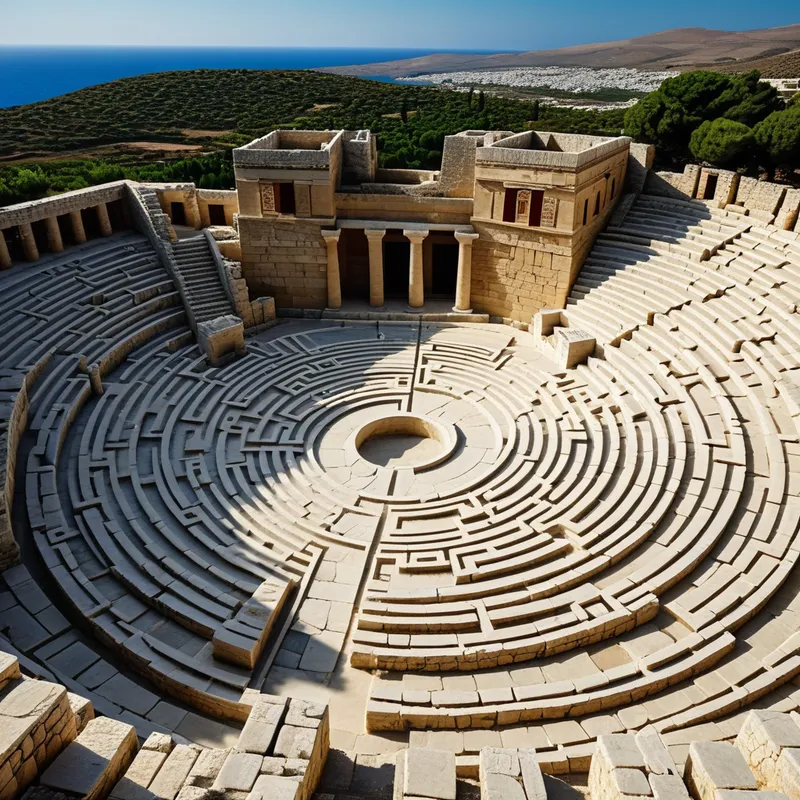
Shame and horror filled the halls of Knossos. The monster’s bellow echoed the king’s own transgression. To hide his sin, Minos again summoned Daedalus, commanding him to build a prison from which nothing could escape. The great artisan, his mind a maze itself, constructed [the Labyrinth](/myths/the-labyrinth “Myth from Greek culture.”/). Not a simple dungeon, but a living puzzle of stone, a winding, turning, ever-shifting confusion of corridors designed to consume all who entered. Into its heart, [the Minotaur](/myths/the-minotaur “Myth from Greek culture.”/) was cast, and there it remained, fed on a gruesome tribute.
For Minos’s son had been killed in Athens. In his vengeance, the king demanded a blood price. Every nine years, seven Athenian youths and seven maidens were shipped across the wine-dark sea to Crete. They were led, weeping, to the mouth of the [Labyrinth](/myths/labyrinth “Myth from Various culture.”/) and abandoned, left to wander the endless halls until the beast found them.
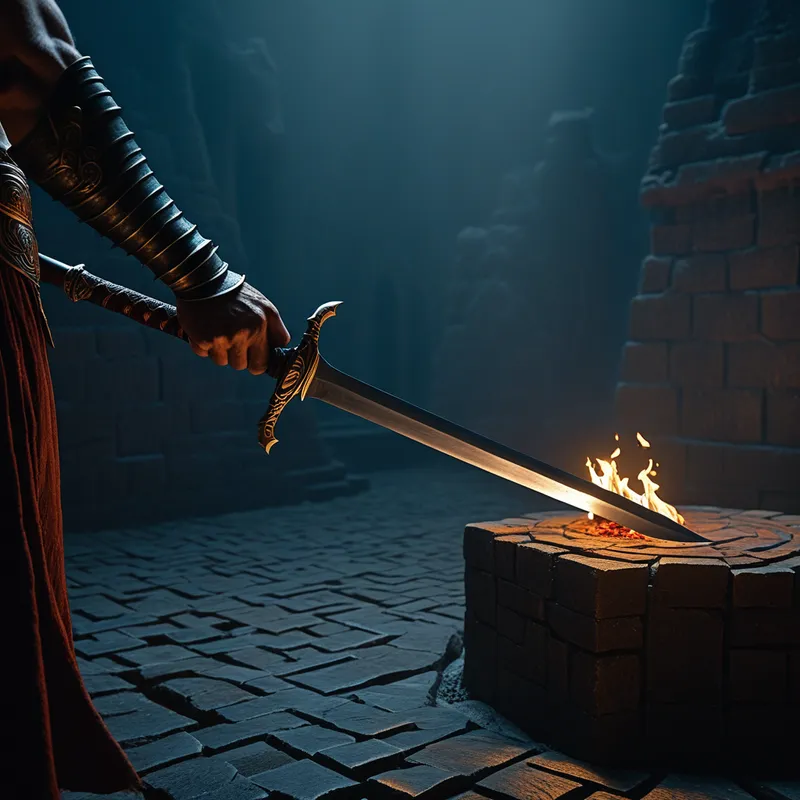
This was [the world](/myths/the-world “Myth from Tarot culture.”/)’s order, a cycle of despair, until the son of the Athenian king, [Theseus](/myths/theseus “Myth from Greek culture.”/), volunteered to be part of the tribute. He sailed to Crete, a prince in chains. There, in [the shadow](/myths/the-shadow “Myth from Jungian culture.”/) of the Labyrinth, Ariadne saw him. Love, or perhaps a desperate hope for her own escape, sparked in her. She went to Daedalus, the maze’s maker, and learned its secret. She gave [Theseus](/myths/theseus “Myth from Greek culture.”/) a ball of thread and a sword. “Tie one end to the entrance,” she whispered. “Unwind it as you go in. It will be your memory in stone, your path back from forgetting.”
Theseus entered the darkness. The air was cold and still, thick with the smell of damp earth and old fear. The only sounds were his own breath, the scrape of his sandals, and the distant, echoing snort of something that was not human. He followed the thread, his hand on the wall, feeling his way deeper into [the earth](/myths/the-earth “Myth from Hindu culture.”/)’s belly. The turns were nonsensical, doubling back, leading nowhere. Time dissolved. He was no longer a prince, but a consciousness moving through a stone intestine.
Then, in a chamber that felt like the center of the world, he found it. The Minotaur emerged from the gloom, a mountain of muscle and rage, its eyes holding the dumb, terrible pain of its own existence. There was no parley, only the roar and the clash. Theseus fought, not with the grace of a duelist, but with the brutal, survivalist fury of one trapped in a nightmare. When it was done, the monster lay still. Theseus, bloodied and trembling, did not linger. He followed the glimmering thread, his lifeline through amnesia, back to the world of light, of air, of Ariadne’s waiting eyes.
Cultural Origins & Context
This is a story told and retold across the Aegean, a foundational myth of the Mycenaean and later Classical Greek world. It exists at a crossroads of history and imagination, likely preserving a cultural memory of the real, sophisticated, and powerful Minoan civilization, which dominated the sea and demanded tribute from mainland cities like Athens. The grand palace of Knossos, with its complex, multi-level layout, could easily have been remembered by later Greeks as a literal labyrinth.
The myth was not scripture, but a living narrative shaped by poets like [Homer](/myths/homer “Myth from Greek culture.”/) and later tragedians. It served multiple societal functions: as an etiological tale explaining Athenian maritime dominance (overcoming the Cretan thalassocracy), as a charter myth for the Panathenaic festival, and as a profound moral lesson. It was a story about the consequences of hubris (Minos’s deceit), the price of order (the Athenian tribute), and the necessity of the heroic principle (Theseus) to confront chaotic, monstrous forces that threaten the community’s soul.
Symbolic Architecture
The [Labyrinth](/symbols/labyrinth “Symbol: The labyrinth represents a complex journey, symbolizing the intricate path toward self-discovery and understanding one’s life’s direction.”/) is not merely a building; it is the [architecture](/symbols/architecture “Symbol: Architecture in dreams often signifies structure, stability, and the framing of personal identity or life’s journey.”/) of a psychic state. It represents the unconscious mind itself—not evil, but neutral, complex, and easy to become lost within. Its winding paths are the circuits of [memory](/symbols/memory “Symbol: Memory symbolizes the past, lessons learned, and the narratives we construct about our identities.”/), [trauma](/symbols/trauma “Symbol: A deeply distressing or disturbing experience that overwhelms the psyche, often manifesting in dreams as unresolved emotional wounds or psychological injury.”/), and instinct, where [logic](/symbols/logic “Symbol: The principle of reasoning and rational thought, often representing order, structure, and intellectual clarity in dreams.”/) fails and [the ego](/myths/the-ego “Myth from Jungian culture.”/) dissolves.
The monster is not placed in the maze; the maze is constructed around the monster. The repressed creates its own prison.
The [Minotaur](/symbols/minotaur “Symbol: The Minotaur, a creature from Greek mythology, is often interpreted as a symbol of inner turmoil and the struggle between human and beast.”/) is the ultimate [symbol](/symbols/symbol “Symbol: A symbol can represent an idea, concept, or belief, serving as a powerful tool for communication and understanding.”/) of the repressed [shadow](/symbols/shadow “Symbol: The ‘shadow’ embodies the unconscious, repressed aspects of the self and often represents fears or hidden emotions.”/). Born from a [king](/symbols/king “Symbol: A symbol of ultimate authority, leadership, and societal order, often representing the dreamer’s inner power or external control figures.”/)’s broken [oath](/symbols/oath “Symbol: A solemn promise or vow, often invoking a higher power or sacred principle, binding individuals to specific actions or loyalties.”/) and a [queen](/symbols/queen “Symbol: A queen represents authority, power, nurturing, and femininity, often embodying leadership and responsibility.”/)’s unnatural desire, it is the incarnate result of denied [truth](/symbols/truth “Symbol: Truth represents authenticity, honesty, and the quest for knowledge beyond mere appearances.”/) and perverted natural order. It is the unspeakable secret, the bestial [aspect](/symbols/aspect “Symbol: A distinct feature, quality, or perspective of something, often representing a partial view of a larger whole.”/) of [the self](/myths/the-self “Myth from Jungian culture.”/) that is fed on [shame](/symbols/shame “Symbol: A painful emotion arising from perceived failure or violation of social norms, often involving exposure of vulnerability or wrongdoing.”/) and grows stronger in the dark. It is not evil, but unintegrated [life](/symbols/life “Symbol: The symbol of ‘Life’ represents a journey of growth, interconnectedness, and existential meaning, encompassing both the joys and challenges that define human experience.”/) force, raging in its [confinement](/symbols/confinement “Symbol: A dream symbol representing restriction, limitation, or being held back physically, emotionally, or psychologically.”/).
Theseus represents the conscious ego embarking on the perilous [journey](/symbols/journey “Symbol: A journey in dreams typically signifies adventure, growth, or a significant life transition.”/) of self-[discovery](/symbols/discovery “Symbol: The act of finding something previously unknown, hidden, or lost, often representing personal growth, new opportunities, or hidden aspects of the self.”/). His weapons are courage and will, but they are useless without Ariadne’s thread. This thread is the symbol of relatedness, of the guiding [connection](/symbols/connection “Symbol: Connection symbolizes relationships, communication, and bonds among individuals.”/) to something beyond the ego—be it love, [intuition](/symbols/intuition “Symbol: The immediate, non-rational understanding of truth or insight, often described as a ‘gut feeling’ or inner knowing that bypasses conscious reasoning.”/), therapy, or a spiritual practice. It is the thin, vital line of [consciousness](/symbols/consciousness “Symbol: Consciousness represents the state of awareness and perception, encompassing thoughts, feelings, and experiences.”/) that must be paid out to navigate the unconscious, and more importantly, to find [the way](/myths/the-way “Myth from Taoist culture.”/) back, transformed, to the world.
The Dreamer’s Resonance
When this myth stirs in modern dreams, the dreamer is at a threshold. Dreaming of being lost in a maze or complex building signals a confrontation with a confusing, multifaceted problem in waking life, often of an internal, psychological nature. The somatic feeling is one of anxiety, claustrophobia, and the frustration of circular thought.
To dream of a monster at the center—whether a bull, a beast, or a terrifying human figure—indicates the approach of a repressed complex. The [psyche](/myths/psyche “Myth from Greek culture.”/) is signaling that a powerful, neglected, or feared aspect of the self can no longer be contained in the inner Labyrinth. It demands recognition. The act of finding the center, however frightening, is a movement toward wholeness. The thread in a dream may appear as a literal string, a trail of light, a voice, or the presence of a trusted companion. Its appearance marks the moment the dream-ego accepts help, surrendering pure willpower for guided insight.
Alchemical Translation
The myth of the Labyrinth is a perfect map for the alchemical process of individuation. The journey is one of psychic transmutation, where base elements of the psyche (shame, trauma, instinct) are confronted and integrated to produce a more complete self (the heroic, sovereign individual).
[The first stage](/myths/the-first-stage “Myth from Alchemical culture.”/) is [nigredo](/myths/nigredo “Myth from Alchemical culture.”/), the blackening. This is the descent into the Labyrinth, the voluntary entry into confusion, depression, or a dark night of the soul. It is the necessary dissolution of old ego structures. Confronting the Minotaur is the mortificatio, the killing of the old, autonomous complex. It is not a murder of part of oneself, but a dismantling of its tyrannical, unconscious power.
The hero does not leave the monster in the maze; he takes its essence with him in his transformed being.
Ariadne’s thread is the filum Ariadis of the alchemists, the guiding principle of divine wisdom or love that prevents the seeker from being utterly consumed by the unconscious. The return, following the thread, is the albedo, the whitening or illumination—emerging with new self-knowledge. Theseus sails away with Ariadne, integrating the anima (the inner feminine guiding principle), but the myth is brutally honest; he later abandons her. This reminds us that integration is rarely a clean, happy-ever-after. Parts are lost, new wounds are acquired, but the central beast has been met. The cycle of blind tribute is broken. The individual is no longer a passive sacrifice to their inner monster, but has become, however imperfectly, the author of their own journey.
Associated Symbols
Explore related symbols from the CaleaDream lexicon: