The Labyrinth of Daedalus - a Myth Meaning & Symbolism
The master craftsman Daedalus builds an inescapable maze to contain a monstrous secret, only to become its first prisoner alongside his son.
The Tale of The Labyrinth of Daedalus - a
Hear now of the maze that was not born of stone, but of shame. In the court of [Minos](/myths/minos “Myth from Greek culture.”/), where the salt air of Crete carried whispers of divine favor and mortal transgression, there walked a man whose mind was a workshop of wonders: Daedalus. His genius was a fire, forging automatons that walked and statues that seemed to breathe. But genius, when bound by a king’s command, can birth nightmares.
For the queen, Pasiphaë, had been cursed with a monstrous desire, and from her union with a magnificent bull sent by [Poseidon](/myths/poseidon “Myth from Greek culture.”/), a creature was born—a being with the body of a man and the head and tail of a bull. This was the [Minotaur](/myths/minotaur “Myth from Greek culture.”/), a roaring testament to broken sacred oaths and unnatural lust. Its bellow echoed the king’s fury and his humiliation. Minos could not kill it, for it was of his own blood and a sign of the god’s displeasure. It must be hidden, but how does one hide a truth that thrashes and roars?
The king turned to his brilliant artisan. “Build a prison,” he commanded Daedalus. “A holding place from which there is no return. Not a dungeon, but a deception. A place so complex, its very walls will become the jailer.”
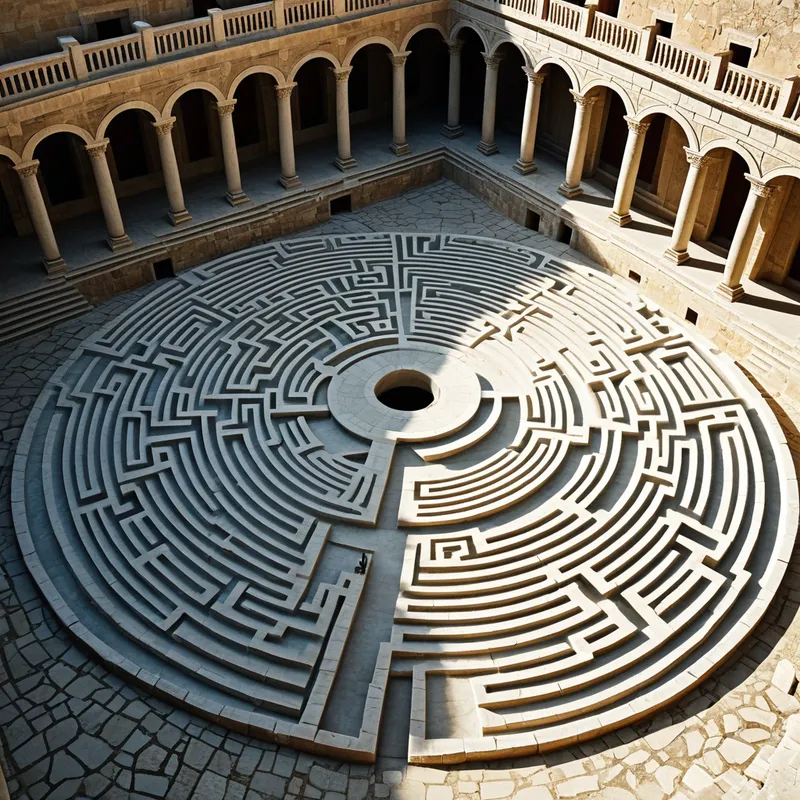
And so Daedalus bent his mind to the task. He did not design a fortress, but a puzzle. He drew upon [the earth](/myths/the-earth “Myth from Hindu culture.”/) a design of such bewildering complexity that the path inward became the trap itself. Winding corridors doubled back upon themselves. Dead ends mocked progress. The very sunlight seemed to get lost in its turns. This was [the Labyrinth](/myths/the-labyrinth “Myth from Greek culture.”/), a masterpiece of confinement. Its center, an open courtyard, became [the world](/myths/the-world “Myth from Tarot culture.”/) for [the Minotaur](/myths/the-minotaur “Myth from Greek culture.”/), who paced and raged in the sun, fed on tributes of flesh. The maze served its purpose. The secret was contained.
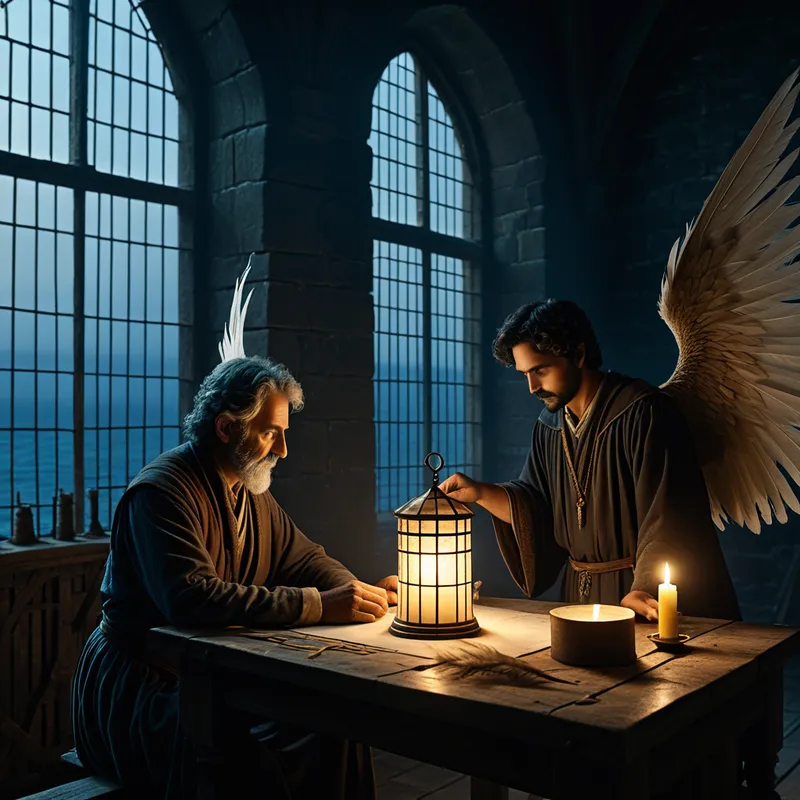
But [the architect](/myths/the-architect “Myth from Various culture.”/) of secrets often becomes their keeper. Daedalus, who knew the secret of the maze’s construction, and his young son [Icarus](/myths/icarus “Myth from Greek culture.”/), became threats to the king’s peace. For knowing [the way](/myths/the-way “Myth from Taoist culture.”/) out of a prison makes you its most dangerous occupant. Minos, in his cunning, turned the genius’s creation against him. He imprisoned Daedalus and [Icarus](/myths/icarus “Myth from Greek culture.”/) within the very tower that overlooked the [labyrinth](/myths/labyrinth “Myth from Various culture.”/), making them captives of the vista of his own brilliant, terrible design.
Stone walls and sea horizons now defined their world. But a mind that can conjure a labyrinth to contain a monster can dream of a path to contain none. Daedalus looked not to the earth, but to [the sky](/myths/the-sky “Myth from Persian culture.”/). “Minos may control the land and [the sea](/myths/the-sea “Myth from Greek culture.”/),” he told Icarus, “but he does not control the air.” Gathering feathers fallen from gulls and hawks, and harnessing the wax of bees, he crafted two pairs of wings, binding feather to feather with wax and cord. They were fragile, sublime things—a father’s final, desperate act of creation.
With warnings as careful as his construction—“Follow my path, fly the middle course, lest the sun’s heat melt the wax or the sea’s damp clog the feathers”—they leapt from their tower. For a glorious, breathless moment, it worked. They were free, soaring over the labyrinth, its confusing patterns now a mere sketch on the earth below. But the heart, once caged, can soar too recklessly. Icarus, drunk on the ecstasy of liberation, flew higher, drawn to the blazing sun. The wax softened, wept, and failed. The feathers scattered. A cry was lost in [the wind](/myths/the-wind “Myth from Various culture.”/), and a father could only watch as his son fell into the sea that now bears his name.
Daedalus flew on, alone, to Sicily. He built a temple to Apollo and hung up his wings as an offering. He had escaped the maze of stone, but he would forever walk the labyrinth of his grief.
Cultural Origins & Context
The myth of Daedalus and the Labyrinth is a foundational strand in the tapestry of Hellenic mythology, most comprehensively preserved in later Roman sources like Ovid’s [Metamorphoses](/myths/metamorphoses “Myth from Greek culture.”/) and threaded through the works of historians like Plutarch. It functions as an etiological myth, explaining the Minoan palace of Knossos (with its complex, multi-chambered layout) to later Greeks as a “labyrinth.” The story was not merely entertainment; it was a cultural narrative about the limits of human ingenuity, the consequences of hubris (both royal and paternal), and the price of containing monstrous truths. Told by bards and later written by poets, it served as a cautionary tale about the creations that outlive and ultimately ensnare their creators, a theme resonant for any civilization navigating the double-edged sword of technological and artistic advancement.
Symbolic Architecture
The [Labyrinth](/symbols/labyrinth “Symbol: The labyrinth represents a complex journey, symbolizing the intricate path toward self-discovery and understanding one’s life’s direction.”/) is the myth’s central, polyvalent [symbol](/symbols/symbol “Symbol: A symbol can represent an idea, concept, or belief, serving as a powerful tool for communication and understanding.”/). It is not merely a [prison](/symbols/prison “Symbol: Prison in dreams typically represents feelings of restriction, confinement, or a lack of freedom in one’s life or mind.”/), but a map of a specific psychic state.
The labyrinth is the perfected structure of a repressed complex—a beautiful, logical, inescapable architecture built to contain something we fear is too monstrous to face.
Daedalus represents the brilliant, [problem](/symbols/problem “Symbol: Dreams featuring a ‘problem’ often symbolize internal conflicts or challenging situations that require resolution and self-reflection.”/)-solving ego-[consciousness](/symbols/consciousness “Symbol: Consciousness represents the state of awareness and perception, encompassing thoughts, feelings, and experiences.”/). His initial [task](/symbols/task “Symbol: A task represents responsibilities, duties, or challenges one faces.”/) is a psychic one: to rationally organize and hide the unacceptable [shadow](/symbols/shadow “Symbol: The ‘shadow’ embodies the unconscious, repressed aspects of the self and often represents fears or hidden emotions.”/) content (the [Minotaur](/symbols/minotaur “Symbol: The Minotaur, a creature from Greek mythology, is often interpreted as a symbol of inner turmoil and the struggle between human and beast.”/)) born from a royal (egoic) transgression. He succeeds, but at the cost of internalizing the [structure](/symbols/structure “Symbol: Structure in dreams often symbolizes stability, organization, and the framework of one’s life, reflecting how one perceives their environment and personal life.”/) of repression. He becomes trapped in his own [defense](/symbols/defense “Symbol: A protective mechanism or barrier against perceived threats, representing boundaries, security, and resistance to external or internal challenges.”/) [mechanism](/symbols/mechanism “Symbol: Represents the body’s internal systems, emotional regulation, or psychological processes working together like a machine.”/). The [Minotaur](/symbols/minotaur “Symbol: The Minotaur, a creature from Greek mythology, is often interpreted as a symbol of inner turmoil and the struggle between human and beast.”/) itself is not evil incarnate, but the instinctual, hybridized [shadow](/symbols/shadow “Symbol: The ‘shadow’ embodies the unconscious, repressed aspects of the self and often represents fears or hidden emotions.”/)—the raw, untamed libido and aggression resulting from a fractured [relationship](/symbols/relationship “Symbol: A representation of connections we have with others in our lives, often reflecting our emotional state.”/) with the divine (Poseidon) and natural law.
The wings fashioned in captivity symbolize the transcendent function—the [psyche](/myths/psyche “Myth from Greek culture.”/)’s [capacity](/symbols/capacity “Symbol: A measure of one’s potential, limits, or ability to contain, process, or achieve something, often reflecting self-assessment or external demands.”/) to generate a completely novel [solution](/symbols/solution “Symbol: A solution symbolizes resolution, clarity, and the overcoming of obstacles, often representing a sense of accomplishment.”/) (puer-like inspiration, the [feather](/symbols/feather “Symbol: A feather represents spiritual elevation, lightness, and the freedom of the spirit. It often symbolizes messages from the divine and connection to ancient wisdom.”/)) grounded by earthly wisdom ([senex](/symbols/senex “Symbol: The wise old man archetype representing spiritual authority, ancestral wisdom, and the integration of life experience into transcendent knowledge.”/)-like caution, the wax). Their [flight](/symbols/flight “Symbol: Flight symbolizes freedom, escape, and the pursuit of one’s aspirations, reflecting a desire to transcend limitations.”/) is the arduous process of individuation, requiring a precise balance between soaring inspiration and grounded [reality](/symbols/reality “Symbol: Reality signifies the state of existence and perception, often reflecting one’s understanding of truth and life experiences.”/). Icarus’s fall is the inevitable [inflation](/symbols/inflation “Symbol: A dream symbol representing feelings of diminishing value, loss of control, or expansion beyond sustainable limits in one’s life or psyche.”/) and collapse when one identifies solely with the liberated [spirit](/symbols/spirit “Symbol: Spirit symbolizes the essence of life, vitality, and the spiritual journey of the individual.”/), ignoring the [material](/symbols/material “Symbol: Material signifies the tangible aspects of life, often representing physical resources, desires, and the physical world’s influence on our existence.”/) constraints of existence.
The Dreamer’s Resonance
To dream of a labyrinth is to dream of being in-process within your own psyche. The somatic feeling is often one of anxiety, frustration, or claustrophobia—a literal embodiment of feeling “boxed in” by a life situation, a relationship, or an internal dilemma. The dreamer is not yet facing the Minotaur; they are navigating the convoluted pathways of resistance their own mind has constructed to avoid it.
This dream pattern signals a profound psychological process: the confrontation with a personal “minotaur.” This could be a buried trauma, a shameful desire, a rageful part of [the self](/myths/the-self “Myth from Jungian culture.”/), or a creative impulse deemed too dangerous. The maze walls are the rationalizations, distractions, and old coping mechanisms that keep this content sequestered. The dream is the psyche’s way of rehearsing the journey to the center, indicating that [the ego](/myths/the-ego “Myth from Jungian culture.”/) is now strong enough, or desperate enough, to begin the descent. There is no [Theseus](/myths/theseus “Myth from Greek culture.”/) in this personal version; the dreamer is both Daedalus and the potential slayer of their own beast.
Alchemical Translation
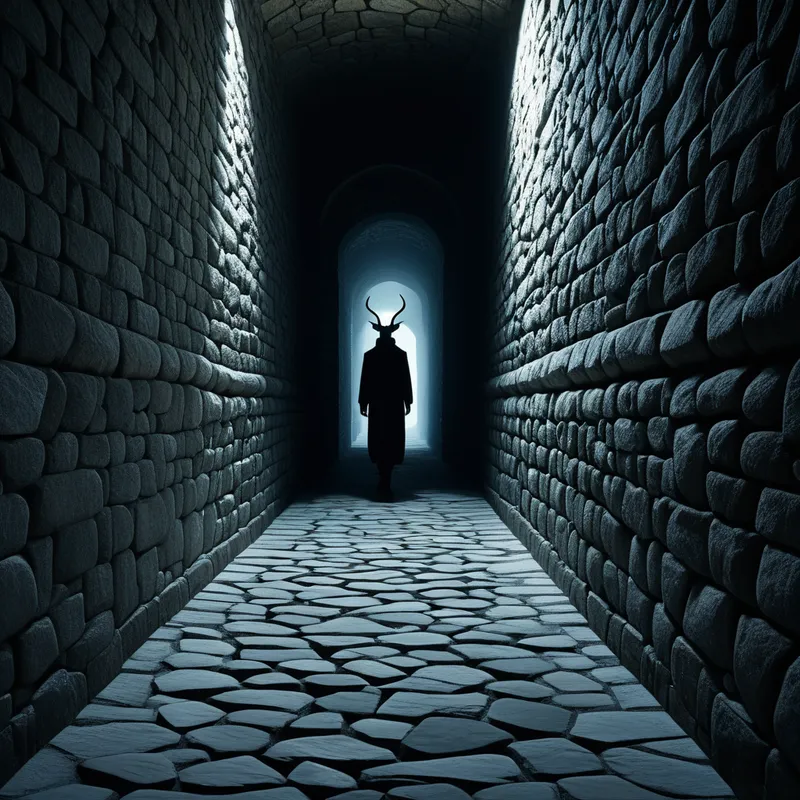
The myth models the full alchemical cycle of psychic transmutation. The [nigredo](/myths/nigredo “Myth from Alchemical culture.”/), or blackening, is the construction of the labyrinth itself—the conscious act of repression that creates a dark, chaotic, and confusing inner landscape. The Minotaur in its courtyard is the [prima materia](/myths/prima-materia “Myth from Alchemical culture.”/), the despised and base material that holds the key to transformation.
The prison of the labyrinth becomes the vas hermeticum, the sealed vessel, where the confrontation between the conscious mind (Daedalus) and the shadow (the Minotaur) must occur under pressure.
Daedalus’s realization in [the tower](/myths/the-tower “Myth from Tarot culture.”/) is the albedo, the whitening or illumination—the moment of insight that a solution must come from a higher order of thinking, from a synthesis of opposites (earth and air, wax and feather). Crafting the wings is the conscious engagement with the transcendent function. The flight itself is the citrinitas, the yellowing or spiritual ascent, a dangerous and ecstatic stage of liberation from old patterns.
Icarus’s fall is a necessary part of the process, representing the dissolution of inflated identification. Daedalus’s lonely landing and dedication to Apollo symbolizes the final stage, [rubedo](/myths/rubedo “Myth from Alchemical culture.”/) or reddening: the integration. He does not return to glory, but to sober, dedicated service to the solar principle of consciousness. He has transcended the maze not by destroying it, but by rising above its pattern, having internalized its lesson. The liberated modern individual is not one who has no labyrinth, but one who has learned its design, faced its center, and found a way to soar, however painfully, beyond its confining walls.
Associated Symbols
Explore related symbols from the CaleaDream lexicon: