The Labyrinth of Crete - each Myth Meaning & Symbolism
A hero enters a maze built by a god to confront a monstrous hybrid, navigating betrayal, love, and cunning to find his way back to the light.
The Tale of The Labyrinth of Crete - each
Hear now the tale of a prison built by a god, a monster born of a king’s shame, and the thread that led a hero home. It begins not with a roar, but with a sigh—the sigh of [the sea](/myths/the-sea “Myth from Greek culture.”/) against the shores of mighty Crete, an island ruled by a king whose pride was as vast as his palace.
King [Minos](/myths/minos “Myth from Greek culture.”/), son of Zeus, prayed to [Poseidon](/myths/poseidon “Myth from Greek culture.”/) for a sign of favor. From the foam-flecked waves, the god sent a bull, a creature of such stunning, snow-white perfection it seemed carved from moonlight on the sea. This bull was meant for sacrifice, a gift returned to the god. But [Minos](/myths/minos “Myth from Greek culture.”/)’s heart, seized by greed, could not part with such splendor. He hid the divine bull and sacrificed another in its place. The sea is not so easily deceived. [Poseidon](/myths/poseidon “Myth from Greek culture.”/)’s wrath did not come as a wave, but as a twisted passion. He caused [Minos](/myths/minos “Myth from Greek culture.”/)’s queen, Pasiphaë, to burn with an unnatural desire for the magnificent beast.
In her desperation, the queen sought the aid of the master craftsman Daedalus, exiled on Crete. With art that blurred the line between creation and abomination, he built for her a hollow cow of wood and hide. From this deception, a creature was born: part man, part bull, all fury. They named him Asterion, but [the world](/myths/the-world “Myth from Tarot culture.”/) would know him as the [Minotaur](/myths/minotaur “Myth from Greek culture.”/). His bellow was not of this earth; it was the sound of a king’s broken oath and a queen’s cursed longing.
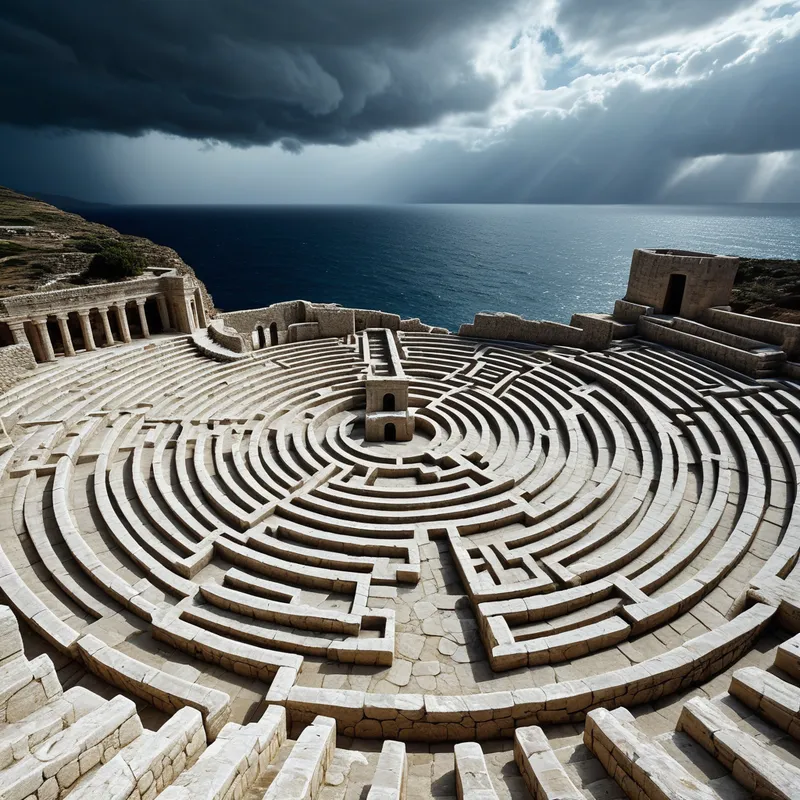
To hide his shame and contain the horror, Minos again summoned Daedalus. “Build me a prison,” he commanded, “from which nothing that enters may ever leave.” And so Daedalus, whose mind held the blueprints of the impossible, conceived the [Labyrinth](/myths/labyrinth “Myth from Various culture.”/). It was not a mere maze of walls, but a living puzzle of stone, a winding, confounding trap where corridors doubled back upon themselves, where the very air grew still and direction died. At its center, in a sunless court, [the Minotaur](/myths/the-minotaur “Myth from Greek culture.”/) paced, feeding on the tribute of a conquered land: seven youths and seven maidens sent every nine years from Athens, a blood price for the death of Minos’s son.
Then came the third tribute. Among the chosen Athenian youths was a prince with the sea in his eyes: [Theseus](/myths/theseus “Myth from Greek culture.”/), son of Aegeus. He vowed to slay the monster and end the ghastly tax. When his ship of black sails arrived in Crete, the princess Ariadne saw him. In his bearing, she saw not just a victim, but an end to the nightmare that haunted her house. Love and defiance sparked in her heart. She went to Daedalus, [the architect](/myths/the-architect “Myth from Various culture.”/) of their collective prison, and learned the secret: to conquer [the Labyrinth](/myths/the-labyrinth “Myth from Greek culture.”/), one must not memorize its path, but carry a guide that connects the inner darkness to the outer world.
She found Theseus in the gloom before the dawn of his descent. Into his hand, she pressed a ball of gleaming thread. “Tie this to the entrance,” she whispered, her voice a thread itself in the silent hall. “Unwind it as you go. It will remember [the way](/myths/the-way “Myth from Taoist culture.”/) when your mind cannot.”
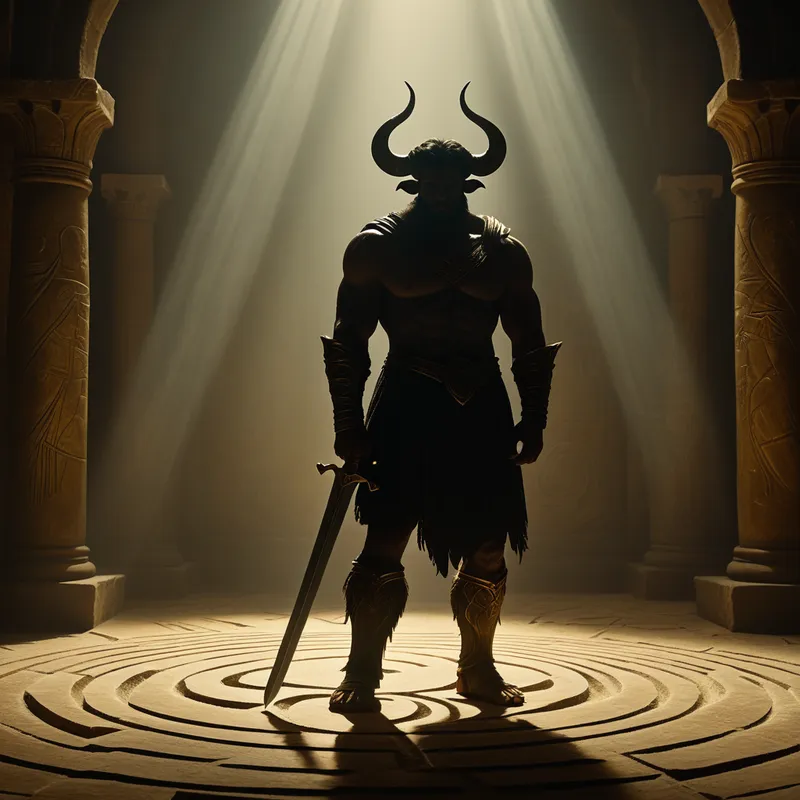
Theseus stepped into the mouth of the Labyrinth. The world of light and sound fell away, replaced by the echo of his own breath, the cool, dead touch of stone, and a distant, rhythmic snuffling. He followed the thread, a slender tether to life, deeper into the belly of the beast. The path writhed, logic unraveled, but the thread held true. He found the center. There, in the oppressive dark, stood the Minotaur—a mountain of muscle and sorrow, its human eyes full of a confused agony, its bull’s head lowering for the charge. The fight was brutal, a primal dance in the dust. With a final, mighty blow, Theseus slew the monster, its death cry echoing through the endless corridors like a fading curse.
Then came the true test: the return. In the disorienting silence, with adrenaline fading, only the slender, golden thread glimmering on the dark floor showed the way. He followed it back, hand over hand, heart pounding, from the realm of the monstrous back to the world of men, emerging into the blinding Cretan sun, a hero born from a knot.
Cultural Origins & Context
This is a core myth of the ancient Aegean world, a foundational story for both Minoan Crete and later Athenian Greece. It exists at a volatile cultural crossroads. Archaeologically, the grandeur of the Palace of Knossos, with its complex, multi-chambered layout, likely inspired the idea of the Labyrinth. The myth served multiple societal functions: for Athens, it explained and justified a historical tributary relationship to Minoan power, while transforming it into a narrative of heroic liberation. For Crete, it was a tale of royal hubris and divine punishment, a warning about the consequences of betraying the gods.
The story was kept alive by oral bards and later cemented by poets like Hesiod and the great tragedians. It was not mere entertainment; it was a psychic map. It taught about the dangers of hybris (excessive pride), the inescapable nature of divine [justice](/myths/justice “Myth from Tarot culture.”/), and the thin line between civilization and the monstrous chaos it seeks to contain. The Labyrinth itself became a universal symbol, transcending its Cretan origins to become a global archetype of the perplexing journey.
Symbolic Architecture
The [Labyrinth](/symbols/labyrinth “Symbol: The labyrinth represents a complex journey, symbolizing the intricate path toward self-discovery and understanding one’s life’s direction.”/) is the myth’s central [symbol](/symbols/symbol “Symbol: A symbol can represent an idea, concept, or belief, serving as a powerful tool for communication and understanding.”/). It is not merely a physical trap, but a representation of the unconscious mind—complex, winding, easy to get lost in, and housing a hidden, terrifying [aspect](/symbols/aspect “Symbol: A distinct feature, quality, or perspective of something, often representing a partial view of a larger whole.”/) of [the self](/myths/the-self “Myth from Jungian culture.”/).
The monster at the center is not an external foe, but the unintegrated shadow, the product of repressed desire, shame, and broken oaths that we refuse to face.
The [Minotaur](/symbols/minotaur “Symbol: The Minotaur, a creature from Greek mythology, is often interpreted as a symbol of inner turmoil and the struggle between human and beast.”/) is the ultimate hybrid, born of a transgression against natural order. It symbolizes the inevitable, monstrous [offspring](/symbols/offspring “Symbol: Represents legacy, responsibility, and the future self. Often symbolizes creative projects or personal growth.”/) of denied passions and spiritual deceit. It is the [king](/symbols/king “Symbol: A symbol of ultimate authority, leadership, and societal order, often representing the dreamer’s inner power or external control figures.”/)’s hidden greed and the [queen](/symbols/queen “Symbol: A queen represents authority, power, nurturing, and femininity, often embodying leadership and responsibility.”/)’s unspeakable desire made flesh, confined but never reconciled.
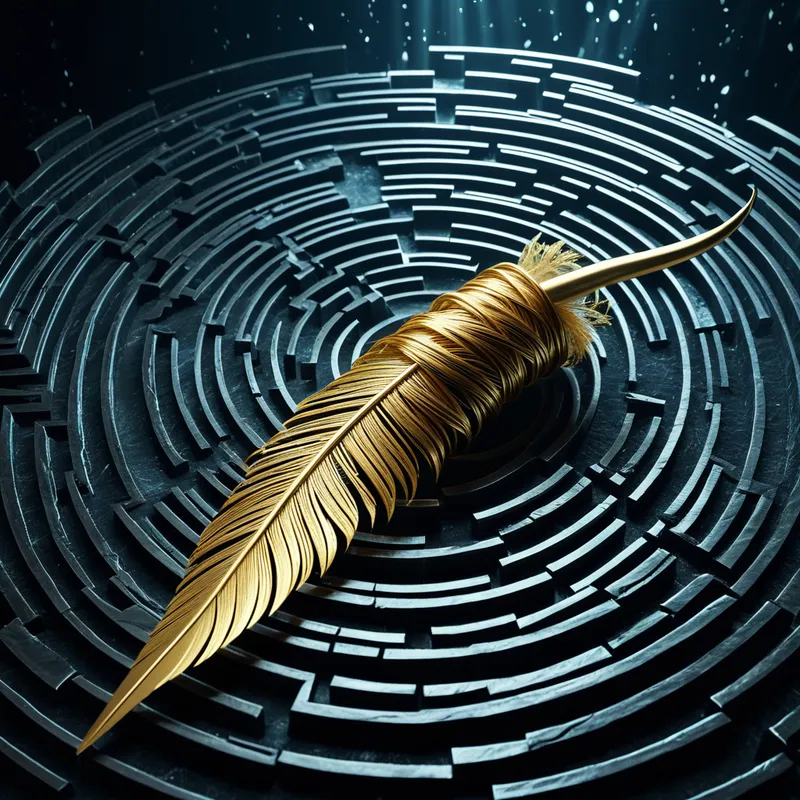
Theseus represents the conscious ego embarking on the perilous [journey](/symbols/journey “Symbol: A journey in dreams typically signifies adventure, growth, or a significant life transition.”/) of self-[discovery](/symbols/discovery “Symbol: The act of finding something previously unknown, hidden, or lost, often representing personal growth, new opportunities, or hidden aspects of the self.”/). His weapons are courage and will, but they are useless without Ariadne’s thread. This thread is the symbol of [gnosis](/symbols/gnosis “Symbol: Direct, intuitive spiritual knowledge or enlightenment that transcends ordinary understanding, often associated with mystical experiences and esoteric traditions.”/)—intuitive [knowledge](/symbols/knowledge “Symbol: Knowledge symbolizes learning, understanding, and wisdom, embodying the acquisition of information and enlightenment.”/), a [connection](/symbols/connection “Symbol: Connection symbolizes relationships, communication, and bonds among individuals.”/) to the guiding principle (Ariadne as an [anima](/symbols/anima “Symbol: The feminine archetype within the male unconscious, representing soul, creativity, and connection to the inner world.”/) figure) that can lead us through inner [chaos](/symbols/chaos “Symbol: In Arts & Music, chaos represents raw creative potential, uncontrolled expression, and the breakdown of order to forge new artistic forms.”/). It is the remembered [truth](/symbols/truth “Symbol: Truth represents authenticity, honesty, and the quest for knowledge beyond mere appearances.”/), the therapy, the creative [insight](/symbols/insight “Symbol: A sudden, deep understanding of a complex situation or truth, often arriving unexpectedly and illuminating hidden connections.”/), or the spiritual practice that provides a continuous link back to [consciousness](/symbols/consciousness “Symbol: Consciousness represents the state of awareness and perception, encompassing thoughts, feelings, and experiences.”/).
The Dreamer’s Resonance
When the Labyrinth appears in modern dreams, the dreamer is navigating a profound state of psychological confusion or a life transition with no clear path forward. The dream environment often feels endlessly repetitive, stifling, or deliberately misleading.
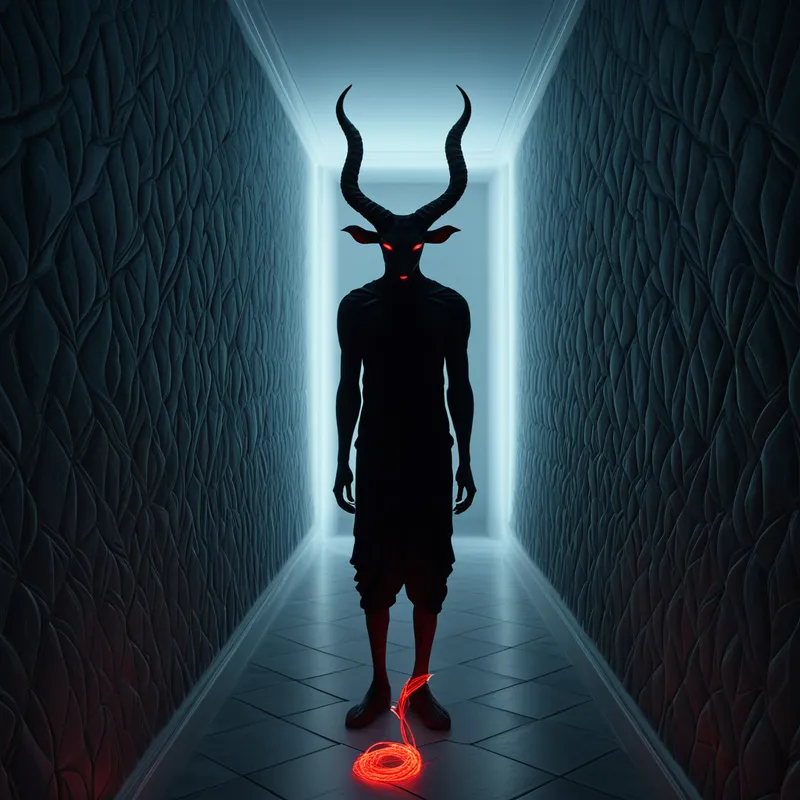
Dreaming of being lost in a maze signals a confrontation with a complex problem—emotional, professional, or existential—where linear thinking has failed. The somatic experience is one of anxiety, a tightening in the chest, and a feeling of being trapped. If the Minotaur appears, it heralds the unavoidable approach of a deeply repressed aspect of the self: perhaps a rage, a desire, or a childhood wound that can no longer be ignored. The creature’s emotion in the dream—whether aggressive, sorrowful, or passive—is a direct reflection of the dreamer’s relationship to their own shadow.
Finding or holding the thread in such a dream is a profoundly positive sign. It indicates the emergence of an inner resource, a nascent intuition or a connection to a supportive inner figure (the anima/animus) that promises a way through the confusion. It is the dream-ego finding its Ariadne.
Alchemical Translation
The myth models the complete process of individuation. The journey into the Labyrinth is the [nigredo](/myths/nigredo “Myth from Alchemical culture.”/), the descent into the darkness of the unconscious, the necessary confrontation with one’s own base and chaotic nature.
The slaying of the Minotaur is not an act of eradication, but of integration. One does not kill the shadow; one defeats its autonomous, terrifying power by bringing it into the light of consciousness.
Theseus’s victory represents the assimilation of [the shadow](/myths/the-shadow “Myth from Jungian culture.”/)’s energy. The brute force of the bull is harnessed; the human consciousness acknowledges its own bestial foundations. But the work is not done with the kill. The return, following the thread, is the critical phase of albedo—the whitening, the ascent. It is the process of bringing the insight gained in the depths back to the surface of daily life, of weaving the unconscious revelation into the fabric of the conscious personality.
Emerging from the Labyrinth, Theseus is transformed. He has faced the ultimate hybrid and survived, meaning he has reconciled dualities within himself. However, the myth’s full alchemy warns that integration is fragile. Theseus’s subsequent forgetfulness—abandoning Ariadne, failing to change his ship’s black sails—shows that the conscious ego, even after [triumph](/myths/triumph “Myth from Roman culture.”/), can lapse, causing new tragedies. The alchemical gold is not a permanent state, but a moment of hard-won wholeness that requires the eternal vigilance of the thread, the sustained connection to the guiding wisdom within.
Associated Symbols
Explore related symbols from the CaleaDream lexicon: