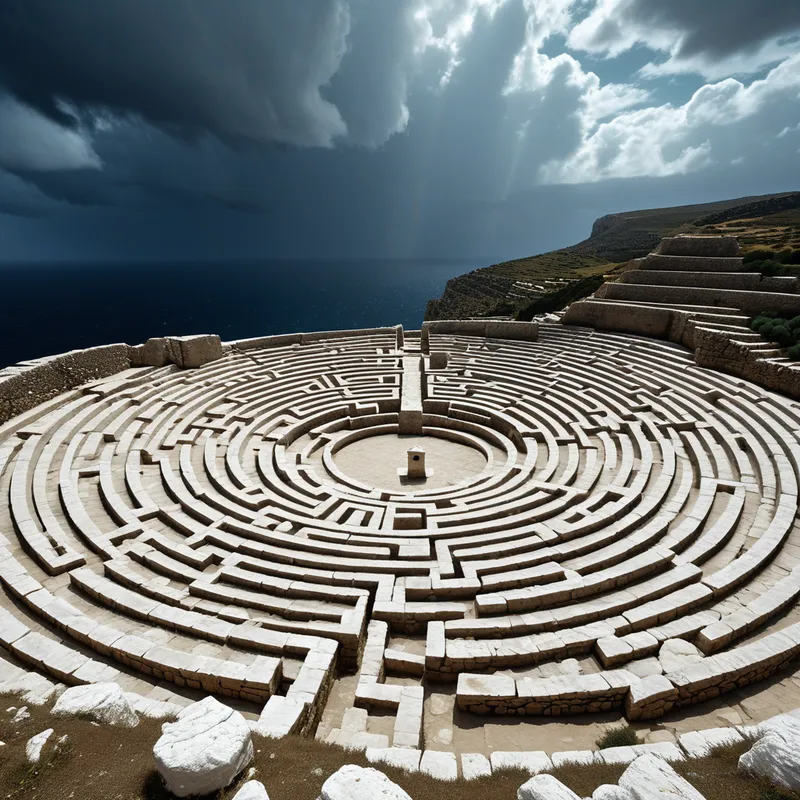
The Labyrinth Myth Meaning & Symbolism
A hero enters a monstrous maze to face the beast within, guided by a thread of consciousness, emerging transformed by his own darkness.
The Tale of The Labyrinth
Hear now the tale of the turning path, the story of the beast in the dark and the hero who was not born, but made. It begins not with a man, but with a king’s shame and a god’s curse.
In the great palace of [Minos](/myths/minos “Myth from Greek culture.”/), a queen walked with a heavy heart. Pasiphaë, bound by a cruel design of [the sea](/myths/the-sea “Myth from Greek culture.”/)-god [Poseidon](/myths/poseidon “Myth from Greek culture.”/), was consumed by a desire not of this world. From her union with a magnificent white bull sent from [the sea](/myths/the-sea “Myth from Greek culture.”/), a horror was born. Not a child, but a creature: a being with the muscled body of a man and the great, snorting head of a bull. They named it the [Minotaur](/myths/minotaur “Myth from Greek culture.”/). Its roar was the sound of shattered taboos, its hunger, a bottomless pit of royal disgrace.
King Minos, cloaking his shame in power, summoned the divine artisan, Daedalus. “Build me a prison,” commanded the king, his voice like cold marble. “A prison from which nothing that enters may ever find its way out.” And Daedalus, whose mind held the blueprints of impossibility, built. He built not a dungeon, but a [Labyrinth](/myths/labyrinth “Myth from Various culture.”/). A place of endless, winding corridors that doubled back upon themselves, where shadows moved independently of light, and the very walls seemed to shift and breathe. At its center, in a chamber of utter blackness, [the Minotaur](/myths/the-minotaur “Myth from Greek culture.”/) waited, its rage the only constant in the turning world.
And so the Labyrinth fed. To atone for the death of his son, Minos demanded a tribute from conquered Athens: seven youths and seven maidens, sent across the wine-dark sea every nine years. They were cast into the maze’s open maw, their cries swallowed by the stone, their fate to be found by the beast in the dark.
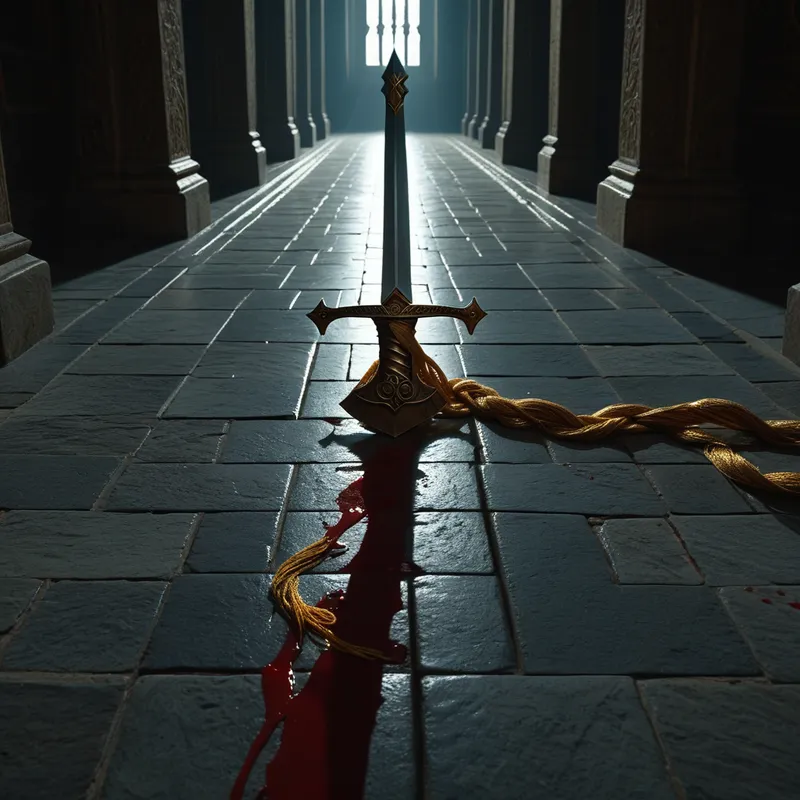
Until one came who would not be prey. [Theseus](/myths/theseus “Myth from Greek culture.”/), prince of Athens, volunteered as tribute. His heart was a fist of defiance. On the shores of Crete, his eyes met those of Ariadne, the princess. She saw not another victim, but a chance for her own escape from the gilded cage of her father’s secret. In the dead of night, she came to him. Into his hands she pressed two gifts: a ball of gleaming thread and a sword. “Tie one end to the entrance stone,” she whispered, her voice a thread itself. “Let it unravel as you walk. It will remember [the way](/myths/the-way “Myth from Taoist culture.”/) when you cannot. And this,” she said, touching the blade, “is for what you find in the heart of the turning.”
Theseus entered. The air grew thick and silent, a woolen blanket over the ears. The light from the entrance faded, replaced by a phosphorescent gloom that clung to the walls. He could hear the distant, rhythmic scrape of his own footsteps, and beneath it, something else: a deep, wet snuffling, and the slow, heavy drag of a chain. He followed the thread, his only tether to a world that no longer felt real. Left, right, a dead end that forced him back, the path coiling like a serpent around its own tail. The snuffling grew louder, mixed with the hot, rancid smell of a stable and a slaughterhouse combined.
Then, in a chamber vast and dark, he found it. The Minotaur was not just a beast; it was a monument of suffering, its eyes holding a terrible, knowing anguish. It charged, a force of pure instinct and inherited shame. The battle was not glorious; it was intimate, brutal, a grappling in the dark. Theseus, guided by Ariadne’s thread and driven by the memory of the Athenian youths, found his moment. The sword bit deep. The roar that echoed through the Labyrinth was one of final release.
Silence. Then, the slow re-winding of the thread, the golden line pulling him back through the nightmare, past the walls that now seemed only stone, back to the blinding light of [the world](/myths/the-world “Myth from Tarot culture.”/). He emerged, not just a prince, but a man who had walked in the house of his own potential madness and returned. With Ariadne and the spared Athenians, he set sail, leaving the empty Labyrinth behind—a silent, intricate tomb for the monster and the secret it once held.
Cultural Origins & Context
The myth of the Labyrinth is not a single story, but a tapestry woven from many threads of pre-Greek and Classical Greek culture. Its oldest layers likely originate in Minoan Crete (circa 2000-1450 BCE), a civilization the later Mycenaean Greeks viewed with awe and fear. The palace complexes of Crete, like Knossos, with their complex, multi-level layouts, may have inspired the idea of an inescapable maze. The bull was a central, sacred symbol in Minoan culture, evident in frescoes of bull-leaping rituals. The Greek myth of the Minotaur can be read as a cultural memory—a demonization of a powerful, bull-worshipping civilization they eventually superseded.
The story was codified in the oral tradition, recited by bards long before it was written down by poets like Hesiod and later dramatized. Its societal function was multifaceted. For Athenians, it was a foundational myth explaining their historical (and likely mythologized) tributary relationship with Minoan Crete, casting their eventual liberation in the heroic mold of Theseus. On a deeper level, it served as a powerful narrative about civic duty, the confrontation with chaos (the monster), and the necessity of cunning ([metis](/myths/metis “Myth from Greek culture.”/)) and external aid (Ariadne’s thread) to navigate impossible political and personal trials.
Symbolic Architecture
The [Labyrinth](/symbols/labyrinth “Symbol: The labyrinth represents a complex journey, symbolizing the intricate path toward self-discovery and understanding one’s life’s direction.”/) is the ultimate [symbol](/symbols/symbol “Symbol: A symbol can represent an idea, concept, or belief, serving as a powerful tool for communication and understanding.”/) of the convoluted, often deceptive [path](/symbols/path “Symbol: The ‘path’ symbolizes a journey, choices, and the direction one’s life is taking, often representing individual growth and exploration.”/) of the [psyche](/myths/psyche “Myth from Greek culture.”/). It is not a [maze](/symbols/maze “Symbol: A maze represents confusion, complexity, or a search for truth, often reflecting life’s challenges or inner turmoil.”/), which implies trickery and dead ends designed to confuse. The classical Labyrinth, as depicted on ancient coins and in myths, is a unicursal path—a single, winding but non-branching route that leads inexorably to the center and back out again. This is its first great secret: the [journey](/symbols/journey “Symbol: A journey in dreams typically signifies adventure, growth, or a significant life transition.”/) [inward](/symbols/inward “Symbol: A journey toward self-awareness, introspection, and the exploration of one’s inner world, thoughts, and unconscious mind.”/) is not a [puzzle](/symbols/puzzle “Symbol: A symbol representing the challenge of solving complex problems, finding order in chaos, or assembling fragmented aspects of self or reality.”/) to be solved, but a process to be endured.
The Labyrinth is not a trap you are put in, but a process you must submit to. Its center is not a destination, but a confrontation.
The [Minotaur](/symbols/minotaur “Symbol: The Minotaur, a creature from Greek mythology, is often interpreted as a symbol of inner turmoil and the struggle between human and beast.”/) represents the [shadow](/symbols/shadow “Symbol: The ‘shadow’ embodies the unconscious, repressed aspects of the self and often represents fears or hidden emotions.”/)—the composite of all that is deemed monstrous, unacceptable, and instinctual within [the self](/myths/the-self “Myth from Jungian culture.”/) or the collective. Born of a transgressive union, it is the embodied consequence of repressed desire and divine [punishment](/symbols/punishment “Symbol: A dream symbol representing consequences for actions, often tied to guilt, societal rules, or internal moral conflicts.”/), fed by periodic sacrifices (the denial or [projection](/symbols/projection “Symbol: The unconscious act of attributing one’s own internal qualities, emotions, or shadow aspects onto external entities, people, or situations.”/) of one’s own vitality). Theseus is [the ego](/myths/the-ego “Myth from Jungian culture.”/)-[consciousness](/symbols/consciousness “Symbol: Consciousness represents the state of awareness and perception, encompassing thoughts, feelings, and experiences.”/) that volunteers for the descent, armed with will but naive to the true [nature](/symbols/nature “Symbol: Nature symbolizes growth, connectivity, and the primal forces of existence.”/) of the dark. Ariadne’s thread is the symbol of sophrosyne—the connecting thread of consciousness, mindfulness, or the guiding principle (be it love, intellect, or [faith](/symbols/faith “Symbol: A profound trust or belief in something beyond empirical proof, often tied to spiritual conviction or deep-seated confidence in people, ideas, or outcomes.”/)) that allows one to venture into the unconscious without becoming permanently lost. The sword is the discriminating, cutting power of conscious [choice](/symbols/choice “Symbol: The concept of choice often embodies decision-making, freedom, and the multitude of paths available in life.”/) and decisive [action](/symbols/action “Symbol: Action in dreams represents the drive for agency, motivation, and the ability to take control of situations in waking life.”/).
The Dreamer’s Resonance
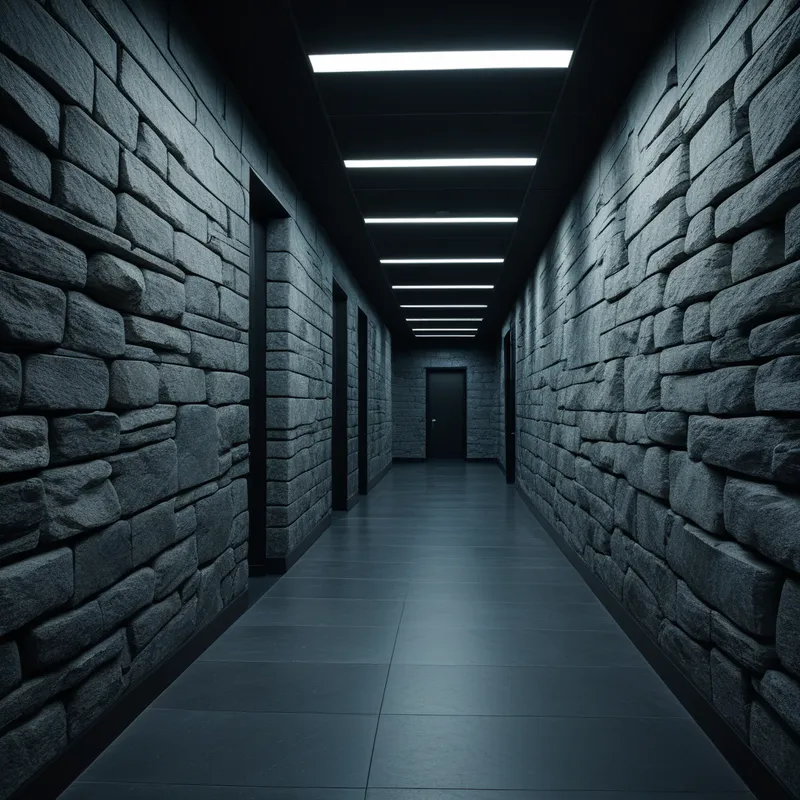
When the Labyrinth appears in modern dreams, it rarely manifests as a literal Cretan maze. It is the endless, repeating hallway; the impossible, shifting floorplan of a childhood home; the bureaucratic office that leads only to another waiting room. The somatic experience is one of profound disorientation, mounting anxiety, a tightening in the chest, and the feeling of time stretching into meaningless eternity.
Psychologically, this dream signals that the dreamer is in a state of psychic initiation. They are in the process, willingly or not, of navigating a complex inner process—a moral dilemma, a creative block, a period of depression, or the integration of a traumatic memory. The feeling of being lost is paramount because the conscious, problem-solving mind has been rendered useless. The dream is an expression of the psyche’s structure during this time: the path is set, but it is winding, dark, and requires surrender to the process itself. The terror of the “Minotaur” around the corner is the fear of what one might discover about oneself if one goes deep enough. The dream asks: What thread are you holding onto? What are you sacrificing to keep the beast in the dark fed?
Alchemical Translation
In the alchemical work of individuation—the process of becoming psychologically whole—the Labyrinth myth provides a precise map for the [nigredo](/myths/nigredo “Myth from Alchemical culture.”/), the blackening, the descent into [the prima materia](/myths/the-prima-materia “Myth from Alchemical culture.”/) of the soul.
The first step is the Call to the Center (The Tribute): Life circumstances or inner turmoil force the ego to acknowledge a neglected, hungry complex (the Minotaur) at the core of one’s personal labyrinth—be it rage, shame, dependency, or a stifled talent. One must volunteer for this journey; it cannot be outsourced.
The second is the Securing of the Thread (Ariadne’s Gift): Before descent, one must establish a connection to a guiding principle. This is not a map, but a tether: it could be a commitment to therapy (the therapeutic alliance as thread), a spiritual practice, a creative ritual, or a core relationship that grounds one in reality. It is the promise that consciousness will not be fully extinguished.
The alchemical gold is not found by slaying the beast, but by recognizing that the beast holds the key to the metal of your own soul.
The third is the Confrontation and Coincidentia Oppositorum (The Battle): In the heart of the dark, the ego meets [the shadow](/myths/the-shadow “Myth from Jungian culture.”/) not as an abstract concept, but as a living, breathing part of the self. The “slaying” is not annihilation, but a violent integration—the recognition that this monster is also you. The bull’s raw instinct and the hero’s conscious will merge in a transformative struggle. This is the alchemical conjunction, where opposites clash to create a third, new [thing](/myths/thing “Myth from Norse culture.”/).
The final step is the Return and Abandonment (The Sail Home): One follows the thread back, carrying the integrated energy of the shadow (now a source of power rather than shame). But the myth is brutally honest: Ariadne is abandoned on Naxos. The specific, personal form of the guiding thread (a particular relationship, an old identity) may not survive the transformation. You emerge from your labyrinth changed, and the world you return to can never be the same. The maze remains, but empty—a monument to the process you underwent, not a prison you inhabit. You are no longer lost, because you have learned that the only way out is all the way in.
Associated Symbols
Explore related symbols from the CaleaDream lexicon:
- Landscape
- Ditch
- Lane
- Freeway
- Indoor
- Zoo
- Route
- Subway
- Pattern
- Trap
- Confused
- Walkway
- Urban
- Metro
- Jail
- Victorian
- Winding Pathway
- Unmade Bed
- Tangled Threads
- Curving Pathway
- Winding Railroad
- Worn-out Footpath
- Asteroid Belt
- Spiraling Germanium
- Forest Path
- Insect-Filled Room
- Crowded Office
- Brick Wall
- Rubik’s Cube
- Narrative Pathways
- Surreal Storyline
- Ladder Shelf
- Metal Filing Cabinet
- Spiral Staircase
- Disoriented GPS
- Light-up Yo-Yo
- Piano Key Patterns
- Secret Passageway
- Abandoned Quarry
- Abandoned Subway Station
- Train Tracks
- Tangled Vines
- Veiled Chambers
- Bramble-Enclosed Sanctuary
- Crumbling Walls
- Grimy Alley
- Twisted Ribbon
- Rectangle
- Zigzag
- Uneven Cobblestones
- Bamboo Trap
- Tangled Fishing Line
- Trap Trigger
- Cave Wall Painting
- Shell Midden
- Natural Rattan
- Sticky Texture
- Stale Air
- Soundproof Room
- The Bureaucracy
- The Clause
- Binding
- Setting
- Hedge
- Torsion
- Twisting
- Curving
- Linear
- Esker
- Organic Swirls
- Deserted Hall