The Labors of Hercules—a serie Myth Meaning & Symbolism
A hero's epic journey of atonement through twelve impossible tasks, a myth of purification, transformation, and the struggle to master the inner and outer worlds.
The Tale of The Labors of Hercules—a serie
Hear now the tale of the strongest man who ever lived, a tale not of glory first, but of blood and madness. It begins in the silent aftermath of a scream. Hercules, beloved of the gods for his strength, lay broken in the courtyard of his own home. The smoke of burnt offerings still hung in the air, but it was now mingled with a sharper, metallic scent. Before him, in the cruel clarity of vanished frenzy, lay his wife and children, slain by his own hands—hands that had strangled serpents in his cradle, now stained with everything he held dear. The Furies whispered in the corners of his mind, their voices the only sound in the terrible silence.
Driven by agony, the hero sought purification. He traveled to the sacred oracle at Delphi, but the words of the Pythia were not of comfort, but of sentence. To be cleansed of his blood-guilt, he must enter the service of his cousin, King Eurystheus of Tiryns, a man small in stature and smaller in spirit. From him, Hercules would receive twelve tasks. Not simple chores, but impossible labors, each a death sentence crafted by the goddess Hera herself, who had sent the madness upon him.
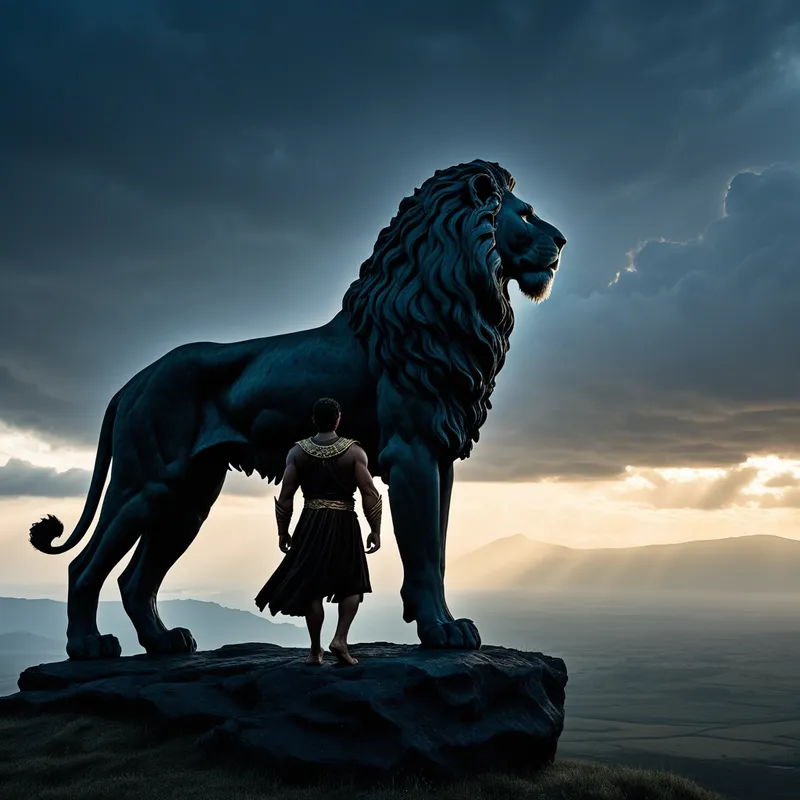
Thus began the great travail. He journeyed to the sun-baked valley of Nemea, where he faced a lion whose hide was impervious to bronze and iron. Weaponless, he entered its dark cave and met the beast with his hands, the struggle a symphony of snarls and cracking stone, until he choked the very breath from it, claiming its pelt as his armor. Next, in the swamps of Lerna, he confronted the Hydra, its heads multiplying with each blow. The air grew thick with the stench of venom and marsh gas. With fire and blade, aided by his loyal nephew Iolaus, he seared the necks to stop the regrowth, burying the one immortal head beneath a mountain.
The tasks unfolded like a map of the known and unknown world. He chased the Ceryneian Hind for a full year, a pursuit of patience over brute force. He captured the Erymanthian Boar by driving it into deep snow. He faced the filth of a generation in the Augean Stables, not with a shovel, but with the genius to divert two rivers. He drove away the monstrous Stymphalian Birds with a thunderous clash of bronze castanets.
His path then led beyond the familiar. To the island of Crete, where he wrestled the Cretan Bull from the sea itself. To the land of the fierce Amazons, where he secured the golden girdle of their queen. To the far west, where he seized the crimson cattle of the giant Geryon, under a hostile, setting sun. He descended into the very gloom of Hades to leash the three-headed hound Cerberus, a creature of shadow and saliva, and brought it, trembling, into the light of the upper world. His final labor was one of sublime cunning: to retrieve the golden apples from the garden of the Hesperides, which he accomplished not by force, but by convincing the Titan Atlas to fetch them for him.
When the twelfth task was done, Hercules stood before Eurystheus for the last time. The king cowered in his bronze jar, as he always had. The hero was no longer the broken man who had arrived. He was weathered, scarred, tempered by impossible trials. The blood-guilt was washed not by water, but by sweat, struggle, and the slow, hard-won mastery of a chaos both outside and within. He walked away, free, his labors complete, but his journey forever etched into the bones of the world.

Cultural Origins & Context
The myth of the Labors of Hercules is a foundational pillar of Hellenic storytelling, with roots stretching back into the Mycenaean Bronze Age. It was not a single, fixed text, but a living oral tradition, shaped and embellished by generations of bards, poets, and later, playwrights and historians. The canonical twelve labors were likely systematized in the Archaic period, possibly crystallized in epic poems now lost, before being recorded by authors like Hesiod and the Athenian playwrights.
Societally, the myth functioned on multiple levels. It was a charter story explaining the origins of place names, religious cults, and natural phenomena across the Greek world—the Nemean Games, the poisonous waters of Lerna, the presence of olive trees in certain regions. More profoundly, it served as a narrative container for the Greek understanding of heroism, which was inherently tragic and complex. Hercules was the ultimate culture hero, clearing the land of monsters to make it safe for civilization, yet he was also a figure of profound suffering, subject to the whims of the gods and the consequences of his own mighty passions. His labors modeled the virtues of ponos (toil, hardship) and kleos (glory, fame), the dual engines of the heroic ethos.
Symbolic Architecture
Psychologically, the labors are not a random series of monster fights, but a profound allegory for the individuation process—the hero’s journey inward. Hercules begins in a state of unconscious identification with his strength (his divine patrimony), which leads to a catastrophic eruption of the shadow (the madness sent by Hera). The labors are the prescribed, excruciating path of assimilation.
The first labor is always the confrontation with one’s own invulnerable, unconscious nature—the Nemean Lion, which can only be mastered from within its own dark cave, by one’s bare hands.
The sequence maps a progression. The early labors (Lion, Hydra, Hind, Boar) represent mastering the untamed, instinctual forces of the psyche—raw aggression, regenerative obsession, elusive spirit, and brute materialism. The middle labors (Stables, Birds) signify the cleansing of accumulated psychic filth and dispersing toxic, nagging thoughts. The later labors, which take him to the edges of the world and into the Underworld, symbolize engaging with the collective unconscious, confronting the “other” (the Amazon, the foreign giant), and ultimately integrating the guardian of the deepest threshold of the self: Cerberus. The final labor, the Apples of the Hesperides, represents the attainment of the sacred, immortal Self (the golden fruit of life), achieved not by direct force, but through wisdom, negotiation, and a temporary bearing of the world’s burden (tricking Atlas).
The Dreamer’s Resonance
When this mythic pattern stirs in the modern dreamer, it often manifests as a series of relentless, Herculean tasks. The dreamer may find themselves in an endless, labyrinthine building needing cleaning, facing a terrifying beast in their childhood home, or repeatedly attempting to complete a simple task that becomes monstrously complex. The somatic feeling is one of profound exhaustion, muscular strain, and gritty determination against impossible odds.
Psychologically, this signals a process of atonement—not for a literal crime, but for a felt sense of guilt, a life lived out of alignment, or a burden of responsibility that feels divinely imposed. The dream-ego is in the service of a petty “King Eurystheus”—often the internalized critic, the demands of the persona, or a soul-crushing job. The specific “labor” imagery provides clues: a dream of a multi-headed problem (Hydra) points to an issue that seems to grow when attacked directly. A dream of chasing something beautiful and elusive (the Hind) may speak to a neglected soul-calling. These dreams mark the psyche’s arduous, necessary work of re-ordering a life that has fallen into chaos or guilt.

Alchemical Translation
The alchemy of the Labors is the transmutation of raw, destructive power (the madness) into disciplined, culture-building strength. It is the opus contra naturam—the work against one’s own base nature—in service of a higher synthesis. Hercules begins as prima materia, a gifted but chaotic element. His crime is the nigredo, the blackening, the descent into utter despair and self-loathing.
Each labor is a calcination, a burning off of a specific impurity: the arrogance of invulnerability, the poison of resentment, the stagnation of neglect, the chaos of unbounded instinct.
The journey through the twelve stages is the long, iterative process of separatio and coagulatio—separating the essential heroic spirit from the dross of monstrous projections, and reconstituting it in a more resilient, integrated form. By descending to bring back Cerberus, he performs the classic alchemical feat of descending to the depths to retrieve the treasure. His final freedom is the rubedo, the reddening, the achievement of the philosopher’s stone: a self that has consciously integrated its shadows, borne its burdens, and can now act not from compulsion, but from hard-won sovereignty. For the modern individual, the myth does not promise a life without impossible tasks, but provides a map for finding sacred meaning within them, transforming endless toil into a purposeful, soul-forging journey.
Associated Symbols
Explore related symbols from the CaleaDream lexicon: