The Labors of Hercules - The c Myth Meaning & Symbolism
Hercules descends to capture Cerberus, the three-headed hound of Hades, in a final labor that is a journey into the deepest self.
The Tale of The Labors of Hercules - The c
The air in the mortal world grew thin for the son of Zeus. Twelve labors were decreed, and eleven lay behind him, each a scar upon [the earth](/myths/the-earth “Myth from Hindu culture.”/) and a trophy upon his soul. But the final task whispered of a different realm. It did not call him across sun-baked plains or into monster-haunted forests. It called him down.
King Eurystheus, his voice a dry rustle in the palace hall, named the unnameable: “Bring me Cerberus. Alive. From the house of [Hades](/myths/hades “Myth from Greek culture.”/) itself.”
A silence fell, deeper than any before. To descend to the land of the dead was one [thing](/myths/thing “Myth from Norse culture.”/); to return with its guardian was a demand that tasted of divine mockery. Yet, [Hercules](/myths/hercules “Myth from Greek culture.”/), his brow heavy with a fate not of his choosing, turned his face from the sun. He sought the mysteries at Eleusis, was purified, and learned the secret paths that lead where the living do not tread.
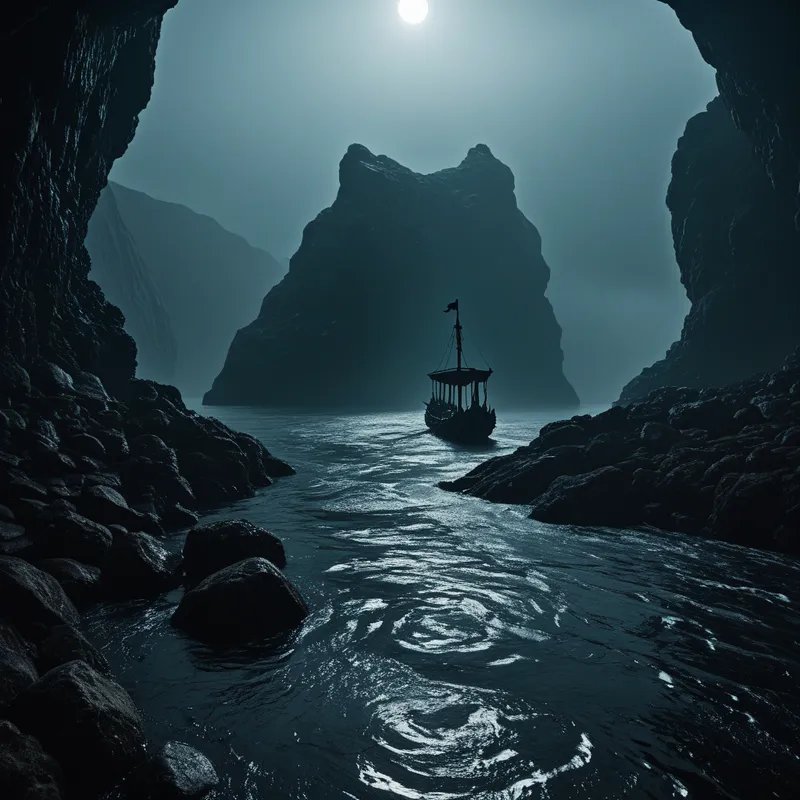
His descent was a shedding of light. The warmth of [the world](/myths/the-world “Myth from Tarot culture.”/) faded, replaced by a clammy, breathless chill. He stood before the Acheron, where the silent ferryman Charon, seeing a living man with purpose in his eyes, trembled and, for once, took a passenger without his coin. The waters of Cocytus wailed. On the far shore, the shadows thickened into forms—the gibbering, flitting shades of the dead, who parted before the solid, terrifying vitality of the hero.
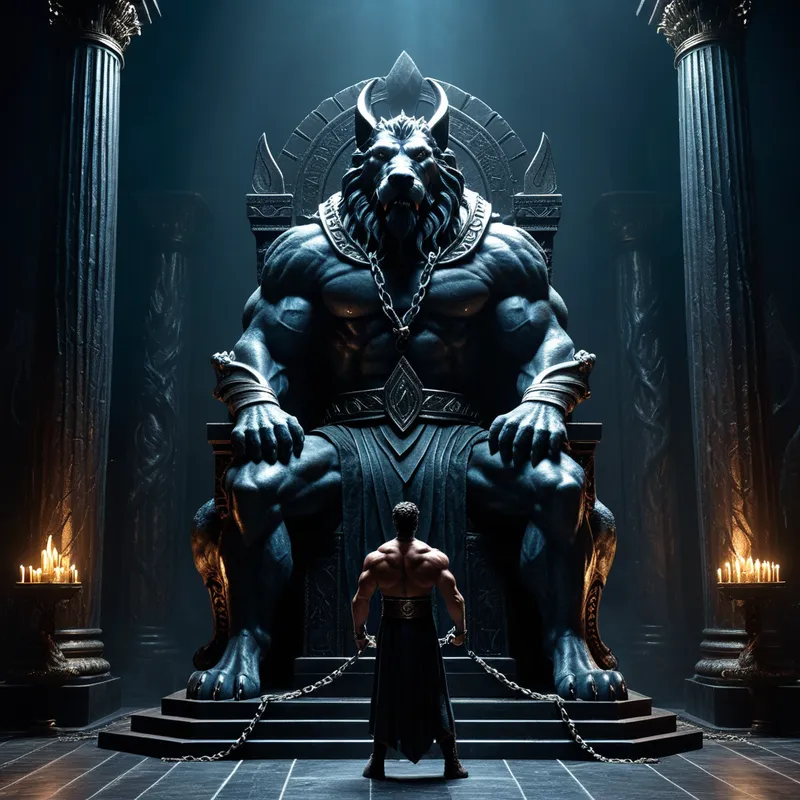
He walked the asphodel meadows, a giant among ghosts, until he stood before the ebony throne. There sat Hades, lord of the lost, his gaze like polished obsidian. And beside the throne, chained to the very gates of the Tartarean pit, was the Beast.
Cerberus was not merely a dog. He was a principle of finality. Three heads, each a maw of teeth that had known only the taste of despair, snarled in dissonant harmony. A mane of live serpents hissed, and his tail was a venomous dragon. He was the living lock on the door of death, the embodiment of “Thou Shalt Not Return.”
Hercules did not draw his club. He met the god’s gaze and asked, as one power to another, for the hound. Hades, with a god’s cold curiosity, consented on one condition: he must master the beast with his hands alone, without weapons. It was a test of raw, contained force against primordial chaos.
The battle was soundless but for the rasp of breath and the scrape of claws on stone. Hercules moved into the storm of teeth. One massive arm locked around a thrashing neck, then another. He absorbed the blows, the serpent bites, [the dragon](/myths/the-dragon “Myth from Chinese culture.”/)’s sting. This was not a fight to kill, but to contain. To wrestle chaos into a shape that could be led. Muscle and will against the essence of negation. Slowly, agonizingly, the wild snapping ceased. The great heads, subdued, drooped. The hero, bleeding from a hundred wounds that burned with otherworldly poison, had imposed his will. He slipped a chain around the creature’s neck.
His ascent was a reversal of creation. He dragged the essence of [the underworld](/myths/the-underworld “Myth from Greek culture.”/) up through the tunnels of the earth, past the staring shades, past a furious Charon, and finally, into the blinding light of the world at Troezen. The sun, which had never shone on such a creature, made the hound whimper. Hercules presented the subdued terror to Eurystheus, who, in a final act of cowardice, shrieked and begged him to take it back. And so Hercules, his labor complete, returned Cerberus to its post, the guardian restored to the gate, the order of the worlds preserved.
Cultural Origins & Context
This myth is the capstone of the most famous heroic cycle in the Western tradition, originating in ancient Greece. It was not a single, fixed story but a living narrative tapestry, woven by bards and refined by poets like [Homer](/myths/homer “Myth from Greek culture.”/) and later dramatized in the plays of Euripides and Seneca. It functioned as the ultimate expression of the demi-god archetype, pushing the concept of the hero to its existential limit.
Societally, the labors served as a foundational myth of order over chaos, civilization over wild nature. This final labor, however, transcended that. It was a boundary myth. By having Hercules successfully navigate the ultimate taboo—entering and exiting the land of the dead at will—it explored the human fascination with and terror of the afterlife. It was told in sacred spaces like Eleusis, hinting at initiatory mysteries, and in public forums as a testament to the extreme limits of human (or semi-human) potential. It asked the audience: What is the final test? It is not another monster in the world, but a confrontation with the guardian of the world beyond.
Symbolic Architecture
The twelfth labor is an unparalleled map of the heroic [journey](/symbols/journey “Symbol: A journey in dreams typically signifies adventure, growth, or a significant life transition.”/)’s final, [inward](/symbols/inward “Symbol: A journey toward self-awareness, introspection, and the exploration of one’s inner world, thoughts, and unconscious mind.”/) turn. Hercules, having conquered the external world, must now confront the internal one. The [Underworld](/symbols/underworld “Symbol: A symbolic journey into the unconscious, representing exploration of hidden aspects of self, transformation, or confronting repressed material.”/) is not a place of [punishment](/symbols/punishment “Symbol: A dream symbol representing consequences for actions, often tied to guilt, societal rules, or internal moral conflicts.”/) here, but the unconscious itself—the repository of all that is forgotten, repressed, and seemingly dead within us.
[Cerberus](/symbols/cerberus “Symbol: The three-headed hound guarding the underworld’s entrance, symbolizing boundaries, protection, and the unconscious mind’s threshold.”/) is the perfect [symbol](/symbols/symbol “Symbol: A symbol can represent an idea, concept, or belief, serving as a powerful tool for communication and understanding.”/) for the [guardian](/symbols/guardian “Symbol: A protector figure representing safety, authority, and guidance, often embodying parental, societal, or spiritual oversight.”/) of this threshold. His three heads represent the triune [nature](/symbols/nature “Symbol: Nature symbolizes growth, connectivity, and the primal forces of existence.”/) of the untamed, instinctual self that blocks [integration](/symbols/integration “Symbol: The process of unifying disparate parts of the self or experience into a cohesive whole, often representing psychological wholeness or resolution of internal conflict.”/): past [trauma](/symbols/trauma “Symbol: A deeply distressing or disturbing experience that overwhelms the psyche, often manifesting in dreams as unresolved emotional wounds or psychological injury.”/) (what bites from behind), present compulsive [emotion](/symbols/emotion “Symbol: Emotion symbolizes our inner feelings and responses to experiences, often guiding our actions and choices.”/) (what snarls in your face), and future [anxiety](/symbols/anxiety “Symbol: Anxiety in dreams reflects internal conflicts, fears of the unknown, or stress from waking life, often demonstrating the subconscious mind’s struggle for peace.”/) (what howls at what is to come). He is the psychic [resistance](/symbols/resistance “Symbol: An object or tool representing opposition, struggle, or the act of pushing back against external forces or internal changes.”/) that says, “You cannot integrate this. You cannot bring this content into the light of [consciousness](/symbols/consciousness “Symbol: Consciousness represents the state of awareness and perception, encompassing thoughts, feelings, and experiences.”/).”
The final labor is not to slay the beast of the unconscious, but to master it with bare hands—to acknowledge its power, to endure its venom, and to bring it, subdued, into the realm of the known.
Hercules’s weaponless combat is critical. He cannot use the tools of his former labors (club, bow, cunning). To integrate the deepest self, [the ego](/myths/the-ego “Myth from Jungian culture.”/) must shed its armaments and engage directly, with [vulnerability](/symbols/vulnerability “Symbol: A state of emotional or physical exposure, often involving risk of harm, that reveals authentic self beneath protective layers.”/) and immense courage. His return with the hound symbolizes the heroic ego’s temporary [assimilation](/symbols/assimilation “Symbol: The process of integrating new experiences, identities, or knowledge into one’s existing self, often involving adaptation and transformation.”/) of the unconscious’s raw, terrifying power. Yet, he must return it. This is the myth’s profound wisdom: we do not own the unconscious; we learn to [dialogue](/symbols/dialogue “Symbol: Conversation or exchange between characters, representing communication, relationships, and narrative flow in games and leisure activities.”/) with it, to respectfully chain its chaotic force so it can guard, not block, our [depths](/symbols/depths “Symbol: Represents the subconscious, hidden emotions, or foundational aspects of the self, often linked to primal fears or profound truths.”/).
The Dreamer’s Resonance
When this myth stirs in the modern [psyche](/myths/psyche “Myth from Greek culture.”/), it manifests in dreams of profound descent and confrontation. The dreamer may find themselves in a vast, dark basement, a deep cave, or a labyrinthine subway system—all symbols of the personal unconscious. The atmosphere is one of dread and momentous purpose.
The “Cerberus” figure is rarely a literal three-headed dog. It may be a snarling, multi-faceted shadow figure; a locked door guarded by three distinct, threatening presences; or a terrifying, composite animal that blocks a crucial path. The somatic experience is key: the dreamer feels the imperative to pass, but is frozen by a triune fear. This is the psyche signaling that a major integration is at hand—perhaps reconciling three conflicting life phases, three core wounds, or three dominant yet unintegrated personality aspects. The labor in the dream is to find the strength to approach, to endure the fear, and to find a way to “subdue” it not through destruction, but through acknowledgment and courageous engagement.
Alchemical Translation
In the alchemy of individuation, this myth models the [rubedo](/myths/rubedo “Myth from Alchemical culture.”/), the reddening—the stage of confrontation and integration that follows the dissolution ([nigredo](/myths/nigredo “Myth from Alchemical culture.”/)) of the descent. The hero’s journey into Hades is the [nigredo](/myths/nigredo “Myth from Alchemical culture.”/), [the dark night of the soul](/myths/the-dark-night-of-the-soul “Myth from Christian Mysticism culture.”/) where all former identities are stripped away.
The capture of Cerberus is the act of consciously seizing the primal, autonomous complex that has ruled the inner kingdom from the shadows. It is the egos attempt to make a pact with its own instinctual foundation.
For the modern individual, this labor translates to the most difficult inner work: facing the core, tripartite complex that guards our deepest pain and greatest power. It might be the triad of Shame, Rage, and Fear. One must “descend” through meditation, therapy, or profound crisis, and meet this complex not as an enemy to be annihilated, but as a powerful, misguided guardian. The “weaponless” condition means dropping our intellectualizations, our spiritual bypassing, our narratives of blame—our usual defenses. We must meet it with raw, honest presence.
Mastering it means understanding its function, hearing its snarled warnings, and, with immense self-compassion, integrating its energy. We bring this chained power back into the light of daily life—not to let it run amok, but to let its fierce loyalty protect our true boundaries, and its primal vitality fuel our authentic will. The final act, returning it to the gate, reminds us that this integrated power now rightfully guards [the threshold](/myths/the-threshold “Myth from Folklore culture.”/) between our conscious and unconscious lives, allowing for conscious passage and preventing a flood of unprocessed content. The labor is complete when the beast of the depths is no longer a terror from [the abyss](/myths/the-abyss “Myth from Kabbalistic culture.”/), but a respected part of [the self](/myths/the-self “Myth from Jungian culture.”/)’s sovereign architecture.
Associated Symbols
Explore related symbols from the CaleaDream lexicon: