The Labors of Hercules - Greek Myth Meaning & Symbolism
A hero's brutal atonement becomes a path of impossible trials, transforming monstrous chaos into sacred order and raw strength into divine wisdom.
The Tale of The Labors of Hercules - Greek
Hear now the tale of the strongest man who ever lived, and the heaviest burden he was made to bear. It begins not with glory, but with madness—a crimson fog sent by Hera, settling upon the mind of Heracles. In that divine delirium, he saw not his beloved wife and children, but monstrous shapes. When the fog lifted, his home was a charnel house, his hands stained with the blood of his own flesh. The silence that followed was more terrible than any roar.
Cleansed of the madness but not the guilt, Heracles, whom the Romans would call Hercules, wandered as a polluted soul. He sought purification at the sacred oracle of Apollo at Delphi. The Pythia, voice trembling with the god’s breath, did not offer absolution. Instead, she gave a sentence: to travel to Tiryns and place himself in the service of his cousin, King Eurystheus, a small and fearful man. From him, Heracles would receive twelve tasks. Not simple feats, but impossible labors. Only by completing them could his spirit be cleansed.
Thus began the path of atonement. The first labors were beasts of flesh and terror: the invulnerable lion of Nemea, whose hide he donned as armor; the many-headed Hydra of Lerna, whose necks sprouted two new heads for each one severed; the fleet-footed Ceryneian Hind, sacred to Artemis; the monstrous boar of Erymanthus. He wrestled, he chased, he cleansed.
But the tasks deepened, becoming journeys into the very architecture of the world. He had to clean the vast, immortal filth of King Augeas’s stables in a single day, a feat of ingenuity as much as strength. He drove away the man-eating Stymphalian birds with bronze-beaten clappers. To capture the savage bull of Crete, he dove into the realm of King Minos. To fetch the man-eating mares of Diomedes, he ventured into the wild north.
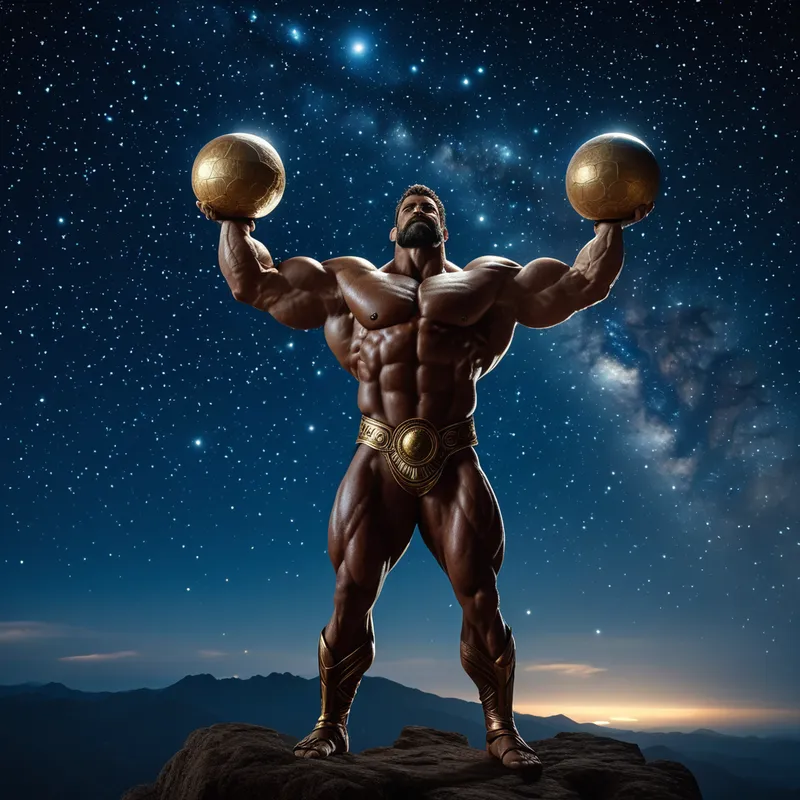
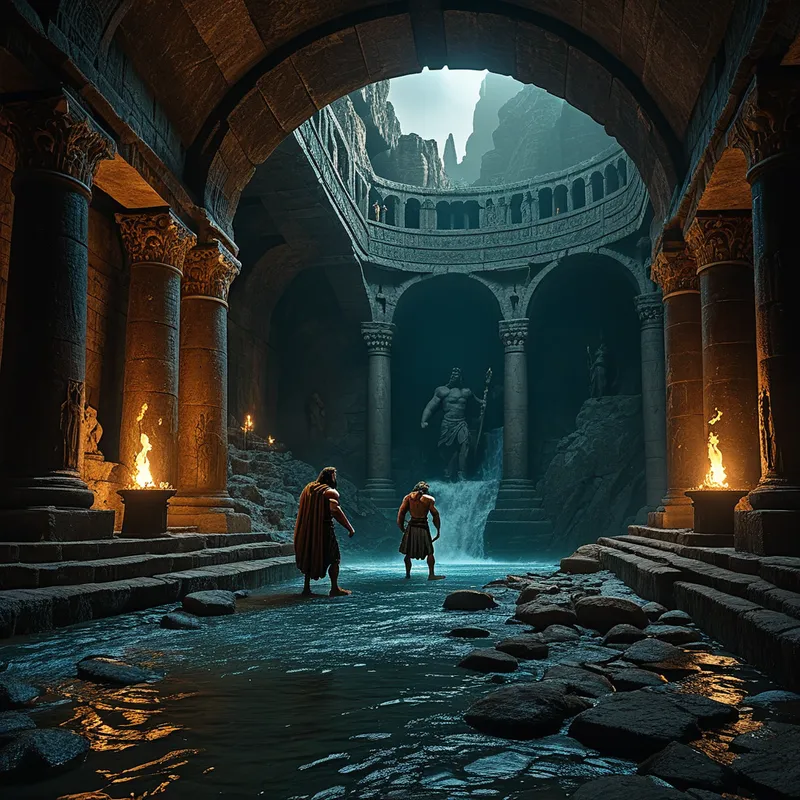
The final labors pulled him to the edges of the map and beyond. He journeyed to the land of the Amazons to retrieve the girdle of their queen. He sailed to the far west to steal the red cattle of the giant Geryon, a being with three bodies. In the twilight garden at the world’s edge, he tricked the titan Atlas into retrieving the golden apples of the Hesperides, himself bearing the weight of the sky. For his final descent, he left the sunlit world entirely. Chaining the three-headed hound Cerberus, he dragged the creature from the black depths of Hades itself, a final proof that not even death was a boundary to his imposed duty.
When the twelfth labor was done, and Cerberus returned to the gloom, a strange quiet fell. The blood was washed, the monsters slain or captured, the impossible achieved. The hero stood, not triumphant, but emptied. The labors were complete. The debt, in the eyes of gods and men, was paid.
Cultural Origins & Context
The myth of Heracles is not a single, frozen story but a living tapestry woven over centuries, from the Bronze Age to the height of Classical Greece. He is a pan-Hellenic figure, claimed by all city-states, yet forever the outsider—a Dorian hero whose myths were adopted and adapted. The canonical set of Twelve Labors was likely formalized in the Archaic period, possibly codified in epic poems now lost, such as the Labours of Heracles.
The tales were transmitted by bards, painted on pottery, sculpted on temple metopes, and performed in plays. Functionally, Heracles served multiple roles: a model of relentless endurance (ponos) and beneficial violence for the community; a symbol of the civilizing force that tames wild nature and monstrous chaos; and a paradox—a god (he would be deified after his death) who suffered a human’s tragic fate. His labors mapped the known and imagined world of the Greeks, from the local groves of the Peloponnese to the fantastical edges of Oceanus, making him a mythic geographer as well as a hero.
Symbolic Architecture
The Labors are not a random checklist of monster-slaying. They are a precise, symbolic curriculum for the transformation of raw, unconscious power. Heracles begins as pure, untamed bia (force)—a strength that, when corrupted by unconscious rage (Hera’s madness), is catastrophically destructive. The labors are the method by which that blind force is directed, focused, and ultimately redeemed.
The sequence itself is alchemical. The early, “Peloponnesian” labors represent the confrontation with the personal and local shadow: the lion (pride, untamed aggression), the hydra (the multiplying problems of repressed trauma), the boar (unchecked lust and gluttony). The later labors force the hero into the realm of culture, the feminine, and the supernatural—cleaning the stables (confronting collective shadow and decay), journeying to the Amazons (integrating the autonomous feminine), and finally, descending to the underworld (confronting mortality itself).
The hero’s path is the ego’s brutal education: raw power must be broken on the wheel of impossible tasks to be remade as conscious will.
Heracles’s tools are symbolic. His club is the primitive will; the Nemean Lion’s skin is the resilience earned through overcoming one’s own violent nature. His greatest labor is often not killing, but capturing and bringing back—a symbol of integration, not annihilation. He doesn’t destroy the underworld; he temporarily borrows its guardian, acknowledging the power of the depths.
The Dreamer’s Resonance
When the pattern of the Labors stirs in the modern psyche, it rarely appears as a classical hero. Instead, the dreamer may find themselves in an endless, exhausting loop of impossible tasks at work, or feel pursued by a relentless, shapeless dread that multiplies when confronted. The somatic feeling is one of profound burden—the shoulders ache, the breath is labored, as if holding up an invisible sky.
Psychologically, this dream-herald signals a profound crisis of atonement and purpose. The dreamer is in the grip of what they perceive as a necessary, brutal, and seemingly endless curriculum imposed by life—recovering from a trauma, navigating a protracted illness, or laboring under a crushing debt or responsibility. The “Eurystheus” figure may be an internal critic, a societal expectation, or a literal oppressive situation. The dream confirms a sacred, if painful, truth: the psyche is orchestrating a series of trials to force a transformation of some unconscious, destructive potential into a structured, resilient strength. The dreamer is in the stables, redirecting rivers of psychic filth. They are in the garden, negotiating for a golden apple of wholeness, while the weight of their world rests on their neck.

Alchemical Translation
The alchemy of the Labors is the transmutation of guilt into responsibility, and brute strength into individuated character. Heracles begins as a man defined by a crime (the polluted ego) and ends as a figure who has earned his divinity through enacted virtue. This is the model for the modern individuation process.
The first stage is the madness—the eruption of the shadow that shatters the old, naïve identity. The ensuing despair and guilt are the nigredo, the blackening. The oracle’s sentence—the labors themselves—is the albedo, the whitening, the long, arduous work of purification. Each labor is a confrontation with a specific aspect of the unconscious: the chthonic (the Hydra, Cerberus), the instinctual (the Boar, the Bull), the numinous (the Hind, the Apples).
Individuation is the ultimate labor: the systematic capture and integration of every wild thing within us, so that nothing in the psyche remains foreign or monstrous.
The final triumph is not a victory parade, but a quiet completion. The modern individual undergoing this “Herculean” process is not seeking applause, but integrity. They are learning to carry the sky of their own consciousness, to journey to their own psychic underworld and return, not with trophies, but with a hard-won knowledge. The labors teach that the goal is not to escape the burden, but to become strong enough, and conscious enough, to bear it rightly. The transformed self is not the one who has killed all its monsters, but the one who has made allies of them, wearing their skins as protection and wielding their essence as hard-earned wisdom.
Associated Symbols
Explore related symbols from the CaleaDream lexicon: