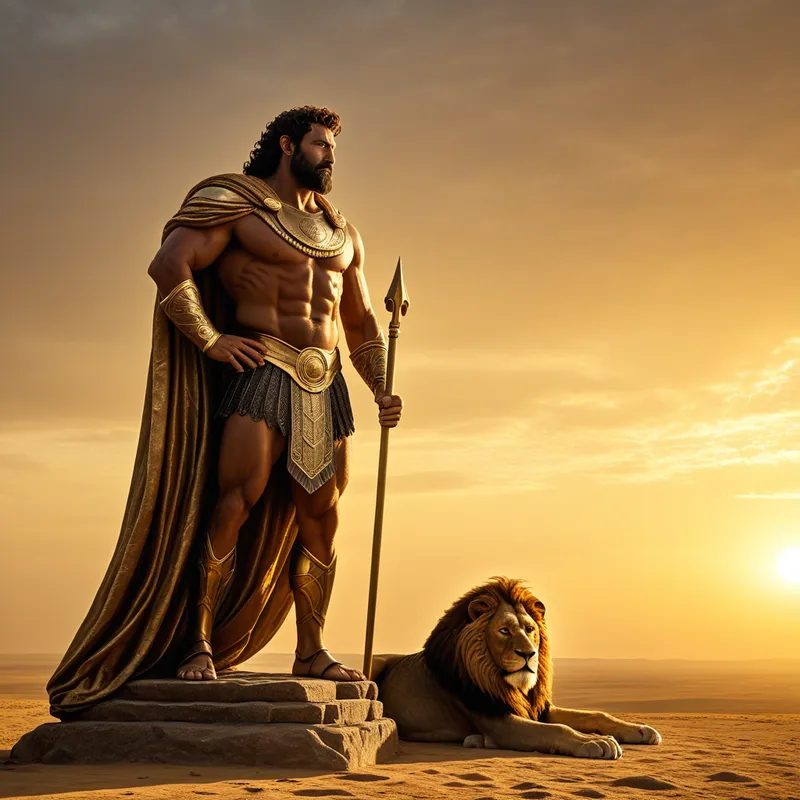
The Labors of Hercules - each Myth Meaning & Symbolism
A demigod, driven mad by a goddess, must complete twelve impossible tasks to atone, facing monstrous beasts and cosmic trials to reclaim his soul.
The Tale of The Labors of Hercules - each
Hear now the tale of a strength that became a curse, and a curse that forged a god. It begins not in glory, but in the crimson fog of madness. Hercules, son of Zeus and the mortal Alcmene, was a demigod whose might shook the earth. But the gaze of Hera was a poison that seeped into his mind. In a fit of divine-induced frenzy, he turned his legendary hands against his own wife and children. When the fog lifted, he stood amidst the ruins of his life, his hands stained not with monster’s blood, but with his own heart’s blood.
Broken, he journeyed to the oracle at Delphi. The Pythia did not offer comfort, but a sentence: to purify his soul, he must bind himself to his cousin, the petty King Eurystheus of Tiryns, and perform ten labors the king would devise. Some say it was ten, but the king, in cowardice and trickery, declared two void, stretching the torment to twelve.
Thus began the pilgrimage of atonement. First, the Nemean Lion, a beast whose hide turned bronze and stone. Hercules strangled it with his bare arms, and from its pelt made his second skin. Next, the Lernaean Hydra in its swamp, its breath a miasma. As he fought, cauterizing each neck with fire, a crab sent by Hera nipped at his heel—a petty, persistent shadow in every great work.
He chased the Ceryneian Hind for a year, a pursuit of elusive grace, capturing it without harm. He faced the Erymanthian Boar, driving it through snow into exhaustion. For the fifth labor, he did not fight, but cleaned: the Augean Stables, a lifetime of filth, were cleansed in a day by diverting two rivers—a lesson that intellect can outmatch brute force.
Then came the Stymphalian Birds, which he frightened from their marsh with bronze rattles. To the island of Crete he sailed, wrestling the fire-breathing Cretan Bull into submission. For the eighth, he journeyed to Thrace to fetch the Mares of Diomedes, taming them by feeding them their cruel master.
The ninth labor was one of allure: the Girdle of Hippolyta. He entered the world of women warriors, where a simple task was twisted by Hera’s whispers into a bloody conflict. The tenth took him to the edge of the world, to steal the Cattle of Geryon, a three-bodied horror he slew at the red shores of sunset.
And for the two labors Eurystheus deemed void? They were the most impossible. He descended into the underworld itself, confronting Hades to leash the three-headed hound Cerberus and bring it, trembling, to the daylight. Finally, he journeyed to the garden of the Hesperides, where he tricked the titan Atlas into retrieving the golden apples of immortality, bearing the weight of the sky upon his own shoulders for a time.
When the twelfth task was done, the man who had begun in madness was gone. In his place stood a hero whose labors had scoured him clean, not of guilt, but of everything that was not essential. He had walked through the world’s nightmares and returned, not with mere trophies, but with a soul tempered in the fires of impossible trial.
Cultural Origins & Context
The myth of Hercules is a foundational pillar of Hellenic culture, yet his figure is a palimpsest, written over by time and geography. His earliest iterations likely stem from pre-Greek, possibly Minoan or Mycenaean, strongman or protector deities. By the time Homer sang, Heracles (his Greek name) was already a legendary, almost tragic, figure from a bygone age—a hero who achieved apotheosis and a place on Olympus.
The canonical Twelve Labors were systematized later, likely in the Archaic or Classical periods, as a cohesive narrative cycle. This structure served multiple societal functions. For the city-states, it was a charter myth of civilization overcoming chaos: each labor purges a specific blight (a lion, a hydra, a boar) from the land, making the world safe for human order. For the individual, it was a profound parable of service, endurance, and the possibility of redemption even from the gravest moral catastrophe. The labors were recounted by bards, depicted on temple metopes and vase paintings, and performed in plays, making Hercules a ubiquitous symbol of the human struggle writ large—the ultimate demi-god who suffers a fully human fate.
Symbolic Architecture
The Labors are not a random checklist of monsters; they are a meticulously ordered map of the psyche’s descent and reintegration. Hercules is the ego inflated by divine power (Zeus) but shattered by the unconscious, complex-driven fury (Hera). His servitude to the weak, cowardly Eurystheus represents the ego’s humiliating but necessary submission to a higher, if seemingly inferior, ordering principle—the Self’s demand for atonement and wholeness.
The labor is not the defeat of the beast, but the integration of its power. The lion’s skin becomes his armor; the hydra’s venom, his weapon.
The sequence moves from confronting raw, personal shadow (the Lion, the Hydra) to engaging with elusive anima energies (the Hind, the Amazon’s Girdle), to performing tasks of “dirty work” that cleanse the foundational complexes (the Augean Stables). The later labors push him to the literal and symbolic edges of the known world—the cattle at the sunset, the underworld, the garden of immortality. This is the ego journeying into the farthest reaches of the collective unconscious, retrieving treasures (the Apples, Cerberus) that symbolize integrated wholeness. Each labor is an alchemical operation, a solve et coagula: the hero dissolves into the challenge and coagulates back, stronger and more complete.
The Dreamer’s Resonance
When the pattern of the Labors appears in modern dreams, it signals a profound, often overwhelming, process of individuation underway. The dreamer may not see Hercules, but they feel the assignment of an impossible series of tasks by a distant, critical authority (a boss, a parent, an internal voice). This is the psyche’s way of announcing that a great work has begun.
Somatically, this can manifest as chronic fatigue, a feeling of carrying a great weight (the sky of Atlas), or tension in the shoulders and hands (the stranglehold on the Lion). Psychologically, it is the experience of being in a protracted ordeal with no clear end. The dreamer is in the swamp with the Hydra, where solving one problem seems to create two more. They are cleaning the Augean Stables of a lifetime of accumulated psychic filth—old resentments, neglected duties, unprocessed trauma. The dream labors are the unconscious presenting the specific “beasts” the dreamer’s soul must now face to move from a state of alienation or “madness” toward a more authentic self.

Alchemical Translation
The myth of the Labors is the Western world’s premier blueprint for psychic transmutation. It models the entire arc of the Great Work. The initial nigredo, the blackening, is Hercules’s murderous madness—the utter dissolution of the old personality. His sentence is the beginning of the albedo, the whitening: the purgative, cleansing phase of the labors themselves, each one a purification by ordeal.
The hero does not choose his monsters; they are chosen for him by the logic of the soul’s necessity. His only choice is to meet them.
The labor of the Hesperides and the Apples represents the citrinitas, the yellowing or solar awakening—gaining the fruit of wisdom from the edge of the world. Finally, bringing Cerberus from the underworld and achieving apotheosis is the rubedo, the reddening or conscious integration of the deepest, most chthonic aspects of the psyche. For the modern individual, this translates not to slaying literal beasts, but to consciously undertaking the “labors” of one’s own life: facing the repressed rage (the Lion), the multiplying anxieties (the Hydra), the sacred but elusive call of creativity or love (the Hind), and the sheer, mundane work of cleaning one’s inner house (the Stables). The goal is not perfection, but completion. We are not meant to become Hercules, but to recognize that the labors he performed are the very tasks that, when embraced, forge an individual from the raw material of a suffering soul.
Associated Symbols
Explore related symbols from the CaleaDream lexicon: