The Kumbh Mela Myth Meaning & Symbolism
A celestial battle for the nectar of immortality spills onto earth, creating sacred sites where humanity gathers to bathe in timeless grace.
The Tale of The Kumbh Mela
Listen, and let the ages whisper. In a time before time was measured, the cosmos churned. Not with stars, but with intent. The great serpent Vasuki became the churning rope, wound around the mountain Mandara, which stood upon the back of [the world](/myths/the-world “Myth from Tarot culture.”/)-turtle, [Kurma](/myths/kurma “Myth from Hindu culture.”/). On one end, the Devas, their faces radiant with hope. On the other, the Asuras, their forms formidable with ambition. Their shared goal: the Amrita, the primordial elixir hidden in the cosmic ocean of milk.
The churning began—a groan that vibrated through the bones of creation. From the depths arose wonders and terrors: the wish-fulfilling cow, [the moon](/myths/the-moon “Myth from Tarot culture.”/), the goddess of wine, and finally, a lethal poison that threatened to end all things. The world held its breath until [Shiva](/myths/shiva “Myth from Hindu culture.”/), in an act of ultimate containment, drank the poison, holding it in his throat, turning it blue.
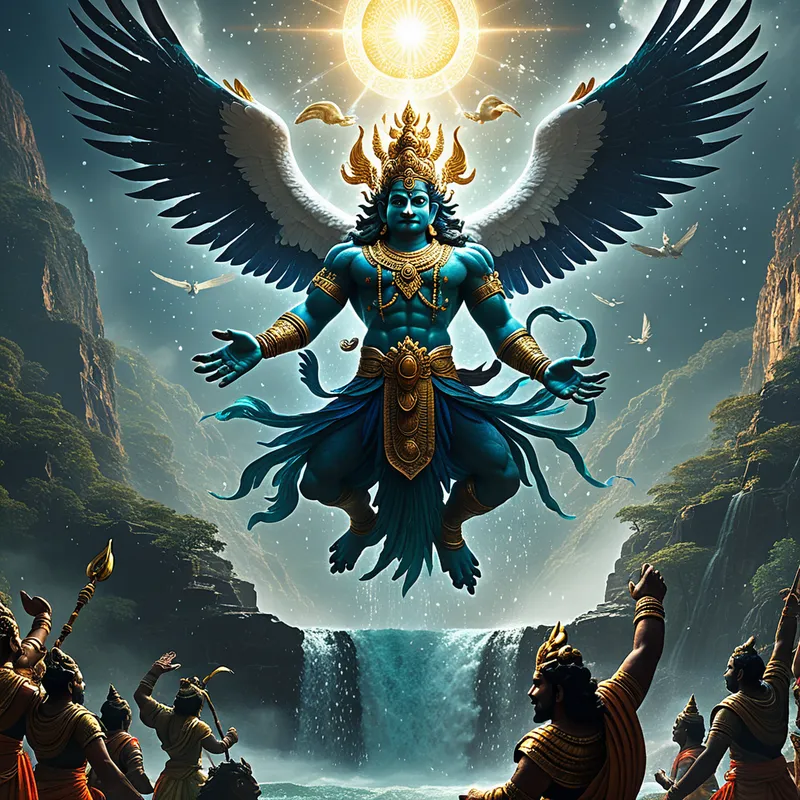
Then, from the frothing depths, emerged Dhanvantari, holding aloft the glowing Kumbha, the pot of Amrita. A silence, sharp as a blade, fell. And then—chaos. The pact shattered. A titanic struggle erupted for [the vessel](/myths/the-vessel “Myth from Alchemical culture.”/). For twelve days and twelve nights—a blink for the eternal, an acon for mortals—the pot passed from hand to hand, a luminous prize in a war of gods and titans.
In the fierce tumult, four drops of the precious nectar fell from [the sky](/myths/the-sky “Myth from Persian culture.”/), splashing upon [the earth](/myths/the-earth “Myth from Hindu culture.”/) at Prayag, Haridwar, Ujjain, and Nashik. Where each drop touched the soil, the land itself became sanctified, a permanent wound of grace in [the earth](/myths/the-earth “Myth from Hindu culture.”/)’s flesh. The [Vishnu](/myths/vishnu “Myth from Hindu culture.”/), in the form of the enchanting Mohini, ultimately secured the Kumbha for the gods. But the deed was done. [The earth](/myths/the-earth “Myth from Hindu culture.”/) now held, in four specific points, a direct memory of immortality. And so, it was decreed that when the stars realign to mirror that primordial moment, the rivers at those sites would once again flow with the essence of that nectar, and all who bathed there would be washed clean of time’s burden.
Cultural Origins & Context
The Kumbh Mela is not merely a story but a living calendar written in the sky. Its origins are found in the Vedas and later elaborated in the Puranas, particularly the Vishnu Purana</ab,br> and the Agni Purana. It functioned as a cosmic almanac, synchronizing human ritual with the slow, majestic dance of Jupiter, the Sun, and the Moon. The myth provided the sacred etiology for the world’s largest peaceful gathering, transforming a complex astrological event into a palpable, collective spiritual experience.
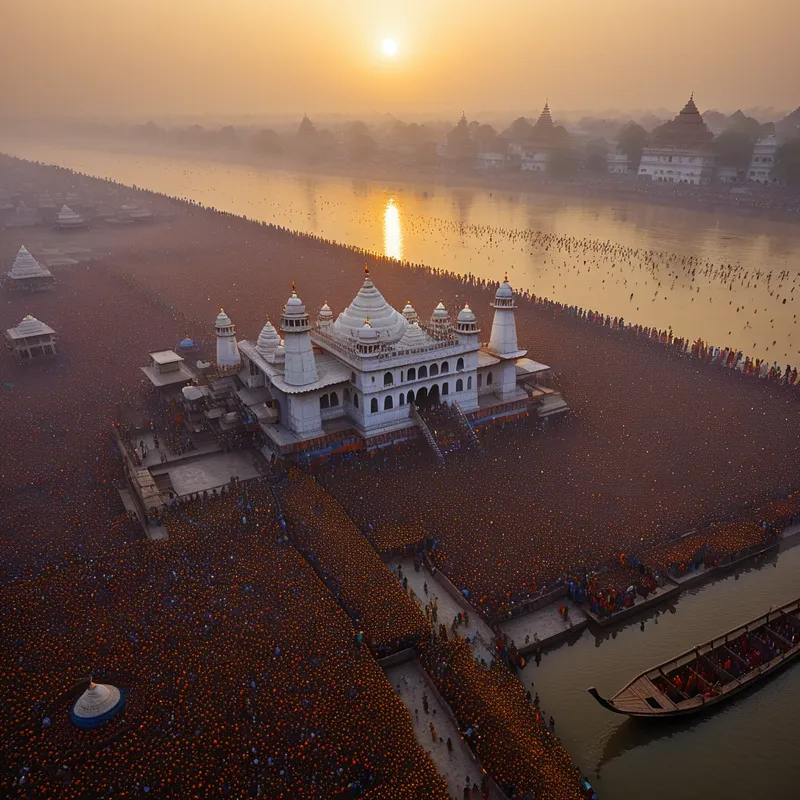
Passed down by storytellers, gurus, and ascetic orders, its societal function was multifaceted. It served as a great unifier, drawing kings and paupers, scholars and laborers, from every corner of the subcontinent to a shared sacred center. It was a rotating seat of spiritual authority, where philosophical debates flourished, lineages were affirmed, and social norms were temporarily suspended in the sacred chaos of the pilgrimage. The Mela was, and is, a massive ritual of collective renewal, where the myth is not just recited but physically enacted through the act of the sacred bath (snan).
Symbolic Architecture
At its core, the myth of the Kumbh Mela is a profound map of the [psyche](/myths/psyche “Myth from Greek culture.”/)’s struggle for wholeness. The churning of the [ocean](/symbols/ocean “Symbol: The ocean symbolizes the vastness of the unconscious mind, representing deeper emotions, intuition, and the mysteries of life.”/) of milk represents the arduous, often turbulent, process of deep introspection—the stirring of the unconscious.
The nectar is only found after confronting the poison. Wholeness requires digesting our own darkness.
The Devas and Asuras are not simple opposites of good and evil. They are complementary psychic forces: the aspirational, ordering principles of [consciousness](/symbols/consciousness “Symbol: Consciousness represents the state of awareness and perception, encompassing thoughts, feelings, and experiences.”/) (Devas) and the raw, potent, desirous energies of the unconscious (Asuras). Both are necessary for the churning; both seek the [elixir](/symbols/elixir “Symbol: A mythical substance representing ultimate healing, immortality, or spiritual transformation, often sought as the pinnacle of alchemical or mystical achievement.”/). The conflict arises from [the ego](/myths/the-ego “Myth from Jungian culture.”/)’s (the Asuras’) desire to possess immortality for itself, rather than integrate it.
The falling drops signify that enlightenment or healing is never a purely private [affair](/symbols/affair “Symbol: An affair represents secretive relationships that often imply deception, desire, and tension between personal ethics and impulses.”/). It spills over, affecting the very “places” (complexes, relationships, times) of our lives. The sacred [river](/symbols/river “Symbol: A river often symbolizes the flow of emotions, the passage of time, and life’s journey, reflecting transitions and movement in one’s life.”/) sites (tirthas) symbolize those moments in time and states of mind where the [boundary](/symbols/boundary “Symbol: A conceptual or physical limit defining separation, protection, or identity between entities, spaces, or states of being.”/) between the eternal and the temporal becomes permeable.
The Dreamer’s Resonance
When this myth stirs in the modern dreamer, it often manifests as dreams of immense crowds, converging at a central, watery location—a train station that is also a riverbank, a city square flooding with clear [water](/myths/water “Myth from Chinese culture.”/). There is a powerful somatic pull toward immersion, a feeling that one must get to the water. This reflects a profound psychological process: the soul’s recognition that it is time for a major purification.
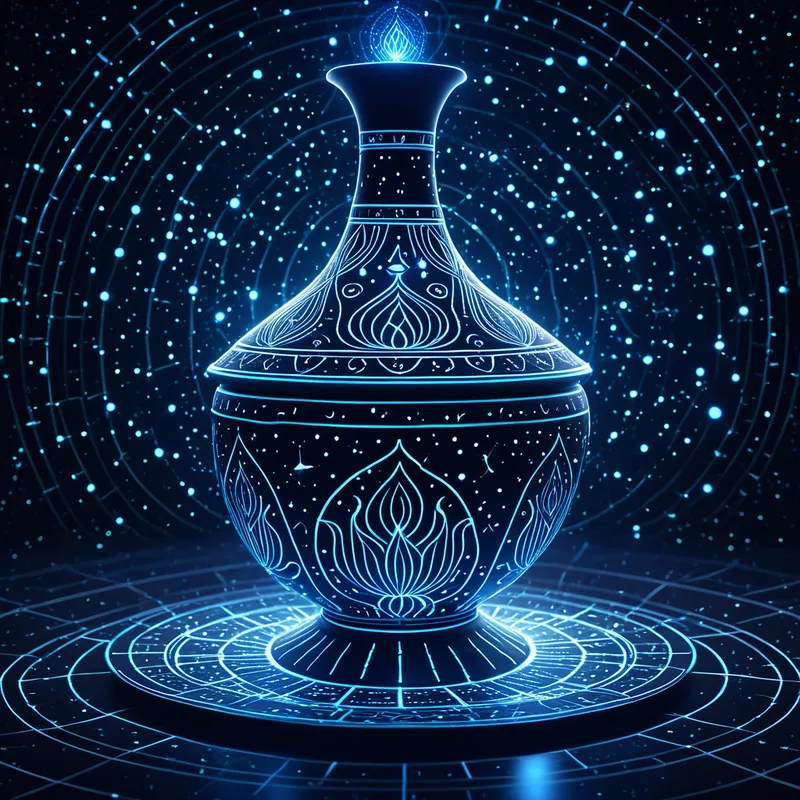
The dreamer may feel lost in the crowd yet paradoxically connected to a vast, purposeful flow. This mirrors the ego’s temporary dissolution in the service of a larger Self. Anxiety about missing the “auspicious time” points to a deep, intuitive knowing about cyclical personal crises and windows for transformation. Dreaming of drinking from a simple clay pot or seeing a vessel crack and leak luminous fluid can signal the direct, often fragile, experience of receiving grace or insight from the unconscious—the personal taste of Amrita.
Alchemical Translation
The Kumbh Mela myth models individuation as a collective rhythm within which personal transformation occurs. The first alchemical stage is Churning (Mortificatio): we must engage with our shadow (the Asuras) and our ideals (the Devas) and stir the depths of our experience, which will inevitably produce both poison (trauma, difficult truths) and nectar (insight, liberation).
The pilgrimage is not to a place, but to the point within where time touches the timeless.
The second stage is Containment (Coagulatio): like Shiva holding the poison, we must develop the capacity to hold our suffering without being destroyed by it, transforming it into a source of power (the blue throat). The final stage is Sacred Timing and Immersion ([Solutio](/myths/solutio “Myth from Alchemical culture.”/)). This is the wisdom of the Kumbh: transformation has its own astrology. We must learn to recognize the internal alignments—the confluence of emotional, mental, and spiritual currents—that create a “sacred site” within us. The plunge into the waters is the courageous act of surrender at that precise moment, allowing the old self to be dissolved in the waters of the unconscious, so that one may emerge, not immortal in body, but renewed in spirit. The individual becomes, for a moment, the Kumbha itself—the vessel that contains, and is transformed by, the divine.
Associated Symbols
Explore related symbols from the CaleaDream lexicon: