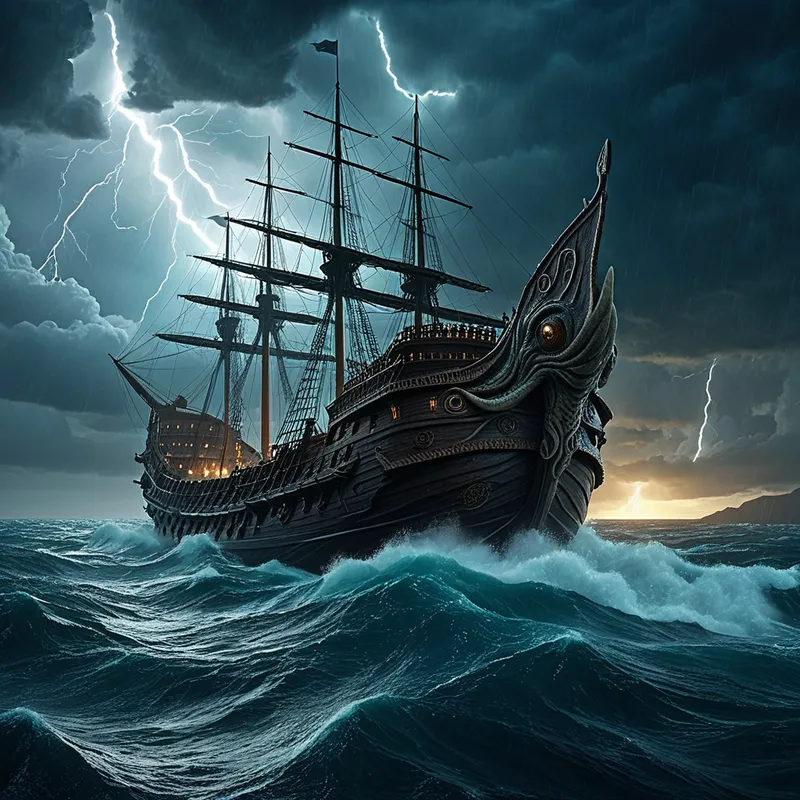
The Kraken Myth Meaning & Symbolism
A colossal sea monster of Greek myth, embodying the primordial chaos that heroes must face to restore cosmic order.
The Tale of The Kraken
Hear now, a tale not of sun-drenched Olympus, but of the wine-dark, fathomless deep. A tale whispered by salt-crusted sailors huddled on night decks, their eyes wide with a terror older than the gods themselves. For beneath the placid face of the [Pontus](/myths/pontus “Myth from Greek culture.”/), in the lightless trenches where even [Poseidon](/myths/poseidon “Myth from Greek culture.”/)‘s trident casts no beam, there slumbers Ceto. Not a single beast, but a concept given flesh: the mother of all monsters.
[The sea](/myths/the-sea “Myth from Greek culture.”/) was not always a road for heroes. Once, it was a realm of pure, churning potential, a womb of chaos before the ordering word of [Uranus](/myths/uranus “Myth from Greek culture.”/) and the firming hand of Gaia. From this ancient, untamed element, Ceto was born—a being of such immense, formless terror that to gaze upon her was to see [the abyss](/myths/the-abyss “Myth from Kabbalistic culture.”/) stare back. She was the deep made manifest, her children the nightmares that haunt the edges of the known world: the serpentine Echidna, the hundred-headed [Hydra](/myths/hydra “Myth from Greek culture.”/), [the gorgon](/myths/the-gorgon “Myth from Various culture.”/) [Medusa](/myths/medusa “Myth from Greek culture.”/).
But the greatest of her brood, the one that became a legend unto itself, was the [Kraken](/myths/kraken “Myth from Norse culture.”/). No poet could fix its form, for it was formlessness itself. To one, it was a mountain of flesh with eyes like cold moons. To another, a forest of tentacles, each thicker than the mast of a warship, capable of dragging the mightiest vessel down to a silent, crushing grave. It did not hunt; it was. Its rising was a cataclysm—the sea would boil, great whirlpools would open like hungry mouths, and a stench of primordial brine and decay would choke the air.
The story is told of a voyage, a hero—perhaps a nameless one, for in this story, every sailor is the hero. The ship, a tiny shell of ordered wood and human hope, cuts across the endless blue. Then, [the world](/myths/the-world “Myth from Tarot culture.”/) changes. The [water](/myths/water “Myth from Chinese culture.”/) grows still, too still, becoming a mirror of oily black. [The wind](/myths/the-wind “Myth from Various culture.”/) dies. From the profound silence, a low groan rises from the deep, a sound felt in the bones more than heard by the ears. Then, the surface ruptures. Not with a splash, but with a geologic heave. The Kraken ascends, a piece of the primal world breaking into the realm of men. The conflict is not of sword against scale, but of cosmos against chaos. The hero’s struggle is to impose a moment of order, a line of courage, against the overwhelming tide of the formless deep. The resolution is never permanent. The Kraken sinks back, sated or perhaps merely returning to its dreaming slumber, leaving the survivors forever marked, their world now known to be thin, with terror sleeping just beneath.
Cultural Origins & Context
It is crucial to clarify that the term “Kraken” is Norse in origin, a later medieval invention from Scandinavian seafaring lore. The entity we conflate with the Kraken in a Greek context is not named as such in classical texts. Instead, it is embodied by the myriad sea monsters (kētē) that populate Greek mythology, most famously the offspring of Ceto and Phorcys. These beings—like [Scylla](/myths/scylla “Myth from Greek culture.”/), Charybdis, [the Hydra](/myths/the-hydra “Myth from Greek culture.”/), or the sea monster sent to devour Andromeda—collectively represent the “Kraken” archetype.
This mythos was not formal scripture but living, breathing oral history. It was passed down by fishermen, traders, and adventurers who plied the unpredictable Aegean and Mediterranean. For a culture that lived by and on the sea, these stories served a vital societal function. They were navigational warnings made epic, explanations for sudden storms, rogue waves, and unexplained disappearances. They personified the very real, existential danger of the deep, transforming blind, natural terror into a narrative with a face—however monstrous. This gave the danger a shape that could, in theory, be understood, outwitted, or appeased through ritual and offering. The myth enforced respect for Poseidon, but also acknowledged a chaos older than his rule.
Symbolic Architecture
Psychologically, the Kraken is the ultimate [symbol](/symbols/symbol “Symbol: A symbol can represent an idea, concept, or belief, serving as a powerful tool for communication and understanding.”/) of the unconscious in its raw, untamed state. It is not [the personal unconscious](/myths/the-personal-unconscious “Myth from Jungian Psychology culture.”/) of repressed memories, but the collective, primordial unconscious—the chaotic, formless substrate from which all [consciousness](/symbols/consciousness “Symbol: Consciousness represents the state of awareness and perception, encompassing thoughts, feelings, and experiences.”/) and order eventually emerge.
The monster from the deep is not an external enemy, but the internal, unformed potential of the self that threatens to dissolve all established structure.
The ordered ship on the surface represents the conscious ego—the [persona](/symbols/persona “Symbol: The social mask or outward identity one presents to the world, often concealing the true self.”/), [identity](/symbols/identity “Symbol: Identity represents the sense of self, encompassing personal beliefs, cultural background, and social roles.”/), and logical mind we construct to navigate the world. The calm, then chaotic sea, is the liminal [space](/symbols/space “Symbol: Dreaming of ‘Space’ often symbolizes the vastness of potential, personal freedom, or feelings of isolation and exploration in one’s life.”/) between consciousness and the unconscious. The Kraken’s [eruption](/symbols/eruption “Symbol: A sudden, violent release of pent-up energy or emotion from beneath the surface, often representing transformation or crisis.”/) is the sudden, often traumatic, intrusion of unconscious content—a repressed complex, a [tidal wave](/symbols/tidal-wave “Symbol: A tidal wave signifies overwhelming emotions or situations, often representing a sense of loss of control or an impending crisis.”/) of [emotion](/symbols/emotion “Symbol: Emotion symbolizes our inner feelings and responses to experiences, often guiding our actions and choices.”/), a psychic [truth](/symbols/truth “Symbol: Truth represents authenticity, honesty, and the quest for knowledge beyond mere appearances.”/) too large to ignore—that threatens to capsize the fragile [vessel](/symbols/vessel “Symbol: A container or structure that holds, transports, or protects something essential, representing the self, emotions, or life journey.”/) of [the ego](/myths/the-ego “Myth from Jungian culture.”/). The heroes who face these monsters, from [Perseus](/myths/perseus “Myth from Greek culture.”/) to [Heracles](/myths/heracles “Myth from Greek culture.”/), are not merely fighting beasts; they are engaging in the fundamental psychic act of confronting [chaos](/symbols/chaos “Symbol: In Arts & Music, chaos represents raw creative potential, uncontrolled expression, and the breakdown of order to forge new artistic forms.”/) to carve out a new, more resilient order of being.
The Dreamer’s Resonance
When this mythic pattern surfaces in modern dreams, it seldom appears as a literal tentacled monster. Its manifestations are more subtle, yet no less potent. One may dream of being on a small boat in a vast, suddenly still ocean, feeling a colossal, unseen presence moving below. Another might dream of a flooded house, with dark water rising from the basement, carrying with it strange, slippery forms. Or perhaps of being entangled in ropes or vines that feel unnervingly alive.
Somatically, the dreamer is often processing a feeling of being overwhelmed by something formless and powerful—a depression that has no clear cause, an anxiety that feels like it comes from “nowhere,” or a creative impulse so vast it feels paralyzing. The dream is the [psyche](/myths/psyche “Myth from Greek culture.”/)’s way of giving shape to this formless pressure. The rising Kraken signals that material from the deep unconscious is forcing its way into awareness, demanding to be seen and integrated. The psychological process is one of confrontation with the unformed. The terror in the dream is the ego’s resistance to being dissolved, even as the unconscious insists on its reality.
Alchemical Translation
The alchemical journey, much like the hero’s voyage, begins with the [prima materia](/myths/prima-materia “Myth from Alchemical culture.”/)—the base, chaotic matter. In the psyche, this is the unexamined, raw stuff of our being: our instincts, our shadows, our archaic fears and boundless potentials. The Kraken is this prima materia of the soul.
The alchemical vessel is not the flask of the sage, but the courageous, witnessing consciousness of the individual who chooses to face the rising deep.
The process of individuation, of becoming whole, requires a descensus ad inferos—a descent into the depths. The myth inverts this: the depths rise to meet us. The Kraken’s attack is the alchemical stage of [nigredo](/myths/nigredo “Myth from Alchemical culture.”/), the blackening, where all certainties are dissolved in the ink of the unconscious. The hero’s stand, that moment of terrified clarity, is the first stirring of the albedo, the whitening. It is the emergence of a conscious standpoint within the chaos. By facing the monster, by naming the formless terror, one performs the ultimate alchemy: one begins to distill spirit from chaos, to draw consciousness from the unconscious. The monster is not slain in the sense of being destroyed; it is transmuted. Its immense energy, once a threat to conscious life, becomes the foundational power upon which a more authentic, resilient self is built. The ordered world the hero returns to is not the same; it is a world now known to be rooted in and forever connected to the deep, a world where one has learned to sail with respect for the monsters below.
Associated Symbols
Explore related symbols from the CaleaDream lexicon: