The Kitchen Witch Myth Meaning & Symbolism
A tale of the spirit in the hearth, where the mundane act of cooking becomes a sacred ritual of protection, nourishment, and alchemical transformation.
The Tale of The Kitchen Witch
Listen. Listen to the crackle of the fire, the sigh of the simmering pot. This is not a story of distant mountains or glittering courts. It is a story of the hearthstone, of shadows dancing on the wall, of the scent of rising bread and bitter herbs. It is the story of the one who tends the flame.
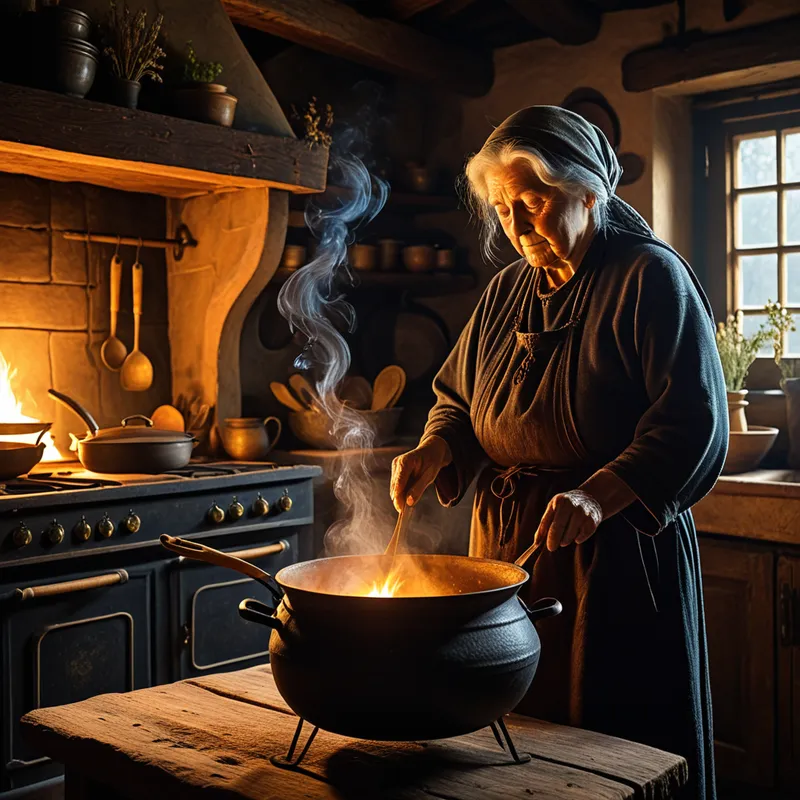
In the long, low house at the edge of the village, where the forest whispers against the thatch, there lived a woman. She was not called a queen, nor a seer, though she was both in her way. To the world, she was simply the grandmother, the mother, the aunt—the keeper of the kitchen. Her domain was one of stone and iron, of clay and wood. Her throne was a three-legged stool by the fire; her scepter, a worn wooden spoon darkened by a thousand stirs.
Her day began before the sun, with the coaxing of embers back to life. Each action was a silent verse in an endless poem: the grinding of grain, the chopping of root and leaf, the careful measurement of salt. But her work was more than provision. When the ague crept into the village, chilling the bones of the children, she did not chant under the moon. Instead, she sliced onions and garlic, simmered them with thyme and a whispered breath over the pot, filling the house with a pungent, healing steam. The sickness broke against her door like a wave against a cliff.
When a traveler arrived with eyes full of a haunted darkness, she did not demand his story. She placed before him a bowl of thick stew, the steam carrying the essence of marrow and slow-cooked love. As he ate, the shadows in his gaze softened, unclenched by the simple, undeniable truth of nourishment. Her protection was not a shouted spell, but a wreath of braided garlic hung by the door, a rowan twig tucked above the lintel, a line of salt so fine it was almost invisible upon the sill.
The conflict came not with a dragon, but with a deep, silent frost that settled over the land. It was a frost of the spirit—a season of lack, where the harvest had been meager and fear had crept into every heart. The village’s collective hope grew thin, brittle. In her kitchen, the woman looked at her nearly empty larder: a handful of grain, a few withered carrots, the last of the dried beans. The fire itself seemed to gutter.
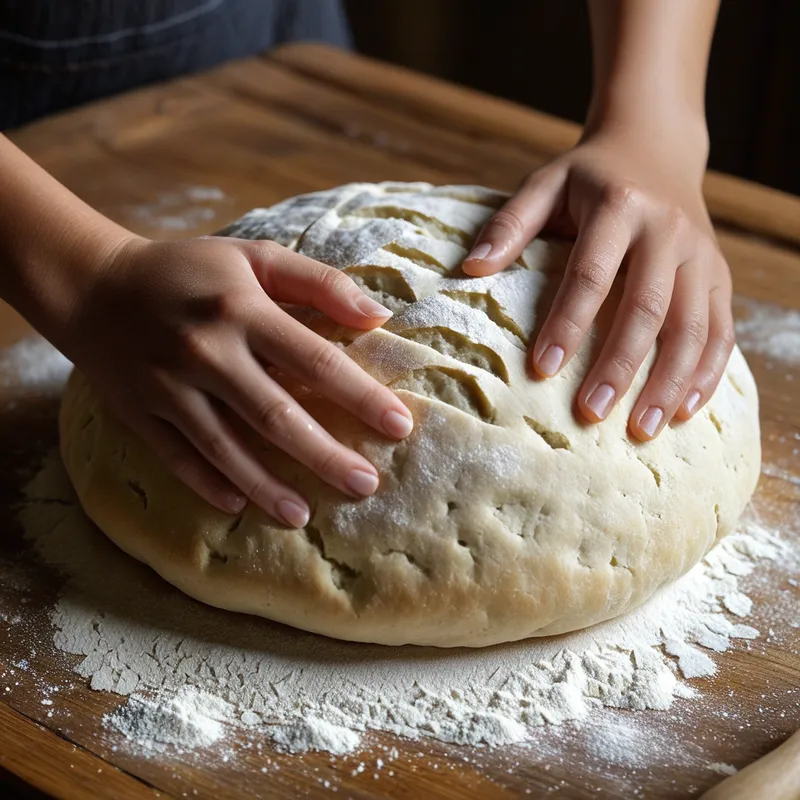
Then, she began. She took the little that was left and treated it not as scarcity, but as potential. She sang to the grain as she ground it, not a magical ditty, but an old song about the sun. She poured not just water, but her own steadfastness into the dough. She stirred the thin broth with a rhythm that spoke of patience, of trust in the process. For three days and nights, she tended her humble creations, the kitchen glowing like a lantern in the long darkness.
On the third morning, as the first weak light touched the windowsill, she pulled a loaf from the oven. It was golden, and it filled the house with a scent so profoundly good it felt like a memory of abundance itself. She ladled the broth, now rich and fragrant. She did not call the village. One by one, drawn by the scent that spoke directly to the soul, they came to her door. From that one loaf and that one pot, she fed them all. No one left hungry. The frost, inside and out, began to thaw. The true magic was not in the multiplying of food, but in the rekindling of the inner fire—the hearth-light—in every heart that had grown cold. The Kitchen Witch had not fought a monster; she had remembered the recipe for courage, and she had shared it.
Cultural Origins & Context
The figure of the Kitchen Witch does not hail from a single sacred text or epic cycle. She is an emergent archetype, woven from the daily lives of countless women across countless generations in European and diasporic folk traditions. Her scripture was the oral recipe, her temple the common house, and her priesthood was one of necessity and keen observation.
This myth was passed down not by bards in halls, but by mothers to daughters, grandmothers to grandchildren, in the very act of doing. It was encoded in the saying, “A pinch of this for luck,” in the habit of stirring the pot sunwise, in the knowledge of which herb eased a cough or which flower lifted a melancholy. The tellers were the practitioners themselves, often operating outside—or beneath the notice of—formal religious structures. Their authority came from results: a healthy family, a preserved harvest, a home that felt safe.
Societally, her function was paramount. She was the first line of defense against physical and psychic decay. In a world where food was life, the one who controlled its transformation from raw, inedible matter into sustaining meal wielded fundamental power. She was the guardian of the threshold between nature (the raw ingredient) and culture (the cooked meal), and by extension, between the chaotic outer world and the ordered, safe inner world of the home. Her myth justified and sanctified the immense, often invisible labor of domestic care, elevating it from mere chore to a sacred, sustaining craft.
Symbolic Architecture
Psychologically, the Kitchen Witch represents the transformative power of the vessel. The kitchen itself is a symbolic womb: a contained space where raw, unconscious contents (ingredients, emotions, experiences) are brought to be processed, “cooked,” and integrated into something that can sustain consciousness.
The cauldron is the psyche, and the fire beneath it is the heat of attention. Transformation is not a passive event, but a sustained, applied warmth.
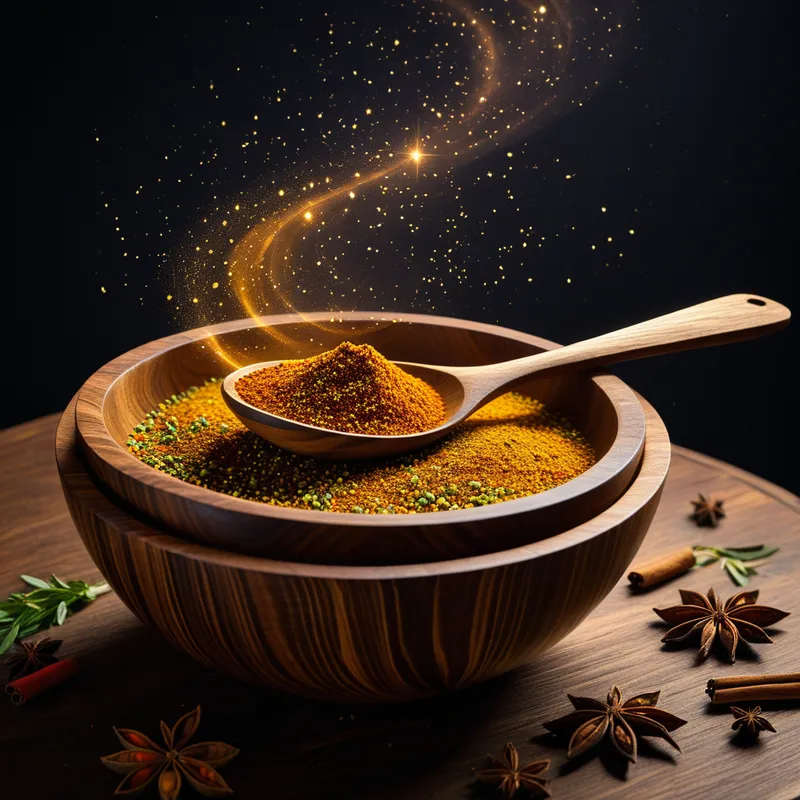
Her tools are profound symbols. The spoon is the instrument of blending, of integrating disparate elements into a harmonious whole. The pot is the container that holds the chaos of the cooking process, allowing the alchemy to occur without spillage or destruction. The hearth fire is the vital energy of the libido—not merely sexual, but the fundamental life force that drives growth, warmth, and metabolism. The act of “seasoning to taste” is the archetype’s lesson in conscious discrimination, knowing what is needed to bring a situation to its fullest, most nourishing flavor.
She is the antithesis of the distant, sky-god magician. Her magic is immanent; it is in the stuff of the earth and the rhythms of the body. She teaches that power is not about commanding distant elements, but about mastering the proximate, the humble, the everyday. Her greatest spell is the creation of enough from not-enough, which is the fundamental alchemy of hope.
The Dreamer’s Resonance
When the Kitchen Witch stirs her pot in the modern dreamscape, she often appears during times of psychic digestion or emotional hunger. Dreaming of a warm, bustling, fragrant kitchen suggests the dreamer’s psyche is in a nourishing phase of processing and integration. The self is being “cooked,” matured, made more complex and flavorful through lived experience.
Conversely, a dream of a cold, dark, or chaotic kitchen points to a neglect of this vital inner function. The dreamer may feel emotionally starved, unable to “stomach” a situation, or may be consuming experiences (information, relationships, stimuli) without properly digesting and deriving nourishment from them. A Kitchen Witch figure appearing in such a scene is a profound call from the unconscious to return to the hearth of the self—to tend one’s own inner fire, to sort the pantry of one’s soul, to begin the slow, patient work of transforming raw experience into wisdom.
Somatically, this myth resonates with the gut—the “second brain.” Dreams of this archetype can coincide with physical issues around digestion or with a deep, intuitive “gut feeling” that demands attention. The psyche is stating that a process of inner nourishment, protection, or detoxification is urgently required.

Alchemical Translation
The individuation process modeled by the Kitchen Witch is one of sacramental materialism. It is the alchemy of finding the sacred in the so-called profane tasks of sustaining a life. Her journey is not a heroic quest outward, but a deepening commitment inward, to the center of one’s own dwelling place.
The core struggle is against the frost of meaninglessness—the chilling belief that our daily rounds are empty of significance. Her triumph is the realization that the vessel of the ordinary life is the only crucible in which the gold of the soul can be formed. The modern individual is tasked with becoming the witch of their own kitchen.
Individuation is the art of learning your own recipes for soul-food, of knowing which inner ingredients need to be brought to a boil and which need to simmer on the back burner of awareness.
This involves several steps: Tending the Hearth (cultivating one’s vital energy and setting boundaries—the “fire” of passion and the “walls” of the home), Gathering the Stores (consciously integrating experiences and knowledge), The Ritual of Preparation (applying focused attention to one’s inner processes), and finally, The Offering (sharing the integrated, nourishing result with the world, thereby completing the cycle of sustenance). The ultimate transmutation is the understanding that in caring for the humble, immediate needs of the self and the immediate circle with conscious love, one performs the most potent magic of all: the conversion of the base lead of daily existence into the living gold of a meaningful life. The Kitchen Witch does not transcend the world; she redeems it, one meal, one healed heart, one protected threshold at a time.
Associated Symbols
Explore related symbols from the CaleaDream lexicon: