The Kitchen as Laboratory Myth Meaning & Symbolism
A myth where the domestic hearth becomes a sacred crucible, and the cook, a solitary alchemist, transmutes base ingredients into soul-nourishing gold.
The Tale of The Kitchen as Laboratory
Listen. Before the world was divided into sacred and profane, there was a place where the two bled together, a place of steam and shadow, of fire and patience. This is the tale of The Hearth-Keeper.
In the first age, when gods walked through the smoke of cooking fires, the substance of the world was raw and potent, but separate. The wheat did not know the water. The salt did not speak to the fire. Humanity ate, but their hunger was a hollow echo, for nourishment touched only the body, leaving the spirit cold.
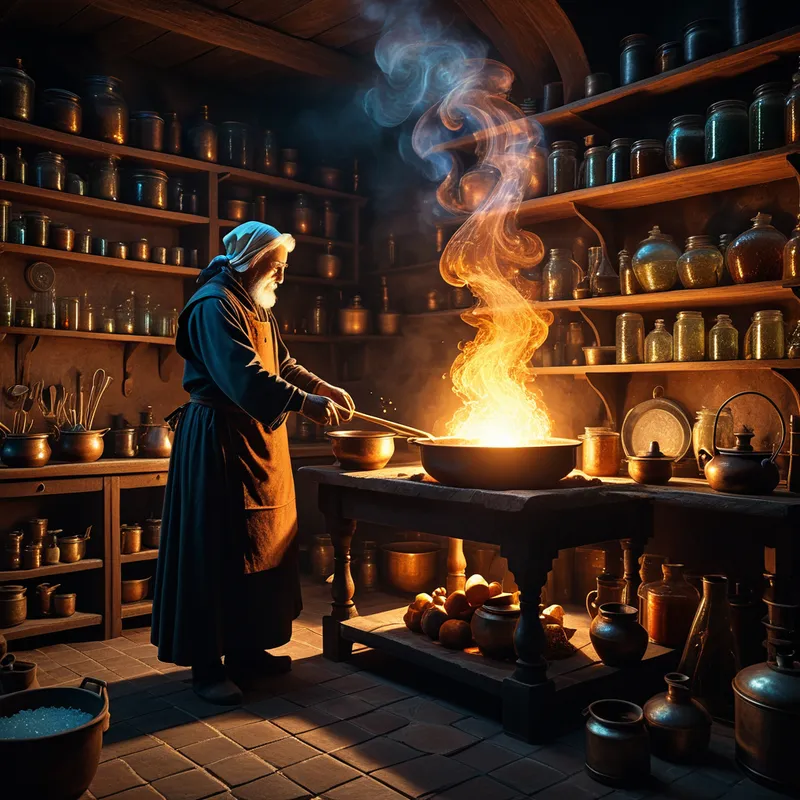
Into this world came She Who Stirs the Silence. She was not a queen or a warrior, but one who attended the flame. Her realm was the kitchen, a space of stone and iron, of hanging herbs and clay jars. One night, during the long dark, a whisper came not from the wind, but from the embers. It was the voice of The Ingredient-That-Is-Not, the potential sleeping within all things.
“Combine us,” it sighed in the crackle of the fire. “But know this: to make the Gold That Nourishes, you must lose yourself in the steam. You must become the vessel and the flame.”
Driven by a longing she could not name, She Who Stirs the Silence began. She took the hard grain, the Tear of the Earth, and ground it not with haste, but with a rhythm that matched her own heartbeat. She added the Water of Sighs, and the mixture became a paste, inert and waiting. Then, she reached for the most mysterious element: a scrap of dough saved from a previous turning, the Sour Ghost. This she folded in, a burial and a seeding.
She placed the mass in a wooden bowl, covered it with a cloth woven from twilight, and waited. This was the Night of the Swelling. In the darkness, unseen, the mass stirred. It breathed. It became alive with a fermentation both physical and spiritual—a quiet chaos.
At dawn, she faced the fire. This was the moment of The Trial by Flame. To bake the bread was to kill the living ferment, to fix its volatile spirit into enduring form. A lesser soul would have turned away, preserving the life at the cost of its purpose. Tears, the Water of Fixation, fell from her eyes into the dough as she shaped it. She placed the loaf into the searing heat of the oven’s belly.
The conflict was in the silence. The fire roared, the dough screamed silently as it transformed, and the Hearth-Keeper held the space, her will the only container for the violence of creation. She did not flee the heat, the scent of sacrifice, the terrifying possibility of failure—ash where there should be crust.
When she drew the loaf forth, it was not mere food. It was a warm sun, pulled from a domestic sky. Its crust was a landscape of gold and bronze; its scent was the very smell of time made benevolent. As she broke it, steam rose like a released spirit, and the first taste was not of flour and water, but of wholeness. The separate had become unified. The base had become noble. The Kitchen had proven itself a Laboratory of the Soul, and the first Philosopher’s Loaf was born.
Cultural Origins & Context
This myth originates not from a single text, but from the oral traditions of the Alchemical Guilds of the late medieval and early Renaissance periods. While grand treatises spoke of kings, queens, and dragons in retorts, this story was whispered in workshops, kitchens, and apothecaries. It was the “little secret” of the tradition, a democratization of the Magnum Opus.
It was passed down from master to apprentice not as formal doctrine, but as a story told while grinding herbs, tending furnaces, or waiting for a decoction to change color. Its societal function was profound: it sacralized the daily, repetitive labor of transformation. It taught that the highest spiritual principles—Solve and Coagula (dissolve and coagulate), sacrifice, and patient incubation—were not locked in a noble’s laboratory but were actively performed by every cook, brewer, and dyer. The myth served as a grounding cord, linking the cosmic ambition of alchemy to the tangible, nourishing work of sustaining life.
Symbolic Architecture
The myth presents a complete symbolic map of the individuation process, hidden in plain sight. The Kitchen is the domicile of the psyche, the place where raw experience is taken in. The Laboratory is the hidden sanctum within it, where that experience is subjected to processes beyond egoic control.
She Who Stirs the Silence is the ego that agrees to serve a deeper process. She is not the arrogant puffer seeking instant gold, but the devoted servant of the work. Her ingredients—grain, water, sourdough starter—symbolize the raw materials of the self: memories, emotions, inherited patterns (the prima materia).
The first transformation is always a dissolution, a willing surrender of hard, defined forms into a chaotic, fermenting mass.
The Sour Ghost is critical. It represents the living, often bitter or “sour” complex from the past—a trauma, a talent, a forgotten passion—that must be re-incorporated to activate the whole. The long Night of the Swelling is the essential, fallow period of introspection, where the unconscious works autonomously. The fiery oven is the inevitable crisis, the “trial by fire” where the newly formed psychic structure is tested and fixed into enduring character. The resulting “loaf” is the Self, a nourishing wholeness born from disciplined sacrifice.
The Dreamer’s Resonance
When this myth stirs in the modern unconscious, it often manifests in dreams of chaotic, transformative domestic spaces. To dream of a kitchen where appliances morph, where recipes are written in unknown languages, or where a simple meal preparation becomes a complex, urgent ritual, is to dream the Culina-Laboratorium.
Psychologically, the dreamer is in a somatic and psychic process of “cooking.” Raw emotional material—a grief, a creative impulse, a relationship conflict—has entered their system and is undergoing an alchemical process. The confusion and urgency in the dream mirror the ego’s struggle to control a process that fundamentally belongs to the autonomous psyche (the laboratory). The dream is an assurance: you are the vessel in which a necessary transformation is brewing. The anxiety is the heat of the oven; the sense of being overwhelmed is the Night of the Swelling. The dream calls for the Hearth-Keeper’s patience: tend the fire, but do not stop the cooking.

Alchemical Translation
For the modern individual, the myth translates the daunting concept of “individuation” into a deeply relatable, non-heroic model. Our “kitchen” is our daily life—our routines, relationships, and responsibilities. The call is to stop seeing it merely as a place of maintenance, and to recognize it as the very crucible assigned to us for the Great Work.
The process demands we become our own Hearth-Keeper. We must consciously “add the Sour Ghost”—face and integrate the difficult, fermented aspects of our history we’d rather discard. We must endure the necessary nigredo of depression or confusion, the “Night of the Swelling,” without aborting the process through distraction or denial.
The gold is not found; it is made through a series of deliberate, heat-bearing sacrifices of what we thought we were.
Finally, we must submit our nascent self to the trial of manifestation—expressing a new idea, living a new value, creating a new work—which always feels like the searing heat of the oven, a risk of being burned or reduced to ash. The triumph is not a king’s treasure, but a “loaf”: something humble, wholesome, sustaining, and meant to be shared. It is the tangible proof that in the laboratory of our own attended lives, base experience can be, and is continually, transmuted into the substance of a meaningful soul.
Associated Symbols
Explore related symbols from the CaleaDream lexicon: