The Keystone in Freemasonry Myth Meaning & Symbolism
The myth of the lost Keystone, a perfect stone of sacrifice, whose absence teaches that true completion is found in the striving of the imperfect builder.
The Tale of The Keystone in Freemasonry
Listen, and hear the story not of a stone laid, but of a stone withheld. It is a tale told in the quiet hour, when the tools are stilled and the plans are spread beneath lamplight.
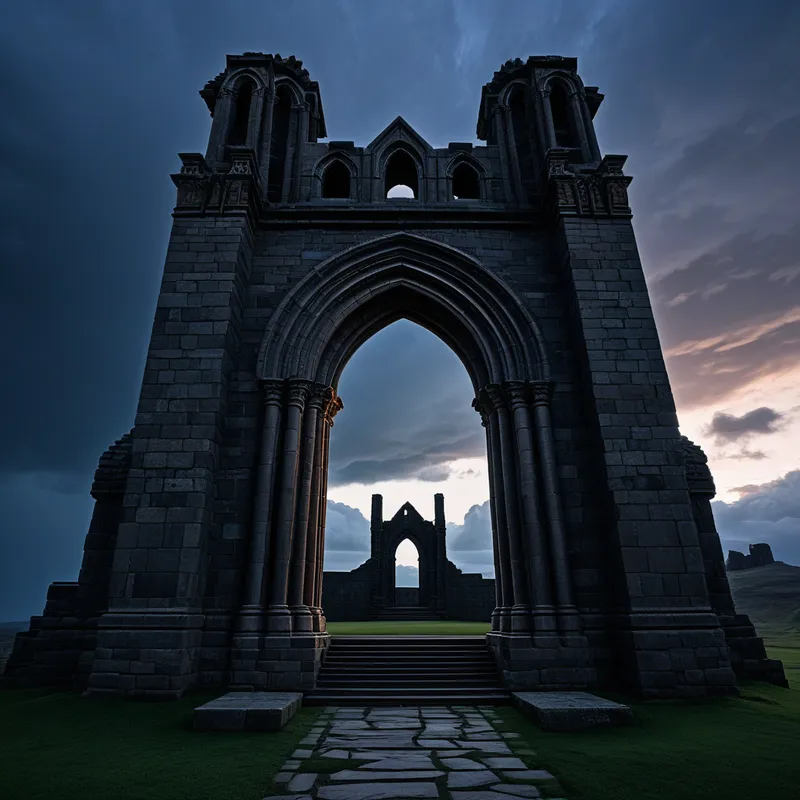
In the dawn of a great work, when the ambition of kings and the faith of priests sought to touch the heavens, the call went out. From every quarry and lodge, the Master Masons came. Their task was not merely to raise walls, but to erect a testament to divine geometry, a temple so perfect its very stones would sing in harmony with the cosmos. The arch was its crown, the sublime curve that defies gravity through perfect balance. And at the apex of that arch, the final, critical piece: the Keystone.
The search for this stone became the great obsession. Apprentices and Fellows shaped countless candidates from the finest marble and granite. Yet each, when offered to the arch, was found wanting—a hair’s breadth too wide, a whisper too shallow, its angles dull, its spirit asleep. The arch remained open, a gaping maw against [the sky](/myths/the-sky “Myth from Persian culture.”/), and [the temple](/myths/the-temple “Myth from Jewish culture.”/)’s song was a dirge of incompletion.
Then, from the silent depths of the most secret quarry, a single, unassuming stone was brought forth. It was not the largest nor the most ornate. But when the Master Builder placed his level upon it, the bubble rested in dead center. His square revealed angles of absolute truth. His compasses found a geometry born not of this earth, but of the starry vault above. This was the one. A hushed awe fell over the workers. This perfect ashlar, this Keystone, would complete [the great work](/myths/the-great-work “Myth from Alchemical culture.”/). The very air seemed to tighten with anticipation.
But as the stone was lifted, poised for its eternal home, the Master Builder stayed the hands of the carriers. He looked not at the stone, but at the arch, and then at the weary, hopeful faces of the builders. A profound knowing settled upon him, a sorrowful wisdom.
Without a word, he took a heavy mallet and struck the Keystone a single, sharp blow. A crack, clean and terrible, echoed through the silent yard. The perfect stone was flawed, rendered forever unfit for its destined place. A collective gasp of horror and confusion rose from the brethren.
The Master Builder then commanded the broken stone be taken not to the arch, but to the darkest, deepest foundation of the temple, and there buried, hidden from all sight. He turned to the assembled, his voice both gentle and firm. “The work is complete,” he declared.
They looked up. The arch remained open, an invitation to the sky. The temple was, by all earthly measures, unfinished. Yet, in that moment of shattered perfection, a deeper understanding began to dawn. The true temple was not in the stone, but in the builder. The true Keystone was not above, but within.
Cultural Origins & Context
This allegory is woven into the very fabric of speculative Freemasonry, particularly within the rituals of the Fellow Craft and the profound lessons of the Master Mason degree. It is not a myth of ancient provenance, but a deliberately crafted “mytho-historical” narrative developed in the 17th and 18th centuries as Freemasonry evolved from a operative stonemasons’ guild into a philosophical and moral society.
Passed down not through books, but through ritualized drama, symbolic lectures, and lodge traditions, the story functions as a masonic allegory. It is told by the Worshipful Master and officers of the lodge during degrees, transforming the lodge room itself into the symbolic temple. Its societal function is pedagogical and initiatory. It serves to reorient the member’s understanding of perfection from an external, attainable object to an internal, eternal process. It binds the community through a shared secret—not a secret of power, but a secret of perspective: that incompletion is the necessary state for growth.
Symbolic Architecture
The [Keystone](/symbols/keystone “Symbol: The central wedge-shaped stone at the apex of an arch, holding all other stones in place through compression and balance.”/) represents the illusion of external, final perfection. It is the fantasy of the finished self, the solved [life](/symbols/life “Symbol: The symbol of ‘Life’ represents a journey of growth, interconnectedness, and existential meaning, encompassing both the joys and challenges that define human experience.”/), the conflict-free existence. It is the ultimate answer we believe will settle all questions.
The perfect stone is a prison. The flawed stone is a key.
Its deliberate breaking and [burial](/symbols/burial “Symbol: A symbolic act of laying something to rest, often representing closure, transformation, or the release of past burdens.”/) is the central, shocking act of the myth. This is not an [accident](/symbols/accident “Symbol: An accident represents unforeseen events or mistakes that can lead to emotional turbulence or awakening.”/), but a sacred vandalism against the idol of perfection. The crack represents the necessary wounding of [the ego](/myths/the-ego “Myth from Jungian culture.”/), the introduction of conscious imperfection, humility, and [mortality](/symbols/mortality “Symbol: The awareness of life’s finitude, often representing transitions, impermanence, or existential reflection in dreams.”/) into the [psyche](/myths/psyche “Myth from Greek culture.”/). By being hidden in the [foundation](/symbols/foundation “Symbol: A foundation symbolizes the underlying support systems, values, and beliefs that shape one’s life, serving as the bedrock for growth and development.”/), the Keystone’s perfection is transmuted. It no longer crowns the work visibly but supports it invisibly. Its symbolic power shifts from being the glorious capstone to being the buried cornerstone of one’s [character](/symbols/character “Symbol: Characters in dreams often signify different aspects of the dreamer’s personality or influences in their life.”/)—the acknowledged, integrated flaw upon which a genuine life is built.
The open arch, then, is the ultimate [symbol](/symbols/symbol “Symbol: A symbol can represent an idea, concept, or belief, serving as a powerful tool for communication and understanding.”/). It is the individuated self—stable, strong, yet forever open to the transcendent (the sky, the divine, the unknown). It is a [structure](/symbols/structure “Symbol: Structure in dreams often symbolizes stability, organization, and the framework of one’s life, reflecting how one perceives their environment and personal life.”/) that breathes. Completion, the myth insists, is a state of dynamic [tension](/symbols/tension “Symbol: A state of mental or emotional strain, often manifesting physically as tightness, pressure, or unease, signaling unresolved conflict or anticipation.”/), not [static](/symbols/static “Symbol: Static represents interference, disruption, and the breakdown of clear communication or signal, often evoking feelings of frustration and disconnection.”/) closure.

The Dreamer’s Resonance
When this myth stirs in the modern unconscious, it may manifest in dreams of searching for a lost, critical object—a key, a document, a piece of a puzzle—that is always almost found, or found broken. One might dream of buildings that are strangely both solid and unfinished, or of trying to force a shape into a space that almost fits.
Somatically, this can feel like a chronic, low-grade anxiety of “almost there,” a striving that never culminates, or a profound fatigue from upholding a facade of perfection. Psychologically, the dreamer is confronting the Shadow aspect of their own ambition and idealism. The psyche is working to dismantle the tyrannical inner “Master Builder” who demands a flawless performance, and to accept the more humble, authentic, and fractured self. The process is one of grieving the idealized self-image to make space for the real.
Alchemical Translation
The myth models the alchemical [rubedo](/myths/rubedo “Myth from Alchemical culture.”/)—the reddening, not as a final glorification, but as the embodiment of wisdom in a flawed vessel. The psychic transmutation follows a precise sequence:
- Calcinatio (The Search): The burning ambition to find the perfect solution, the ultimate truth that will fix everything. This is the ego’s project.
- Mortificatio (The Breaking): The shocking, often painful realization that the ideal is an illusion. The ego’s perfect stone is shattered. This is a necessary death.
- [Separatio](/myths/separatio “Myth from Alchemical culture.”/) (The Burial): Consciously taking the fragments of that ideal—the shame of imperfection, the grief of limitation—and not discarding them, but burying them in the foundation of the psyche. They are separated from their old, lofty purpose and given a new, grounded one.
- Coniunctio (The Open Arch): The marriage of the conscious self with the accepted flaw. This union does not produce a sealed whole, but a stable structure with an opening. [The self](/myths/the-self “Myth from Jungian culture.”/) is now in a constant, living relationship with the transcendent, through the very aperture of its acknowledged incompleteness.
Individuation is not the carving of a perfect statue, but the wise construction of a bridge that forever leads beyond itself.
For the modern individual, the [triumph](/myths/triumph “Myth from Roman culture.”/) is not in achieving a state of flawless self-mastery, but in the courage to cease the desperate search for the external Keystone. It is to take up the gavel, chisel, and compass not to finish the temple, but to enjoy, with sober humility, the sacred and eternal work of its building. The Keystone is lost so that the builder may be found.
Associated Symbols
Explore related symbols from the CaleaDream lexicon: