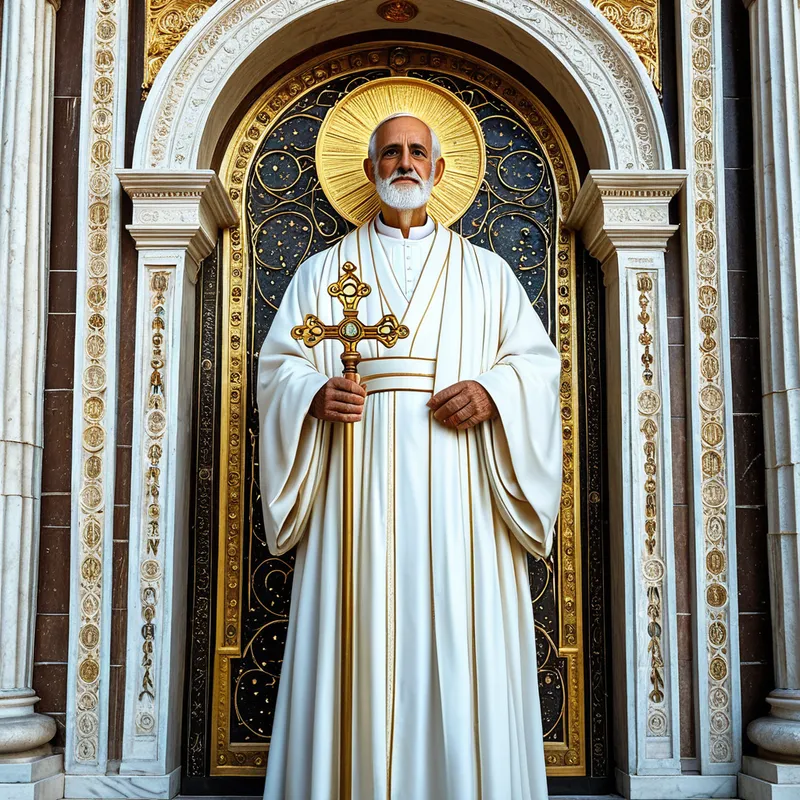
The Keys of Heaven Myth Meaning & Symbolism
The story of Peter receiving the keys to the kingdom of heaven, a divine mandate of discernment, authority, and the power to bind and to loose.
The Tale of The Keys of Heaven
The air in the high country of Caesarea Philippi was thin and carried the chill of stone and old gods. The disciples walked a dusty path, their minds heavy with the riddles of their teacher. He was a man who spoke of seeds and light, of lost coins and prodigal sons, yet [the shadow](/myths/the-shadow “Myth from Jungian culture.”/) of the Roman eagle and the scowling temple authorities clung to them like a second cloak.
He stopped and turned, his gaze sweeping over them, not as students, but as pillars yet unformed. “Who do people say that I am?” he asked, his voice quiet against [the wind](/myths/the-wind “Myth from Various culture.”/).
They offered the rumors: Elijah returned, Jeremiah, one of [the prophets](/myths/the-prophets “Myth from Biblical culture.”/) of old. The wind seemed to hush.
Then he looked directly at Simon, the fisherman whose spirit was as changeable as [the Sea](/myths/the-sea “Myth from Greek culture.”/) of Galilee—one moment a wave of fervent faith, the next sinking into doubt. “But you,” he said, the words not a question but a declaration taking shape. “Who do you say that I am?”
Simon felt the question not in his ears, but in his bones. It was a key searching for a lock within him. From the depths of his being, a truth erupted, solid and unshakable as the bedrock beneath them. “You are the Christ,” he said, his voice steady. “The Son of the living God.”
A profound stillness followed, as if creation itself paused. The teacher’s face shone with a joy not of this earth. “Blessed are you, Simon son of [Jonah](/myths/jonah “Myth from Christian culture.”/)! For flesh and blood has not revealed this to you, but my Father who is in heaven.”
He placed his hands on Simon’s shoulders, a gesture of immense weight and transformation. “And I tell you, you are [Peter](/myths/peter “Myth from Biblical culture.”/), and on this rock I will build my church, and the gates of [Hades](/myths/hades “Myth from Greek culture.”/) will not overcome it.”
Then, reaching into the very fabric of the promise, he spoke words that would echo through eternity: “I will give you the keys of the kingdom of heaven. Whatever you bind on earth will be bound in heaven, and whatever you loose on earth will be loosed in heaven.”
No physical keys appeared in that moment, yet the air crackled with the weight of their forging. Peter felt the imprint of them in his soul—a terrifying, glorious burden. They were not for a treasure chest, but for the gate that stands between time and eternity, between the striving of earth and the peace of the kingdom. The fisherman from Galilee was gone. In his place stood the Keeper of the Gate, the one upon whose discernment the passage of souls would hinge. The wind resumed, but it now carried the silent, metallic whisper of a responsibility that would outlast empires.
Cultural Origins & Context
This pivotal narrative is recorded in the Gospel of Matthew (16:13-20), a text composed for a primarily Jewish-Christian audience navigating its identity within and beyond Judaism. The setting at Caesarea Philippi, a center for the worship of the god Pan and the emperor, is profoundly significant. It is a place of competing sovereignties. Here, against a backdrop of pagan grottoes and political power, [Jesus](/myths/jesus “Myth from Christian culture.”/) establishes a new locus of spiritual authority.
The conferral of the “keys” is dense with Rabbinic symbolism. In [Isaiah](/myths/isaiah “Myth from Abrahamic culture.”/) 22:22, the key of the House of David is given to Eliakim, conferring stewardly authority over the royal household. Jesus adapts this royal and messianic imagery, transferring it not to a dynastic successor, but to a flawed human who has perceived a divine truth. In the early Church, this passage became the foundational scriptural warrant for the authority of Peter and, by extension, the apostolic teaching office. It was not merely about administrative power, but about the authority to “bind and loose”—a technical term for making definitive judgments on matters of doctrine and community discipline, of declaring what is permitted or forbidden in the journey of faith.
Symbolic Architecture
The myth centers on a profound psychological [transaction](/symbols/transaction “Symbol: An exchange of value, energy, or information between parties, representing balance, reciprocity, and the flow of resources in life.”/): the recognition of the divine within the [human](/symbols/human “Symbol: The symbol of a human represents individuality, complexity of emotions, and social relationships.”/), and the consequent bestowal of immense [responsibility](/symbols/responsibility “Symbol: Responsibility in dreams often signifies the weight of duties and the expectations placed upon the dreamer.”/) upon the recognizer. Peter’s [confession](/symbols/confession “Symbol: The act of revealing hidden truths, secrets, or wrongdoings, often to relieve guilt, seek forgiveness, or achieve psychological liberation.”/) is the “rock”—not his personal [strength](/symbols/strength “Symbol: ‘Strength’ symbolizes resilience, courage, and the ability to overcome challenges.”/), but the [moment](/symbols/moment “Symbol: The symbol of a ‘moment’ embodies the significance of transient experiences that encapsulate emotional depth or pivotal transformations in life.”/) of unshakable, inwardly revealed [insight](/symbols/insight “Symbol: A sudden, deep understanding of a complex situation or truth, often arriving unexpectedly and illuminating hidden connections.”/) upon which authentic [identity](/symbols/identity “Symbol: Identity represents the sense of self, encompassing personal beliefs, cultural background, and social roles.”/) and [purpose](/symbols/purpose “Symbol: Purpose signifies direction, meaning, and intention in life, often reflecting personal ambitions and core values.”/) are built.
The key is not a tool for possession, but an instrument of passage. It does not claim the territory beyond the gate for itself; it serves the function of opening and closing, of discernment.
The Keys themselves are the ultimate [symbol](/symbols/symbol “Symbol: A symbol can represent an idea, concept, or belief, serving as a powerful tool for communication and understanding.”/) of mediated [authority](/symbols/authority “Symbol: A symbol representing power structures, rules, and control, often reflecting one’s relationship with societal or personal governance.”/). They represent the power of discernment and judgment, the terrifying human participation in divine order. They are a binary: one key to bind, to hold fast, to set limits; the other to loose, to liberate, to forgive. This reflects the essential dualities of [consciousness](/symbols/consciousness “Symbol: Consciousness represents the state of awareness and perception, encompassing thoughts, feelings, and experiences.”/): [structure](/symbols/structure “Symbol: Structure in dreams often symbolizes stability, organization, and the framework of one’s life, reflecting how one perceives their environment and personal life.”/) and flow, law and grace, [the ego](/myths/the-ego “Myth from Jungian culture.”/)’s necessary boundaries and the [soul](/symbols/soul “Symbol: The soul represents the essence of a person, encompassing their spirit, identity, and connection to the universe.”/)’s need for [expansion](/symbols/expansion “Symbol: A symbol of growth, increase, or extension beyond current boundaries, often representing personal development, opportunity, or overwhelming change.”/).
The Gate is the liminal [space](/symbols/space “Symbol: Dreaming of ‘Space’ often symbolizes the vastness of potential, personal freedom, or feelings of isolation and exploration in one’s life.”/), [the threshold](/myths/the-threshold “Myth from Folklore culture.”/) of transformation. It is the point of [crisis](/symbols/crisis “Symbol: A crisis symbolizes turmoil, urgent challenges, and the need for immediate resolution or change.”/), judgment, and transition—whether that be [death](/symbols/death “Symbol: Symbolizes transformation, endings, and new beginnings; often associated with fear of the unknown.”/), a major [life](/symbols/life “Symbol: The symbol of ‘Life’ represents a journey of growth, interconnectedness, and existential meaning, encompassing both the joys and challenges that define human experience.”/) [decision](/symbols/decision “Symbol: A decision in a dream reflects the choices one faces in waking life and can symbolize the pursuit of clarity and resolution.”/), or the [passage](/symbols/passage “Symbol: A passage symbolizes transition, movement from one phase of life to another, or a journey towards personal growth.”/) from one state of consciousness to another. Peter, as the gatekeeper, symbolizes the part of the [psyche](/myths/psyche “Myth from Greek culture.”/) (or the [community](/symbols/community “Symbol: Community in dreams symbolizes connection, support, and the need for belonging.”/)) that must evaluate what is ready to cross, what must be held back, and what must be released.
The Dreamer’s Resonance
When this myth stirs in the modern unconscious, it rarely appears as a biblical tableau. Instead, the dreamer may find themselves standing before a significant door—to a house, a vault, a garden—holding a key that may or may not fit. The somatic feeling is one of acute anxiety mixed with solemn purpose. This is the psyche working on the theme of authority and judgment.
To dream of receiving a key often coincides with a life stage where one is being handed a new level of responsibility—for a project, a family, or one’s own inner truth. The dream asks: Do you recognize the authority of your own insight? Are you ready to bear the weight of the choices it unlocks?
To dream of being a gatekeeper, deciding who or what may pass, speaks to the necessity of setting boundaries. It is the psyche’s council on what influences, memories, or relationships must be “bound” (restricted from affecting the core self) and which must be “loosed” (released from guilt or shame). The anxiety in the dream mirrors the difficulty of this psychic discernment.

Alchemical Translation
The individuation process, the journey toward psychic wholeness, is mirrored perfectly in this myth. It begins with the “confession at Caesarea Philippi”—the moment of profound self-recognition. This is when the ego, after identifying with various roles and opinions (“some say Elijah, some say Jeremiah”), finally names the central, guiding principle of [the Self](/myths/the-self “Myth from Jungian culture.”/), the inner Self. “You are the Christ” translates psychologically to: “I recognize the transcendent, unifying principle at the core of my being.”
Upon this rock of self-recognition, the structure of the personality is rebuilt. Then comes the terrifying gift: the [Keys of Heaven](/myths/keys-of-heaven “Myth from Christian culture.”/). In alchemical terms, this is the coniunctio oppositorum—[the conjunction](/myths/the-conjunction “Myth from Alchemical culture.”/) of opposites. The dreamer must take up the dual authority of the conscious mind.
Individuation requires us to become the keeper of our own gate. We must learn to bind the chaotic, destructive forces of the shadow and to loose the creative, transformative ones. We must bind outworn narratives and loose authentic expression.
The “power of the keys” is the ultimate responsibility of self-governance. It is the alchemical operation where we are no longer passive subjects of internal complexes or external pressures, but active stewards of our own inner kingdom. We decide what thoughts to entertain (bind or loose), what emotions to integrate, what aspects of our past to hold or release. The gate we keep is the threshold of our own awareness, and the keys are the courage and discernment we wield to navigate the eternal transition between who we were and who we are becoming. The myth assures us that this authority, though daunting, is divinely sanctioned—it is the birthright of anyone who has dared to recognize the rock of truth within.
Associated Symbols
Explore related symbols from the CaleaDream lexicon: