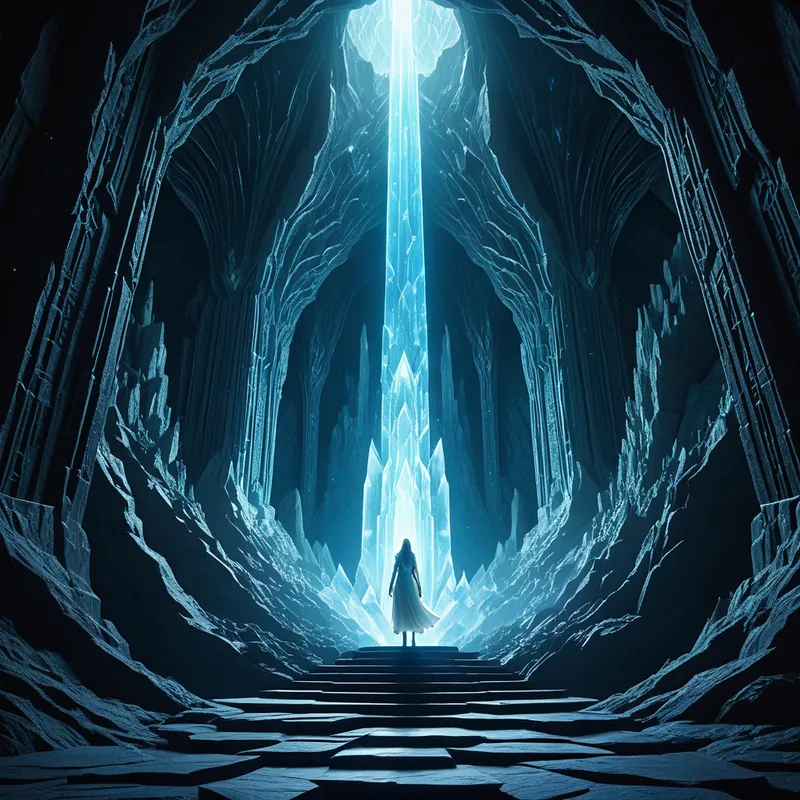
The katabasisof Ina Myth Meaning & Symbolism
A goddess descends into the underworld to retrieve a lost memory, confronting the shadow of her own creation to restore cosmic balance.
The Tale of The katabasisof Ina
Listen. Before the world knew its second name, there was only the Song. And from the Song, the first beings coalesced: the Luminous. Among them was Ina, whose thoughts were not mere sparks but tapestries. She wove the patterns of the waking world, the sequences of dawn and dusk, the logic of growth and decay. All was order, a beautiful, predictable lattice of light.
But a dissonance crept into the Song. A single, piercing note of pure forgetting. It was not a sound of malice, but of profound, empty silence. Where it passed, the patterns Ina had woven began to fray. Rivers forgot their courses. Stars forgot their constellations. The very memory of purpose began to bleed from the world.
The other Luminous shielded their cores, fearing the silence would unmake them. But Ina could not. The fraying patterns were her children. She traced the dissonance to its source: a tear in the fabric of reality, a wound leading not out, but down. Into the Katabasis. This was the realm antithetical to her being—a place of un-pattern, of potential that had never known the touch of form. To enter was to risk dissolution, to have one’s own luminous tapestry unraveled into its constituent, meaningless threads.
Yet, she went. Her light dimmed to a mere ember as she crossed the threshold. The Katabasis was not fire and brimstone, but a vast, inverted cathedral of obsidian and cold crystal. Here, gravity was a suggestion, and time pooled in stagnant eddies. She walked through forests of frozen thought, past shadows of creatures that never were. The silence was a pressure, seeking to leach the memory from her very steps.
Her guide was The Mnemolith, a shifting, faceless entity of the abyss. It did not speak, for in this place, words were patterns, and patterns were resisted. It simply was, a mirror to her increasing formlessness. As she descended, pieces of her own tapestry began to peel away—the memory of her first creation, the name of her sibling Luminous, the feeling of the Song’s warmth. She was becoming a ghost of herself.
At the nadir, in a cavern where the darkness was so absolute it felt solid, she found the source of the dissonance. It was not a monster. It was a void, a perfect sphere of non-being. And within its event horizon, she saw it: the First Memory, the primal pattern of connection that anchored all others, spinning slowly, being erased. This was the world’s forgotten heart. To retrieve it, she would have to step into the void, offering the last coherent pattern she possessed: the memory of her own self.
With a final, silent breath of who she was, Ina stepped forward. The void consumed her. In that moment of absolute un-becoming, a miracle of paradox occurred. Her sacrifice, the willing unraveling of her own pattern, became a new pattern. It was a pattern of surrender, of trust in something beyond the self. This new weave was strong enough to touch the First Memory without possessing it. She did not seize it; she remembered it for the void. And in that act of remembering-for-another, the dissonance ceased. The void, having been known, was transformed. It became the Chamber of Latency, no longer a wound but a womb.
Ina emerged. But she was not the same weaver. She was quieter, her light deeper, holding within her the memory of the abyss and the First Memory, now intertwined. She returned to the upper world, and where her feet touched the frayed edges of creation, new patterns grew—not just of order, but of resilience, woven with threads of darkness and the wisdom of loss. The Song continued, richer for having contained the silence.
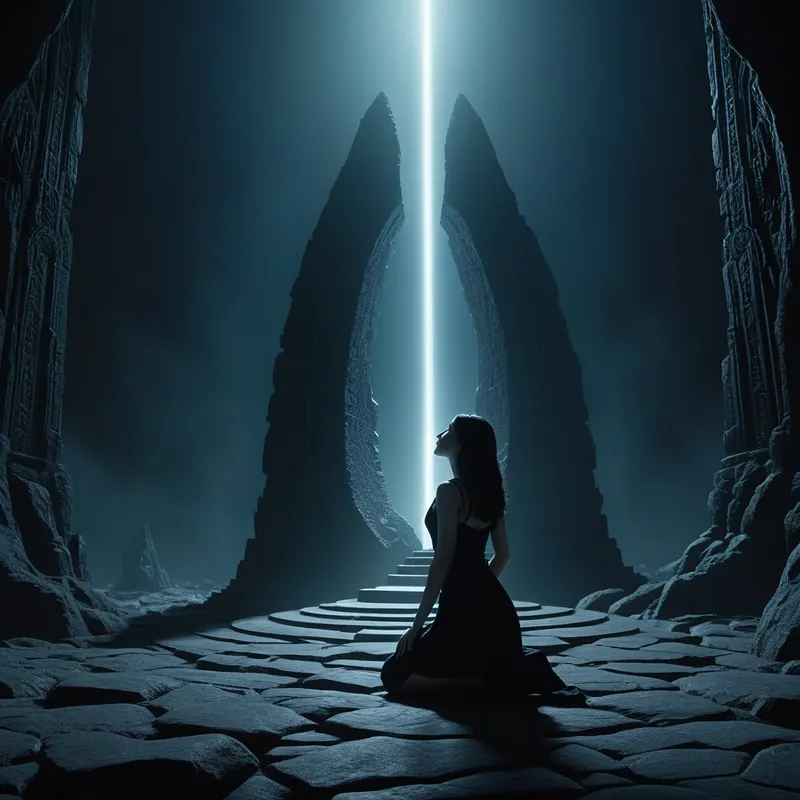
Cultural Origins & Context
The myth of the katabasis of Ina is considered a foundational “ur-myth” within the Global/Universal corpus, a term used by comparative mythologists for narratives so fundamental they appear, in varying forms, across countless human cultures. It is not tied to a single priesthood or text but is understood as a psychic inheritance, passed down through the language of dreams, ritual theater, and the oral traditions of storytellers who served as “memory-keepers.”
Its primary societal function was initiatory. It was recited during rites of passage—not just for individuals, but for communities facing existential crises, plagues, or the death of a cultural epoch. The story was not entertainment; it was a map for navigating collective despair. The teller, often in a state of ritual trance, would not merely narrate but enact the descent, their voice dropping to a whisper in the passages describing the Katabasis, forcing the audience to lean into the shared silence. This performative context underscores the myth’s purpose: to provide a container for the experience of profound loss and the terrifying, necessary journey into meaninglessness that precedes renewal.
Symbolic Architecture
At its core, the myth is a profound allegory for the psyche’s encounter with the Shadow and the process of reclaiming disowned wholeness. Ina, the weaver of conscious order, represents the structuring principle of the ego and the persona—the part of us that creates coherence, identity, and logical meaning.
The underworld is not hell; it is the un-lived life, the totality of potentials we refused in order to become who we are.
The Katabasis is the journey into the personal and collective unconscious. The fraying patterns are the disintegration of a life structure that has become too rigid, too divorced from its instinctual roots. The Mnemolith is the Shadow itself, not as a monster, but as a silent, mirror-like truth-bearer. Its lack of form reflects the ego’s terror of its own opposite: chaos, passivity, and the unknown.
The climax holds the key. The “First Memory” is the Self, the original, whole pattern of the psyche before it was split into conscious and unconscious. Ina cannot retrieve it through force of will (ego), for the ego is precisely what obscures it. She can only approach it through the ego’s sacrifice—the willingness to let go of her current identity, to be unmade.
The Dreamer’s Resonance
When this myth activates in the modern dreamer, it often manifests not as a literal narrative, but as a somatic and emotional pattern. The dreamer may experience dreams of being in vast, empty buildings (the inverted cathedral), of losing vital documents or memories, or of encountering a silent, imposing figure that evokes both dread and fascination.
Psychologically, this signals a numinous crisis. The conscious attitude is failing. This can follow a major life disruption—a career loss, the end of a relationship, a spiritual bankruptcy. The psyche is initiating its own katabasis. The somatic sensations are crucial: a feeling of hollowing out, of “falling apart,” or a heavy, leaden depression. These are not signs of failure, but of the process itself. The ego is being compelled to release its rigid control, to descend into the body and the unconscious to find what has been lost—not an old memory, but a more authentic way of being.
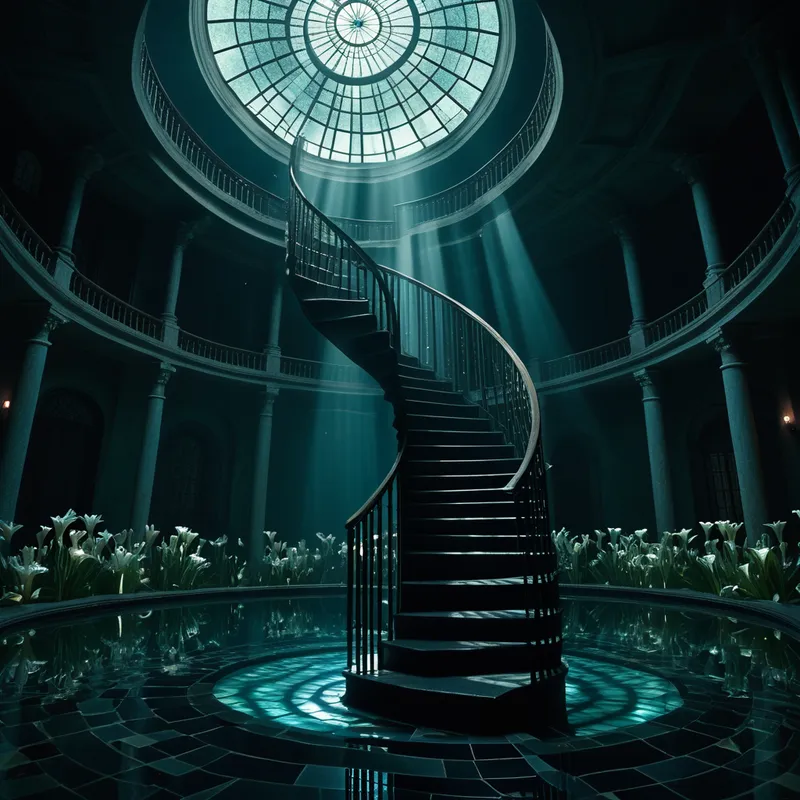
Alchemical Translation
The alchemical process mirrored in Ina’s journey is the Nigredo, the descent into darkness and putrefaction, which is necessary for the subsequent stages of purification and unification. For the modern individual seeking individuation, the myth provides a non-pathologizing model for deep depression or existential doubt.
The treasure is guarded by a dragon because the treasure is the dragon. Wholeness is found by integrating, not slaying, the shadow.
The conscious mind (Ina) must willingly engage with what it has rejected (the Katabasis). The goal is not to “fix” the darkness with light, but to undergo a transmutation where the opposition itself is transcended. Ina’s ultimate act is one of symbolic death; she offers her old self-concept to the void. In psychological terms, this is the dissolution of an outworn ego-complex. The miracle is that from this dissolution, a new, more capacious center of personality can form—one that includes the wisdom of the abyss. The Chamber of Latency she leaves behind represents the transformed relationship with the unconscious. It is no longer a threatening void to be avoided, but a creative source, a womb of future potential that the renewed self can consult. The individual returns to daily life not “cured” of darkness, but in a conscious, dynamic relationship with it, able to weave a life-pattern that is both structured and resilient, informed by both light and depth.
Associated Symbols
Explore related symbols from the CaleaDream lexicon: