The Kamogawa River and Kiyomizu-dera Myth Meaning & Symbolism
A tale of a monk's sacred vow, a dragon's wrath, and the alchemical union of pure water and spiritual resolve that birthed a temple.
The Tale of The Kamogawa River and Kiyomizu-dera
Listen, and let the mists of time part. In the ancient hills east of Heian-kyō, where the air hummed with the whispers of kami, there flowed a river. The Kamogawa was not merely [water](/myths/water “Myth from Chinese culture.”/) over stone; it was a vein of the land, a restless spirit carving its path from mountain to sea. Its waters were dark, deep, and known to be the domain of a powerful, tempestuous ryū. This dragon was [the river](/myths/the-river “Myth from Buddhist culture.”/)’s soul, its moods dictating [the flood](/myths/the-flood “Myth from Biblical culture.”/) and the drought, its presence a thrum in the dreams of those who lived along its banks.
Into this realm came a monk of profound determination, named Enchin. He was a seeker, a man who heard not the river’s roar, but a celestial call for a sanctuary of pure compassion. He dreamed of a temple dedicated to Kannon, a place where mercy would flow as freely as water. But the site he was drawn to, a precipitous cliff overlooking the Otowa waterfall, was guarded. [The dragon](/myths/the-dragon “Myth from Chinese culture.”/) of the Kamogawa saw this intrusion not as piety, but as a challenge to its sovereignty. The monk’s prayers were met with tremors in [the earth](/myths/the-earth “Myth from Hindu culture.”/); his meditations were shattered by the river’s sudden, furious swell.
The conflict brewed like a storm. Enchin, in his humble hermitage, fasted and chanted, his resolve hardening like the ancient cypress. The dragon, its scales the color of tarnished silver and deep jade, stirred the waters to a boiling fury, sending visions of deluge and despair to test the monk’s spirit. For days and nights, this silent war of wills shook the very roots of the hills. The air grew thick with the scent of ozone and cedar, of damp earth and spiritual tension.
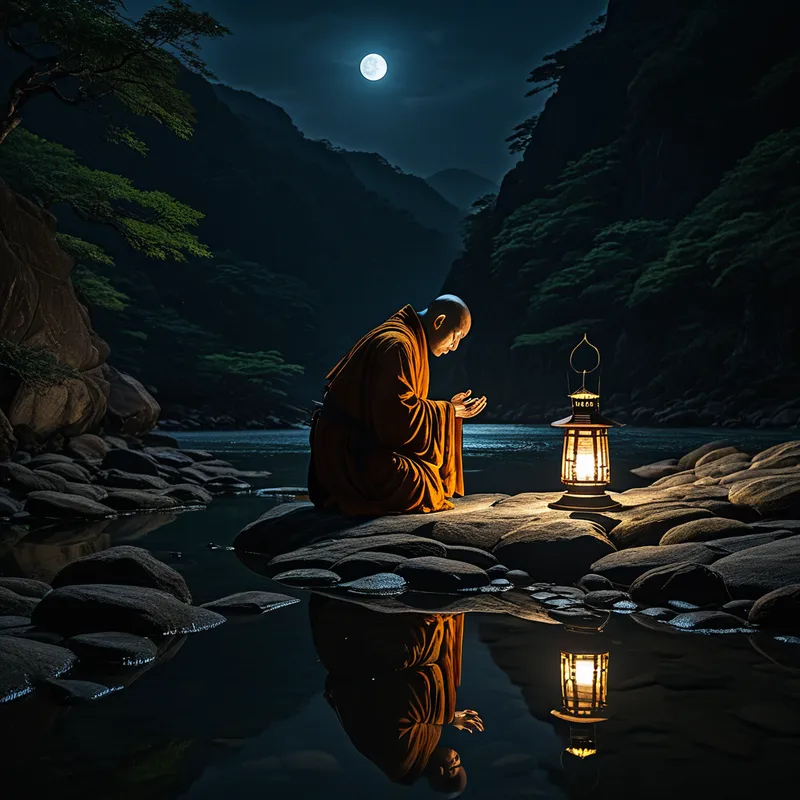
Then, on a night when [the moon](/myths/the-moon “Myth from Tarot culture.”/) was a sliver of cold [pearl](/myths/pearl “Myth from Chinese culture.”/), Enchin descended to the river’s edge. He did not come with incantations of binding, but with an offering of his entire being. He stood upon a rock, the icy spray soaking his robes, and made a vow that echoed into [the abyss](/myths/the-abyss “Myth from Kabbalistic culture.”/). He would not conquer the dragon; he would honor it. He would build [the temple](/myths/the-temple “Myth from Jewish culture.”/) not in spite of the [river spirit](/myths/river-spirit “Myth from Native American culture.”/), but with it, channeling the pure, life-giving essence of the waterfall into the heart of his sanctuary. [The temple](/myths/the-temple “Myth from Jewish culture.”/) would be a bridge between the wild, untamed power of nature and the serene, boundless compassion of [the Buddha](/myths/the-buddha “Myth from Buddhist culture.”/).
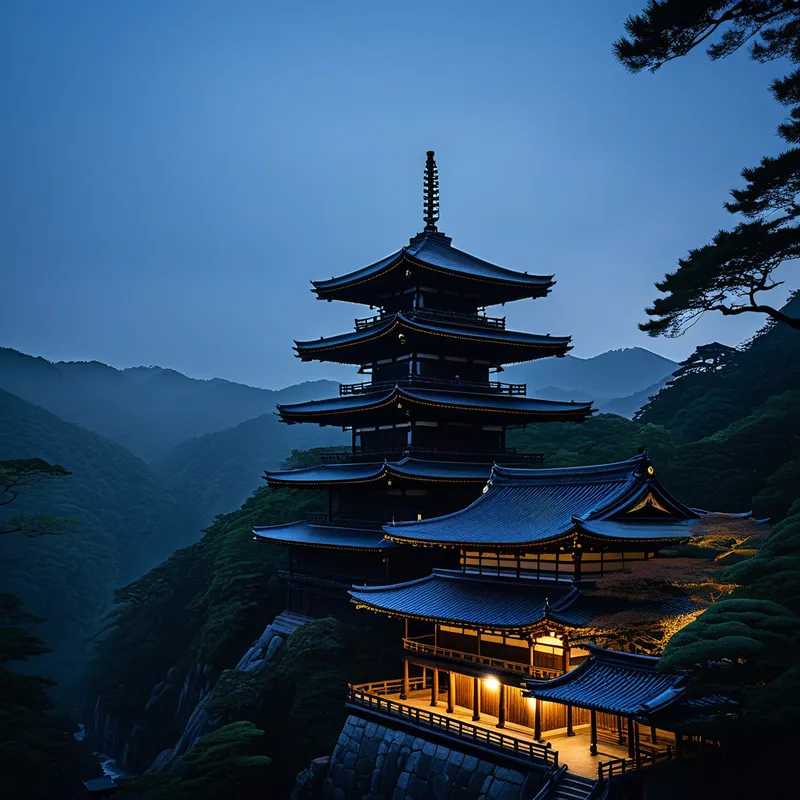
A great silence fell. The churning waters stilled, becoming a mirror to [the star](/myths/the-star “Myth from Tarot culture.”/)-strewn sky. From the profound depths rose the dragon, not in wrath, but in solemn acknowledgment. It beheld the monk, not as an enemy, but as a worthy steward. In a moment of alchemical grace, the dragon’s fierce energy transformed. It did not submit; it allied. Its spirit infused the site, becoming the protective genius loci of the temple. The waterfall’s streams—later named for longevity, success, and love—became the temple’s sacred lifeblood. Thus, Kiyomizu-dera was born, not from conquest, but from a sacred pact, its famous stage built out over [the void](/myths/the-void “Myth from Buddhist culture.”/) as if floating on the dragon’s own transformed breath.
Cultural Origins & Context
This foundational narrative is woven into the early history of Kiyomizu-dera, which dates to 778 CE, in the early Heian period. The story exists in the liminal space between recorded temple origin (engi) and popular folklore. It was transmitted not solely through monastic texts, but orally by temple priests, storytellers, and pilgrims who came to drink from the Otowa waterfall. Its societal function was multifaceted: it served as a chinju, a mythic charter legitimizing the temple’s powerful and perilous location. It explained the palpable, awe-inspiring presence felt at the site—the roar of the waterfall, the vertigo of the cliff—as the embodied spirit of the dragon.
Furthermore, the myth performed a crucial act of cultural syncretism. It harmonized the indigenous Shinto veneration of nature spirits (the dragon kami) with the imported doctrines of Mahayana Buddhism. The dragon was not exorcised; it was converted, becoming a protector of the Buddhist law (dharma). This narrative thus modeled for the populace how to integrate deep, local spiritual identities with a new, universalizing faith, a process central to the development of Japanese religious life.
Symbolic Architecture
At its core, this myth is a profound map of psychic [integration](/symbols/integration “Symbol: The process of unifying disparate parts of the self or experience into a cohesive whole, often representing psychological wholeness or resolution of internal conflict.”/). The Kamogawa [dragon](/symbols/dragon “Symbol: Dragons are potent symbols of power, wisdom, and transformation, often embodying the duality of creation and destruction.”/) represents the untamed, unconscious forces of the [psyche](/myths/psyche “Myth from Greek culture.”/)—the raw emotional power, instinct, and primal [energy](/symbols/energy “Symbol: Energy symbolizes vitality, motivation, and the drive that fuels actions and ambitions.”/) that can feel chaotic, dangerous, and overwhelming. It is the [shadow](/symbols/shadow “Symbol: The ‘shadow’ embodies the unconscious, repressed aspects of the self and often represents fears or hidden emotions.”/)-as-tama, the volatile [life](/symbols/life “Symbol: The symbol of ‘Life’ represents a journey of growth, interconnectedness, and existential meaning, encompassing both the joys and challenges that define human experience.”/) force that floods us with [passion](/symbols/passion “Symbol: Intense emotional or physical desire, often linked to love, creativity, or purpose. Represents life force and deep engagement.”/), rage, and creative potential.
The monk Enchin symbolizes the conscious ego and its spiritual aspiration—the desire for order, [clarity](/symbols/clarity “Symbol: A state of mental transparency and sharp focus, often representing resolution of confusion or attainment of insight.”/), and compassionate understanding. His initial approach—seeking to build his [temple](/symbols/temple “Symbol: A temple often symbolizes spirituality, sanctuary, and a deep connection to the sacred aspects of life.”/) of [consciousness](/symbols/consciousness “Symbol: Consciousness represents the state of awareness and perception, encompassing thoughts, feelings, and experiences.”/) on the dragon’s territory—inevitably sparks conflict. This is the classic inner war between our controlled self-[image](/symbols/image “Symbol: An image represents perception, memories, and the visual narratives we create in our minds.”/) and the wild, authentic power we have repressed or feared.
The true sanctuary is not built by slaying the dragon, but by hearing its roar as a sacred vow.
The transformative pivot is Enchin’s vow of [inclusion](/symbols/inclusion “Symbol: The state of being accepted, welcomed, or integrated into a group, community, or society. It represents belonging and participation.”/), not domination. He offers not battle, but partnership. This is the critical move from repression to [dialogue](/symbols/dialogue “Symbol: Conversation or exchange between characters, representing communication, relationships, and narrative flow in games and leisure activities.”/). The Otowa [waterfall](/symbols/waterfall “Symbol: Waterfalls in dreams often signify a release of emotions or a transformation, symbolizing the flow of life and the transition of feelings.”/) becomes the [symbol](/symbols/symbol “Symbol: A symbol can represent an idea, concept, or belief, serving as a powerful tool for communication and understanding.”/) of this [alchemy](/symbols/alchemy “Symbol: A transformative process of purification and creation, often symbolizing personal or spiritual evolution through difficult stages.”/): the dragon’s chaotic, watery power is channeled into three distinct, life-affirming streams. Psychologically, this represents the [sublimation](/symbols/sublimation “Symbol: Transforming base impulses into creative or socially acceptable outlets, often seen in artistic expression.”/) of raw libido or psychic energy into specific, nourishing faculties of the [personality](/symbols/personality “Symbol: Personality in dreams often symbolizes the traits and characteristics of the dreamer, reflecting how they perceive themselves and how they believe they are perceived by others.”/)—perhaps into creative work (success), loving [relationship](/symbols/relationship “Symbol: A representation of connections we have with others in our lives, often reflecting our emotional state.”/) (love), and holistic well-being (longevity).
Kiyomizu-dera’s famous stage, built without nails, jutting over the void, is the ultimate symbol of the integrated Self. It is the conscious personality, supported by the transformed power of the unconscious, able to stand and survey [the world](/myths/the-world “Myth from Tarot culture.”/) from a position of breathtaking clarity and courage, grounded in the deep, negotiated pact with one’s own [depths](/symbols/depths “Symbol: Represents the subconscious, hidden emotions, or foundational aspects of the self, often linked to primal fears or profound truths.”/).
The Dreamer’s Resonance
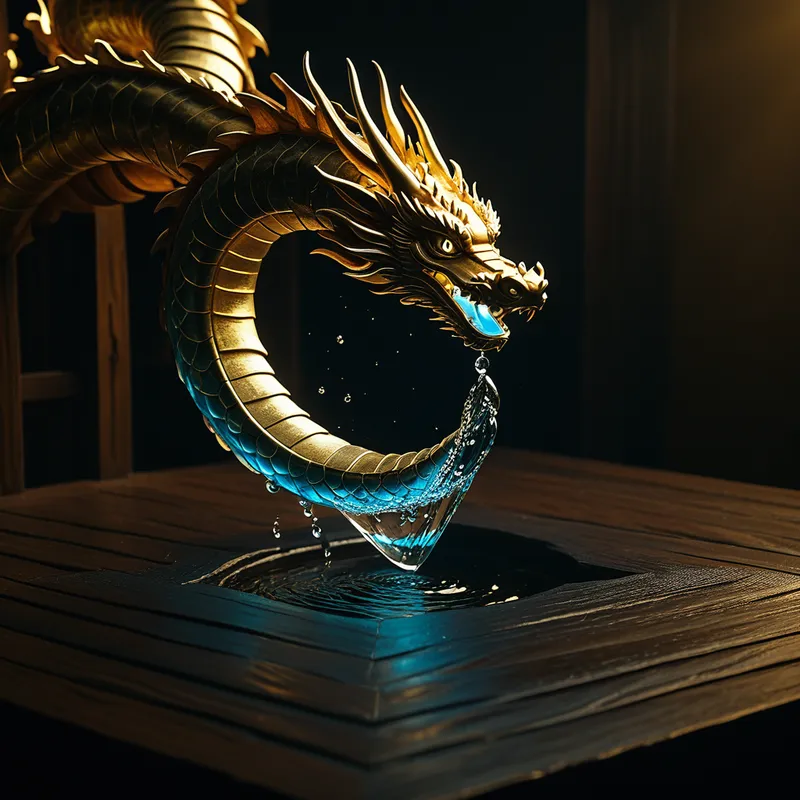
When this mythic pattern stirs in the modern dreamer, it signals a profound somatic and psychological process of encountering and integrating a powerful, autonomous complex. To dream of a turbulent, dark river or a coiled, watchful serpent/dragon in a natural setting points to the uprising of deep, instinctual energy—perhaps a long-buried passion, a justified anger, or a surge of creative impulse that threatens to flood one’s current life structures.
Dreaming of attempting to build something (a house, a platform) near such waters reflects [the ego](/myths/the-ego “Myth from Jungian culture.”/)’s attempt to achieve a goal while this powerful unconscious content is active. The feeling is often one of anxiety, instability, or being sabotaged from within. The pivotal dream moment would be one of facing the dragon not with a weapon, but with an open-handed gesture, a question, or an offering of respect. This marks the shift from a psychology of conflict to a psychology of conversation.
Somatically, this process may be felt as a release of tension in the gut or solar plexus, a feeling of “flow” replacing constriction, or a visceral sense of a deep, rumbling energy finding a new channel through the body. The dreamer is learning to drink from their own Otowa falls—to find the precise, life-giving applications for their once-feared inner power.
Alchemical Translation
The myth of the Kamogawa and Kiyomizu-dera is a masterful blueprint for the individuation process. It models the alchemical [nigredo](/myths/nigredo “Myth from Alchemical culture.”/) and albedo in spiritual terms.
[The first stage](/myths/the-first-stage “Myth from Alchemical culture.”/) (nigredo) is the confrontation with the “black waters”—[the shadow](/myths/the-shadow “Myth from Jungian culture.”/) dragon of our unresolved complexes, our emotional history, our instinctual self. This is a necessary, dark, and chaotic phase where old structures of the personality feel threatened. The ego’s temptation is to fight, to dam the river, to deny the dragon. This only leads to inner stagnation or explosive crisis.
The alchemical key is the monk’s vow, which initiates the citrinitas or albedo. This is the stage of dialogue and sublimation. One must go to the edge of one’s own abyss and speak to the dragon. What does it want? What power does it hold? How can its fierce energy be honored and directed? This is not an intellectual exercise, but a heartfelt negotiation with the deepest layers of [the Self](/myths/the-self “Myth from Jungian culture.”/).
Individuation is the architecture that emerges when the river’s flow and the builder’s plan become a single, sacred design.
The final stage, the [rubedo](/myths/rubedo “Myth from Alchemical culture.”/), is the completed “temple.” This is the individuated personality: unique, resilient, and compassionate. The Kiyomizu stage is the conscious mind, now stable and expansive because it is openly supported by the transformed power of the unconscious. The once-threatening waters now feed the sacred springs of the individual’s purpose. The modern seeker’s task is thus clear: to locate their own inner Kamogawa, to face its guardian with respect, and to broker the sacred pact that allows a life of pure, clear action to be built upon its mighty, eternal flow.
Associated Symbols
Explore related symbols from the CaleaDream lexicon: