The Kabbalah Tree of Life Myth Meaning & Symbolism
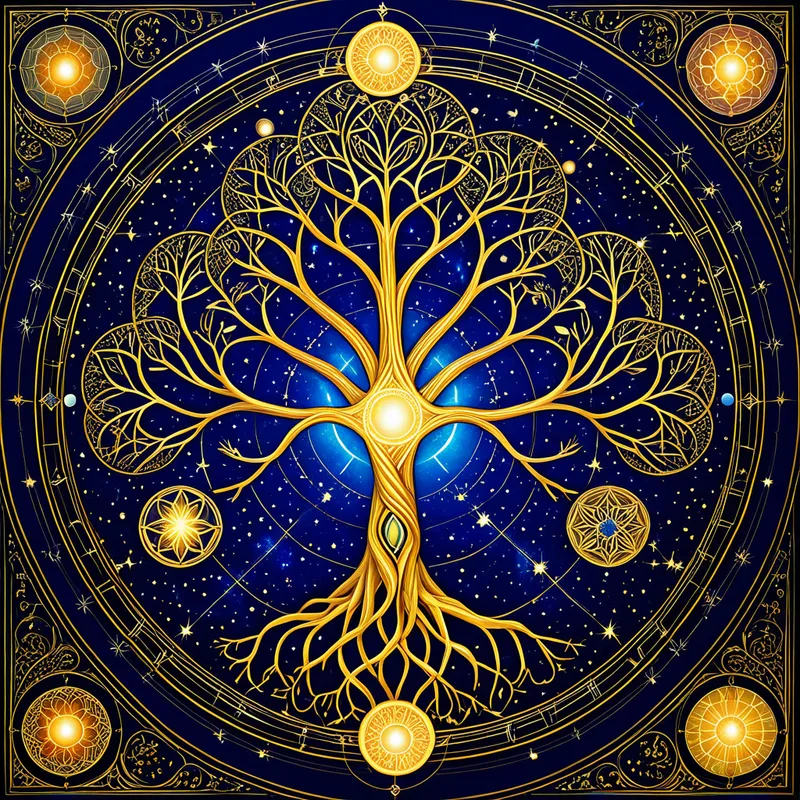
A luminous map of divine emanation, the Tree of Life charts the descent of infinite light into form and the soul's perilous ascent back to unity.
The Tale of The Kabbalah Tree of Life
Listen. Before the worlds were worlds, there was only the Ein Sof—the No-Thing, the endless, the silence so profound it was a song. And within that endlessness, a desire arose: to be known. So the Ein Sof contracted, making a hollow within itself, a womb of potential. Into that hollow, it poured a single ray of its own endless light.
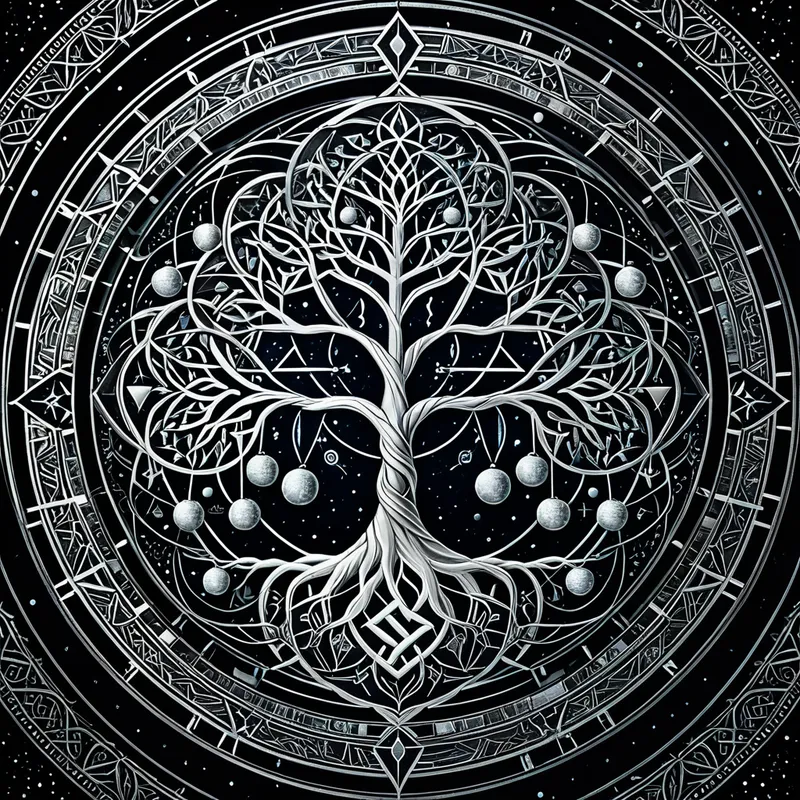
That ray did not simply shine; it cascaded, it crystallized. It became ten vessels of light, ten holy Sefirot, arranged in the pattern of a cosmic man, a divine form. At the crown sat Keter, a point of pure, ineffable radiance. From it flowed Chokhmah and Binah, father and mother of the worlds. Down the central pillar, the light descended: Chesed and Gevurah, balanced in the heart by Tiferet. Then to the lower realms: Netzach and Hod, finding foundation in Yesod, and finally pouring into the tenth vessel, Malkhut, the queen who would become our world.
But the light was too pure, too fierce. The lower vessels, unprepared for the torrent from above, shattered. Vessels of Sefirot fractured, and holy sparks of that primordial light were flung into the abyss, scattered and buried in the shells of brokenness, the <abbr title=“The “shells” or realms of impurity and fragmentation resulting from the shattering of the vessels”>Kelipot. The Tree was wounded. The channels were broken. The world was born from this cataclysm—a world of separation, of matter, of pain, where the divine light lies hidden in the mud and the marrow of things.
Yet the Tree did not die. It remained, a luminous skeleton, a map of what was and what could be again. And a path was set: the path of the Tzitzum and the Shevirat HaKelim. The Flaming Sword of divine judgment now guards the way back to the Garden, but it is also the very path itself—22 twisting, turning pathways that connect the spheres. This is the great drama: the descent of the One into the Many, and the sacred duty of the Many to remember the One, to gather the sparks, to mend the vessels, to heal the wounded Tree from its roots in the earth to its crown in the endless light.
Cultural Origins & Context
This is not a myth told around campfires, but one whispered in the study halls of mystics. Its origins are esoteric, emerging from the heart of medieval Jewish spirituality, particularly in 12th-13th century Provence and Spain with the text of the Zohar. The Tree of Life, or Etz Chaim, is the central glyph of Kabbalah, a contemplative technology for understanding the nature of God, creation, and the human soul.
It was passed down from master to carefully prepared disciple, often orally, to prevent its profound and potentially destabilizing power from being misunderstood. Its societal function was not for the masses but for the elite seeker. It served as a mystical map of the cosmos and the psyche, providing a framework to understand divine providence, the meaning of the commandments (mitzvot), and the soul’s journey. It was a way to reconcile an infinite, unknowable God with a finite, suffering world—to find the divine structure within the apparent chaos of exile.
Symbolic Architecture
The [Tree](/symbols/tree “Symbol: In dreams, the tree often symbolizes growth, stability, and the interconnectedness of life.”/) is a symbolic [architecture](/symbols/architecture “Symbol: Architecture in dreams often signifies structure, stability, and the framing of personal identity or life’s journey.”/) of [consciousness](/symbols/consciousness “Symbol: Consciousness represents the state of awareness and perception, encompassing thoughts, feelings, and experiences.”/) itself. It is not merely a diagram of God, but a [blueprint](/symbols/blueprint “Symbol: A blueprint represents the foundational plan or design for something, often symbolizing potential, structure, and the mapping of one’s inner self or future.”/) of the [human](/symbols/human “Symbol: The symbol of a human represents individuality, complexity of emotions, and social relationships.”/) [soul](/symbols/soul “Symbol: The soul represents the essence of a person, encompassing their spirit, identity, and connection to the universe.”/) in its perfected state. Each Sefirah represents an archetypal divine attribute and its corresponding psychological faculty.
The journey from Malkhut (Kingdom) to Keter (Crown) is the soul’s ascent from identification with the fragmented persona to communion with the transcendental Self.
The three pillars—Right (Mercy), Left (Severity), and Central (Balance)—model the eternal psychic [tension](/symbols/tension “Symbol: A state of mental or emotional strain, often manifesting physically as tightness, pressure, or unease, signaling unresolved conflict or anticipation.”/) between [expansion](/symbols/expansion “Symbol: A symbol of growth, increase, or extension beyond current boundaries, often representing personal development, opportunity, or overwhelming change.”/) and [contraction](/symbols/contraction “Symbol: A symbolic process of compression, reduction, or inward movement, often representing preparation, transition, or the tension between opposing forces.”/), yes and no, which must be reconciled in the [heart](/symbols/heart “Symbol: The heart symbolizes love, emotion, and the core of one’s existence, representing deep connections with others and self.”/)-center of Tiferet. The shattering of the vessels (<abbr title=“The “shells” or realms of impurity and fragmentation resulting from the shattering of the vessels”>Shevirat HaKelim) is the primordial [trauma](/symbols/trauma “Symbol: A deeply distressing or disturbing experience that overwhelms the psyche, often manifesting in dreams as unresolved emotional wounds or psychological injury.”/) of individuation—the necessary [fragmentation](/symbols/fragmentation “Symbol: The experience of breaking apart, losing cohesion, or being separated into pieces. Often represents disintegration of self, relationships, or reality.”/) of the original, unconscious unity that creates the world of ego and experience. The scattered sparks are the fragments of wholeness, of meaning, and of divinity buried in our complexes, our wounds, and the raw [material](/symbols/material “Symbol: Material signifies the tangible aspects of life, often representing physical resources, desires, and the physical world’s influence on our existence.”/) of the world.
The Dreamer’s Resonance
When this myth appears in modern dreams, it rarely manifests as a literal tree. Instead, one may dream of intricate schematics, glowing networks, or a ladder of lights. One might dream of repairing a broken circuit board, gathering scattered jewels in a dark landscape, or trying to balance two opposing forces within one’s own body. The somatic sensation is often one of tension seeking resolution—a pull between the head and the heart, or a feeling of being “scattered” and needing to be “re-wired.”
Psychologically, this dream pattern signifies a profound process of psychic integration. The dreamer is encountering the deep architecture of their own psyche, recognizing both its divine blueprint and its fractured state. It is the soul mapping itself, identifying where energy is blocked (a broken pathway) or where an attribute is over- or under-developed (an imbalanced Sefirah). The dream is an invitation to engage in <abbr title=“The Kabbalistic concept of “repair” or “rectification,” the process of healing the world”>Tikkun—not of the world out there, but of the inner world first.
Alchemical Translation
The Kabbalistic myth models the alchemical opus of individuation with stunning precision. The process begins with the contractio (Tzimtzum), where the ego-consciousness withdraws its projections to create a vessel for the Self. Then comes the separatio and mortificatio of the <abbr title=“The “shells” or realms of impurity and fragmentation resulting from the shattering of the vessels”>Shevirat HaKelim—the painful breaking apart of old, rigid structures of identity and worldview.
The great work is not to avoid the shattering, but to consciously participate in the gathering. Each integrated shadow, each healed complex, is a spark redeemed.
The 22 paths are the stages of the iter (journey), the confrontations and unions that transmute base consciousness into gold. Balancing Chesed and Gevurah within is the alchemical coniunctio oppositorum (union of opposites), achieved in Tiferet, the redeemed heart. The ultimate goal, the attainment of Keter, is not ego-inflation but ego-dissolution in the unio mystica—the realization that the seeker, the path, and the destination were never separate from the infinite light that began the cascade.
Associated Symbols
Explore related symbols from the CaleaDream lexicon:
- Tree of Life — The central glyph and mythic entity, representing the structured emanation of divine consciousness into manifestation and the map for the soul’s return.
- Light — The primordial substance of the Ein Sof, which becomes fragmented into sparks; symbolizes consciousness, divinity, and the goal of the mystical quest.
- Circle — Reflects the cyclical nature of emanation and return, and the wholeness of the Sefirot as a unified system.
- Key — Represents the wisdom of Kabbalah and the individual insights that unlock the understanding of the pathways and spheres on the Tree.
- Temple — Symbolizes the cosmos and the human soul as sacred structures built according to the divine blueprint of the Tree.
- Journey — The essential narrative of the myth: the descent of the light and the arduous ascent of the soul through the 22 paths.
- Order — The divine structure imposed on the chaos of potential, creating a cosmos of meaning and relationship from unity.
- Soul — The entity that mirrors the structure of the Tree; its healing and elevation are the purpose of the mythic drama.
- Shadow — Manifest in the <abbr title=“The “shells” or realms of impurity and fragmentation resulting from the shattering of the vessels”>Kelipot, the shells that trap the holy sparks; represents the fragmented, unconscious aspects awaiting integration.
- Root — The hidden, foundational connection of Malkhut back to Keter, and the archetypal origins of the psyche in the unconscious.
- Crown — The Sefirah of Keter, representing transcendence, pure potential, and the origin point of the Self.
- Fruit-Laden Tree — A manifestation of Malkhut, the world in its state of fulfilled potential, where the divine sparks are gathered and the Tree bears the fruit of its own repair.