The Jazz Muse Myth Meaning & Symbolism
A musician's pact with a divine spirit grants genius but demands the surrender of his worldly self to the eternal, collective sound.
The Tale of The Jazz Muse
Listen. In the deep night, where the city’s breath steams and the streetlights bleed halos on wet asphalt, there was a man named Leo. He had hands that knew the horn, a heart that beat in 4/4 time, but a sound that was only ever almost-there. It was a good sound, a true sound, but it lived in the realm of the known. It had no wings.
One night, in the back room of a club called The Blue Vein, after the last set had died and the last drunk had stumbled home, Leo played for the walls. It was a lament, a prayer of frustration sent into the silence. And the silence answered.
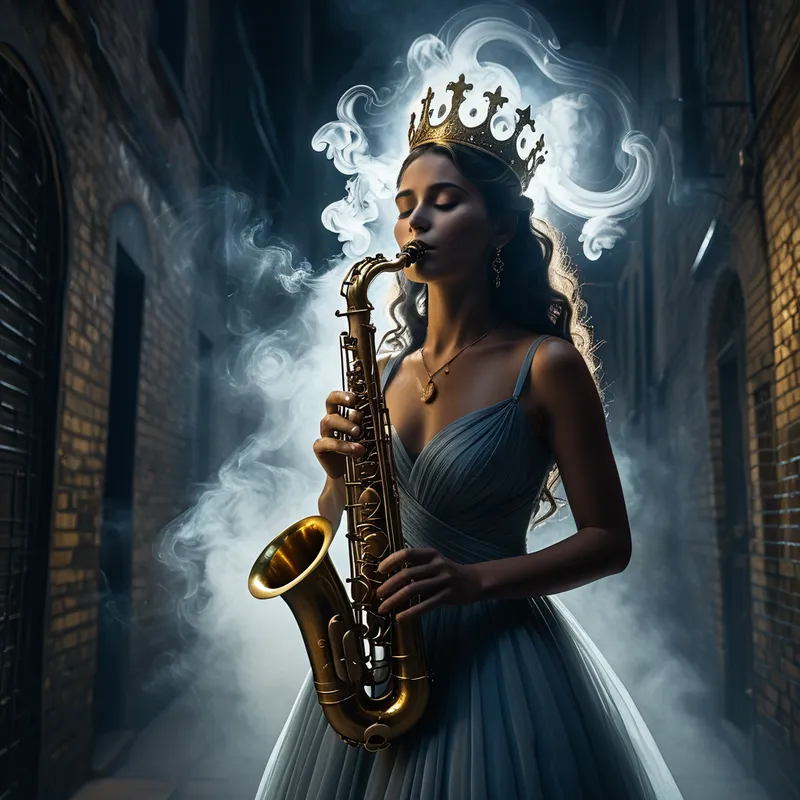
The air grew thick, sweet with the scent of ozone and old whiskey. The single bulb flickered, and in the pooling shadows, a form coalesced. She was not a woman, but the idea of one: a silhouette of smoke and shifting, brass-colored light. Her hair was the echo of a cymbal crash; her eyes held the deep, purple ache of a blues progression. She was The Jazz Muse.
She spoke without moving her mouth, her voice the rasp of a needle on vinyl, the whisper of fingers on catgut. “You call for a song that has no end. I can give you the notes that live between the notes. I can make your horn speak with the voice of the river and the cry of the train at midnight. But my gift is not a loan. It is a trade.”
Leo, his own breath caught in his chest, asked the price. The Muse smiled, a slow, sad curve of light. “The sound will move through you. It will be yours, and it will be everyone’s. But you… you will become its vessel. The man who worries about rent, who loves a woman, who remembers his childhood name… that man must step aside. The music must have the whole room.”
Trembling, driven by a hunger deeper than fear, Leo agreed. He put the horn to his lips. The moment he breathed out, it was not his breath. It was a hurricane. A sound poured forth that had never been heard—a cascade of gold and midnight blue, notes that bent around corners and truths that hurt to hear. He played until the sun threatened the horizon, and when he stopped, he was empty. And full.
He played like that every night. He became a legend, a ghost story musicians told. But off the bandstand, Leo grew quiet, distant. The love of his life touched his face and found it cool, his eyes fixed on some inner horizon. He was forgetting the taste of coffee, the feel of his own fingerprints. He was becoming a beautiful, hollow reed.
The final night came at The Velvet Vortex. The room was packed, electric. Leo played a solo that tore the roof off the world. As he hit the last, searing note, he didn’t stop. He kept blowing, and his physical form began to shimmer, to dissolve into the very vibration. His horn clattered to the stage, empty. But the note—his note—hung in the air, perfect and eternal, joining the great, collective Song of the City. Leo was gone. The music remained.
Cultural Origins & Context
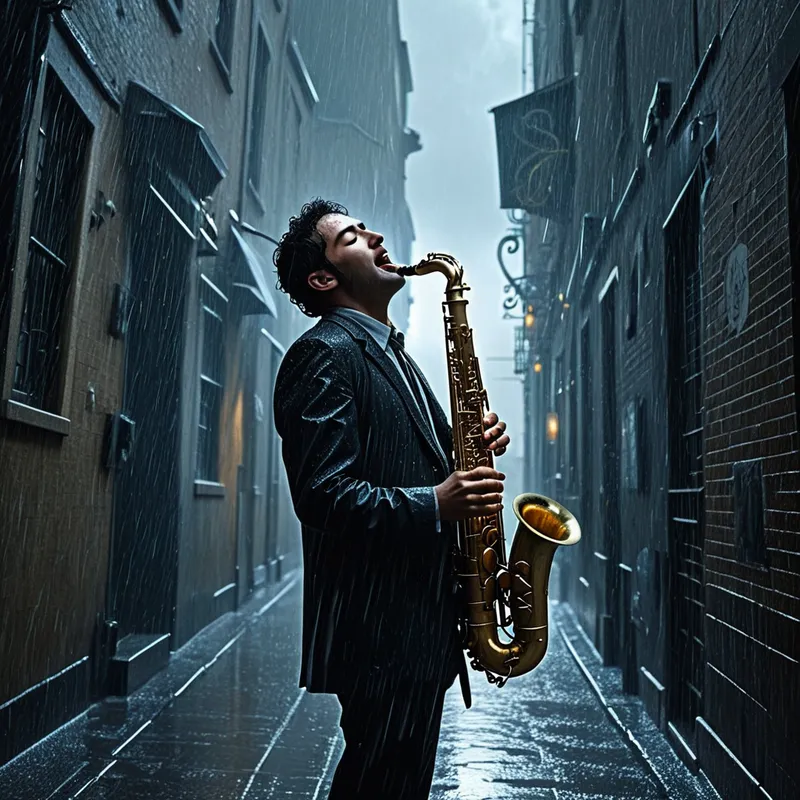
This myth emerged not from ancient scrolls but from the oral tradition of the mid-20th century American jazz underground. It was passed between musicians in green rooms, after hours in dimly lit bars, and on long bus rides between gigs. The tellers were often the elders—sidemen who had seen “cats” come and go, who spoke in hushed, respectful tones of figures like Bird or Precious.
Its societal function was multifaceted. For the culture, it was a cautionary hymn and a justification. It explained the often-tragic arcs of brilliant, self-destructive artists, framing them not as merely flawed men but as vessels chosen for a divine burden. It sacralized the music itself, suggesting that the greatest jazz was not composed, but channeled from a numinous source beyond the individual. The myth served to bind the community in a shared, sacred understanding of the price of their art, elevating the musician from entertainer to priest of an invisible, demanding god.
Symbolic Architecture
At its core, the myth maps the psyche of the creative act. The Jazz Muse represents the autonomous, daemonic force of the creative unconscious—what the Greeks called the daimon and Jung termed the creative complex. She is beautiful and terrifying because she is the raw, unmediated power of inspiration itself, indifferent to the well-being of the ego that temporarily houses it.
The pact is not with a devil, but with one’s own deepest potential. The price is not damnation, but dissolution.
Leo’s journey symbolizes the ultimate artistic conflict: the tension between the needs of the individual personality and the demands of the impersonal creative spirit. His gradual emptying—forgetting his name, his love—is the symbolic shedding of the personal ego. The horn is the alchemical vessel, and his breath is the spiritus, the animating force. His final dissolution into the Song of the City represents the artist’s work being subsumed into the collective cultural canon, achieving immortality not as a person, but as a permanent vibration within the shared human soul.
The Dreamer’s Resonance
When this myth pattern erupts in modern dreams, it rarely appears as a literal jazz club. Instead, the dreamer may find themselves in a high-stakes performance (a presentation, a surgery, an exam) where they are suddenly possessed by a flawless, alien skill that is not their own. They perform brilliantly, but upon waking, they feel a profound, somatic unease—a hollowing in the chest, a sense of having been “used.”
This dream signals a critical phase in a psychological process: the confrontation with a powerful, autonomous content of the unconscious that seeks expression through the individual. The dreamer is, like Leo, being offered a gift of immense potential (creative, professional, intellectual) that comes with a terrifying condition: the temporary or permanent relinquishment of conscious control. The anxiety in the dream is the ego’s rightful terror at its own potential obsolescence. It is the somatic signature of the psyche preparing for a possible death-and-rebirth sequence, where an old identity must be sacrificed to serve a larger, more potent inner force.

Alchemical Translation
The myth of The Jazz Muse is a stark roadmap for the alchemical stage of mortificatio and sublimatio in the journey of individuation. Leo’s initial skill represents the conscious attitude (persona). The Muse is the summons from the Self.
The process is not about becoming a famous artist, but about allowing one’s central, guiding purpose—one’s unique “note”—to sound through the vessel of one’s life, even at the cost of cherished personal identifications. The modern individual undergoes this when they must surrender a comfortable, familiar identity (the reliable employee, the dutiful child, the defined persona) to answer a deeper, more authentic calling. This calling feels like a possession; it disrupts and demands.
The triumph is not in avoiding the hollowing, but in recognizing that the hollow is the shape the spirit requires to resonate.
The “legend” left behind is not public fame, but the integrated life. The final stage, dissolution into the Song of the City, translates as the realization that one’s deepest work and worth are not personal property, but a contribution to the anonymous, collective stream of human experience and understanding. The individuated person no longer plays their song, but allows the Song to play through them, finding a paradoxical, profound freedom in this sacred service. The ego is not destroyed, but rightly positioned: as the skilled musician for the greater symphony of the Self.
Associated Symbols
Explore related symbols from the CaleaDream lexicon: