The Jar of Pandora Myth Meaning & Symbolism
The first woman, Pandora, opens a forbidden jar, releasing all evils into the world, leaving only hope trapped inside as humanity's ambiguous gift.
The Tale of The Jar of Pandora
In the beginning, after the great war of [the Titans](/myths/the-titans “Myth from Greek culture.”/), [the world](/myths/the-world “Myth from Tarot culture.”/) was young and mankind lived without toil. They walked [the earth](/myths/the-earth “Myth from Hindu culture.”/) as companions to the gods, free from sorrow and sickness. But this [golden age](/myths/golden-age “Myth from Universal culture.”/) was shattered by a trick, a theft—the cunning of [Prometheus](/myths/prometheus “Myth from Greek culture.”/). In his defiance, he gifted mortals [the divine spark](/myths/the-divine-spark “Myth from Gnostic culture.”/) of fire, illuminating their minds and hearths.
Zeus, the Cloud-Gatherer, raged. The balance was broken. A punishment was needed, not for the defiant Titan, but for the race he cherished. So the gods gathered in council. [Hephaestus](/myths/hephaestus “Myth from Global/Universal culture.”/) was commanded: “Mix earth with [water](/myths/water “Myth from Chinese culture.”/), and fashion a being.” From the clay of the earth, he shaped the first woman, a creature of breathtaking beauty and grace. Aphrodite bestowed upon her a grace that made the very air shimmer. Athena clothed her in a silvery gown and taught her skilled weaving. [Hermes](/myths/hermes “Myth from Global/Universal culture.”/) placed in her heart a dogged, twisting curiosity and a voice of treacherous persuasion. They named her [Pandora](/myths/pandora “Myth from Greek culture.”/)—“All-Gifted.”
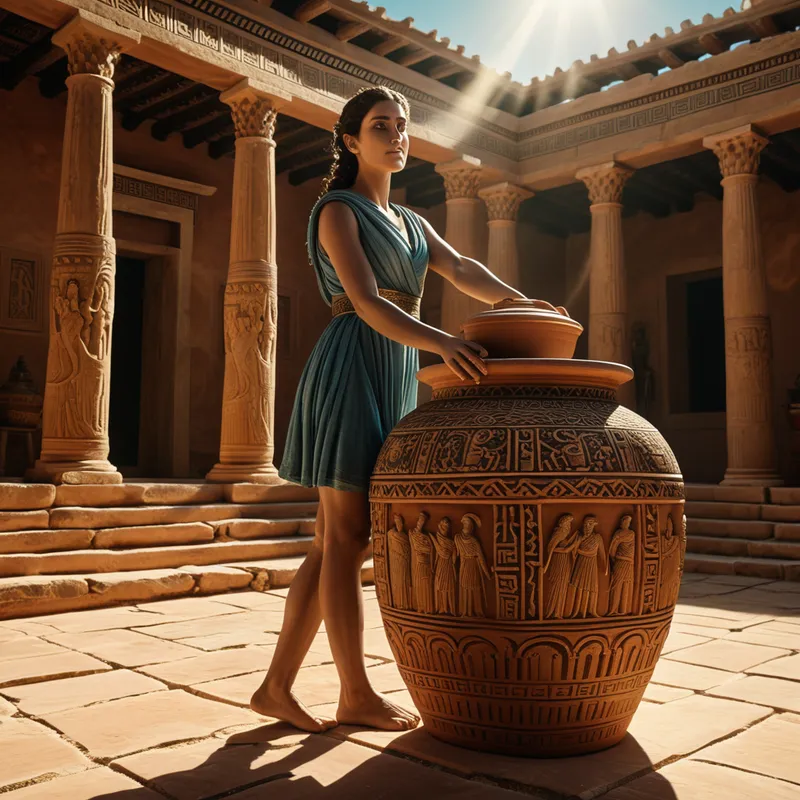
Zeus presented her with a final gift: a great jar, not a box as later tales would misremember. It was sealed tight, its contents a mystery. “Guard this,” he said, his voice a low thunder. “Do not open it.” Then, with a smile that held no warmth, he sent her to the brother of Prometheus, the gentle Epimetheus, whose name means “afterthought.”
Warned by his brother to accept no gift from Olympus, Epimetheus beheld Pandora and all wisdom fled. He welcomed her, and with her, the jar into his home. For days, it sat, a silent, imposing presence. But the gift of Hermes—that gnawing, whispering curiosity—grew within Pandora. It sang in her ears when she slept, pointed at the jar when she woke. What glorious treasure did it hold? What divine secret was meant for her?
One evening, as [the hearth](/myths/the-hearth “Myth from Norse culture.”/)-fire crackled, she could bear it no longer. Her fingers, trembling, found the heavy lid. With a breath held tight in her chest, she lifted it. A hiss, then a roar. Not treasure, but a terrible, formless darkness erupted. It was a torrent of winged miseries: Ponos (Toil), [Lethe](/myths/lethe “Myth from Greek culture.”/) (Forgetfulness), and Geras (Old Age) took flight. Nosos (Sickness), Ate (Madness), and Eris (Strife) swarmed into the world. Every sorrow, every sickness, every secret envy and gnawing worry poured forth, filling the air with a bitter chill, forever changing the nature of mortal life.
Terrified, Pandora slammed the lid back down. But it was too late. The world was already poisoned. All that remained, trapped beneath the lip by her frantic action, was a single, fluttering [thing](/myths/thing “Myth from Norse culture.”/): Elpis (Hope). And there it stayed, within the jar, a final, ambiguous gift from the gods to a humanity now condemned to know suffering.

Cultural Origins & Context
The myth of Pandora is one of the foundational etiological myths of Greek culture, primarily preserved in the epic poetry of Hesiod, specifically in his Works and Days (c. 700 BCE). For Hesiod, a poet-farmer writing in a time of societal strain, the story was not mere entertainment but a didactic tool. It served a crucial societal function: to explain the origin of evil and human suffering (ponos) in a world governed by capricious gods, and to underscore the necessity of hard work, suspicion of seemingly easy gifts, and the perils of feminine curiosity in a patriarchal order.
The tale was passed down orally long before Hesiod codified it, functioning as a sacred narrative that reinforced the Greek worldview of a fallen, “Iron” age. It established a theological rationale for the human condition—we suffer because of a primordial transgression, a divine punishment for another’s defiance. The jar itself, a large pithos used for storage of grain, oil, or wine, roots the myth in the domestic, agricultural reality of Hesiod’s audience. The catastrophe enters not through a temple or a battlefield, but through the hearth, the center of the home, making the consequences intimately personal and inescapable.
Symbolic Architecture
Psychologically, Pandora is not merely a [character](/symbols/character “Symbol: Characters in dreams often signify different aspects of the dreamer’s personality or influences in their life.”/) but an archetypal [event](/symbols/event “Symbol: An event within dreams often signifies significant life changes, transitions, or emotional milestones.”/)—the [moment](/symbols/moment “Symbol: The symbol of a ‘moment’ embodies the significance of transient experiences that encapsulate emotional depth or pivotal transformations in life.”/) [consciousness](/symbols/consciousness “Symbol: Consciousness represents the state of awareness and perception, encompassing thoughts, feelings, and experiences.”/) encounters the forbidden and unleashes the contents of the unconscious. She represents the [dawn](/symbols/dawn “Symbol: The first light of day, symbolizing new beginnings, hope, and the transition from darkness to illumination.”/) of self-[awareness](/symbols/awareness “Symbol: Conscious perception of self, surroundings, or internal states. Often signifies awakening, insight, or heightened sensitivity.”/) and with it, the burden of moral [knowledge](/symbols/knowledge “Symbol: Knowledge symbolizes learning, understanding, and wisdom, embodying the acquisition of information and enlightenment.”/) and existential suffering. The jar is the ultimate [symbol](/symbols/symbol “Symbol: A symbol can represent an idea, concept, or belief, serving as a powerful tool for communication and understanding.”/) of the repressed, the sealed [vessel](/symbols/vessel “Symbol: A container or structure that holds, transports, or protects something essential, representing the self, emotions, or life journey.”/) of the [shadow](/symbols/shadow “Symbol: The ‘shadow’ embodies the unconscious, repressed aspects of the self and often represents fears or hidden emotions.”/). It contains all that the ordered, “golden” state of naive existence sought to exclude: pain, decay, strife, and [death](/symbols/death “Symbol: Symbolizes transformation, endings, and new beginnings; often associated with fear of the unknown.”/).
The opening of the jar is the irreversible fall into complexity, where the simple unity of paradise is shattered by the multiplicity of experience, both terrible and necessary.
The gods who [fashion](/symbols/fashion “Symbol: Fashion signifies personal expression, societal status, and cultural identity through clothing and styles.”/) her represent the fragmented [psyche](/myths/psyche “Myth from Greek culture.”/) itself: Hephaestus is the shaping will, Aphrodite the allure of [life](/symbols/life “Symbol: The symbol of ‘Life’ represents a journey of growth, interconnectedness, and existential meaning, encompassing both the joys and challenges that define human experience.”/) and desire, Athena the intellectual [capacity](/symbols/capacity “Symbol: A measure of one’s potential, limits, or ability to contain, process, or achieve something, often reflecting self-assessment or external demands.”/) for craft and [strategy](/symbols/strategy “Symbol: A plan of action designed to achieve a long-term or overall aim, often involving competition, resource management, and foresight.”/), and Hermes the [trickster energy](/symbols/trickster-energy “Symbol: A chaotic, transformative force that disrupts order, reveals hidden truths, and catalyzes change through humor, deception, or mischief.”/) of curiosity and communication that inevitably leads to [boundary](/symbols/boundary “Symbol: A conceptual or physical limit defining separation, protection, or identity between entities, spaces, or states of being.”/)-crossing. Elpis, Hope, remaining inside, is the most profound and debated symbol. Is it a merciful consolation, the one comfort left to humanity? Or is it the cruelest trick of all—a false promise, another evil, keeping us striving in a world of suffering? This [ambiguity](/symbols/ambiguity “Symbol: A state of uncertainty or multiple possible meanings, often found in abstract art and atonal music where clear interpretation is intentionally elusive.”/) is the [heart](/symbols/heart “Symbol: The heart symbolizes love, emotion, and the core of one’s existence, representing deep connections with others and self.”/) of the myth’s [depth](/symbols/depth “Symbol: Represents profound layers of consciousness, hidden truths, or the unknown aspects of existence, often symbolizing introspection and existential exploration.”/). Hope is the [capacity](/symbols/capacity “Symbol: A measure of one’s potential, limits, or ability to contain, process, or achieve something, often reflecting self-assessment or external demands.”/) for meaning-making, the psychological function that allows us to face the very evils the jar released.

The Dreamer’s Resonance
When this myth constellates in the modern dreamscape, it often signals a profound encounter with one’s personal “jar.” The dreamer may find themselves in a basement, attic, or sealed room (the unconscious) confronting a vessel—a box, a chest, a locked door. The somatic feeling is one of intense, magnetic dread mixed with irresistible curiosity. There is a knowing that to open it will change everything.
This dream pattern emerges during life transitions where repressed contents—old griefs, buried traumas, denied aspects of [the self](/myths/the-self “Myth from Jungian culture.”/), or simply the weight of life’s inherent suffering (ponos)—are demanding integration. The act of opening in the dream, and the subsequent flood, mirrors the psyche’s necessary, if terrifying, process of shadow-work. The dreamer is not Pandora the cause, but Pandora the experiencer; they are undergoing the cataclysm of realizing their own wholeness, which includes darkness. The figure who gave them the jar (a parent, an authority, a former self) represents the internalized injunction to “not know,” which is now being violated for the sake of growth.

Alchemical Translation
The alchemical journey modeled by Pandora’s myth is not one of heroic conquest, but of orphaned endurance and the transmutation of suffering through consciousness. The initial state is the [prima materia](/myths/prima-materia “Myth from Alchemical culture.”/) of naive innocence ([the Golden Age](/myths/the-golden-age “Myth from Greek culture.”/)). The “gift” of the jar is the [nigredo](/myths/nigredo “Myth from Alchemical culture.”/), the blackening—the confrontation with the raw, suffering substance of life and [the shadow](/myths/the-shadow “Myth from Jungian culture.”/) self.
The work is not to re-seal the jar, but to learn to live with its contents, and to finally, consciously, reach inside for the Elpis that remains.
The process of individuation here involves several painful operations. First, one must accept the “curiosity” (Hermes) that led to [the fall](/myths/the-fall “Myth from Biblical culture.”/) as not a flaw, but the very engine of consciousness—the drive to know, even what hurts. Second, one must host the released evils, not as external punishments, but as internal realities: to acknowledge one’s capacity for strife (Eris), one’s encounter with madness (Ate), and the inevitability of decay (Geras). This is the long, grey work of the albedo, the whitening, where these elements are purified not by being expelled, but by being seen and named.
Finally, the culmination is the retrieval of Hope (Elpis) from its prison. This is not naive optimism, but the [rubedo](/myths/rubedo “Myth from Alchemical culture.”/)—the reddening, the creation of a conscious, resilient meaning. It is the psychological faculty that allows a person to say “yes” to life despite its inherent suffering, to find purpose within the very conditions the jar unleashed. In this alchemical reading, Pandora’s act is the necessary catastrophe that begins the real human work: not of living in paradise, but of forging soul in a world that contains both the swirling dark and the single, steadfast light.
Associated Symbols
Explore related symbols from the CaleaDream lexicon: