The Jade Palace Myth Meaning & Symbolism
A celestial realm of perfect order is shattered, requiring a mortal hero to undertake a perilous journey to restore cosmic and psychic balance.
The Tale of The Jade Palace
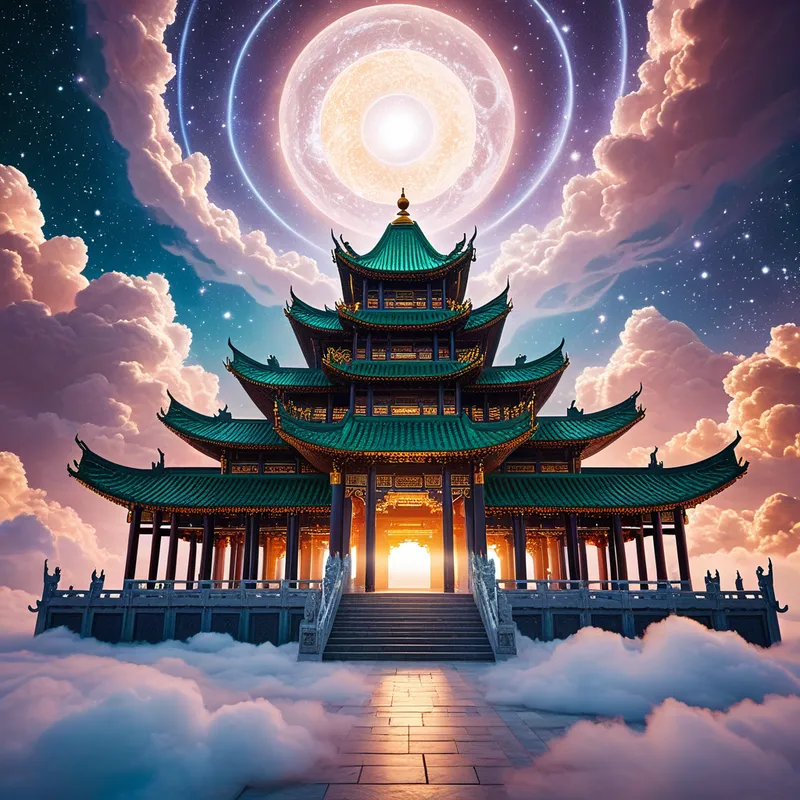
Listen, and let your spirit travel to the time before time, when the Hundun had just been parted. High above the Nine Heavens, where the Qi of creation is purest, stood the Jade Palace. Its spires were carved from the heart of the Kunlun, its tiles were polished moonbeams, and its foundations rested upon the orderly breaths of the Bagua. Here, the Jade Emperor presided in unassailable serenity. His will was the rhythm of the seasons, his gaze the measure of justice. The Heavenly Court moved in a silent, perfect dance—a symphony of cosmic administration where every star knew its path and every destiny was inscribed upon jade tablets.
But perfection is a weight even heaven cannot bear forever. From the murky depths of neglected corners, a ripple of discord was born. Some say it was the pride of a fallen star; others whisper it was the accumulated sigh of mortal suffering, rising like a forgotten prayer. A fundamental pillar of the palace, the one that connected it to the mortal realm—the Mount Buzhou—suffered a flaw. A hairline fracture, born of cosmic entropy or divine oversight, snaked through its jade core.
The fracture spread. It was not a crash, but a terrible, slow unmaking. A celestial silence shattered as a single note of the universal scale went flat. Tiles of heavenly jade, which held the constellations in place, began to tremble and fall. Stars, wrenched from their ordained circuits, streaked across the sky in panic. The orderly clouds churned into chaotic storms. The Jade Emperor felt the tremor in his throne. The Mandate of Heaven itself was slipping. The palace, the very symbol of cosmic order, was becoming a monument to impending chaos. The court was in disarray; no celestial decree could mend a crack in the foundation of reality.
Yet, within the great Register of Life and Death, a counter-mandate was written. The restoration would not come from heaven, but must be earned from earth. A call went out, not as a thunderous command, but as a subtle aligning of fate—a dream placed in the heart of a mortal whose spirit was uncorrupted, whose will was like tempered steel. This chosen one, often a scholar, a dutiful child, or a righteous warrior, would awaken with a profound knowing: they must journey to the foot of the broken world-pillar and ascend. Their quest: to find the Yuanshi Jade, the first fragment of solidified order from which the palace was born, and seal the rift.
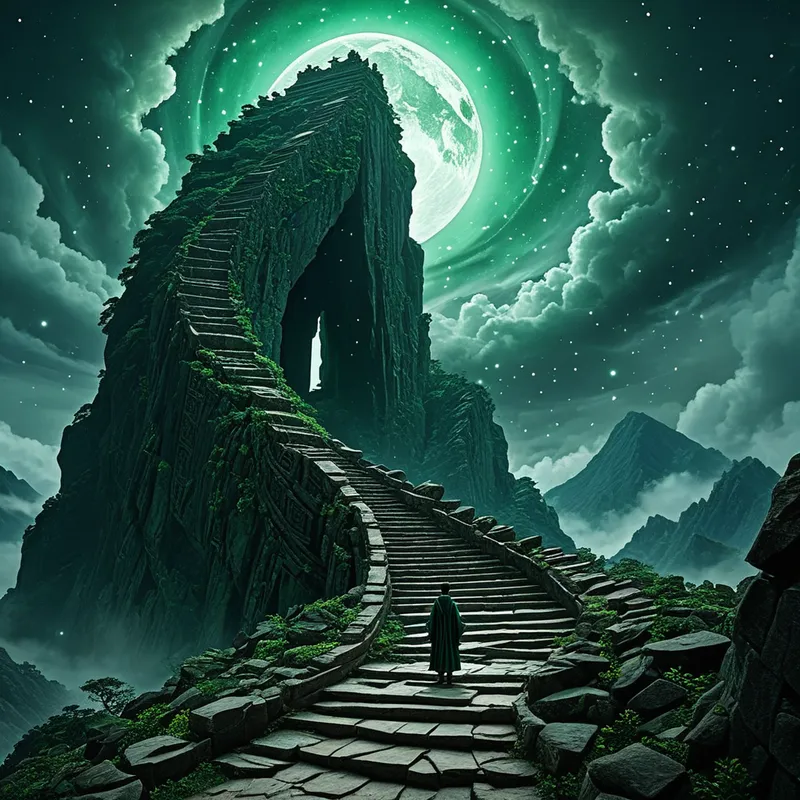
Their path was the Mount Buzhou itself—a climb through realms of illusion, past guardians of doubt and memory, through landscapes that reflected the chaos in the sky. They faced the Xiezhi testing their integrity, navigated mazes of temporal fog, and resisted the siren song of abandoning the climb for a simpler, earthly paradise. Finally, bleeding spirit more than body, they would reach the source: a hidden grotto at the mountain’s heart, holding a pulsating fragment of pure, green light—the Yuanshi Jade.
The return was the final trial. Carrying the fragment back to the fracture, the hero would place it not with force, but with a gesture of profound reconciliation—a bow, a tear of understanding, a recited poem of balance. The jade would melt into light, flowing into the crack. The tremors would cease. The falling stars would halt, and slowly, reverse their course. In the heavens, the Jade Palace would gleam anew, not with the cold light of perfect stasis, but with the warmer, more resilient glow of order restored, of harmony earned. The hero, forever touched by the celestial, would return to the mortal world, their life a quiet testament to the bridge between heaven and earth.
Cultural Origins & Context
The myth of the Jade Palace is not a single, codified story from one text, but a pervasive narrative pattern woven into the fabric of Chinese spiritual and philosophical thought. It finds its roots in the Daoist cosmological vision of the Han dynasty and later, where the celestial bureaucracy mirrored the imperial one on earth. The palace is the administrative heart of the Heavenly Court, a concept that gave metaphysical legitimacy to earthly rule through the Mandate of Heaven.
This myth was passed down through a tapestry of sources: esoteric Daoist jing, folktales told by village elders, and episodes in classical novels like Journey to the West, where the Monkey King causes havoc in its halls. Its societal function was multifaceted. For the ruling class, it reinforced the ideology of a just, hierarchical cosmic order. For the common people, it offered a narrative where the cosmic balance was fragile and could be disrupted by moral decay, but also where a virtuous individual—not just a deity—could play a crucial role in its restoration. It served as a mythic template for resilience, teaching that periods of chaos (luan) are followed by a return to order (zhi), but only through conscious, virtuous effort.
Symbolic Architecture
The Jade Palace is the ultimate symbol of the conscious mind in its idealized, ruling function. It represents the psychic structure we build—our identity, our principles, our ordered worldview. The Jade Emperor is the ruling principle of consciousness, the ego that believes it is in full, unchallenged control.
The crack in the pillar is the inevitable intrusion of the unconscious—the repressed, the chaotic, the aspects of life and self that our perfect psychic order cannot accommodate.
The falling jade tiles and wayward stars are the symptoms of a psychological crisis: depression, anxiety, the disintegration of a long-held belief system, or the eruption of a complex. The myth wisely states the restoration cannot come from the ruling consciousness (the Emperor) alone. The ego cannot fix the problem it created by excluding parts of the self.
The mortal hero is the nascent Self, the part of the psyche that answers the call to wholeness. Their journey down and up the Mount Buzhou is the descent into the unconscious—the confrontation with shadow, anima/animus, and archetypal guardians. The Yuanshi Jade they seek is the core, authentic self before it was shaped by the demands of the personal “palace”—the primordial integrity of the soul.
The Dreamer’s Resonance
When this myth stirs in the modern dreamer, it often manifests as dreams of crumbling institutions, failing infrastructure, or beautiful but fragile structures breaking apart. You may dream of your childhood home collapsing, a prestigious workplace building flooding, or a pristine museum exhibit shattering. The somatic feeling is one of profound vertigo and helplessness—the ground of your being is no longer stable.
Psychologically, this signals that a previously dominant life structure—a career identity, a relationship paradigm, a core belief—is undergoing an unavoidable deconstruction. The “palace” you built is cracking. The dream is not merely predictive but initiatory; it is the psyche’s way of forcing the “hero” aspect of you awake. The feeling of anxiety is the call to adventure you are resisting. The dream invites you to stop trying to patch the ceiling from inside the throne room (conscious problem-solving) and instead to consent to the dangerous, necessary descent to find what was lost when the palace was first constructed.
Alchemical Translation
The myth models the alchemical process of individuation—the transmutation of the lead of a fragmented personality into the gold of an integrated Self. The initial state is the illusion of perfected order (the intact palace), which is a form of spiritual inflation. The nigredo, or blackening, is the cracking of the pillar—the dark night of the soul where all one has built seems worthless.
The hero’s journey is the albedo, the whitening. It is the purification that comes from confronting the unconscious contents without being destroyed by them. Climbing the broken mountain is the arduous inner work of analysis, introspection, and shadow integration.
Finding and returning the Yuanshi Jade is the rubedo, the reddening—the moment of synthesis where the retrieved essence of the true self is integrated back into the psychic structure.
The restored Jade Palace is not the same as before. It is a coniunctio oppositorum—a union of opposites. It now contains within its structure the memory of the crack and the journey to mend it. The conscious mind (the Emperor) no longer rules with absolute, ignorant authority but governs in dialogue with the depths (the hero/Self). For the modern individual, this translates to moving from a life of rigid, brittle perfectionism to one of resilient, compassionate integrity. Your identity is no longer a static palace to be defended, but a living, breathing ecosystem—a celestial court in harmonious dialogue with the vast and wild earth of your own soul.
Associated Symbols
Explore related symbols from the CaleaDream lexicon: