
The Jade Emperor Korean
The Korean interpretation of the Jade Emperor blends celestial authority with local spiritual traditions, reflecting cultural adaptation and divine hierarchy.
The Tale of The Jade Emperor Korean
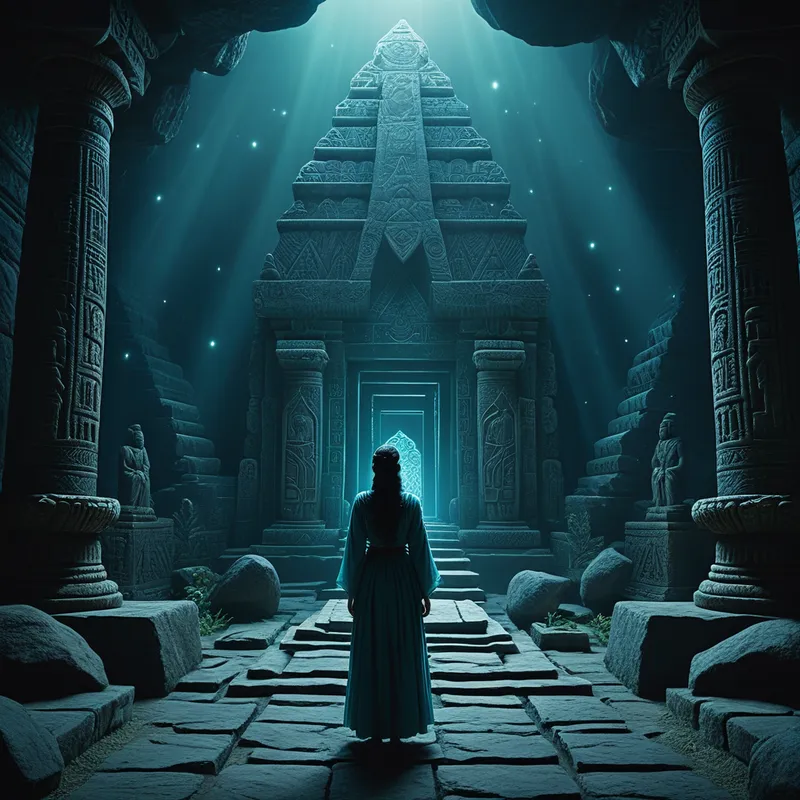
In the celestial courts of the Cheon-guk, where the fabric of fate is woven from starlight and principle, [the Jade Emperor](/myths/the-jade-emperor “Myth from Taoist culture.”/) presides not as a distant, abstract force, but as the ultimate administrator of cosmic order. His Korean tale is not one of dramatic birth or heroic quest, but of profound, unwavering governance. He is the Haneullim or Cheonje, seated upon a throne carved from the heart of the universe itself, a nexus where all petitions, all deeds, and all spirits converge.
The myth speaks of his palace, the Jagung, a realm of jade pillars and pearlescent clouds, where the bureaucracy of existence operates with flawless precision. Here, the souls of the virtuous are weighed, the petitions of mortals are heard, and the mandates of heaven are decreed. His story is the story of the cosmos in balance. When drought parches [the earth](/myths/the-earth “Myth from Hindu culture.”/), it is not his wrath but a correction within the celestial ledger; when blessings rain upon a household, it is the execution of a cosmic [justice](/myths/justice “Myth from Tarot culture.”/) too vast for mortal comprehension. He listens to the reports of mountain spirits, Sansin, and river dragons, integrates the pleas of ancestral sin, and measures them against the immutable laws of Li.
Yet, his authority is most keenly felt in the transition of souls and the granting of destiny. He is the final arbiter in the Sip-wang judgment, his seal upon the scroll that determines a soul’s next passage. To approach him is to stand before the essence of Order itself—a terrifying and awe-inspiring encounter with the ultimate source of all structure, law, and consequence. His tale is the silent, omnipresent narrative of cause and effect elevated to a divine principle, a sovereign who rules not by passion, but by the cold, beautiful, and necessary mathematics of the cosmos.
Cultural Origins & Context
The Korean [Jade Emperor](/myths/jade-emperor “Myth from Chinese culture.”/) is a deity shaped by profound cultural negotiation. His origins lie in the Chinese Yù Huáng, a pinnacle figure of the Daoist celestial bureaucracy, who traveled across [the sea](/myths/the-sea “Myth from Greek culture.”/) of ideas along with Buddhism and Confucian statecraft. However, upon reaching the shores of the Korean peninsula, this imperial god did not simply conquer the local [pantheon](/myths/pantheon “Myth from Roman culture.”/); he was compelled to assimilate into a deeply layered spiritual landscape.
He encountered the ancient Korean veneration of Haneul, a more impersonal, overarching celestial force. He met the robust cults of the Sansin, earth-bound deities of potent local power and maternal or paternal presence. To become relevant, the Jade Emperor could not remain an aloof foreign potentate. He underwent a process of Adaptation, becoming the Haneullim—a synthesis where the imported celestial bureaucracy was grafted onto the native trunk of heaven-worship. He became the supreme commander to whom even the mighty Sansin reported, integrating the local into his universal hierarchy.
This integration reflects the Korean historical experience of absorbing profound foreign influences—from Chinese state models to Buddhist metaphysics—and refining them into a distinctively Korean synthesis. The Jade Emperor’s court became a mirror of the ideal Confucian state, yet one that made room for [the shaman](/myths/the-shaman “Myth from Siberian culture.”/)’s ecstatic prayer and the mountain god’s earthy authority. He exists at the apex of a spiritual Hierarchy that validates and organizes the very Korean world of spirits, from household deities to ancestral guardians, without erasing them. His presence legitimizes a complex, ordered cosmos that is both universally principled and intimately local.
Symbolic Architecture
The Korean [Jade](/symbols/jade “Symbol: A precious stone symbolizing purity, protection, and spiritual connection, often associated with wisdom, longevity, and harmony.”/) Emperor is [less](/symbols/less “Symbol: The concept of ‘less’ often signifies a need for simplicity, reduction, or minimalism in one’s life or thoughts.”/) a [personality](/symbols/personality “Symbol: Personality in dreams often symbolizes the traits and characteristics of the dreamer, reflecting how they perceive themselves and how they believe they are perceived by others.”/) and more an [architecture](/symbols/architecture “Symbol: Architecture in dreams often signifies structure, stability, and the framing of personal identity or life’s journey.”/) of [consciousness](/symbols/consciousness “Symbol: Consciousness represents the state of awareness and perception, encompassing thoughts, feelings, and experiences.”/). He symbolizes the [human](/symbols/human “Symbol: The symbol of a human represents individuality, complexity of emotions, and social relationships.”/) [psyche](/myths/psyche “Myth from Greek culture.”/)’s ultimate encounter with [the principle](/symbols/the-principle “Symbol: A fundamental truth, law, or doctrine that serves as a foundation for a system of belief, behavior, or reasoning, often representing moral or ethical standards.”/) of Order. He is the internalized sovereign, the inner ruler that demands accountability, [structure](/symbols/structure “Symbol: Structure in dreams often symbolizes stability, organization, and the framework of one’s life, reflecting how one perceives their environment and personal life.”/), and alignment with a law greater than personal desire. His celestial [bureaucracy](/symbols/bureaucracy “Symbol: Dreams of bureaucracy often represent feelings of powerlessness, frustration with rigid systems, or anxieties about societal structures and personal agency.”/) is a profound [metaphor](/symbols/metaphor “Symbol: A figure of speech where one thing represents another, often revealing hidden connections and deeper truths through symbolic comparison.”/) for the [psyche](/myths/psyche “Myth from Greek culture.”/)’s own complex [system](/symbols/system “Symbol: A system represents structure, organization, and interrelated components functioning together, often reflecting personal or social order.”/) of checks and balances, where memories, impulses, and ideals are constantly being judged, filed, and processed.
He represents the terrifying and necessary moment when the soul must stand before the totality of its own choices, stripped of narrative and excuse, to be measured by an impersonal standard. This is the divine as the ultimate internal judge.
His [throne](/symbols/throne “Symbol: A seat of authority, power, and sovereignty, representing leadership, divine right, or social hierarchy.”/) is not a seat of tyranny, but of [responsibility](/symbols/responsibility “Symbol: Responsibility in dreams often signifies the weight of duties and the expectations placed upon the dreamer.”/). To be under his gaze is to be seen completely by the objective [universe](/symbols/universe “Symbol: The universe symbolizes vastness, interconnectedness, and the mysteries of existence beyond the individual self.”/). This is the [source](/symbols/source “Symbol: The origin point of something, often representing beginnings, nourishment, or the fundamental cause behind phenomena.”/) of both profound [anxiety](/symbols/anxiety “Symbol: Anxiety in dreams reflects internal conflicts, fears of the unknown, or stress from waking life, often demonstrating the subconscious mind’s struggle for peace.”/) and profound [peace](/symbols/peace “Symbol: Peace represents a state of tranquility and harmony, both internally and externally, often reflecting a desire for resolution and serenity in one’s life.”/): anxiety because no flaw can be hidden, peace because within his [Hierarchy](/symbols/hierarchy “Symbol: A structured system of ranking or authority, often representing social order, power dynamics, and one’s position within groups or institutions.”/), everything has its proper place and [purpose](/symbols/purpose “Symbol: Purpose signifies direction, meaning, and intention in life, often reflecting personal ambitions and core values.”/). The [tension](/symbols/tension “Symbol: A state of mental or emotional strain, often manifesting physically as tightness, pressure, or unease, signaling unresolved conflict or anticipation.”/) in his worship stems from this duality—the mortal [seeker](/symbols/seeker “Symbol: A person actively searching for meaning, truth, or a higher purpose, often representing the dreamer’s own quest for identity or fulfillment.”/) craves the merciful, personal touch of a [Mother](/symbols/mother “Symbol: The symbol of ‘Mother’ represents nurturing, protection, and the foundational aspect of one’s emotional being, often associated with comfort and unconditional love.”/) or Sansin, yet must ultimately submit their [case](/symbols/case “Symbol: A case often signifies containment, protection of personal matters, and the need for organization in one’s life.”/) to the impersonal, procedural justice of the celestial court. He is the [Father](/symbols/father “Symbol: The father figure in dreams often symbolizes authority, protection, guidance, and the quest for approval or validation.”/) of [cosmos](/symbols/cosmos “Symbol: The entire universe as an ordered, harmonious system, often representing the totality of existence, spiritual connection, and the unknown.”/) as structure, the author of law rather than the bestower of unconditional grace.
The Dreamer’s Resonance
To dream of the Jade Emperor is to dream of ultimate accountability and the architecture of one’s own life. He appears not as a companion, but as a presiding presence. Such a dream may manifest as standing in a vast, silent courtroom, awaiting a verdict that never comes in words, only in a feeling of profound assessment. It may be the dream of finding an impossibly complex and beautiful administrative document—a celestial ledger—with one’s own name inscribed within it.
Psychologically, this figure resonates when the dreamer’s life is at a [crossroads](/myths/crossroads “Myth from Celtic culture.”/) of moral reckoning or structural collapse. He emerges when the conscious ego has become chaotic, self-serving, or adrift, and [the Self](/myths/the-self “Myth from Jungian culture.”/)—the psyche’s total organizing principle—demands a return to order. It is a call to internal governance, to review the “petitions” of one’s neglected duties, unfulfilled promises, and fragmented ambitions. The encounter can feel cold, but its purpose is integrative: to force the dreamer to confront the consequences of their actions and thoughts, and to re-align with a personal sense of cosmic Destiny and ethical law. He is the archetypal Ruler activating within, compelling the individual to become the sovereign of their own inner kingdom.

Alchemical Translation
The alchemical process invoked by the Jade Emperor is [coagulatio](/myths/coagulatio “Myth from Alchemical culture.”/)—the fixing of spirit into form, the imposition of lasting order upon the volatile waters of experience. He is the agent that turns the lead of chaotic potential into the gold of realized destiny. His domain is not the initial spark of inspiration (Fire), but the meticulous and often tedious process of building the Tower according to a divine blueprint.
Worship of this deity is, in essence, a ritual of alignment. The devotee does not seek to be loved by him, but to have their personal will and actions correctly filed within the great archive of cosmic law, thus ensuring their smooth passage through life’s trials and the courts of the afterlife.
The psychological operation is one of submission to a transpersonal principle. [The ego](/myths/the-ego “Myth from Jungian culture.”/), with its desires and fears, must kneel before the greater Authority of the Self. This is not a negation of individuality, but its refinement. The “jade” of his title is key: jade is prized for its toughness and durability, its cool beauty, and its resonance. The alchemical goal is to transform the soft, perishable flesh of the ego into a jade-like vessel—orderly, resonant with truth, and capable of enduring the pressures of existence. The Korean context adds a crucial step: this jade must be inlaid with the local patterns of one’s own Root—one’s family, land, and ancestral spirits—to be truly complete.
Associated Symbols
Explore related symbols from the CaleaDream lexicon:
- Jade — The celestial stone of eternal order, cool virtue, and imperishable authority, representing the immutable law at the heart of the cosmos.
- Hierarchy — The fundamental structure of reality, the celestial ladder of being that connects the mortal realm to the divine court, demanding and defining place and purpose.
- Authority — The impersonal, absolute power to decree fate, judge souls, and maintain the cosmic balance, vested in the sovereign who is principle incarnate.
- Throne — The fixed center of the universe, the seat from which all mandates flow and to which all reports return, symbolizing the unwavering point of governance.
- Mountain — The earthly anchor of celestial power, the abode of the Sansin who report to the Emperor, representing stable, enduring authority rooted in the land.
- Archive — The celestial library of deeds and destinies, where every action is recorded and every soul’s scroll is kept, embodying the totality of cosmic memory and judgment.
- Order — The supreme principle of arrangement and law, the harmonious pattern that the Emperor embodies and enforces against the constant pull of [chaos](/myths/chaos “Myth from Greek culture.”/).
- Scepter of Authority — The ritual object that channels and focuses the power to command the forces of heaven and earth, an extension of the sovereign’s will.
- Adaptation — The process of cultural and spiritual synthesis, where a foreign divine concept is reshaped and integrated into the native soil of local belief and practice.
- Root — The deep, anchoring connection to the native land and its indigenous spirits, which gives the imported celestial authority its local legitimacy and vitality.
- Destiny — The pre-ordained path or fate for an individual or nation, as decreed and administered by the celestial bureaucracy from the Emperor’s court.
- Temple — The structured, ritual space where the cosmic hierarchy is mirrored on earth, and where communication with the celestial bureaucracy is formally conducted.