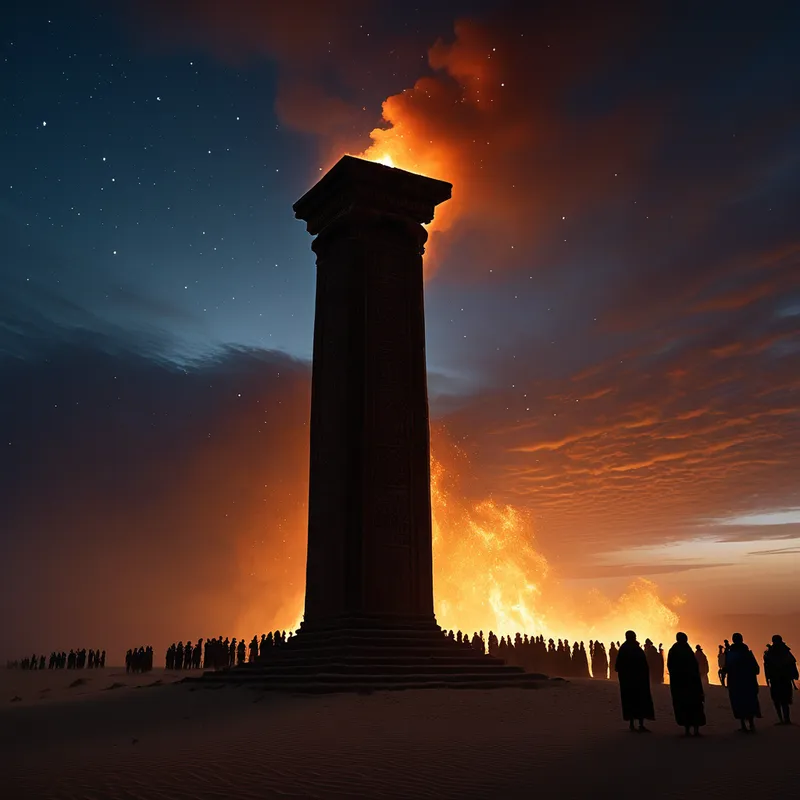
The Israelites Myth Meaning & Symbolism
A people bound by a divine covenant endure slavery, exodus, and wilderness to forge a collective soul and a promised identity.
The Tale of The Israelites
Listen. The story begins not with a king, but with a voice in the dark. A voice that called a man named Abraham from the comfort of his father’s house, from the known gods of clay and stone. “Lech lecha,” it whispered—go forth, to a land I will show you. And he went, a stranger in a strange land, his only map a promise: that his descendants would be as countless as the stars, and that through them, all families of [the earth](/myths/the-earth “Myth from Hindu culture.”/) would find blessing. This was the covenant, sealed under a sky ablaze with stars, a pact cut in the very flesh of his household.
Generations passed. The promise grew heavy in [the womb](/myths/the-womb “Myth from Various culture.”/) of time. [Jacob](/myths/jacob “Myth from Biblical culture.”/), who wrestled a divine being in the mud of a riverbank at night and emerged limping, renamed Israel. His sons, driven by jealousy, sold a brother into Egyptian chains. Yet this brother, [Joseph](/myths/joseph “Myth from Biblical culture.”/), would become their savior in a time of famine, drawing the clan into the fertile belly of the [Nile delta](/myths/nile-delta “Myth from Egyptian culture.”/). For a time, there was bread and safety.
But seasons turned. A new [pharaoh](/myths/pharaoh “Myth from Egyptian culture.”/) arose who knew not Joseph. The blessing had become a threat. The descendants of Israel were enslaved, their bodies pressed into the mud and straw of monument-building, their spirits crushed under the weight of taskmasters’ whips. Their cries did not dissolve into [the desert](/myths/the-desert “Myth from Biblical culture.”/) air; they rose like bitter smoke, and the God of the covenant heard. From a burning bush that was not consumed, the voice spoke again, this time to [Moses](/myths/moses “Myth from Biblical culture.”/), a fugitive prince. “I have seen the affliction of my people. I will bring them out.”
What followed was a clash of sovereignties. The Nile turned to blood. Frogs, lice, boils, locusts, darkness—plagues fell upon Egypt like hammer blows, each one unmasking a local god. The final, terrible blow struck at the heart of every Egyptian household. But for the Israelites, there was a sign: the blood of a lamb on the doorpost, a mark of protection and a hurried, anxious meal eaten ready for travel. That night, a great wailing went up in Egypt, and a people were thrust from slavery into the terrifying openness of [the wilderness](/myths/the-wilderness “Myth from Biblical culture.”/).
But [the sea](/myths/the-sea “Myth from Greek culture.”/) lay before them, and the chariots of Pharaoh behind. At the command of Moses, a wind from the east blew all night, and the waters were driven back, heaping up like walls. The people walked on dry ground through the midst of the sea, a birth canal of deliverance. As the last Israelite reached the far shore, the waters collapsed, swallowing the pursuit. On the bank of freedom, they sang a song to the Lord, a song of horse and rider thrown into the sea.
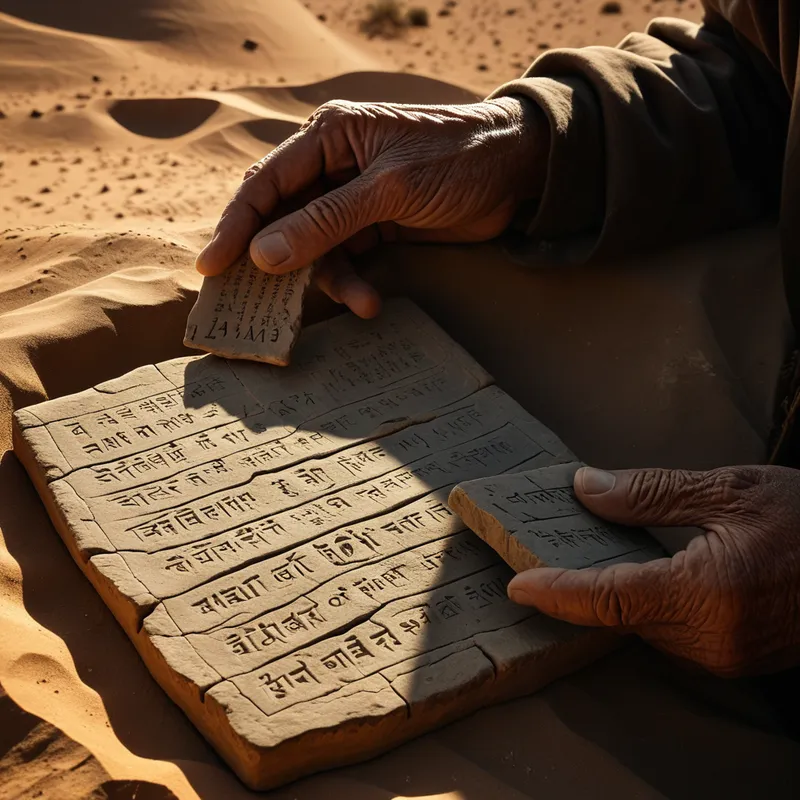
Yet freedom was not a land, but a condition of the soul. They entered the vast, silent crucible of the desert. Hunger and thirst became their new masters, and they grumbled for the fleshpots of Egypt. [Manna](/myths/manna “Myth from Biblical culture.”/), bread from heaven, appeared with [the dew](/myths/the-dew “Myth from Alchemical culture.”/). [Water](/myths/water “Myth from Chinese culture.”/) sprang from a rock struck in frustration. At the mountain of Sinai, amidst thunder and thick cloud, the covenant was forged anew, not just with a patriarch, but with a nation. Laws were given, etched by the finger of God on tablets of stone—a framework for a holy community. They built a mobile sanctuary, a [Tabernacle](/myths/tabernacle “Myth from Biblical culture.”/), so the divine could dwell among them.
But the human heart is a wilderness. Fear of the unknown giants in [the Promised Land](/myths/the-promised-land “Myth from Biblical culture.”/) turned them back, condemning a generation to wander until they dissolved into the sands. For forty years they circled, learning to depend not on the bread of slaves, but on [the word](/myths/the-word “Myth from Biblical culture.”/) that proceeds from the mouth of the divine. The old, slave-minded generation died. A new generation, born in [the wind](/myths/the-wind “Myth from Various culture.”/) of freedom, stood on the banks of the Jordan. Moses, who saw the land from a mountain peak but could not enter, passed his spirit to Joshua. The waters parted once more. The long pilgrimage from promise to fulfillment, from a name given to a nation born, began its next chapter.
Cultural Origins & Context
This is not a single myth, but the foundational national epic of ancient Israel, woven from oral traditions, tribal lore, cultic rituals, and legal codes over centuries. It was compiled and redacted during the monarchy and especially after the traumatic Babylonian Exile, a period where questions of identity, destiny, and divine purpose were existential. The texts—primarily [the Torah](/myths/the-torah “Myth from Jewish culture.”/) or Pentateuch—served as a constitutional and spiritual anchor for a people often without political power.
It was told and retold at Passover (Pesach), where the story is not merely recited but re-lived through ritual food and question. It was sung in psalms, debated by prophets, and taught to children as their birthright. Its societal function was multifaceted: to explain their unique relationship with the divine (the covenant), to justify their claim to a land, to provide a legal and ethical framework for communal life, and, most profoundly, to forge a collective identity rooted not in conquest alone, but in liberation and moral responsibility. It answered the question: Why are we here? with the story: Because we were brought out.
Symbolic Architecture
At its core, the myth of the Israelites is the archetypal [journey](/symbols/journey “Symbol: A journey in dreams typically signifies adventure, growth, or a significant life transition.”/) of the [psyche](/myths/psyche “Myth from Greek culture.”/) from a state of unconscious bondage to a conscious, covenanted Self.
The Exodus is not a flight from geography, but from a state of being. Egypt (Mitzrayim) is the constricted ego, identified wholly with the material, the secure, and the known, even in its misery. Pharaoh is the tyrannical complex of habit, collective expectation, and internalized oppression that demands endless production of bricks—the repetitive, soul-crushing tasks that build monuments to a foreign god (a life not one’s own).
The [wilderness](/symbols/wilderness “Symbol: Wilderness often symbolizes the untamed aspects of the self and the unconscious mind, representing a space for personal exploration and discovery.”/) is the necessary liminal [space](/symbols/space “Symbol: Dreaming of ‘Space’ often symbolizes the vastness of potential, personal freedom, or feelings of isolation and exploration in one’s life.”/), the psychic hinterlands where the old [identity](/symbols/identity “Symbol: Identity represents the sense of self, encompassing personal beliefs, cultural background, and social roles.”/) dies of thirst and the new one is not yet formed. It is the stage for the critical [alchemy](/symbols/alchemy “Symbol: A transformative process of purification and creation, often symbolizing personal or spiritual evolution through difficult stages.”/): transforming the complaint of the slave (“Why have you brought us out to die?”) into the lament and ultimately the [dialogue](/symbols/dialogue “Symbol: Conversation or exchange between characters, representing communication, relationships, and narrative flow in games and leisure activities.”/) of a [partner](/symbols/partner “Symbol: In dreams, the symbol of a ‘partner’ often represents intimacy, connection, and the dynamics of personal relationships, reflecting one’s desires and fears surrounding companionship.”/) in [covenant](/symbols/covenant “Symbol: A binding agreement or sacred promise between parties, often carrying deep moral, spiritual, or social obligations and consequences.”/). The giving of the Torah at Sinai represents the [reception](/symbols/reception “Symbol: The symbol of ‘reception’ often signifies the act of welcoming or accepting new ideas, experiences, or people into one’s life.”/) of an internal psychic [structure](/symbols/structure “Symbol: Structure in dreams often symbolizes stability, organization, and the framework of one’s life, reflecting how one perceives their environment and personal life.”/)—not a [prison](/symbols/prison “Symbol: Prison in dreams typically represents feelings of restriction, confinement, or a lack of freedom in one’s life or mind.”/), but the bones of a new Self. [The law](/symbols/the-law “Symbol: Represents external rules, societal order, moral boundaries, and the tension between personal freedom and collective structure.”/) provides the form; the wandering provides the time and [friction](/symbols/friction “Symbol: Friction represents resistance, conflict, or the necessary tension required for movement and transformation in dreams.”/) for that form to be internalized.
The [Promised Land](/myths/promised-land “Myth from Biblical culture.”/), therefore, is not a place of rest, but a state of responsible [consciousness](/symbols/consciousness “Symbol: Consciousness represents the state of awareness and perception, encompassing thoughts, feelings, and experiences.”/). It is the difficult [terrain](/symbols/terrain “Symbol: Terrain in dreams often represents the landscape of one’s life, including challenges, opportunities, and feelings about one’s current circumstances.”/) of an integrated [life](/symbols/life “Symbol: The symbol of ‘Life’ represents a journey of growth, interconnectedness, and existential meaning, encompassing both the joys and challenges that define human experience.”/), where one must now live out the principles received in the wilderness. It is always “a land flowing with milk and [honey](/symbols/honey “Symbol: A sweet, viscous substance produced by bees, symbolizing natural sweetness, reward, and nourishment.”/)” that also contains “giants”—the enduring, formidable [shadow](/symbols/shadow “Symbol: The ‘shadow’ embodies the unconscious, repressed aspects of the self and often represents fears or hidden emotions.”/) aspects of the psyche that must be faced for [the Self](/myths/the-self “Myth from Jungian culture.”/) to be fully realized.
The Dreamer’s Resonance
When this myth stirs in the modern dreamscape, it signals a profound process of psychic liberation. Dreaming of being trapped in a vast, oppressive system (a factory, a labyrinthine bureaucracy) with no way out mirrors the brick-making slavery. A dream of a sudden, disruptive natural event (a parted sea, a burning bush) often precedes a life crisis that forces a break from the known.
Dreams of wandering in a vast, featureless desert reflect the disorienting but necessary period after a major life change—a divorce, career shift, or loss—where the old supports are gone and the new direction is unclear. The somatic feeling is often one of free-floating anxiety, thirst, and profound loneliness. This is the psyche in its wilderness phase, where [the ego](/myths/the-ego “Myth from Jungian culture.”/) feels abandoned by its guiding complexes. Dreaming of receiving a book, a set of rules, or a map symbolizes the nascent emergence of a new inner ordering principle, the dreamer’s personal “law” or value system beginning to crystallize from the chaos.

Alchemical Translation
The Israelite myth is a master blueprint for the Jungian process of individuation. It models the entire arc: the call to leave the parental complex (Ur of the Chaldees), the descent into and confrontation with [the shadow](/myths/the-shadow “Myth from Jungian culture.”/) (Egypt/slavery), the arduous journey of transformation with the aid of the wise old man archetype (Moses), and the eventual approach to the Self (the Promised Land).
The alchemical nigredo, the blackening, is the slavery in Egypt—the recognition of one’s own unconscious bondage, the leaden weight of a life lived falsely. The albedo, the whitening, is the passage through the sea and the wilderness—a purification by ordeal, where the attachments of the old life are washed away and one is reduced to essential dependence. The receiving of the Law is the citrinitas, the yellowing, where light (conscious insight) begins to structure the newly purified matter.
The ultimate goal is the [rubedo](/myths/rubedo “Myth from Alchemical culture.”/), the reddening, the creation of [the sacred marriage](/myths/the-sacred-marriage “Myth from Various culture.”/) (hieros gamos). This is symbolized by the goal of the covenant itself: “I will be your God, and you will be my people.” It is the integration of the transcendent function (the divine voice) with the earthly, communal human psyche, resulting in a living, embodied Self that is both unique and in relationship. The individual is no longer a slave to internal Pharaohs, nor a lost wanderer, but a citizen of a promised inner landscape, capable of both receiving law and enacting freedom. The journey never truly ends, for the land must be settled and tended, but the orientation shifts from survival to sovereignty.
Associated Symbols
Explore related symbols from the CaleaDream lexicon: