The Island of the Sun Myth Meaning & Symbolism
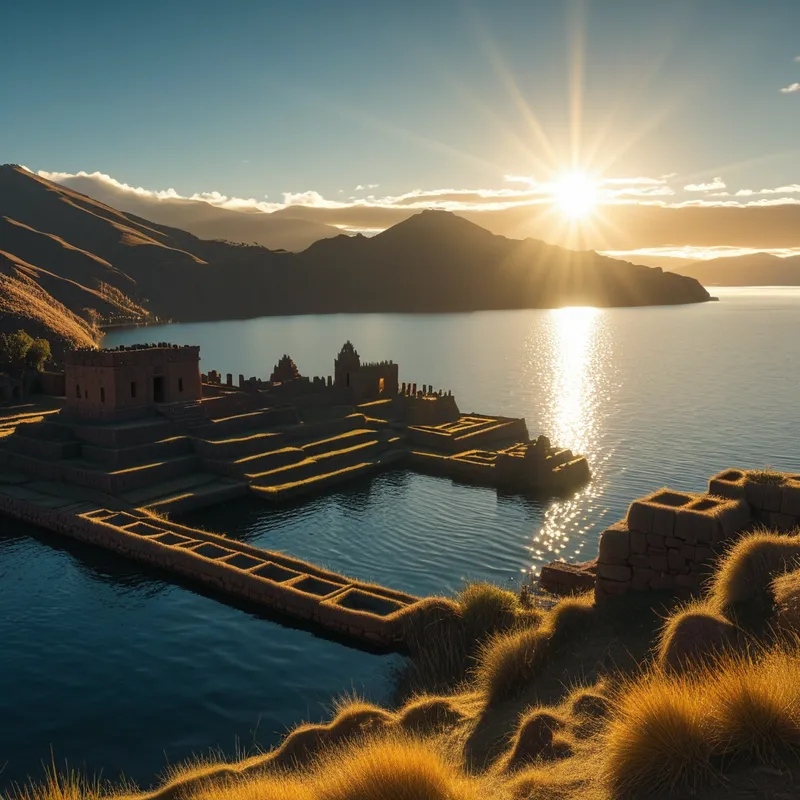
From the depths of Lake Titicaca, the Sun God Inti rose to create the first Incas, establishing cosmic order from primordial chaos on a sacred island.
The Tale of The Island of the Sun
In the time before time, when the world was a formless, silent dark, there existed only the vast, cold expanse of Lake Titicaca. No sun warmed its deep waters; no moon silvered its surface. It was a world of shadow, where humanity huddled in caves, living like wild beasts, knowing nothing of civilization, law, or the sacred.
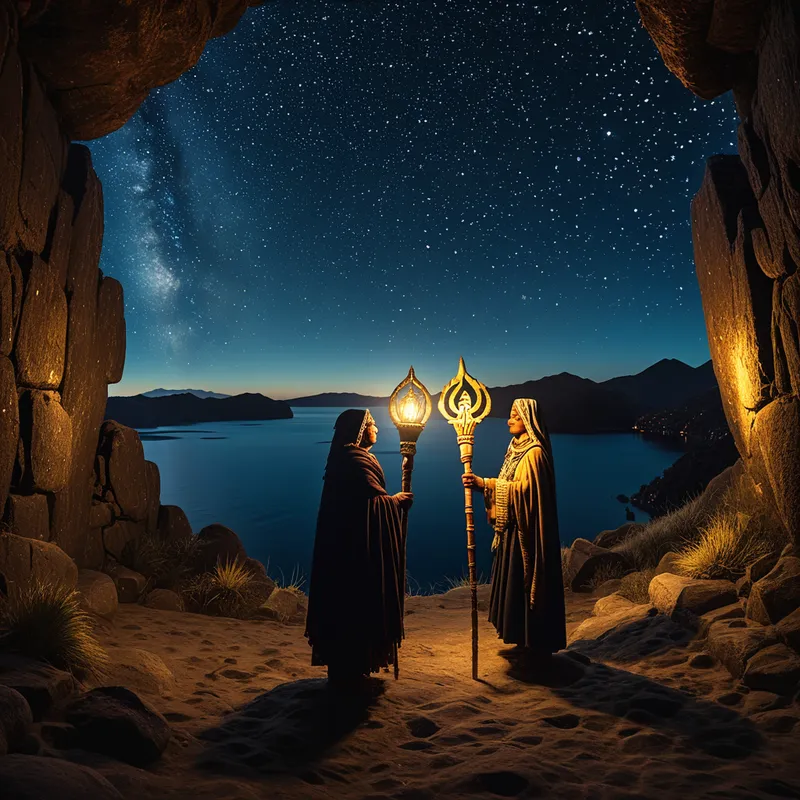
Then, from the heart of the void, the great Inti stirred. Pity filled his radiant heart for the creatures lost in the perpetual gloom. He resolved to bring forth light and order. He chose as his crucible an island in the lake’s center, a place of potent, silent power. To this island, he summoned his two children, born of his own divine essence. To his son, he gave a staff of pure, solid gold. To his daughter, he bestowed the sacred knowledge of weaving and cultivation.
“Go forth,” commanded Inti, his voice the first crack of dawn. “Where this staff of gold sinks effortlessly into the earth, there you will found a kingdom. You will teach the people to cease their wandering, to build, to worship, and to live under my benevolent gaze.”
Thus, Manco Cápac and Mama Ocllo emerged from a sacred cave on the Island of the Sun, the Titicaca stone itself. They were bathed in the first light ever seen, a light so piercing it etched their shadows onto the island’s rock for eternity. Holding the golden staff aloft, they stepped onto a reed boat and began their journey across the mirrored waters.
For days they traveled, the staff testing the land. They moved north, leaving the sacred island behind, a beacon of their origin. They encountered the scattered, primitive people, who shielded their eyes from the shocking brilliance of the siblings and their divine tool. Manco Cápac taught the men the arts of agriculture, architecture, and war. Mama Ocllo taught the women to weave intricate textiles, to cook, and to maintain the hearth. The golden staff remained unmoved, until they reached the fertile valley of Cusco. There, with a sigh that seemed to come from the earth itself, the staff plunged deep into the rich soil, disappearing up to its hilt.
On that spot, they founded the city of Cusco, the Navel of the World. From that sacred point, the light of Inti, first kindled on the Island of the Sun, spread its rays, organizing chaos into the mighty Tawantinsuyu. The island remained, forever the luminous birthplace, the first point of contact between the divine sun and the dark, waiting earth.
Cultural Origins & Context
This foundational myth originates from the Tawantinsuyu, the Inca Empire, which dominated the Andes from the 13th to 16th centuries. It is an etiological myth, serving to explain the origin of the Inca people, the legitimacy of their ruling dynasty, and the sacred geography of their world. The story was not written but orally transmitted by the Amautas and Acllas.
Its primary societal function was political and spiritual legitimacy. By claiming direct descent from Inti himself, the Sapa Inca solidified his divine right to rule as the child of the sun. The myth also established a sacred pilgrimage route. The Island of the Sun in Lake Titicaca became the most important shrine in the empire, a place where the emperor himself would journey to make offerings and reaffirm the cosmic covenant between the sun and his lineage.
Symbolic Architecture
The myth is a profound map of [consciousness](/symbols/consciousness “Symbol: Consciousness represents the state of awareness and perception, encompassing thoughts, feelings, and experiences.”/) emerging from the unconscious. The primordial darkness of [Lake](/symbols/lake “Symbol: A lake often symbolizes a place of reflection, emotional depth, and the subconscious mind, representing both tranquility and potential turmoil.”/) Titicaca represents the undifferentiated, potential-filled state of the unconscious psyche—the materia prima. The [Island](/symbols/island “Symbol: An island represents isolation, self-reflection, and the need for separation from the external world.”/) of the Sun is the first point of ego-[consciousness](/symbols/consciousness “Symbol: Consciousness represents the state of awareness and perception, encompassing thoughts, feelings, and experiences.”/), the “I am,” rising from this vast, inner sea.
The journey from the island is not an exile, but a necessary differentiation. The light must leave its source to illuminate the world.
The golden staff is the [symbol](/symbols/symbol “Symbol: A symbol can represent an idea, concept, or belief, serving as a powerful tool for communication and understanding.”/) of divine will and discernment. It does not seek just any land, but the right land—the place where the conscious principle (the sun/[king](/symbols/king “Symbol: A symbol of ultimate authority, leadership, and societal order, often representing the dreamer’s inner power or external control figures.”/)) can take root in the earthly, instinctual [realm](/symbols/realm “Symbol: The symbol of ‘Realm’ often signifies the boundaries of one’s consciousness, experiences, or emotional states, suggesting aspects of reality that are either explored or ignored.”/) (the [soil](/symbols/soil “Symbol: Soil symbolizes fertility, nourishment, and the foundation of life, serving as a metaphor for growth and stability.”/)/queendom) and create a sustainable order. Manco Cápac and Mama Ocllo represent the archetypal pair of Logos and Eros, the masculine principle of [structure](/symbols/structure “Symbol: Structure in dreams often symbolizes stability, organization, and the framework of one’s life, reflecting how one perceives their environment and personal life.”/) and law and the feminine principle of [relationship](/symbols/relationship “Symbol: A representation of connections we have with others in our lives, often reflecting our emotional state.”/), nurture, and culture. Their union is essential for the creation of a whole, functioning psyche and society.

The Dreamer’s Resonance
When this myth stirs in modern dreams, it often signals a profound process of re-orientation and the birth of a new conscious attitude. Dreaming of a sacred island in a vast, dark body of water may point to the dreamer isolating a core truth or talent (the “island of the self”) from the overwhelming flux of the unconscious or the demands of daily life.
Dreams of testing the ground with a staff or rod speak to a search for one’s true vocation or place in the world—a deep, somatic need to find where one’s essence can “sink in” and take root. The emergence from a cave into blinding light is a classic motif of psychic rebirth, often following a period of depression, confusion, or introversion (“the dark night of the soul”). The dreamer is undergoing the somatic process of moving from a state of passive suffering to active, conscious creation, carrying a new-found inner authority (the gold) out into their life.
Alchemical Translation
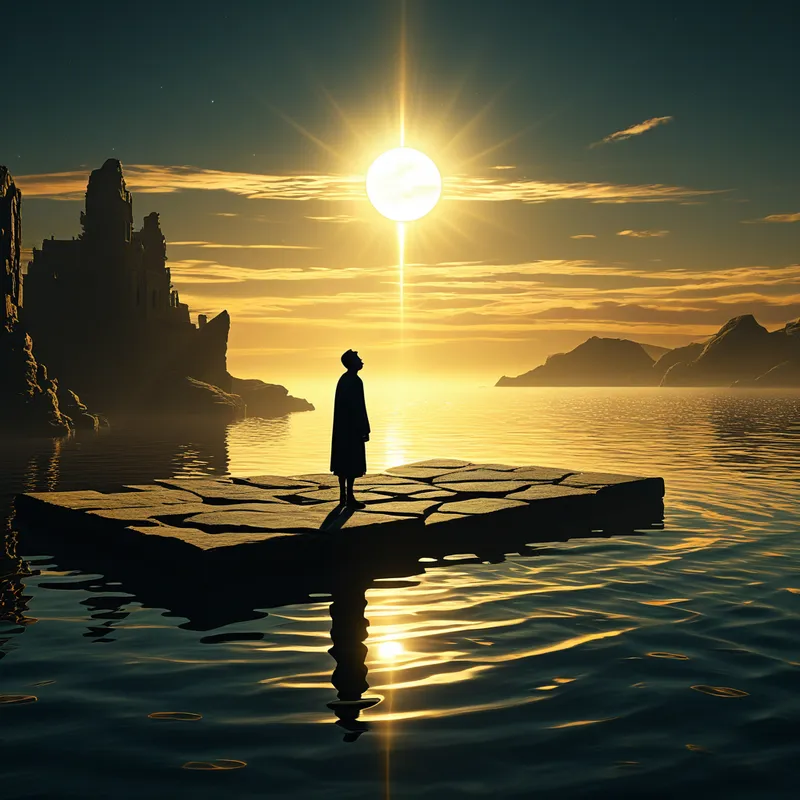
The alchemical process mirrored here is the Nigredo giving way to the Albedo. The initial state is the black, chaotic waters—the massa confusa of the unexamined life. The first operation is the appearance of the island, the Lapis in its raw, initial form: a point of concentrated value and consciousness.
The journey of the siblings is the labor of the alchemist: to take this precious, nascent consciousness (the gold of the sun/island) and project it into the world, “planting” it in the appropriate medium (the valley of Cusco) to create the Philosopher’s Stone—which, psychologically, is the fully realized, individuated Self. The empire they build is the Rubedo, the coherent, integrated personality where all inner opposites (male/female, spirit/instinct, light/dark) are organized under a central, solar principle.
Individuation is not about staying on the island of pure spirit, but about carrying its light into the valleys of matter, thereby making the whole world sacred.
For the modern individual, this myth models the path from a diffuse, reactive existence (the dark lake) to identifying a core, authentic self (the island). It then demands the courage to leave that secure, isolated identity to engage with the complex world, using one’s inner gold—one’s unique gifts and values—as a tool to found a life of meaning, order, and creative contribution.
Associated Symbols
Explore related symbols from the CaleaDream lexicon:
- Sun — The central, radiant source of consciousness, divine order, and life-giving energy, representing the active, illuminating principle of the psyche that emerges from darkness.
- Island — The nascent, isolated Self emerging from the vast unconscious; a place of sacred origin and concentrated potential that must eventually be left for the sake of creation.
- Journey — The essential process of carrying consciousness from its point of origin into the wider world, symbolizing the life-long path of psychological development and purpose-seeking.
- Stone — The foundational, enduring reality; represented by the Titicaca rock, it is the unshakable ground of being from which new life and consciousness are born.
- Gold — The incorruptible value of the spirit and divine will; the staff of gold is the tool of discernment that finds where true meaning can take root in the material world.
- Cave — The womb of the unconscious and the place of mystery; the point of emergence where potential becomes manifest, often after a period of gestation or hidden development.
- Mountain — The aspirational goal and place of order; the Andean landscape embodies the striving to build a stable, elevated consciousness from the chaotic lowlands.
- Water — The primordial, formless unconscious—Lake Titicaca itself—from which all forms of consciousness and life initially arise and upon which they depend.
- Order — The cosmic principle Inti imposes on chaos; the psychological necessity of structuring the inner and outer worlds to create a habitable, meaningful existence.
- Temple — The constructed space for the sacred; the civilization built by Manco Cápac and Mama Ocllo is a temple to the solar consciousness they brought into the world.
- Root — The act of taking hold in reality; the golden staff sinking into the earth signifies the moment when spirit successfully anchors itself in matter, allowing for growth and stability.
- Light — The first and fundamental gift of consciousness, which dispels the primordial darkness and allows for perception, differentiation, and the recognition of form and beauty.