The Ishtar Gate and Processional Way of Babylon Myth Meaning & Symbolism
A mythic journey through a radiant gate, a sacred path of divine power, and the soul's descent into the underworld to reclaim wholeness.
The Tale of The Ishtar Gate and Processional Way of Babylon
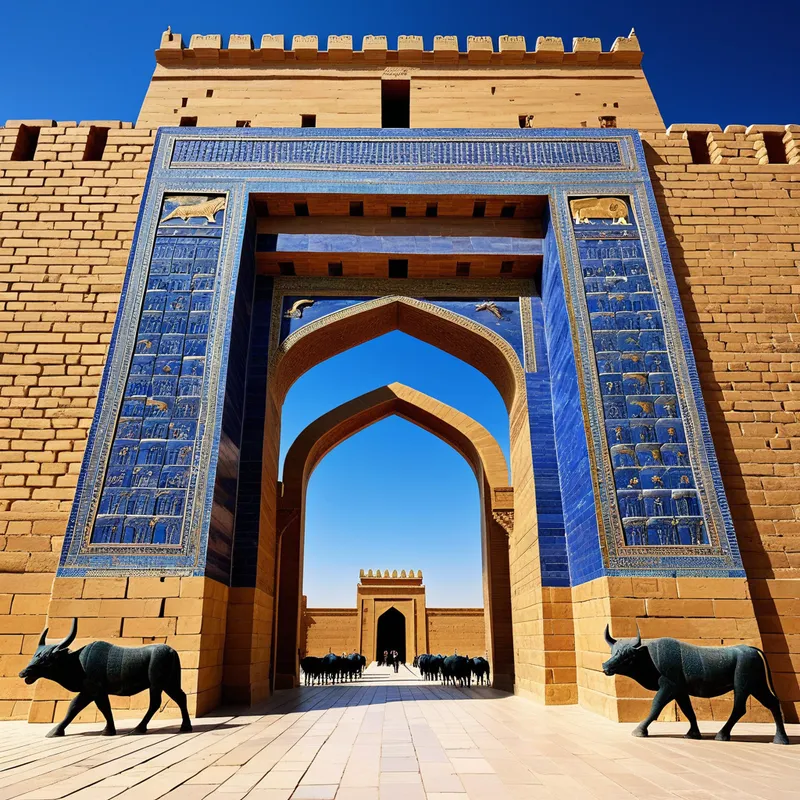
Hear now the tale of the path that is not merely stone, and the gate that is not merely clay. In the heart of [the world](/myths/the-world “Myth from Tarot culture.”/), where the twin rivers embrace the land, stood Babylon, the navel of the cosmos. Its walls were the ribs of [the earth](/myths/the-earth “Myth from Hindu culture.”/), and at its core pulsed a sacred artery: the Processional Way.
This was no street for common feet. It was the Dur-Sharrukin, the “Fortress of the King,” paved with slabs of red and white stone, polished by centuries of celestial traffic. Its flanking walls, higher than ten men, were sheathed in lions—not of flesh, but of fired clay and lapis glaze, their silent roars a perpetual ward against chaos. They were the guardians of [Marduk](/myths/marduk “Myth from Mesopotamian culture.”/), and their amber eyes watched the approach to the impossible.
For at [the Way](/myths/the-way “Myth from Taoist culture.”/)’s end, piercing the city’s inner sanctum, stood the Gate that swallowed [the sky](/myths/the-sky “Myth from Persian culture.”/). The [Ishtar Gate](/myths/ishtar-gate “Myth from Mesopotamian culture.”/). It was not built; it was invoked. From kilns of devotion came tens of thousands of bricks, each tinged with the blue of the deepest heaven and the ocean’s abyss. Upon this cerulean field marched the sacred powers of the world: the mighty rēmu, its muscles coiled in glazed gold, a walking tempest of fertility and raw strength. And beside it, the mušḫuššu, the “furious serpent,” with the body of a serpent, the forelegs of a lion, and the hind legs of an eagle—a chimera of all domains, earth, sky, and [the underworld](/myths/the-underworld “Myth from Greek culture.”/).
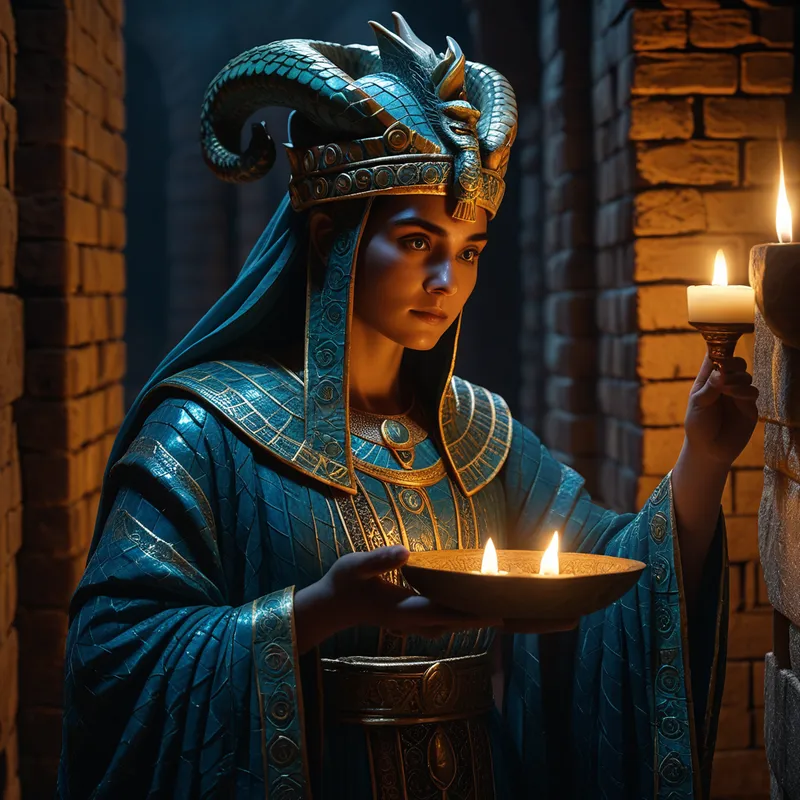
Once each year, as the stars turned, the gate’s true purpose was awakened. This was the Akitu. The statue of Marduk would be borne from his temple, Esagila, and placed upon a golden chariot. Then began the Procession. Priests chanted hymns older than kings. The scent of cedar resin and roasted barley filled the air. The god, in his effigy, moved down the lion-guarded Way, a sovereign returning to his throne. But to reach it, he must first pass through.
The Gate was not an entrance, but a threshold. To pass under the gaze of [Ishtar](/myths/ishtar “Myth from Babylonian culture.”/)’s beasts was to undergo a metamorphosis. It was a descent into the luminous blue womb of the goddess, into the realm of [Ishtar](/myths/ishtar “Myth from Babylonian culture.”/) herself—she who had descended to the Kur and returned. As the god-king crossed, he died to his old year and was reborn for the new. The lions on the walls ceased to be stone; they became the roaring vitality of the restored cosmos. The bulls on the gate breathed out the storm that cleanses the world. The mušḫuššu coiled and uncoiled, binding all realms into one ordered whole. The procession was the heartbeat of the universe, and the Gate was the valve through which divine lifeblood flowed, renewing the covenant between heaven, earth, and the city of man.
Cultural Origins & Context
This was not a myth told in a single epic, but one enacted in brick, glaze, and ritual procession. Its origins are embedded in the very political and theological identity of Nebuchadnezzar II’s Babylon. The construction of the Gate and Way was a supreme act of cosmological engineering, a permanent inscription of divine order into the urban landscape. The myth was performed annually during the Akitu festival, a twelve-day drama that re-enacted Marduk’s victory over the primordial sea dragon [Tiamat](/myths/tiamat “Myth from Mesopotamian culture.”/) (as told in the Enūma Eliš), the king’s ritual humiliation and reaffirmation, and the god’s triumphant procession.
The story was “told” by the priests of Marduk and [the temple](/myths/the-temple “Myth from Jewish culture.”/) functionaries. It served a critical societal function: to legitimize the king’s rule (as Marduk’s chosen regent), to ensure the fertility and stability of the land for the coming year, and to reinforce the hierarchical, divinely-sanctioned structure of Babylonian society. Every glazed brick was a syllable in a prayer for permanence, a magical defense against the ever-lurking chaos that the Mesopotamians saw in the surrounding desert and unpredictable rivers.
Symbolic Architecture
The myth of the Gate and Way is a profound map of a psychic [journey](/symbols/journey “Symbol: A journey in dreams typically signifies adventure, growth, or a significant life transition.”/). It is not a [linear](/symbols/linear “Symbol: Represents order, predictability, and a direct, step-by-step progression. It symbolizes a clear path from cause to effect.”/) narrative of a single [hero](/symbols/hero “Symbol: A hero embodies strength, courage, and the ability to overcome significant challenges.”/), but a symbolic [landscape](/symbols/landscape “Symbol: Landscapes in dreams are powerful symbols representing the dreamer’s emotional state, personal journey, and the broader context of life situations.”/) through which [consciousness](/symbols/consciousness “Symbol: Consciousness represents the state of awareness and perception, encompassing thoughts, feelings, and experiences.”/) must travel.
The Gate is the transformative wound, the narrow passage where one identity is broken so a greater one may be assembled.
The Processional Way, with its regimented, protective lions, represents the prepared and defended ego-[structure](/symbols/structure “Symbol: Structure in dreams often symbolizes stability, organization, and the framework of one’s life, reflecting how one perceives their environment and personal life.”/)—the “[kingdom](/symbols/kingdom “Symbol: A kingdom symbolizes authority, belonging, and a sense of identity within a larger context or community.”/) of [the self](/myths/the-self “Myth from Jungian culture.”/)” as it currently exists. It is orderly, proud, and guarded. The Ishtar Gate itself is the archetypal threshold. Its radiant blue is the color of the deep unconscious, the [lapis](/symbols/lapis “Symbol: A deep blue stone historically revered as a celestial connection and symbol of wisdom, truth, and spiritual enlightenment.”/) philosophorum of the alchemists. The animals are not mere decorations; they are the primal, instinctual powers that must be integrated. The [bull](/symbols/bull “Symbol: The bull often symbolizes strength, power, and determination in many cultures.”/) is raw, unchanneled [life](/symbols/life “Symbol: The symbol of ‘Life’ represents a journey of growth, interconnectedness, and existential meaning, encompassing both the joys and challenges that define human experience.”/) force and potency. The mušḫuššu-[dragon](/symbols/dragon “Symbol: Dragons are potent symbols of power, wisdom, and transformation, often embodying the duality of creation and destruction.”/) is the ultimate hybrid, the coniunctio oppositorum (union of opposites)—it embodies the reconciliation of serpentine [earth](/symbols/earth “Symbol: The symbol of Earth often represents grounding, stability, and the physical realm, embodying a connection to nature and the innate support it provides.”/) (instinct, chthonic wisdom), leonine [passion](/symbols/passion “Symbol: Intense emotional or physical desire, often linked to love, creativity, or purpose. Represents life force and deep engagement.”/), and avian [spirit](/symbols/spirit “Symbol: Spirit symbolizes the essence of life, vitality, and the spiritual journey of the individual.”/).
To pass through the Gate is to willingly submit [the ego](/myths/the-ego “Myth from Jungian culture.”/) (the “[king](/symbols/king “Symbol: A symbol of ultimate authority, leadership, and societal order, often representing the dreamer’s inner power or external control figures.”/)”) to the transformative powers of the unconscious (Ishtar’s domain). Ishtar, as [goddess](/symbols/goddess “Symbol: The goddess symbolizes feminine power, divinity, and the nurturing aspects of life, embodying creation and wisdom.”/) of both love and war, [fertility](/symbols/fertility “Symbol: Symbolizes creation, growth, and abundance, often representing new beginnings, potential, and life force.”/) and destruction, perfectly embodies this ambivalent, all-consuming transformative power. Her own descent to the Kur—where she is stripped of her attributes and temporarily dies—is the prototype for this [passage](/symbols/passage “Symbol: A passage symbolizes transition, movement from one phase of life to another, or a journey towards personal growth.”/).
The Dreamer’s Resonance
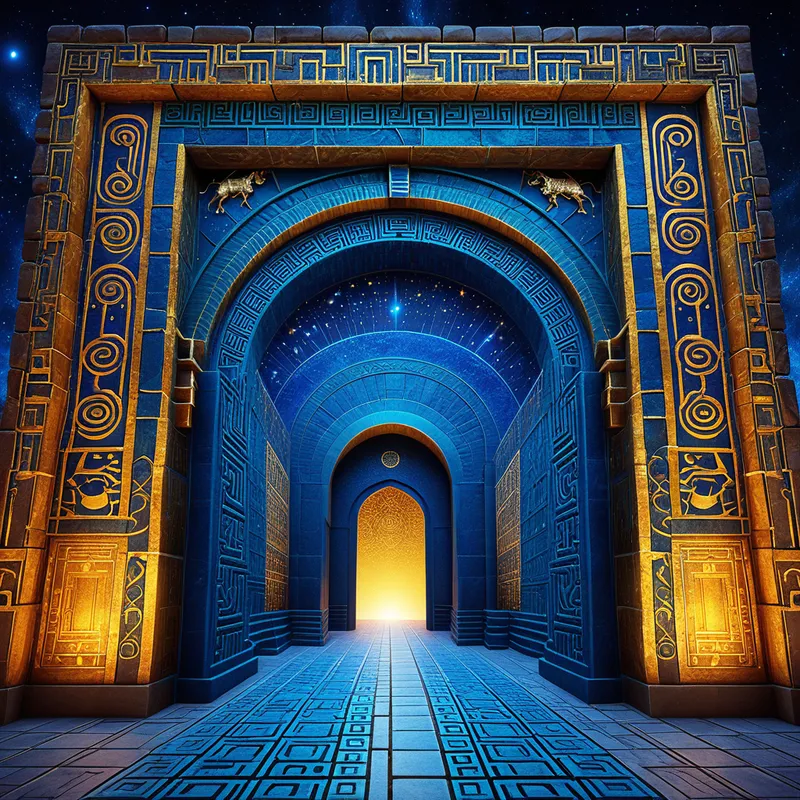
When this mythic pattern stirs in the modern dreamer, it often signals a profound rite of passage in the [psyche](/myths/psyche “Myth from Greek culture.”/). One may dream of approaching a magnificent, often blue, gateway or archway. There is a sense of momentous occasion, of preparing for a “procession.” The path leading to it may feel ancient, ceremonial, or dauntingly grand.
The somatic experience can be one of both awe and dread—the trembling before a sacred encounter. The conflict arises from the dreamer’s hesitation at [the threshold](/myths/the-threshold “Myth from Folklore culture.”/). The guardians (lions, bulls, dragons) may appear threatening, not as protectors but as gatekeepers demanding a price for entry. This reflects the psyche’s resistance to the dissolution required for transformation. The dreamer is being called to “process” a part of their life—a role, an identity, a trauma—down this sacred way and offer it at the gate of change. The resolution in the dream, if achieved, is not a battle won, but a submission undergone: passing through, feeling the old self fall away, and emerging into a new, more luminous, but initially unfamiliar inner landscape.
Alchemical Translation
For the individual, this myth models the alchemical process of Individuation. The Processional Way is the initial, conscious [nigredo](/myths/nigredo “Myth from Alchemical culture.”/)—the gathering and acknowledgment of one’s history, defenses (the lions), and accomplishments (the kingly role). It is taking stock of the “kingdom of the self.”
The journey to the gate is the work of consciousness; the passage through it is the surrender to a wisdom greater than consciousness.
The approach to the Ishtar Gate is the albedo, the whitening, where one confronts the dazzling, numinous power of the Self (symbolized by the radiant blue and gold). The integration of the gate’s animals—taming the bull’s rage, befriending [the dragon](/myths/the-dragon “Myth from Chinese culture.”/)’s chaotic wisdom—is the crucial work. Finally, passing through is the [rubedo](/myths/rubedo “Myth from Alchemical culture.”/), the reddening or glorious achievement. It is the rebirth of the ego, now in service to the greater Self, just as the Babylonian king was reaffirmed as the servant of Marduk.
The modern individual does not rebuild Babylon, but they are tasked with constructing an inner via sacra—a path of self-awareness—that leads to their own transformative threshold. The myth teaches that sovereignty (the archetype of the Ruler/Hero) is not achieved by building higher walls, but by having the courage to walk the sacred path and pass through the gate of one’s deepest fears and potentials, to be ritually dismantled and reconstituted in a more authentic, divine alignment. The Ishtar Gate stands eternally in the psyche: an invitation to descend, to be stripped, and to return radiant.
Associated Symbols
Explore related symbols from the CaleaDream lexicon: