The Inklings Myth Meaning & Symbolism
A myth of primordial entities who dreamt the world into being from the formless void, wrestling with the chaos of their own unshaped potential.
The Tale of The Inklings
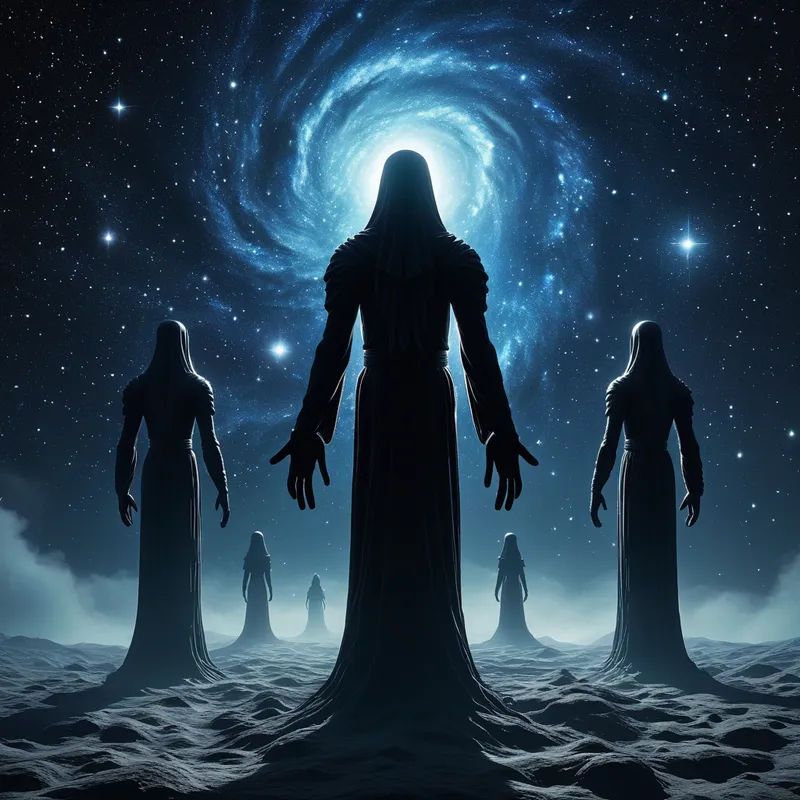
In the time before time, there was only the Void. It was not an empty place, for emptiness implies a space to be empty within. It was a state of pure, silent potential, a deep and dreaming nothingness. And within that nothingness, they stirred. They were not born, for there was no mother. They did not awaken, for there was no sleep. They simply… were. They were The Inklings.
Their forms were like shadows cast by no light, suggestions of substance in the absolute dark. They were beings of pure essence, and their essence was a yearning. A yearning for form, for sound, for distinction. They communed without words, a shared resonance of longing in the featureless expanse.
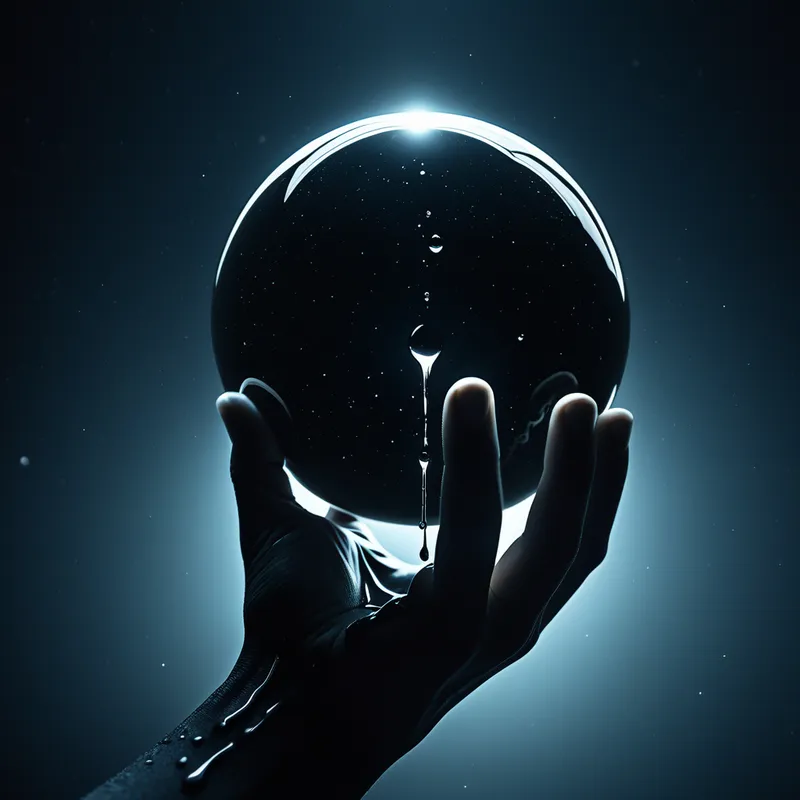
Then, from the core of their collective being, the first act emerged. Not a thought, but an impulse. One of them—though one is a concept that would come later—reached out a limb that was not a limb into the Void. And where it passed, it left a trail. Not of light, but of a deeper darkness, a substance that was both liquid and idea. It was the first Ink. It dripped, not downward, for there was no down, but outward, into possibility.
The others felt this. It was a shock, a delicious rupture in the eternal sameness. They, too, began to move. They traced lines in the Void, lines that curved and crossed, lines that bled and pooled. At first, it was chaos. The Ink ran into itself, smearing into formless blots. The Inklings recoiled, their resonance humming with a new frequency: frustration. The substance of creation resisted them. It had its own will, a tendency to return to the formless state from which it and they had emerged.
This was the first conflict. Not a war of gods, but a struggle of intention against inertia. An Inkling would envision a shape—a sharp angle, a perfect curve—and the Ink would blur it, soften it, swallow it back into the pool. The Void itself seemed to pull at their efforts, a gravitational force of non-being.
But within one Inkling, a different impulse grew. Instead of fighting the blur, it listened to it. It watched the way a drop fell and splattered, and saw not a mistake, but a pattern of radiating tendrils. It observed a smear and perceived the ghost of a mountain range. This Inkling began to work with the flow, guiding the chaos rather than commanding it. It would let a blot form, then, with a touch infinitely gentle, pull a single thread from its edge, spinning it into a filament of silver that became a river in the nascent world. It would use a smear as the foundation for a vast, dark continent.
The others gathered, their forms shimmering around this new way. They learned. Together, they became not just makers, but gardeners of potential. They poured the Ink and sang to it, and the Ink began to sing back. From their concerted resonance, the blots coalesced into spheres. The smears stratified into land and sky. The drips crystallized into stars. They dreamed the world into being, and the world, in turn, began to dream of them. The struggle was not over—chaos lingered at the edges of every fresh creation—but it was now a dance, a creative tension between the will to form and the memory of the formless.
Cultural Origins & Context
The myth of The Inklings originates from the oral traditions of the river-delta cultures of the ancient Sylvan Basin. It was not a state-sponsored epic of conquest, but a foundational story told by craft-guilds—potters, weavers, scribes, and brewers—those whose work involved transforming raw, formless material (clay, thread, blank parchment, grain) into objects of purpose and beauty.
The tale was recited during initiation rites for master artisans and at the commencement of great communal projects, like the building of a temple or the drafting of a new legal codex. The storyteller was often the eldest master of the guild, who would tell it not as a distant legend, but as the sacred precedent for their own daily acts of creation. The societal function was clear: to sanctify the creative process, to frame the struggle with stubborn materials and elusive inspiration not as a personal failing, but as a primordial, even sacred, conflict. It taught that true creation is a dialogue with chaos, not a domination of it.
Symbolic Architecture
At its heart, the myth is a map of the psyche confronting its own unmanifest potential. The Void represents the unconscious in its pure state—teeming with energy and possibility, but without differentiation. The Inklings are the nascent forces of consciousness itself, the first stirring of an "I" that seeks to know and express itself.
The Ink is the primal substance of the soul—the raw, often messy, emotional and imaginative material from which a conscious life is formed.
The initial conflict—the Ink blurring, the forms refusing to hold—symbolizes the profound frustration of early psychological development and creative endeavor. It is the child’s scribble that doesn’t look like a horse, the first draft of a novel that is a tangled mess, the inarticulate feeling that cannot find words. The Void’s pull is the seductive lure of regression, of abandoning the difficult work of formation to return to the passive, undemanding state of non-being.
The pivotal turn in the myth is psychological gold. The one Inkling who learns to "listen" to the blur represents the emergence of the transcendent function—the capacity of the psyche to engage with unconscious material on its own terms, to find the pattern in the chaos. This is the shift from willful imposition (which leads to frustration and sterile order) to attentive collaboration with the depths. The resulting creation is not a perfect, static ideal, but a living, dynamic system born of tension—a true symbol, holding both conscious intention and unconscious resonance.
The Dreamer's Resonance
When this myth activates in the modern dreamer, it often manifests as dreams of overwhelming, formless tasks. You may dream of being in a room filling with black water or ink, tasked with bailing it out with a thimble. You may dream of trying to sculpt melting clay or write with a pen that leaks, obscuring the words. These are somatic dreams of psychic overload, where the unconscious (the Ink) is prolific, but the conscious ego (the dreamer) lacks the vessel or the technique to give it form.
The psychological process underway is one of containment and differentiation. The ego is being challenged to build a stronger vessel—a more resilient sense of self—to hold the rising tide of unconscious content. The frustration felt in the dream is the same frustration of The Inklings; it signals that the old, forceful methods of control are failing. The dream is an invitation, often an urgent one, to discover the "listening" mode: to step back from the panic of the flood and ask what the formless substance itself wants to become.
Alchemical Translation
The alchemical journey mirrored in this myth is the opus contra naturam—the work against nature—which, paradoxically, is a work in deep accord with nature’s hidden laws. The prima materia, the worthless starting substance of the alchemists, is the chaotic, smearing Ink. The alchemist’s vessel is the focused, attentive consciousness of the listening Inkling.
The goal is not to destroy the prima materia, but to suffer its transformations with it, to guide its inherent tendencies toward revelation.
For the modern individual seeking individuation, the myth models the entire process. We begin in the void of unidentified life, filled with potential we cannot access. Our first forays into self-creation—crafting an identity, a career, relationships—often feel like the Inklings’ first, frustrating attempts: we impose rigid ideals that shatter against the complex reality of our own souls. The crisis comes when this fails, plunging us back into a sense of chaotic inner void.
The alchemical translation, the transmutation, occurs precisely in the moment of surrender to the process. It is when we stop trying to force our lives into a pre-fabricated mold and instead begin to observe, with curiosity and respect, the strange shapes that our own pain, desire, and imagination naturally take. We learn to "pull the thread" from the blot of a depression, finding the creative insight within it. We use the "smear" of a failed project as the foundation for a new direction. We engage in a dialogue with our own chaos, and from that dialogue, a unique, authentic, and living form of the Self—imperfect, dynamic, and truly our own—slowly coalesces from the void. We become both the Inkling and the Ink, the dreamer and the dream.
Associated Symbols
Explore related symbols from the CaleaDream lexicon: