The Immortals' Game of Go Myth Meaning & Symbolism
A myth where two celestial beings play a game of Go, creating a mountain and a river, symbolizing the cosmic dance of order and chaos within the psyche.
The Tale of The Immortals' Game of Go
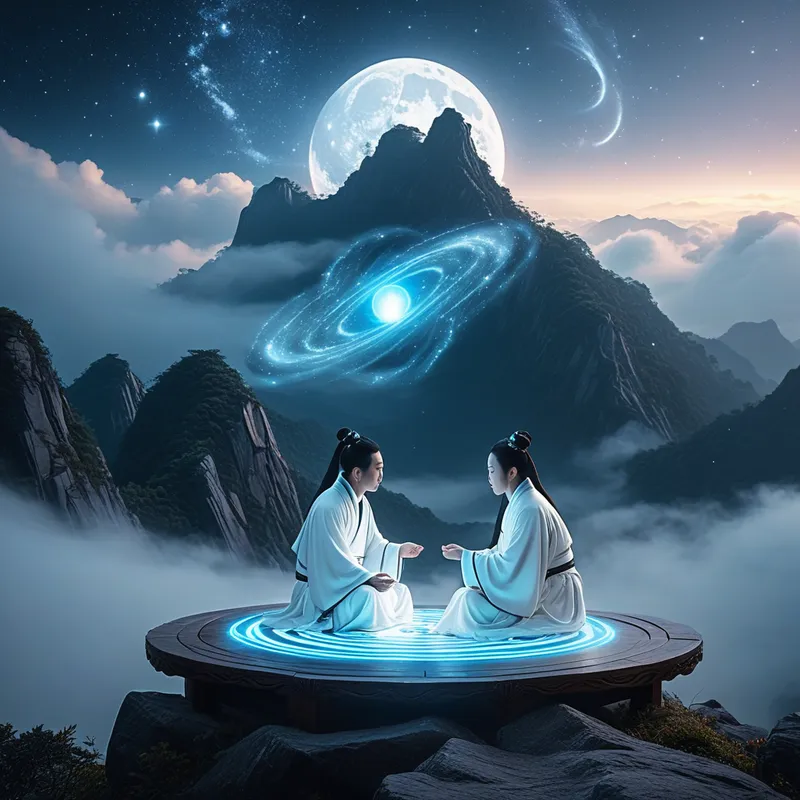
In the time before time was measured, when the mists of Hundun still clung to the peaks of the world, two figures descended from the celestial courts. They were not of this earth. One was Shou Xing, the Star of Longevity, his robes the color of bleached bone and his beard like a waterfall of frost. The other was his eternal counterpart, whose name is lost to the whispering winds, clad in robes of deepest night, his eyes holding the calm of the void between stars.
They did not come to teach or to punish, but to play.
Upon a nameless, flat-topped mountain that pierced the clouds, they sat. No table stood between them. With a gesture, Shou Xing drew a grid of light upon the empty air—nineteen lines by nineteen, a lattice of potential. From sleeves of infinite depth, they produced their stones: his were white, like captured moonlight; his companion’s were black, like polished obsidian drawn from the heart of the earth.
The game began. It was not a pastime. It was a slow, silent war of conception. When the white stone touched the grid, the sound was not a click, but the deep, resonant tone of a temple bell. Where it landed, the earth far below groaned and stirred. Rock thrust skyward, forests sprouted in an instant, a new peak was born—Mount Lushan, they would later call it.
The black stone answered. Its touch was the soft sigh of shifting sand. Where it fell, the land surrendered, carving itself away. Water rushed in from hidden springs and gathered clouds, etching a deep, winding channel—the mighty Yangtze River began to flow.
For days that were centuries, they played. The landscape shuddered and sang with each move. Mountains rose where white stones claimed territory; valleys and rivers snaked where black stones sought influence. The board in the air became a living map of conflict and cooperation, a dance of Yin and Yang made manifest in stone and water. They played until the initial, chaotic potential of the board resolved into a state of breathtaking, precarious balance—a Taiji of geography. Then, as one, they ceased. They looked upon the world they had shaped through their contest, nodded in silent respect to one another, and ascended, leaving behind the board and the transformed earth as testament to their game. The stones remained, some say, as the very boulders and islands in the river’s course.

Cultural Origins & Context
This myth is a Shenmo tale, a story of gods and marvels, deeply rooted in the Daoist imagination that flourished during the Tang and Song dynasties. It was not preserved in a single, canonical text but was woven into the fabric of local folklore, particularly in the regions surrounding the actual Lushan and the Yangtze River. Storytellers and Daoshi would recount it not as a literal history, but as an etiological myth—a story explaining the origin of dramatic, awe-inspiring landscapes.
Its societal function was multifaceted. On one level, it sanctified the Chinese landscape, attributing its sublime beauty and power to a divine act of play. On a deeper level, it served as a philosophical parable. In a culture that revered the strategic depth of the game of Weiqi as a metaphor for warfare, statecraft, and cosmic principle, this myth elevated the game to a cosmogonic act. It taught that the universe itself operates not through brute force, but through the elegant, strategic interaction of opposing yet complementary principles. The myth was a narrative vessel for the core Daoist idea that the greatest creations arise from a dynamic balance, not from the victory of one force over another.
Symbolic Architecture
The myth’s power lies in its stark, elegant symbolism. The two Immortals are not gods of creation in the Western sense. They are personified principles, conscious fragments of the Dao. Their game is the ongoing process of reality itself.
The board is the Wanwu, the field of all manifestation. The stones are the acts of intention, the moments of decisive being that shape the seemingly solid world.
The white stones, played by the Star of Longevity, symbolize the Yang force: assertion, structure, rising, and defining form. Each white stone is a moment of poiesis, the bringing-forth of distinct being—hence, a mountain. The black stones embody the Yin force: receptivity, flow, erosion, and the creation of space. Each black stone is an allowance, a surrender that makes movement and life possible—hence, a river. The game is never won or lost; it is brought to a state of dynamic equilibrium. This is the psychological truth of the healthy psyche: not a state without conflict, but one where opposing impulses—conscious and unconscious, order and chaos, ego and shadow—are engaged in a perpetual, creative dialogue that shapes the terrain of the self.
The Dreamer's Resonance
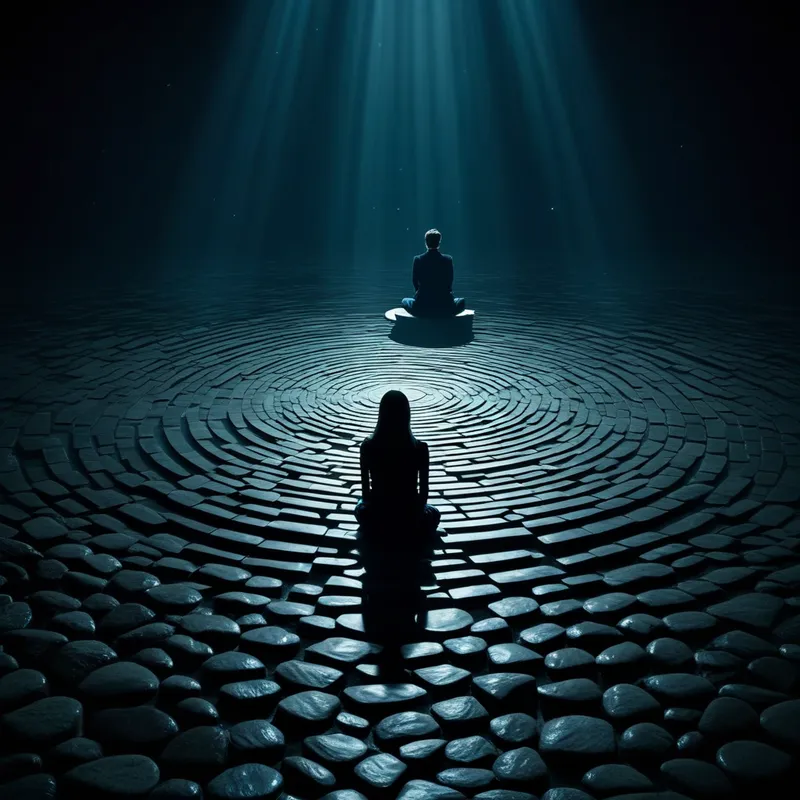
When this myth pattern stirs in the modern unconscious, it often manifests in dreams of profound internal negotiation. The dreamer may find themselves before a vast board, tasked with placing a stone, paralyzed by the weight of the decision. Or they may be one of the players, locked in a silent, intense game with a shadowy opponent who is both alien and intimately familiar—their own hidden self.
Somatically, this can correlate with feelings of being "at a crossroads," of tectonic shifts within one’s emotional landscape. A "mountain" rising in a dream—a new, solid conviction, a defended boundary—may follow the conscious integration of a previously unconscious Yang energy. A "river" carving through—a release of old grief, a new emotional current—may signal the acceptance of a deep Yin process of letting go. The dream is reporting on the ongoing, autonomous "game" within the psyche, where each new insight or accepted shadow aspect literally reshapes the internal world. The anxiety or awe in the dream is the ego’s reaction to witnessing this vast, impersonal, yet deeply personal, act of self-creation.
Alchemical Translation
For the individual on the path of individuation, the Immortals’ Game is a perfect model for psychic alchemy. The modern seeker often misidentifies the goal as the victory of "light" over "darkness," of consciousness over the unconscious. This myth corrects that error. The alchemical work is not to defeat one’s inner opponent, but to engage it in a sacred, strategic game.
Individuation is the long game where you learn to sit as both players and the board. You must develop the discernment to know when to play the white stone of conscious action and when to play the black stone of conscious surrender.
The "mountain" formed is the ego, solidified and given enduring form through disciplined effort and will (Yang). The "river" formed is the connection to the collective unconscious, the flow of symbolic meaning, intuition, and psychic energy that erodes rigid ego structures to allow for growth and adaptation (Yin). The transmutation occurs in the tension of the game itself. Each time we consciously engage a complex, rather than repress or act it out blindly, we place a stone. We shape our inner world. The final, balanced board—the goal of the process—is the Self, where all opposites are contained in a living, dynamic system. We become, like the landscape left by the Immortals, a testament to the beautiful, rugged, and flowing terrain shaped by the game of being.
Associated Symbols
Explore related symbols from the CaleaDream lexicon: