The 'I'iwi Myth Meaning & Symbolism
A myth of a god's sacrifice, where his blood transforms a plain bird into a creature of sacred, fiery beauty, symbolizing profound change.
The Tale of The ‘I’iwi
Listen, and let the mists of [Hawaiki](/myths/hawaiki “Myth from Polynesian culture.”/) part. In the time when gods walked the islands and the land was young, there was a bird. It was a simple creature, clad in feathers of unremarkable brown, a soft voice lost in [the chorus](/myths/the-chorus “Myth from Theater culture.”/) of the uluhe fern and the towering kukui. It went by no great name, this little one, flitting among the blossoms of the ʻōhiʻa lehua, sipping nectar with its curved beak. It was part of the forest’s breath, unseen, unheard in the grand chants.
But the gods see what mortals do not. The great god Kū walked the upland forests. He was a god of stern aspects, of deep forests and the silent growth of trees, but also of profound creation. He heard the bird’s faint song, a thread of pure, unadorned life amidst the grandeur. And in that hearing, a profound sorrow touched Kū’s heart—a sorrow for the fleeting, fragile beauty of the mundane world, so easily overlooked.
A resolve, heavy as volcanic stone, settled within him. He would not merely observe; he would consecrate. In a secluded grove, where the morning sun pierced the canopy like spears of light, Kū called the plain brown bird to him. Without a word of explanation, a bond was forged in silence. Then, with a gesture that was both an offering and a wound, Kū drew from his own divine essence. A single, brilliant drop of his blood—not the blood of battle, but the blood of life-force, of mana itself—welled from his fingertip.
He let it fall.
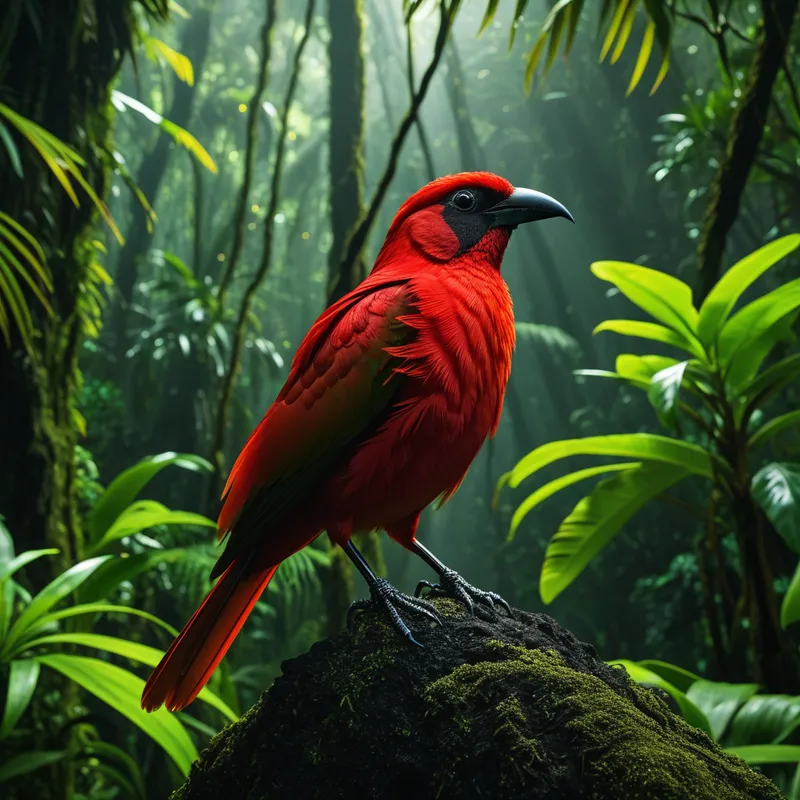
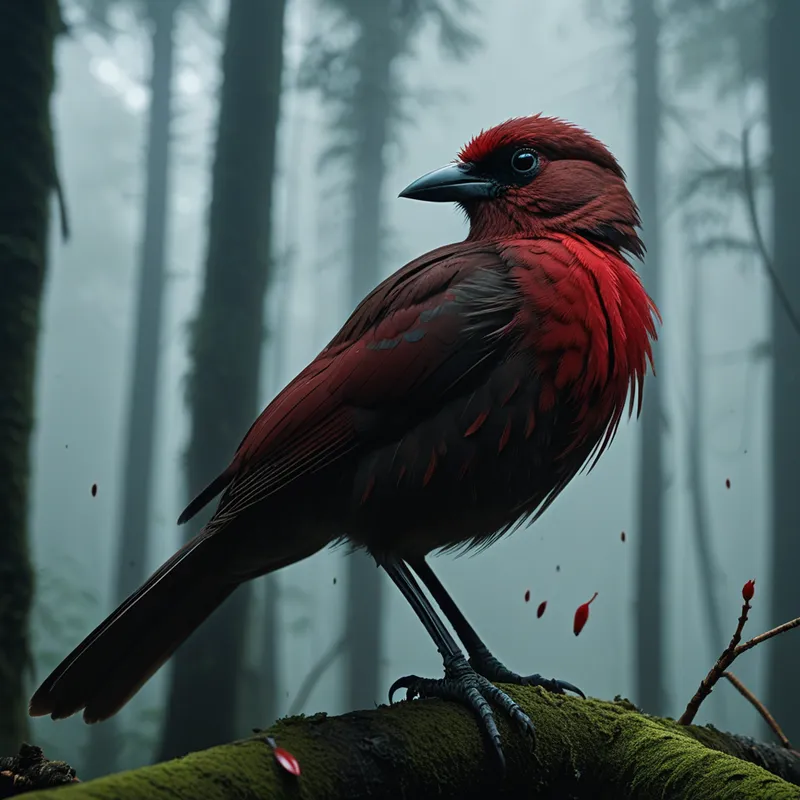
It struck the bird’s breast, a tiny, terrible baptism. The creature did not cry out, but shuddered, seized by a force beyond its understanding. The brown feathers began to smoke, not with fire, but with transformation. From the point of contact, a radiant, searing scarlet erupted. It spread like a sunrise across its body, a tide of divine fire consuming the dullness. Its beak, once a simple tool, blazed a brilliant orange. The transformation was not gentle; it was an alchemical furnace, remaking the very substance of the bird. When it was done, the little brown bird was gone. In its place perched a vision: a living flame, a feathered ember, its plumage the color of sacred pōhaku and the most vibrant lehua blossom. It was the ʻIʻiwi. It opened its beak, and its new song was a clear, whistling melody that spoke of the god’s sacrifice and its own impossible beauty—a beauty born not of birth, but of bestowed grace, paid for in the currency of divine self-offering.
Cultural Origins & Context
This myth originates in the rich oral traditions of the Hawaiian people, a branch of the wider Polynesian cultural sphere. It was not a story for children’s amusement, but a mele or moʻolelo passed down by kahuna and storytellers. Its function was multifaceted. On one level, it was an aetiological myth, explaining the stunning, otherworldly appearance of the ʻIʻiwi bird, a creature so vivid it seemed clearly touched by the gods.
On a deeper societal level, it reinforced core Hawaiian values. It illustrated the concept of mana—how it could be transferred and how it manifested in the natural world. The ʻIʻiwi became a kinolau, a bodily form, of the god Kū (in his creative, forest-dwelling aspect). To see the bird was to witness a living piece of the divine. The myth also modeled the relationship between the potent (akua) and the seemingly insignificant (kanaka, and by extension, all creatures). It taught that profound beauty and sacredness could arise from an act of conscious, painful sacrifice from a higher power, framing the natural world not as separate, but as a canvas of divine interaction.
Symbolic Architecture
At its [heart](/symbols/heart “Symbol: The heart symbolizes love, emotion, and the core of one’s existence, representing deep connections with others and self.”/), this is a myth of radical [transmutation](/symbols/transmutation “Symbol: A profound, alchemical process of fundamental change where one substance or state transforms into another, often representing spiritual evolution or personal metamorphosis.”/) through sacred wounding. The plain brown [bird](/symbols/bird “Symbol: Birds symbolize freedom, perspective, and the connection between the earthly and spiritual realms, often representing the soul’s aspirations or personal growth.”/) represents the latent, unrealized self—the potential that exists in a state of anonymity, of “unremarkable brown.” It is the [psyche](/myths/psyche “Myth from Greek culture.”/) before its calling, the individual before their encounter with a transformative principle.
Kū’s [blood](/symbols/blood “Symbol: Blood often symbolizes life force, vitality, and deep emotional connections, but it can also evoke themes of sacrifice, trauma, and mortality.”/) is the catalytic agent of divine [consciousness](/symbols/consciousness “Symbol: Consciousness represents the state of awareness and perception, encompassing thoughts, feelings, and experiences.”/). It is not mere pigment; it is concentrated [life](/symbols/life “Symbol: The symbol of ‘Life’ represents a journey of growth, interconnectedness, and existential meaning, encompassing both the joys and challenges that define human experience.”/), will, and creative power.
The wound that transforms is not an injury of malice, but a puncture in the mundane world, through which the numinous pours.
The resulting ʻIʻiwi symbolizes the realized self, marked forever by its encounter with the sacred. Its scarlet feathers are not just [beauty](/symbols/beauty “Symbol: This symbol embodies aesthetics, harmony, and the appreciation of life’s finer qualities.”/), but the visibility of the sacred touch. The curved beak, now brilliant, signifies a specialized [purpose](/symbols/purpose “Symbol: Purpose signifies direction, meaning, and intention in life, often reflecting personal ambitions and core values.”/)—it is perfectly adapted to drink from the deep, tubular flowers of the ʻōhiʻa, making it an essential part of the ecosystem’s [fertility](/symbols/fertility “Symbol: Symbolizes creation, growth, and abundance, often representing new beginnings, potential, and life force.”/). Thus, the transformation is not for vanity, but for function within a larger, sacred order. The pain of the change is inseparable from the [beauty](/symbols/beauty “Symbol: This symbol embodies aesthetics, harmony, and the appreciation of life’s finer qualities.”/) of the [outcome](/symbols/outcome “Symbol: Outcome symbolizes the results of actions or decisions, often reflecting hopes, fears, and the consequences of choices.”/); one purchases the other.
The Dreamer’s Resonance
When this myth pattern stirs in the modern dreamer, it often surfaces during a profound somatic or psychological initiation. To dream of a dull, forgotten, or “brown” version of oneself being pierced or stained by a vibrant, vital substance (often red) points to an ongoing process of profound identity shift. The dream ego is the bird before the transformation.
The somatic experience might be one of burning, tingling, or a feeling of pressure in the chest—the site of the mythical wound. Psychologically, this signals that a core aspect of the dreamer’s old self-image is being dismantled by an influx of powerful, perhaps painful, new energy or awareness. This could relate to a creative awakening, a spiritual crisis, or the integration of a traumatic experience that demands a re-framing of [the self](/myths/the-self “Myth from Jungian culture.”/). The dream is not about the trauma itself, but about the alchemical process that the trauma has initiated—the forced, sacred move from brown to scarlet. Resistance to this process may manifest as dreams of trying to wipe off the “stain,” only to find it permanent.
Alchemical Translation
For the individual navigating the path of individuation, the ʻIʻiwi myth is a master map of psychic transmutation. The “brown bird” stage is [the ego](/myths/the-ego “Myth from Jungian culture.”/)’s comfortable, adapted [persona](/myths/persona “Myth from Greek culture.”/)—functional but lacking in deeper meaning or connection to the Self. The god Kū represents the autonomous, transformative power of the unconscious, the archetypal force that decides, often abruptly, that this adaptation is no longer sufficient.
The sacrifice of blood is the critical, painful operation. In psychological terms, this is the sacrifice of the old attitude, the cherished self-narrative, or a long-held complex. It is a willing (or forced) offering of one’s familiar psychic substance to a higher, unknown order.
Individuation is not self-improvement; it is the self’s crucifixion and resurrection in the colors of its own unique destiny.
The resulting “scarlet self” is the nascent individuality. It is vivid, unmistakable, and carries the mark of its ordeal. Like the ʻIʻiwi’s specialized beak, this new self finds its purpose and nourishment in a specific, life-giving way that was previously inaccessible. The modern individual’s journey mirrors this: through a crisis (the wound), an old way of being dies (the brown feathers), and a more authentic, potent, and strangely beautiful self emerges (the scarlet plumage), now capable of engaging with [the world](/myths/the-world “Myth from Tarot culture.”/) from a place of consecrated purpose. The myth assures us that the pain of becoming is not a sign of error, but the signature of the creator-god upon the soul.
Associated Symbols
Explore related symbols from the CaleaDream lexicon: