The Hydra of Lerna Myth Meaning & Symbolism
Heracles battles a regenerating serpent in a poisoned swamp, a myth of confronting the self-replicating chaos that emerges from the depths of the psyche.
The Tale of The Hydra of Lerna
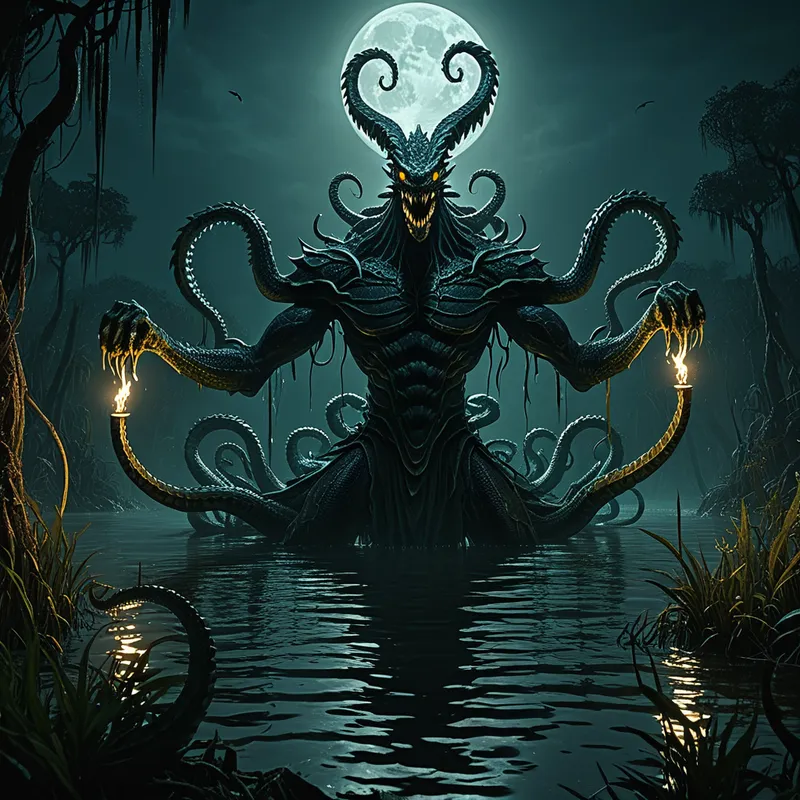
Hear now of the second labor, a curse born of a king’s spite. Far from the sun-drenched hills, in the land of Argos, there lies a place where [the earth](/myths/the-earth “Myth from Hindu culture.”/) weeps. The marshes of Lerna—a vast, sighing expanse of choked reeds and still, black [water](/myths/water “Myth from Chinese culture.”/). Here, the air is thick with the breath of decay, and the very ground is a treacherous, sucking maw. It was not always so. Once, a sacred spring bubbled here. But the spring was poisoned, its guardian perverted, by a [thing](/myths/thing “Myth from Norse culture.”/) born of the oldest nightmares.
From the primeval ooze of the swamp, from the union of the monstrous [Typhon](/myths/typhon “Myth from Greek culture.”/) and the half-woman, half-serpent Echidna, [the Hydra](/myths/the-hydra “Myth from Greek culture.”/) was spawned. It made its lair beneath a solitary, gnarled plane tree at the spring of Amymone. Do not imagine a mere beast. This was a perversion of nature itself—a colossal, hulking body of a dog, from which sprouted not one, but nine serpentine necks, each crowned with a viper’s head. Its breath was a visible, corrosive miasma; its blood, a venom so potent it could wither the land. And one of those heads, the central one, was immortal, shining with a cold, unkillable light.
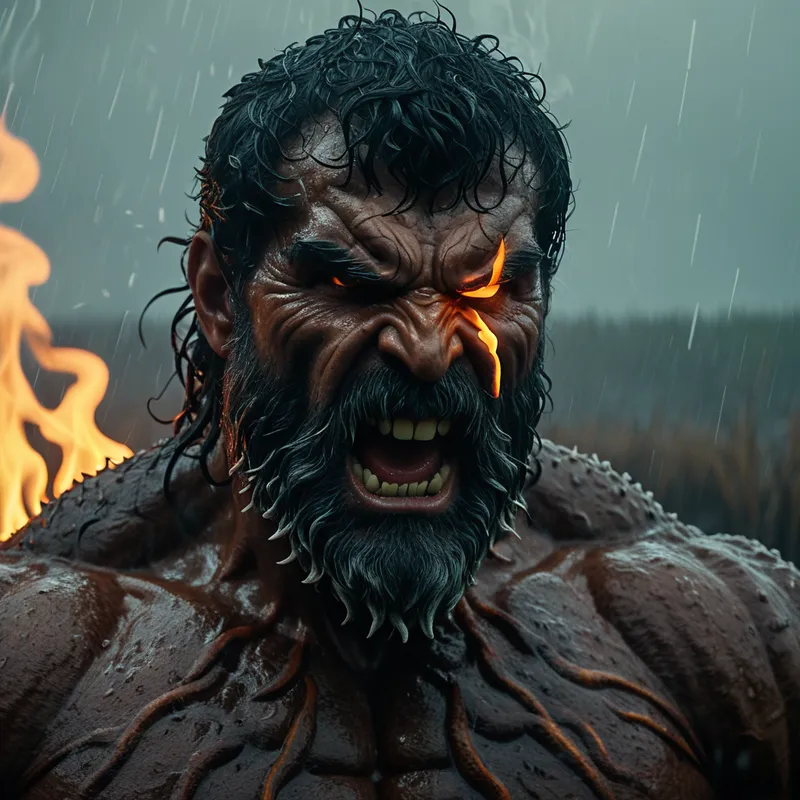
The hero, [Heracles](/myths/heracles “Myth from Greek culture.”/), son of Zeus, was commanded to slay it. He came not with an army, but with his nephew, Iolaus, as his only companion. As they approached the fens, the stench of rot and reptile filled their nostrils. The silence was profound, broken only by the drip of water and the distant, slithering rustle in the reeds. [Heracles](/myths/heracles “Myth from Greek culture.”/), clad in the impenetrable skin of the Nemean Lion, advanced. To draw the monster out, he shot flaming arrows into its dark lair.
With a hiss that shook the marsh, the [Hydra](/myths/hydra “Myth from Greek culture.”/) emerged. Nine heads weaving in unison, eyes like polished jet, mouths agape, dripping venom that sizzled on the water’s surface. Heracles swung his mighty club, crushing one skull. But as the head fell, from the bleeding stump, two new necks erupted, sprouting two new, shrieking heads. He severed another. Two more grew in its place. The more he fought, the more the horror multiplied. The swamp itself seemed to be giving birth to the creature anew. To make the terror complete, a giant crab, sent by the goddess Hera, scuttled from the deep to pinch at the hero’s feet, adding chaos to the hopeless struggle.
Heracles, realizing brute force was his doom, called to Iolaus. “Bring fire!” he roared. As Heracles wrestled with the snapping heads, severing each with his sword or crushing them with his hands, Iolaus rushed forward with a blazing torch. As soon as a neck was cut, Iolaus seared the bleeding stump with fire, cauterizing the wound with a hiss of smoke and the smell of burning flesh. The regeneration was stopped. Head after head fell and was sealed. Finally, only [the immortal](/myths/the-immortal “Myth from Taoist culture.”/) head remained, thrashing and undying. Heracles, using a sword blessed or golden, depending on the teller, severed it too. This head he did not burn, but buried under a massive, immovable rock at [the crossroads](/myths/the-crossroads “Myth from Celtic culture.”/) of the swamp, where it would hiss and whisper forever, contained but not destroyed. Then, in a final act of cunning, he dipped his arrows in the Hydra’s own venom, turning the monster’s power into his weapon. The marsh waters, poisoned by the battle, receded, but the place remained cursed, a monument to a struggle that changed the hero forever.
Cultural Origins & Context
The myth of the Hydra is a foundational strand in the epic cycle of Heracles, one of the most pervasive and adaptable hero figures in the pan-Mediterranean world. Its earliest written form is found in the fragmented works of poets like Hesiod, and it was later codified as part of the canonical “Twelve Labors” by authors such as Apollodorus. This was not mere entertainment. The labors were a sacred curriculum, a map of impossible trials imposed as penance and path to immortality.
The tale was told at symposia, enacted in rituals, and depicted on countless vases and temple metopes. Its function was multifaceted. On one level, it was an etiological myth, explaining the perceived miasmic and dangerous nature of certain wetlands. On another, it served as a potent political allegory for the city-states of Argolis, symbolizing the conquest of chaotic, pre-civilized forces (the swamp monster) by heroic, Olympian-sanctioned order (Heracles). Most importantly, it was a master narrative of resilience. It taught that some adversaries cannot be overcome by direct, repetitive force; they require a shift in strategy, the aid of a trusted companion (Iolaus), and the transformative application of a new element—fire.
Symbolic Architecture
The [Hydra](/symbols/hydra “Symbol: A multi-headed serpent from Greek mythology that regenerates two heads when one is cut off, symbolizing persistent, multiplying challenges.”/) is not a [monster](/symbols/monster “Symbol: Monsters in dreams often symbolize fears, anxieties, or challenges that feel overwhelming.”/) to be slain once, but a [pattern](/symbols/pattern “Symbol: A ‘Pattern’ in dreams often signifies the underlying structure of experiences and thoughts, representing both order and the repetitiveness of life’s situations.”/) of the [psyche](/myths/psyche “Myth from Greek culture.”/) to be understood. It is the archetypal representation of a neurosis, a [trauma](/symbols/trauma “Symbol: A deeply distressing or disturbing experience that overwhelms the psyche, often manifesting in dreams as unresolved emotional wounds or psychological injury.”/), or a [shadow](/symbols/shadow “Symbol: The ‘shadow’ embodies the unconscious, repressed aspects of the self and often represents fears or hidden emotions.”/) [aspect](/symbols/aspect “Symbol: A distinct feature, quality, or perspective of something, often representing a partial view of a larger whole.”/) that regenerates and multiplies when attacked directly with suppression or denial.
The swamp is the unconscious itself—the murky, fertile, and often frightening ground of our being where repressed contents fester. The Hydra is the specific complex that has taken root there.
Each head represents a symptomatic manifestation: an addiction, a compulsive thought, a pattern of self-sabotage, an outburst of rage. Cutting off one head (quitting a habit through sheer will) only leads to the [emergence](/symbols/emergence “Symbol: A process of coming into being, rising from obscurity, or breaking through a barrier, often representing birth, transformation, or revelation.”/) of two related symptoms ([anxiety](/symbols/anxiety “Symbol: Anxiety in dreams reflects internal conflicts, fears of the unknown, or stress from waking life, often demonstrating the subconscious mind’s struggle for peace.”/) and [insomnia](/symbols/insomnia “Symbol: A state of persistent sleeplessness, often symbolizing unresolved anxieties, mental restlessness, or a subconscious refusal to surrender control.”/), for instance). The immortal head is the core wound, the primal trauma or belief that feels eternal and unkillable. It cannot be destroyed, only contained and integrated under the “heavy rock” of conscious acknowledgment.
The crab sent by Hera symbolizes the unexpected, sideways attacks from the deeper psyche or from [life](/symbols/life “Symbol: The symbol of ‘Life’ represents a journey of growth, interconnectedness, and existential meaning, encompassing both the joys and challenges that define human experience.”/) circumstances when we are intensely focused on a single [problem](/symbols/problem “Symbol: Dreams featuring a ‘problem’ often symbolize internal conflicts or challenging situations that require resolution and self-reflection.”/)—the ancillary crises that emerge during any profound struggle. Heracles’ [solution](/symbols/solution “Symbol: A solution symbolizes resolution, clarity, and the overcoming of obstacles, often representing a sense of accomplishment.”/)—the [combination](/symbols/combination “Symbol: A combination in dreams often signifies the blending of various aspects of oneself or different life situations.”/) of cutting (confrontation) and cauterizing with fire (the transformative [application](/symbols/application “Symbol: An application symbolizes engagement, integration of knowledge, or the pursuit of goals, often representing self-improvement and personal development.”/) of [consciousness](/symbols/consciousness “Symbol: Consciousness represents the state of awareness and perception, encompassing thoughts, feelings, and experiences.”/) and new [insight](/symbols/insight “Symbol: A sudden, deep understanding of a complex situation or truth, often arriving unexpectedly and illuminating hidden connections.”/))—models the only way to integrate such a complex. The fire represents the light of [awareness](/symbols/awareness “Symbol: Conscious perception of self, surroundings, or internal states. Often signifies awakening, insight, or heightened sensitivity.”/), the heat of emotional processing, which must be applied to the raw wound to prevent the psychic [energy](/symbols/energy “Symbol: Energy symbolizes vitality, motivation, and the drive that fuels actions and ambitions.”/) from re-coagulating into the same old pattern.
The Dreamer’s Resonance
When the Hydra slithers into modern dreams, it rarely appears as a classical monster. Its form is protean, adapting to the dreamer’s life. One may dream of trying to clean a house where mold spreads faster than it can be scrubbed, or of managing a project where solving one problem instantly creates two more. It may manifest as a bureaucratic nightmare with endlessly multiplying forms, or a social conflict where apologizing for one misstep reveals two more grievances.
Somatically, these dreams are accompanied by feelings of futility, breathless exhaustion, and rising panic. The dream ego is engaged in a Sisyphean task, using tools (logic, force, pleading) that are fundamentally mismatched to the problem. This is the psyche’s brilliant dramatization of a state of psychological overwhelm where a core complex has been activated. The dream is not a prediction of failure, but a stark presentation of the current, futile strategy. It is an invitation from the unconscious to stop the direct assault. The appearance of a “Iolaus” figure in the dream—a friend, a therapist, a sudden intuitive idea (the torch)—is the first hint of the necessary new approach.

Alchemical Translation
The labor of the Hydra is the alchemical stage of [nigredo](/myths/nigredo “Myth from Alchemical culture.”/) in [the vessel](/myths/the-vessel “Myth from Alchemical culture.”/) of the individual soul. It is the putrefaction in the swamp, the confrontation with the multiplicities of [the shadow](/myths/the-shadow “Myth from Jungian culture.”/). The goal is not to emerge pristine, but to transmute the base material of the complex into a source of strength.
The hero who enters the swamp with only a club seeks to conquer the shadow. The hero who emerges has learned to converse with it, and to wield its own venom as a sacred poison—a discriminating wisdom.
For the modern individual, this translates to the painful but essential work of shadow integration. We are instructed to first locate our swamp—the area of life (relationships, work, self-image) where we face recurring, multiplying problems. We must then cease the automatic, “club-like” responses of blame, suppression, or frantic activity. Instead, with the “Iolaus” of self-reflection or therapeutic guidance, we must apply the “fire” of mindful attention to the root of each symptomatic “head” as it appears. What fear is this rage protecting? What lack does this compulsion attempt to fill?
The final act—burying the immortal head—is crucial. It signifies that the core wound or fundamental flaw may never be erased from our personal history. Individuation is not about achieving perfection, but about consciously containing that immortal fragment of our pain, placing it under the stone of acceptance where it can no longer control us, but from whose whispers we can still learn. The arrows dipped in the Hydra’s venom represent the hard-won result: our vulnerabilities, once understood, become our most precise tools—a deepened empathy, a resilient character, a wisdom that can navigate future darkness because it has been forged in the deepest part of the swamp.
Associated Symbols
Explore related symbols from the CaleaDream lexicon: