The Hummingbird and the Sun Myth Meaning & Symbolism
A myth of a tiny hummingbird's impossible journey to steal fire from the Sun, bringing light and warmth to a world shrouded in primordial cold and darkness.
The Tale of The Hummingbird and the Sun
In the first times, the world was a place of shadows and chill. The great Forest stretched endlessly, a tapestry of deep greens and browns, but it was a tapestry woven without light. The Sun existed, but it was a distant, jealous god, a blazing orb that kept its fire and warmth locked high in the Sky, far from the earth. The people and creatures below lived in a perpetual, damp twilight, shivering, unable to cook their food, their spirits dimming like embers in the rain.
They gathered and lamented. The jaguar, with all his strength, could not leap high enough. The eagle, lord of the air, flew until his wings grew heavy with the thin, cold air, but still the Sun was a searing disk of impossible distance. Despair, cold and deep as river mud, settled upon them all. Who could complete such a Journey?
Then, a sound was heard—not a roar or a cry, but a soft, persistent hum. It was Kui, the Hummingbird, the smallest of all birds. “I will go,” she said, her voice a whisper of vibrating air. Laughter, bitter and sharp, echoed from the larger animals. You? You are nothing but a flash of color, a breath of movement. You will be burned to ash before you draw near.
But Kui’s heart was a drum of fierce resolve. She did not speak of strength, for she had little. She did not speak of size, for she had none. She spoke of purpose. With a beat of her wings so fast they became a blur, a shimmering halo around her body, she ascended. Up from the dark canopy, through the layers of mist, into the vast, empty blue.
The journey was an agony of will. The air grew thin and scorching. The light was not illumination but a hammer of pure fire. Her iridescent feathers, which once caught the faint forest light, now smoked and curled. Her eyes felt seared dry. The Sun grew from a disk to a world of roaring, golden flame, a God of incandescent fury. She was a mote of dust flying into a furnace.
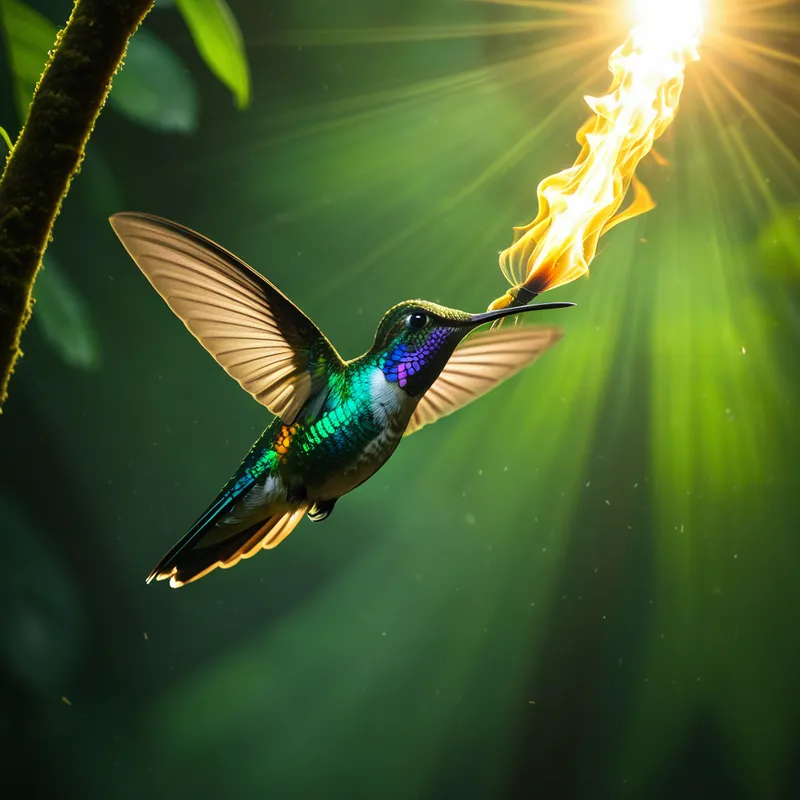
Yet, she did not turn back. She flew into the very heart of the fury, into the radiating tendrils of solar fire. There, at the moment her being felt ready to dissolve into light, she saw it: a fragment of the Sun’s essence, a dancing, living spark clinging to a radiant branch of cosmic fire. With a final, desperate dart, she opened her beak and took the spark.
Pain, absolute and consuming, erupted within her. The fire was eating her from the inside. But she clutched it, turned, and began the plummeting Journey home. She became a falling star, a comet trailing smoke and determination. The fire in her beak was both her Sacrifice and her cargo. She could not swallow it, nor could she drop it.
Down she fell, through the cooling layers of atmosphere, past the eyes of the astonished eagle, through the canopy and into the clearing where the people waited. As her strength failed, she dropped the spark onto a prepared bed of dry tinder. With her last breath, she blew upon it.
The spark caught. It flickered, then grew, then blossomed into the first Fire on earth. Warmth, true warmth, radiated out for the first time. Light, golden and dancing, pushed back the shadows. The people felt their blood thaw, their spirits ignite. They looked at the tiny, charred body of the hummingbird, and they understood the price of the light. From her Death came their life; from her Rebirth as ash came the eternal flame.
Cultural Origins & Context
This myth originates from various Indigenous peoples across the Amazon basin, with versions found among Tupi-Guarani and other cultural-linguistic groups. It was not a story written, but one breathed—passed down through generations by elders and shamans (Pajés) during long nights around the communal fire, the very fire whose origin they recounted. Its function was multifaceted: it was an etiological myth explaining the origin of fire, a moral narrative about courage and the value of the seemingly insignificant, and a cosmological map detailing the relationship between the earthly realm, the celestial realm, and the creatures that bridge them.
The telling was a Ritual in itself, reinforcing social values of community, gratitude, and respect for all beings. The hummingbird, often overlooked, was elevated to a Hero of culture, a reminder that power does not reside solely in size or strength, but in relentless spirit and precise purpose. The myth served as a spiritual technology, encoding the understanding that life-sustaining gifts often come through perilous journeys and profound sacrifice.
Symbolic Architecture
At its core, the myth is an [allegory](/symbols/allegory “Symbol: A narrative device where characters, events, or settings represent abstract ideas or moral qualities, conveying deeper meanings through symbolic storytelling.”/) for the awakening of [consciousness](/symbols/consciousness “Symbol: Consciousness represents the state of awareness and perception, encompassing thoughts, feelings, and experiences.”/). The primordial, cold world represents the unconscious state—fertile but dormant, potential without activation. The distant, hoarded Sun symbolizes a latent, potent [energy](/symbols/energy “Symbol: Energy symbolizes vitality, motivation, and the drive that fuels actions and ambitions.”/)—the full force of psychic [life](/symbols/life “Symbol: The symbol of ‘Life’ represents a journey of growth, interconnectedness, and existential meaning, encompassing both the joys and challenges that define human experience.”/) and [illumination](/symbols/illumination “Symbol: A sudden clarity or revelation, often representing spiritual awakening, intellectual breakthrough, or the dispelling of ignorance.”/)—that is inaccessible to the earthly psyche.
The hero is not the one with the most strength, but the one with the most need, whose very being becomes the vessel for the impossible translation.
The Hummingbird is the archetypal psychopomp, the guide or messenger who ventures into the [realm](/symbols/realm “Symbol: The symbol of ‘Realm’ often signifies the boundaries of one’s consciousness, experiences, or emotional states, suggesting aspects of reality that are either explored or ignored.”/) of overwhelming energy (the solar, conscious principle) to retrieve a vital spark. Her attributes are critical: incredible speed (the rapidity of an [insight](/symbols/insight “Symbol: A sudden, deep understanding of a complex situation or truth, often arriving unexpectedly and illuminating hidden connections.”/)), [precision](/symbols/precision “Symbol: The quality of being exact, accurate, and meticulous. It represents control, clarity, and the elimination of error in thought or action.”/) (the focused intent of consciousness), and tirelessness (the sustained [effort](/symbols/effort “Symbol: Effort signifies the physical, mental, and emotional energy invested toward achieving goals and personal growth.”/) of individuation). Her near-destruction represents the ego’s necessary [dissolution](/symbols/dissolution “Symbol: The process of breaking down, dispersing, or losing form, often representing transformation, release, or the end of a state of being.”/) when confronting the Self’s immense power. The fire she brings back is not the blinding, destructive totality of the Sun, but a [human](/symbols/human “Symbol: The symbol of a human represents individuality, complexity of emotions, and social relationships.”/)-sized fire—the controlled, usable flame of consciousness, culture, warmth, and spiritual illumination.
The Dreamer’s Resonance
When this myth pattern stirs in the modern Dream, it often manifests as dreams of impossible, urgent journeys. The dreamer may be tiny in a vast landscape, tasked with carrying a fragile, crucial item (a light, a seed, a secret) across a great distance against overwhelming odds. There is a somatic quality of frantic movement—the feeling of hummingbird wings beating in the chest, a racing heart that is both anxiety and propulsion.
Psychologically, this signals a call to retrieve a vital, energizing spark from a place that feels intimidatingly vast, distant, or “too much”—perhaps from a dominant complex (a tyrannical inner “Sun,” like a crushing inner critic or idealized perfection), or from a neglected talent or passion that feels godlike and unreachable. The burning sensation in the dream mirrors the psychic pain of integration; bringing a new level of awareness into one’s life hurts because it changes everything. The dream is the psyche’s confirmation that the journey, though it may seem to demand everything, is the only way to bring light to the cold, shadowed parts of one’s inner world.

Alchemical Translation
The myth perfectly models the alchemical opus, the process of psychic transmutation or individuation. The prima materia is the cold, dark, unconscious state (nigredo). The hummingbird’s ascent is the sublimatio—the spirit rising to meet the divine, the ego aspiring to connect with the Self. The searing encounter with the Sun is the calcinatio—the burning away of all that is superfluous, the reduction of the ego to its essential core by the fire of a supreme value or truth.
The treasure is always guarded by a dragon; the fire is always kept by a jealous sun. The theft is not a crime, but the fundamental act of consciousness claiming its birthright.
The retrieval of the spark is the separatio—the extraction of a precious, transformative element from the undifferentiated whole. The hummingbird’s return and death is the mortificatio—the necessary death of the old identity that undertook the quest. Finally, the ignition of the earthly fire is the rubedo—the reddening, the creation of the lasting philosophical gold, which is the established, integrated consciousness that now warms and illuminates the individual’s entire psychic landscape. We are all called to be the hummingbird, to undertake the impossible flight toward our own inner sun, not to become the sun, but to learn how to carry its creative fire.
Associated Symbols
Explore related symbols from the CaleaDream lexicon:
- Hummingbird — The archetypal hero of precision and relentless spirit, representing the focused will and immense courage required to bridge impossible distances for a vital cause.
- Sun — The distant, potent source of all life and consciousness, symbolizing the overwhelming power of the Self or a dominant psychic force that must be engaged with, not merely worshipped from afar.
- Fire — The stolen spark of transformation, representing cultivated consciousness, cultural warmth, spiritual illumination, and the controlled energy that sustains life and community.
- Journey — The sacred, perilous quest from the known (the dark forest) into the unknown (the celestial realm), embodying the essential process of seeking and retrieval necessary for growth.
- Sacrifice — The hummingbird’s ultimate offering of its life, representing the ego’s necessary dissolution or surrender to serve a purpose greater than individual survival.
- Death — The end of the hummingbird’s former existence, signifying the crucial transition point where one state of being must end for a new, more enlightened order to be born.
- Rebirth — The eternal flame born from the hummingbird’s ashes, symbolizing the new, sustainable form of life and consciousness that arises from a complete psychic sacrifice.
- Sky — The realm of the gods and distant powers, representing the aspirational, spiritual, or intellectual heights one must reach to obtain a transformative element.
- Forest — The primordial, dark world of potential, symbolizing the unconscious, fertile but unilluminated psyche before the awakening spark is integrated.
- Hero — The mythic role embodied by the hummingbird, representing the part of the psyche that answers the call to adventure against all odds for the benefit of the whole.