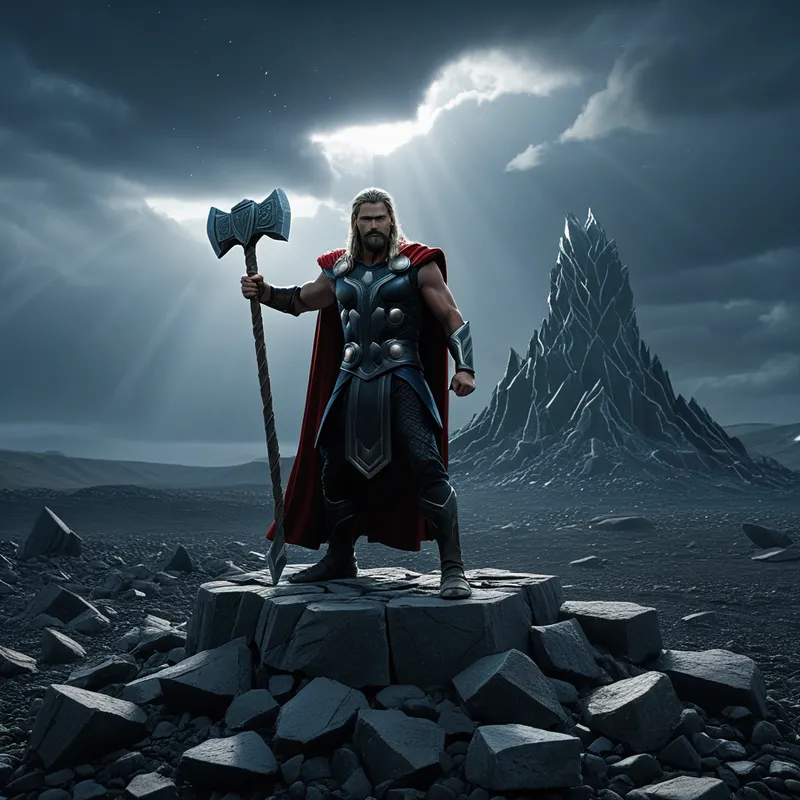
The Hrungnir's Heart Myth Meaning & Symbolism
Thor shatters the stone giant Hrungnir, but his heart remains. The myth reveals the confrontation with our own petrified, defensive core to find true strength.
The Tale of The Hrungnir’s Heart
Listen, and hear of the day the thunder’s rage met the mountain’s stillness.
The air in Asgard was thick with the boastful fumes of mead. Thor, returned from the eastern battles, found his hall invaded by a presence vast and cold. It was Hrungnir, his spirit fired by Odin’s taunts and the gods’ own drink. The giant towered, a cliff-face given voice, and his words were grinding stones. “I will drink your ale, break your walls, and carry your precious gods, Freyja and Sif, back to Jotunheim as my trinkets!” The hall fell silent but for the crackle in Thor’s knuckles.
The challenge was cast, not in whispers, but in the crashing of worlds. They would meet at the borders, at Griottunagardar, the “Stone-Fence Enclosure,” a place fit only for endings. Hrungnir prepared, a moving mountain. His heart and head were of hard, dark stone; his shield was a vast whetstone; his weapon, a massive hone, crude and devastating. His comrades, fearing the thunder-god’s fury, fashioned a companion for him: a clay giant, nine leagues tall, three wide at the chest, named Mokkurkalfi, “Mist-Calf.” But for all its size, its heart was that of a mare, and it quaked with a coward’s pulse.
Thor came with the storm front. Lightning lit the grim plain. Thialfi, Thor’s loyal servant, ran ahead, a dart of fear and cunning. He found Hrungnir, a statue of impending violence. “You fool!” Thialfi cried. “Thor comes not from the front, but from beneath! He will dive up through the earth to gut you!” And so the giant, in his literal-minded might, stood upon his shield, believing he was safe.
The sky split. Thor’s chariot roared across the heavens, drawn by goats whose hooves struck sparks from the clouds. He saw his foe, raised his hammer Mjolnir, and let it fly. Hrungnir, seeing the missile, hurled his hone in a desperate, grinding arc. The weapons met in mid-air with a cataclysm of sound—flint on divine iron. The hone shattered into a thousand fragments that scattered across the world, becoming the source of all flint. But one shard, deadly and sharp, lodged itself in Thor’s own forehead.
Mjolnir did not stop. It crashed through the hone, through the air, and struck the giant’s skull of stone. The sound was the world cracking. Hrungnir fell, his mountainous body collapsing. But in his fall, his leg trapped Thor beneath him. The god of strength was pinned, helpless, under the dead weight of the giant.
And there, in the settling dust and the god’s own spilled blood, lay the truth of the giant. His body was shattered clay and rubble. But from the ruin, one thing remained whole: his heart. Not a heart of flesh, but a heart of stone. A grim, three-cornered knot of dark flint, cold and immovable, lying upon the ground where the giant’s chest had been.
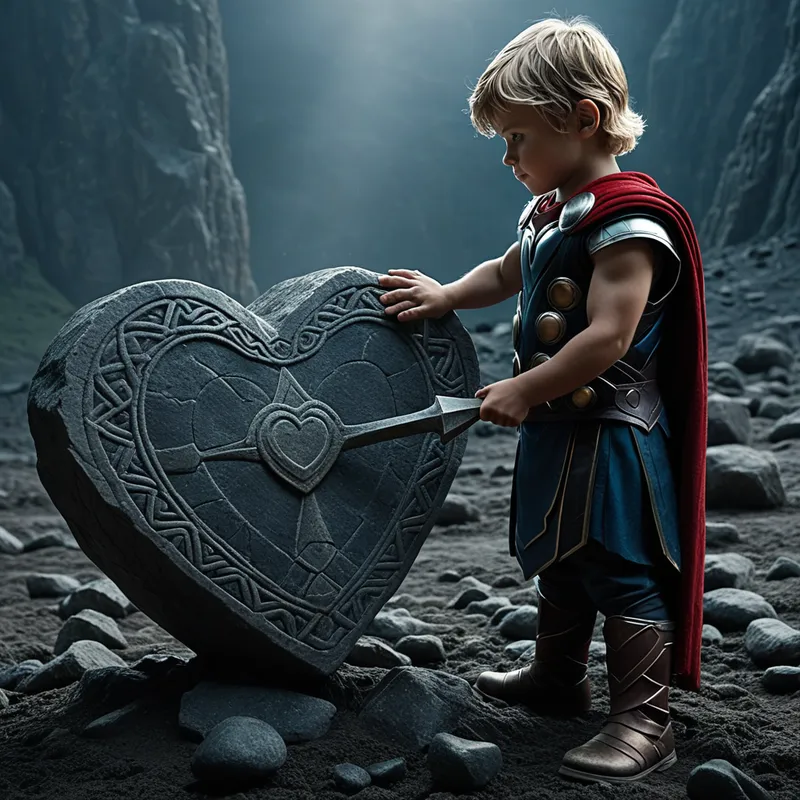
The gods came, but even their combined strength could not lift the leg of the fallen giant. They called for Thor’s three-year-old son, Magni. The boy came, his youth no measure of his lineage. With a grunt of effort that echoed his father’s, he heaved the giant’s limb and freed the thunderer. Thor, in gratitude, gave him Hrungnir’s great steed, Gullfaxi. But the heart remained. A silent, stony prize upon the bloodied earth. The battle was won, the giant slain. Yet his core, his essence, endured. Unbroken. Unyielding. A question left upon the ground.
Cultural Origins & Context
This myth reaches us from the rich, perilous world of the Viking Age, preserved in the Prose Edda of Snorri Sturluson. Snorri, an Icelandic scholar and poet of the 13th century, wrote in a Christian era, yet his work remains our most detailed window into the older, oral traditions of the North. The tale of Hrungnir would have been a skáldskaparmál—a piece of “poetic diction”—a story told not just for entertainment, but to encode the complex kennings and metaphors a skald (poet) needed to speak of gods, giants, and battles with proper, riddling artistry.
Its societal function was multifaceted. On one level, it is a classic “giant-bashing” story, affirming the cosmic order where the forces of Asgard (culture, order) must constantly battle the forces of Jotunheim (chaos, wilderness). It explained natural phenomena: the flint stones in the earth were born from Hrungnir’s shattered weapon. On a human level, it explored profound themes of lineage and unexpected strength. The hero is saved not by his own might, but by his young son, Magni, whose name means “Mighty One.” This speaks to a culture deeply concerned with legacy, with the strength of the next generation surpassing the trials of the current one. The myth was a narrative tool for contemplating victory that is not clean, triumph that leaves a fragment of the enemy—and a fragment of the conflict—permanently embedded within the self.
Symbolic Architecture
Hrungnir is not merely a giant; he is the archetype of the petrified psyche. His body of stone and clay, animated by a heart of flint, represents a consciousness that has armored itself against vulnerability, feeling, and change. He is rigid opinion, unmovable grievance, a defensive identity forged in cold isolation.
The stone heart is not a symbol of courage, but of a courage that has died and fossilized. True courage is fluid, like blood; the heart of stone mistakes immovability for strength.
Thor’s struggle is the heroic ego’s confrontation with this inner monolith. He shatters the outer form—the brittle behaviors, the towering defenses—but is immediately pinned by the very structure he destroyed. This is the critical psychological truth: you cannot simply destroy a part of your psyche without being trapped by its aftermath. The shard of the hone in Thor’s forehead is the enduring wound, the lasting scar, the piece of the conflict that becomes a part of you. It is the price of integration.
The three-cornered heart is a profound symbol. Triangular, it is a closed system, stable but sterile. It represents a trinity turned in on itself: thought, emotion, and will, frozen into a defensive knot. It is the core complex, the irreducible nucleus of a trauma or a fixation that survives all attempts to dismantle the personality built around it.
The Dreamer’s Resonance
When this myth stirs in the modern unconscious, it manifests in dreams of immovable objects, petrified landscapes, or confronting a silent, stony presence. You may dream of trying to lift something impossibly heavy, or of having a piece of rock or glass embedded in your skin. The somatic sensation is one of crushing weight on the chest, of breathlessness, of being paralyzed by something that is both dead and powerfully present.
Psychologically, the dreamer is encountering their own “Hrungnir complex.” This is the part of the self that became stone to survive—perhaps in childhood, in a past trauma, or under prolonged stress. It is the defensive core that says “I will not feel,” “I will not change,” “I will not be moved.” The dream is not about the giant’s threat, but about its inertia. The conflict has moved inward; the battle is now with one’s own frozen history. The dream presents the heart on the ground, asking: “Here is your petrified self. What will you do with it?”
Alchemical Translation
The alchemical process modeled here is not solve (dissolution) alone, but the crucial, subsequent stage of coagula (coagulation). Thor’s lightning-bolt rage provides the solve: it shatters the rigid, literal-minded form of the giant (the outdated, defensive personality). But the work is incomplete. He is pinned, wounded, and the core remains.
Individuation is not the killing of the giant, but the retrieval and transformation of its heart. The stone must be recognized, lifted, and its latent energy transmuted.
Magni, the divine child, represents the emerging, instinctual strength of the Self—not the ego’s brute force, but a new, holistic power that arises from the psyche’s depths. He lifts the weight the ego cannot. His action symbolizes the capacity of the nascent, more complete personality to handle the burdens of the past.
The alchemical goal is to take that three-cornered stone—the frozen trinity—and warm it in the hands of consciousness. To turn flint, which makes sparks when struck, into a tool for kindling inner fire, not conflict. The shard in Thor’s forehead becomes a permanent reminder, a wisdom scar. It signifies that the confrontation with our own stone-hearted defenses changes us irrevocably. We carry a piece of that battle forward, not as a weakness, but as a testament and a guide. The myth concludes not with the heart’s destruction, but with its presence acknowledged on the field. The next step—the lifting, the warming, the integration—is the dreamer’s own lifelong work.
Associated Symbols
Explore related symbols from the CaleaDream lexicon: